Key Takeaways
- Recapitalization changes the mix of debt and equity in a company’s capital structure; the business itself stays the same.
- The main types are leveraged, equity and dividend recapitalizations, while a leveraged buyout uses the same borrowing mechanics but transfers control to a new owner.
- Private owners recapitalize mainly for partial liquidity and growth capital; public companies more often do it to deleverage, return capital or defend against a takeover.
- A recapitalization deliberately changes the debt-to-equity ratio, while refinancing swaps old debt for new and leaves that ratio roughly where it was.
- In private equity, a majority or minority recap lets owners take cash off the table without selling the whole company, and a dividend recap returns capital to a sponsor that keeps the asset.
- Many recapitalizations qualify as tax-free reorganizations under Section 368(a)(1)(E), but boot, some preferred stock exchanges and dividend proceeds can be taxable.
- Lenders and investors ask for the cap table, debt documents, financials and material contracts first, so have the data room ready before term sheets go out.
Table of Contents
ToggleRecapitalization is a transaction that changes the mix of debt and equity in a company’s capital structure without selling the business outright. A company might borrow to buy back shares or pay a dividend, issue equity to pay down debt, or sell a stake to a private equity investor while its owners keep the rest.
Every recap has at least three parties with different goals: a lender underwriting new debt, an investor or sponsor negotiating terms, and owners deciding how much to sell or keep, with several sets of counsel papering it on a deadline.
This guide covers the types of recapitalization, how private equity uses them, how a recap compares with a full sale and with refinancing, the process, and the documents each party will ask for.
What Is a Recapitalization Transaction?
A recapitalization transaction is any deal whose main purpose is to change a company’s capital structure rather than its business. The ratio that moves is debt to equity. A leveraged recap pushes it up, an equity recap pushes it down, and a private equity recap often does both, with new equity buying out part of the owners’ stake and new debt funding the rest.
In an M&A transaction, recaps show up on both sides. A target may deleverage before a sale so its balance sheet is easier to underwrite, and an acquirer may restructure its own capital to fund a purchase, which is why buy-side and sell-side teams both model them.
A recap can also be the deal itself. When a sponsor buys a majority stake in a founder-owned company, the transaction is a sale of control, but it is usually marketed and documented as a recapitalization, because the owner keeps a meaningful amount of equity in the business.
What Are the Main Types of Recapitalization?
Five structures cover most recaps. They differ on which way leverage moves, who receives the cash, and whether control changes.
| Type | What changes | Who typically initiates it | Primary goal |
|---|---|---|---|
| Leveraged recapitalization | Debt up, equity down: the company borrows to buy back shares or pay a special dividend | The company’s board, often at a public company | Return capital, concentrate ownership, deter a takeover |
| Equity recapitalization | Equity up, debt down | An over-leveraged company, often pushed by its lenders | Deleverage and improve credit standing |
| Dividend recapitalization | Debt up, proceeds paid out as a dividend | A private equity sponsor | Return capital to owners without selling the company |
| Majority or minority recapitalization | A new investor buys a stake, funded with equity and often new debt | The owner, usually with a banker | Partial liquidity and a growth partner |
| Leveraged buyout | Debt up on the target or its acquisition vehicle; control changes | An acquirer or sponsor | Fund an acquisition largely with borrowed money |
Table 1. Types of recapitalization compared
Leveraged recapitalization
In a leveraged recapitalization, the company itself borrows and uses the proceeds to repurchase shares or pay a special dividend, replacing part of its equity with debt. With fewer shares outstanding, earnings per share rise as long as the after-tax cost of the new debt is lower than the earnings yield on the shares retired, and the remaining shareholders own a larger slice. The cost is higher interest expense and thinner covenant headroom.
Leveraged buyout
A leveraged buyout uses the same borrowing mechanics as a leveraged recap, but as part of a change of control. A sponsor or acquirer buys the target with a relatively small equity check and a large amount of debt. That debt is secured by the target’s assets and repaid from the target’s cash flows, so it ends up on the target’s balance sheet or that of the acquisition vehicle that owns it.
Most LBOs are negotiated with the target’s board; a hostile approach is the exception. CapLinked’s guide to leveraged buyouts covers the financing structure in more detail.
Equity recapitalization
In an equity recapitalization, the company issues new shares and uses the cash to retire debt, the reverse of a leveraged recap. Lower leverage can protect a credit rating, restore covenant headroom and make the company easier for a buyer or lender to underwrite. Existing owners pay for it through dilution.
Dividend recapitalization
In a dividend recapitalization, a company borrows new debt and pays the proceeds out as a one-time dividend. Ownership doesn’t change: shareholders take cash, and the company carries more leverage. This is overwhelmingly a private equity tool, used by sponsors who hold companies longer than planned and want to return cash to limited partners without selling.
| Did You Know
Sponsors took $50.2 billion in dividends from US broadly syndicated loan recaps in 2025, the highest annual total on record. Average leverage on 2025 recaps was 5.2x, and 23% of deals were done at 6x or more (PitchBook, June 2026). |
The cost falls on the company, through higher interest and less room if trading weakens. That is why lenders usually ask for a solvency opinion before funding a dividend recap, and why boards approving one should see the downside case, not only the base case.
How Do Private Equity Recapitalizations Work?
In private equity, a recapitalization is less a defensive move than a standard way to structure an investment. For a founder or family owner, it is often the first institutional deal rather than the exit.
Majority vs. minority recapitalization
In a majority recapitalization, a sponsor buys a controlling stake, more than 50%, and the owner rolls the rest into the new structure. The owner takes cash now and keeps equity that pays out again when the sponsor exits, often called a second bite of the apple. Succession drives much of this demand: a retiring owner gets partial liquidity, a partner, and a path to a full exit later.
In a minority recapitalization, an investor buys a non-controlling stake. The owner keeps control and the board majority, and raises capital for partial liquidity, a partner buyout or growth. In exchange, the investor usually negotiates protective provisions: consent rights over major decisions, a preferred return or liquidation preference, information rights, and a route to liquidity after a set period.
| Factor | Majority recap | Minority recap |
|---|---|---|
| Control | Transfers to the sponsor | Stays with the owner |
| Owner liquidity | Most of the value at closing, the rest at exit | A smaller portion at closing |
| Investor protections | Full board control | Consent rights, preferred terms, information rights |
| Exit timing | Set by the sponsor, usually within several years | Negotiated, often through put or drag-along rights |
| Best fit | Owners planning succession or a staged exit | Owners who want capital without giving up control |
Table 2. Majority vs. minority recapitalization
Dividend recaps inside a sponsor’s portfolio
Sponsors use recaps across a portfolio for three reasons: to return capital to LPs while holding the asset, to refinance into cheaper or longer-dated debt, and to simplify a cap table before a sale. A dividend recap lets a fund show distributions without exiting, which becomes more valuable when exit markets are slow.
Fund recapitalizations (GP-led secondaries)
A fund recapitalization works one level up. Instead of restructuring a portfolio company, the general partner restructures the fund: one or more assets move into a continuation vehicle backed by new secondary capital, existing limited partners choose between cashing out and rolling into the new vehicle, and the GP keeps managing the assets.
| Worth Knowing
GP-led transactions accounted for $115 billion of the $240 billion in global secondary volume in 2025, about 48% of the total, and continuation vehicles made up the majority of GP-led deals (Jefferies Global Secondary Market Review, February 2026). |
Because the GP sits on both sides of the price, LPs usually expect a competitive process and a third-party fairness opinion. The process also runs two diligence tracks at once: secondary buyers review the portfolio companies, and LPs deciding whether to roll need the same valuation materials, election forms and fund documents on a short deadline.
How Is a Recapitalization Different From an Acquisition?
A recap and a full sale can start with the same banker and the same buyer list. The difference is how much the owner sells, what they keep, and what they sign up for afterward.
| Factor | Recapitalization | Full acquisition |
|---|---|---|
| Control | Stays with the owner in a minority or dividend recap; transfers in a majority recap | Transfers to the buyer at closing |
| Owner liquidity at closing | Partial | Full, subject to escrow and any earnout |
| Second bite | Yes, through retained or rolled equity | No, unless the seller rolls equity |
| Diligence scope | Lender credit work plus investor diligence; narrower in a dividend recap | Full buy-side diligence across every function |
| Ongoing obligations | Shareholders’ agreement, board seats, covenants and reporting | Mostly end at closing, apart from indemnities and earnouts |
| Typical counterparty | Sponsor, growth investor or lender | Strategic buyer or sponsor |
Table 3. Recapitalization vs. acquisition
A majority recap sits between the two, since control changes but the owner keeps a meaningful stake and stays involved. Owners who want out entirely, or who don’t want a partner with consent rights over their decisions, are usually better served by a sale.
Why Do Companies Recapitalize?
The reason usually depends on who owns the company. Private owners recapitalize mostly for liquidity and growth capital, while public companies more often do it to change leverage or return capital.
1. Give owners liquidity without a full sale
Private owners can turn paper value into cash without selling the company. This is the most common reason among founder- and family-owned mid-market companies, and it is often tied to succession planning.
2. Reduce the debt burden
A company carrying expensive debt can swap some of it for equity to cut interest costs and restore covenant headroom. This has been common among mid-market companies that borrowed at floating rates and saw interest costs rise.
3. Fund growth without diluting owners
Borrowing to fund an acquisition or expansion avoids issuing new shares. It works best where cash flow is predictable enough to service the debt.
4. Support the share price or defend against a takeover
Public companies sometimes borrow to buy back shares after a sharp price decline, signaling confidence and lifting earnings per share. The same move can make the company less attractive to a would-be acquirer, which would inherit the new debt, so boards have used leveraged recaps as a defense against hostile takeovers.
5. Reorganize in bankruptcy
In bankruptcy, a recapitalization is how creditors’ claims become new equity and the company avoids liquidation. A Chapter 11 plan that converts debt into equity is a recap approved by the court and by the creditors who vote on the plan.
Outside court, the same logic drives out-of-court exchanges and amend-and-extend deals; CapLinked’s guide to restructuring strategies covers those options.
How Does the Recapitalization Process Work?
Most recaps move through six steps, from a capital structure review to closing. A straightforward dividend recap with an existing lender can close in about four to six weeks, while a recap that brings in a new investor or runs through bankruptcy takes months.
- Assess the current capital structure. Model current leverage, interest coverage, covenant headroom and free cash flow.
- Define the objective. Deleveraging, a payout, partial liquidity, defense or sale preparation each points to a different structure.
- Choose the instrument. A senior loan, high-yield bond, private credit, preferred or common equity, or a mix; then negotiate pricing, covenants and call protection.
- Secure approvals. Board, shareholder and existing lender consents, often starting with waivers or amendments under the current credit agreement.
- Run diligence and documentation. Lenders and investors review financials, debt documents, the cap table and material contracts; a solvency opinion is common in dividend recaps.
- Close and execute. Funds are drawn, shares repurchased or issued, distributions paid, and the new structure takes effect.
Who is involved, and who negotiates the terms?
A recap brings more parties to the table than a typical refinancing, and each one negotiates a different document.
Table 4. Parties to a recapitalization and what each negotiates
| Party | Role | What they negotiate |
|---|---|---|
| Owners and board | Decide how much to sell or borrow; approve the deal | Price, retained stake, governance |
| Investment banker | Runs the process and builds the investor or lender list | Valuation and competing term sheets |
| Sponsor or investor | Provides new equity | Investment agreement, board seats, consent rights, preferred terms |
| Lenders | Provide new debt (bank, syndicated or private credit) | Credit agreement: pricing, covenants, security |
| Counsel for each side | Draft and negotiate the documents | Purchase, shareholders’ and credit agreements |
| Accountants and valuation firms | Quality of earnings, tax structuring, solvency or fairness opinions | Scope of each opinion |
The banker usually leads the commercial negotiation with incoming capital, and counsel negotiates the documents. For owners, the terms that matter most after closing often sit in the shareholders’ agreement rather than the price: consent rights, drag-along and tag-along terms, and how the investor eventually gets liquidity.
What Documents Do Lenders and Investors Ask For in a Recap?
Lenders underwrite cash flow and collateral, and equity investors underwrite growth and governance, so the request list covers both. Most investors sign an NDA first, and having the documents below in a due diligence data room before term sheets go out shortens the time from signed term sheet to funding.
Table 5. Recapitalization document checklist
| Category | What’s included | Who focuses on it |
|---|---|---|
| Cap table and equity documents | Fully diluted cap table, option and warrant schedules, existing shareholder and voting agreements, prior investment documents | Equity investors, counsel |
| Debt documents | Credit agreements, indentures, amendments and waivers, security and intercreditor agreements, covenant compliance certificates, payoff letters | Lenders, lender counsel |
| Financials | Three years of audited or reviewed statements, monthly management accounts, quality of earnings report, projections and the model | All parties; QoE is often lender-driven |
| Material contracts | Top customer and supplier contracts, leases and IP licenses, flagged for change-of-control and assignment terms | Investors, counsel |
| Corporate records | Charter and bylaws, board minutes, good standing certificates, litigation and permit lists | Counsel |
| Tax | Returns for open years, structure memo, net operating loss and interest-limitation analysis | Tax advisors on both sides |
A quality of earnings report is often the document that sets the pace, since lenders size the debt off the adjusted EBITDA it confirms.
How new equity comes in
New equity rarely arrives as plain common stock. A minority investor typically buys preferred stock with a liquidation preference and protective provisions. In a majority recap, the sponsor usually forms a new holding company, the owner rolls part of their shares into it, and the rest is bought for cash.
Either way, the closing set includes a stock purchase or investment agreement, an amended charter, a new shareholders’ agreement and, where debt funds part of the price, the credit agreement and security documents. Drafts of these sit in the data room alongside the diligence materials, so access controls matter from the first term sheet.
| CTA banner
Lenders and investors will ask for the cap table, debt documents and financials in week one. Build the recap data room before term sheets go out. |
Is Recapitalization the Same as Refinancing?
No, the two get conflated because both involve raising new debt, but they answer different questions: refinancing asks whether the terms of existing debt can be improved, and a recap asks whether the balance of debt and equity is right.
Refinancing replaces existing debt with new debt, usually at a lower rate or a longer maturity, and leaves equity and the debt-to-equity ratio largely unchanged. A recap deliberately shifts that ratio.
A dividend recap is where the line genuinely blurs. The test is where the money goes: proceeds that retire old debt make it a refinancing, and proceeds paid to shareholders make it a recap.
| Note
Moody’s Ratings found that US private equity-backed companies raised about $94 billion in leveraged loans and high-yield bonds in 2025 to fund payouts, and about 53% of that volume, roughly $50 billion, went to owners, up from 34% in 2024. The rest went to refinancing and other corporate uses (Private Equity Wire, April 2026). |
| Factor | Refinancing | Recapitalization |
|---|---|---|
| What changes | Debt terms: rate, maturity, covenants | The debt-to-equity mix |
| Typical trigger | Lower rates or an approaching maturity | Owner liquidity, deleveraging, a payout or a new investor |
| Effect on shareholders | Largely none | Cash out, dilution or a new partner |
| Effect on leverage | Roughly unchanged | Rises or falls by design |
| Approvals | Lenders | Lenders, board and often shareholders |
Table 6. Recapitalization vs. refinancing
Commercial real estate uses both terms in a narrower sense. Refinancing a property replaces the mortgage. Recapitalizing it brings in new equity, usually to buy out an existing partner, fund capital work or reduce loan-to-value, without selling the asset. An owner facing a maturity that can’t be refinanced at the old loan amount often needs a recap to fill the gap, since the new lender will lend less against the same property.
Three Recapitalization Examples, Worked Through
The first two examples are hypothetical and show the arithmetic; the third is a 2026 market deal.
Example 1: A leveraged recapitalization to defend a share price
A mid-cap manufacturer trades at $20 a share with 50 million shares outstanding and almost no debt, after a 30% share-price decline. It issues $200 million of senior notes and uses the proceeds to repurchase 10 million shares at $20. Shares outstanding fall to 40 million, earnings per share rise as long as the after-tax interest cost is below the earnings yield on the retired shares, and the balance sheet moves from almost no debt to meaningful leverage. The trade-off is less room if trading weakens further.
Example 2: An equity recapitalization to prepare for a sale
A logistics company carries $120 million of debt against $40 million of equity, a 3:1 debt-to-equity ratio. It sells $50 million of new equity to a growth investor and uses the proceeds to retire debt. Debt falls to $70 million and equity rises to $90 million, taking the ratio to about 0.78:1. Interest expense drops, covenant headroom improves, and existing owners are diluted by the new investor’s stake.
Example 3: A dividend recapitalization in the market
In January 2026, Ensemble RCM completed a dividend recap in the US broadly syndicated loan market that carried about $4.7 billion of total debt and funded a $1.05 billion distribution to its owners, according to the PitchBook analysis cited above. No ownership changed hands: the owners took cash, and the company took on more debt. PitchBook counts $72 billion of sponsored dividend recap loans in 2025, the second-highest annual total on record.
Tax Implications of Recapitalization
A recapitalization can qualify as a tax-free reorganization under Section 368(a)(1)(E) of the Internal Revenue Code, which treats it as a reshuffling of capital within one corporation. When it qualifies, shareholders and the company generally recognize no gain or loss.
That default has several exceptions to understand before structuring anything:
- Boot. Cash or other property received alongside stock triggers gain up to the value of the boot.
- Preferred stock exchanges. Some exchanges into preferred stock can produce ordinary dividend income.
- Dividend recap proceeds. A cash distribution is taxed as a dividend to the extent of earnings and profits, then as a return of basis, then as capital gain.
- Interest deductibility. Section 163(j) generally limits deductible business interest to 30% of adjusted taxable income, which can cap the tax benefit of new debt.
- Loss limitation. An ownership change can trigger Section 382 and limit the use of net operating losses.
| Note: Structuring drives the outcome, so have this conversation with tax counsel before agreeing terms. This section is general information, not tax advice. |
How CapLinked Virtual Data Room Supports a Recapitalization
A recapitalization is a document-heavy transaction running on a tight clock. Credit agreements, cap tables, financials, consents and opinions move between owners, lenders, investors and several sets of counsel, and each party should see only its part.
- One permission group per lender or investor. In a CapLinked virtual data room, access is granted to permission groups with view, download and upload rights set by folder. A lender group can see the debt schedule and collateral package without the equity waterfall, and one investor never sees another’s term sheet.
- Confidentiality agreement on entry. You can require guests to accept an NDA before entering the workspace, assign different agreements to different parties, and keep the signed copy on file.
- Control after download. FileProtect applies watermarks carrying the viewer’s name, email and IP address, blocks printing and re-sharing, and lets you revoke access to downloaded files when a lender or investor drops out.
- Q&A routed to the right person. EZ Q&A assigns lender questions to the CFO and legal questions to counsel, builds a shared FAQ, and exports a full Q&A log.
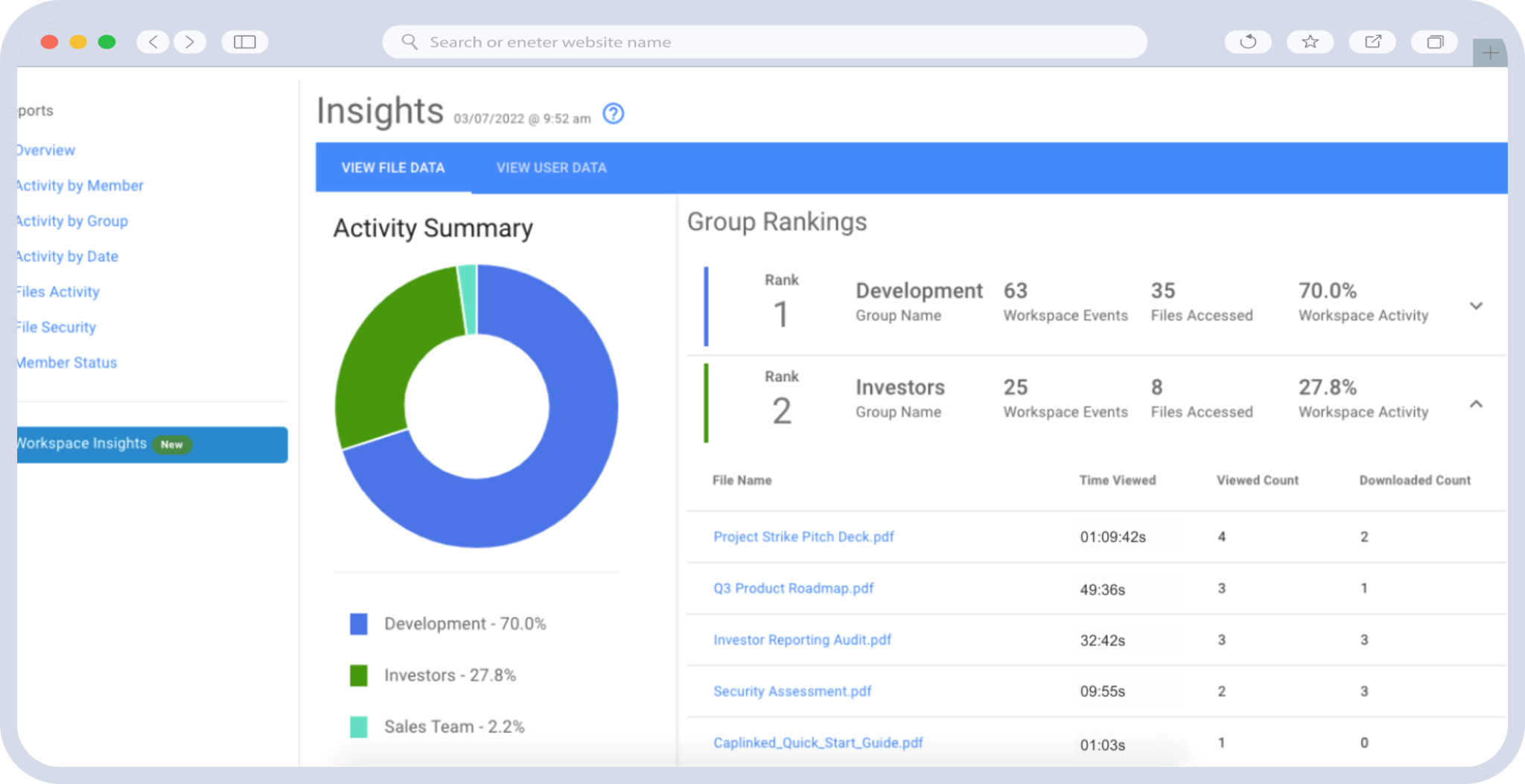
- Activity Tracker. Shows which groups opened which documents and for how long, with CSV export. It tells you who has done the reading, not how they will respond to terms.
- AI Executive Report. Packages room activity into a downloadable PDF for owner or board updates during the process.
- Investor reporting after close. Workspaces stay open after closing, so the same room can hold quarterly financials, covenant compliance certificates and board materials for new investors and lenders, with group access set to expire when a party’s role ends.
CapLinked is SOC 2 certified, encrypts data at rest with 256-bit AES and in transit with TLS, and runs on AWS infrastructure that is itself SOC 2 and ISO 27001 certified. The security overview lists the controls behind its secure document sharing.
As of October 2026, the Team plan is $399 per month with no long-term contract and includes watermarking, FileProtect, EZ Q&A, the Activity Tracker and OCR search; Enterprise is quoted individually. See current pricing and the full feature set for plan details.
Before a recap goes to market, settle three things: how much control the owners will give up, how much debt the business can carry if trading weakens, and which documents each lender and investor will need. The answers shape the structure, the counterparties and the data room.
| Set up the recap workspace before term sheets go out, or talk to CapLinked about running several deals and post-close reporting from one account. |
Frequently Asked Questions
What is a recapitalization in private equity?
A private equity recapitalization is a deal in which a sponsor buys a majority or minority stake in a company, funded with equity and often new debt. The owners take partial liquidity and keep equity that pays out again at the sponsor’s exit.
What is the difference between a majority and a minority recapitalization?
In a majority recap, the investor buys control and decides board matters and exit timing. In a minority recap, the owner keeps control, and the investor negotiates protective provisions, preferred returns and a route to liquidity.
What is a fund recapitalization?
A fund recapitalization is a GP-led secondary in which a private equity fund’s assets move into a continuation vehicle backed by new investors. Existing limited partners can sell for cash or roll their interests into the new vehicle.
How is a recapitalization different from an acquisition?
In an acquisition, the owner sells the company and control transfers at closing. In a recapitalization, the owner sells part of the company or borrows against it, takes some cash, and keeps an equity stake and often control.
What is the difference between recapitalization and refinancing?
Refinancing replaces existing debt with new debt on better terms and leaves the debt-to-equity ratio roughly unchanged. A recapitalization deliberately changes that ratio. In a dividend recap, the test is whether proceeds retire old debt or go to shareholders.
Is a recapitalization a taxable event?
Often not. A recapitalization can qualify as a tax-free reorganization under Section 368(a)(1)(E). Cash or other boot, some preferred stock exchanges and dividend recap proceeds can still be taxable, so structure it with tax counsel.
What documents are needed to complete a recapitalization?
Lenders and investors usually ask for the cap table, existing debt documents, three years of financials and projections, material contracts and corporate records. Closing adds an investment agreement, amended charter, shareholders’ agreement and, if debt is raised, a credit agreement.