Key Takeaways:
- M&A deal velocity is the speed at which a transaction moves from sourcing to close, measured across the whole cycle rather than at any single stage.
- It is not sales deal velocity. That measures a revenue pipeline in dollars per day. Same phrase, entirely different metric.
- The M&A deal process runs through seven stages, and the two where a buyer can unilaterally save weeks are sourcing and diligence.
- Sourcing is a volume game with brutal conversion: the average private equity firm reviews around 80 opportunities to close one.
- A scored, actively pruned pipeline is what lets good deals move without competing for senior attention with stale ones.
- Advisory fees fall sharply as a percentage of deal value as deal size rises, which changes the economics of pursuing small transactions.
- Diligence is the longest compressible stage, and published estimates put virtual data room timeline compression at 30 to 50%.
Table of Contents
ToggleM&A deal velocity is the speed at which a transaction moves from sourcing to close, measured across the entire deal cycle rather than at any single stage. A firm with high deal velocity does not necessarily work faster at any one task. It removes the waiting between tasks.
One clarification, because the term is overloaded. Sales teams use “deal velocity” to describe how quickly revenue opportunities move through a sales pipeline, calculated from opportunity count, deal size, win rate, and cycle length. This guide is about M&A, where a deal is an acquisition and the cycle runs months rather than weeks. Different metric, different levers, same phrase.
For your firm to accelerate deal flow and maximize returns, you need a process, and tooling, that streamline collaboration, protect sensitive data, and eliminate friction from the deal cycle. The faster your team can execute due diligence, structure agreements, and close capital, the more competitive advantage you hold. However, if your virtual data room is outdated, clunky, or slow to navigate, you’re not only losing time, you’re also sacrificing opportunities.
This guide covers what deal velocity actually measures, how the M&A deal process runs stage by stage, how to source and manage a pipeline that moves, what advisory fees look like by deal size, and where deals most commonly stall.
What Is M&A Deal Velocity, and Why Does It Matter?
Deal velocity refers to the speed at which investment professionals can move a transaction from sourcing to close. It is influenced by how quickly firms can:
- Gather and review due diligence materials
- Coordinate across legal, financial, and operational teams
- Respond to LP inquiries or co-investor feedback
- Make decisions with confidence and clarity
In a competitive environment, slow deal cycles can lead to missed opportunities through delayed decisions, reduced negotiating leverage, and a lower internal rate of return (IRR) over time.
The IRR point is the reason velocity is a financial metric and not an operational preference. IRR is time-weighted, so the same absolute return delivered a year earlier is a materially higher IRR. A firm that shortens its average cycle improves fund performance without improving a single underlying business. The same logic applies at the front of the cycle: capital deployed sooner starts working sooner.
Faster deal velocity means quicker closes, earlier returns, and more bandwidth for sourcing the next opportunity. When data access is critical, deal velocity increasingly depends on whether your data room is helping or hurting your workflow.
How the M&A Deal Process Runs, Stage by Stage
Deal management is the work of keeping all of these stages moving at once. Knowing where the time actually goes is the prerequisite for shortening any of it.
| Stage | What happens | Where time is lost |
|---|---|---|
| Sourcing and screening | Targets identified and qualified against criteria | No criteria, so everything gets a meeting |
| Initial contact and NDA | Approach, mutual interest established, NDA signed | NDA negotiation, which can run weeks with no standard form |
| Valuation and LOI | Indicative valuation, terms agreed, exclusivity secured | Internal approval loops with unclear decision rights |
| Due diligence | Commercial, financial, legal, tax, and technical review in parallel | The longest and most compressible stage. Seller readiness dominates. |
| Negotiation and documentation | Findings priced in, definitive agreements drafted | Reopened points that diligence should have settled |
| Regulatory clearance | Filings and any second requests | Largely outside the buyer’s control, so plan around it |
| Signing, closing, integration | Funds flow, the integration plan begins | Integration planning that started too late |
Two observations. The stage most firms try to speed up is negotiation, where the counterparty controls half the clock. The two stages where a buyer can unilaterally save weeks are sourcing, by qualifying out faster, and the administrative half of diligence. Both are covered below.
Velocity improves in one of three ways: removing a stage, shortening a stage, or running stages in parallel that were previously sequential. Every recommendation in this guide is one of those three.
How to Fill Your M&A Deal Sourcing Pipeline Faster
Sourcing sets the ceiling on everything downstream, and the conversion maths are unforgiving. The average private equity firm reviews roughly 80 opportunities for every deal it closes, a conversion rate of about 1.25%, according to analysis of outbound origination programs. Behind that number is real time spent on companies that were never going to close.
A firm reviewing forty relevant targets a year has more options and more leverage than one reviewing eight, and leverage is what lets a buyer walk away from a slow seller.
Proprietary sourcing
Targets reached directly, before a banker runs a process. Slower to build and by far the most valuable, because there is no competitive auction setting the pace or the price. Built through sector specialization, relationships with owners and operators, and patience across years rather than quarters. Leading firms source the majority of their deals through proactive channels of this kind rather than waiting for inbound.
Intermediated sourcing
Deals that arrive through investment banks, brokers, and advisers. Faster to access and more competitive, with a process timeline the seller controls. The velocity question here is not how fast you can find these deals but how fast you can qualify out of the ones you will not win.
Data-led screening and trigger monitoring
Systematic screening against defined criteria using market data and financial databases, combined with monitoring for events that signal readiness to transact: leadership changes, funding rounds, ownership tenure milestones. Outreach timed to a trigger consistently outperforms generic outreach by a wide margin, which is what turns sourcing from reactive to continuous.
Networks and referrals
Portfolio company executives, operating partners, lenders, accountants, and lawyers all see transactions before they reach the market. The firms that get the most from this treat it as a maintained system with a named owner, not as something that happens by itself.
Whichever mix a firm uses, the discipline that speeds sourcing is the same: define the criteria before outreach, tier the target universe by fit, and disqualify early on the things that kill deals late, such as customer concentration, regulatory exposure, and misaligned management.
How to Build and Manage a Healthy M&A Deal Pipeline
An M&A deal pipeline is not a list of every company anyone has ever mentioned. It is a scored, actively maintained view of what is live, what is waiting, and what is dead, and the maintenance matters more than the building.
- Score every target against the same criteria. Strategic fit, size, valuation expectation, owner readiness to transact, and competitive intensity. A weighted scorecard forces a comparison that narrative does not.
- Tier the target universe before contacting anyone. Tier 1 targets get partner attention and a tailored approach. Tier 3 targets get a monitored watchlist. Treating them identically is how senior time gets consumed by low-probability names.
- Define the stages and the exit criteria for each. Identified, contacted, qualified, LOI, diligence, closing. A target advances because it meets the stated criteria for the next stage, not because someone likes it.
- Set a staleness rule and enforce it. Any target with no meaningful movement for ninety days gets reviewed and either reactivated with a specific next action or moved to dormant. Most pipelines carry substantial dead weight because nobody wants to be the one to remove a name.
- Track conversion between stages, not just the total. If ninety percent of qualified targets never reach LOI, the qualification criteria are wrong, and that is a fixable problem hiding behind a healthy-looking pipeline count.
- Keep one system of record. A pipeline split across a CRM, a spreadsheet, and three partners’ inboxes is not a pipeline. Whatever the tool, it has to be the place where the answer lives.
The purpose of pruning is not tidiness. A cluttered pipeline consumes the attention of the same senior people the live deals need, and that competition for attention is where velocity is quietly lost.
What M&A Fees Look Like by Deal Size
Fees matter to velocity because they determine which deals are worth running a full process on. Advisory economics scale inversely with deal size: the percentage falls as value rises, which is why the smallest transactions are often the least attractive relative to the work involved.
| Deal size | Typical success fee | Notes |
|---|---|---|
| Under $50 million | 4% to 7% | Lower end of the market. Minimum fee thresholds are common, since small deals are otherwise uneconomic for the adviser. |
| $50 to $500 million | 2% to 4% | Mid-market. Retainer plus success fee is the standard structure. |
| $500 million to $1 billion | 1% to 2% | Fully negotiated. Bulge-bracket and strong middle-market banks. |
| Above $1 billion | Under 1% | Percentage falls sharply while absolute fees remain large. |
Figures above are drawn from published M&A advisory fee benchmarks (Event Driven Daily and M&A Community). Buy-side advisory typically sits lower than sell-side, commonly in the 0.5% to 2% range.
Two components sit alongside the success fee. Retainers are paid monthly or quarterly, usually credited against the success fee, and commonly run from $50,000 to $500,000 depending on deal size and complexity. Success fees typically account for the large majority of total advisory compensation, with retainers and expense reimbursement making up the rest.
The practical velocity implication is that the fixed costs of running a process do not scale down proportionally. A firm doing many small deals spends a far higher share of transaction value on process costs than one doing a few large ones, and needs a correspondingly more repeatable process for the economics to work. That is an argument for standardized diligence templates and reusable data room structures rather than for avoiding small deals.
Why M&A Deals Slow Down
Diagnostic list. Most stalled deals are stalled for one of these reasons, and most firms recognize their own bottleneck in the first three.
- The seller was not ready. Documents assembled reactively, contracts that cannot be located, financials that need reconstructing. This is the single largest cause of extended timelines and it is entirely predictable at the outset.
- The data room is disorganized. Missing documents force repeated requests, and a badly structured room signals to the buyer that the underlying business may be equally disorganized. That is a confidence problem as well as a time problem.
- Q&A runs on email. Questions get lost, the same question is answered three times by three people with three different answers, and nobody can tell which version is current. This is where delay accumulates most invisibly.
- Decision rights are unclear. Nobody is sure who can approve a change, so everything waits for the next scheduled meeting.
- Diligence findings reopen settled points. A material surprise late in the process sends the deal back to valuation. The fix is sequencing: find the deal-breakers first.
- Regulatory review extends. Largely outside the buyer’s control. The US Department of Justice’s “Comply with Care” initiative, introduced in August 2025, expanded second-request reviews and data-retention requirements, which raises the documentation burden on deal teams. Plan the timeline around it rather than hoping.
- Too many deals compete for the same people. A partner spread across six live processes is the bottleneck in all six. This is the pipeline hygiene point from earlier, appearing as a symptom.
How a Virtual Data Room Speeds Up Diligence and Closing
Diligence is the longest stage a buyer can actually compress, and a large share of that time is administrative rather than analytical. Legacy data rooms are often the silent bottlenecks in high-stakes transactions. Clunky interfaces, limited access controls, and slow upload speeds frustrate both internal teams and external stakeholders.
The compression available is well documented. CapLinked’s analysis of how virtual data rooms accelerate M&A timelines puts the overall effect at 30 to 50%, with PwC reporting a 40% average reduction in due diligence timelines for firms running VDR-enabled parallel workflows. The gains concentrate in three places: document preparation, parallel buyer review, and Q&A resolution.
Setup that does not eat the first week
A virtual data room should be ready when the deal is. CapLinked lets deal teams launch workspaces in minutes, upload thousands of documents by drag-and-drop, and apply permission structures in a few clicks. There is no complex onboarding or manual folder creation to slow you down, and permission templates mean the structure does not need rebuilding for the next target in the pipeline.
Access without technical friction
CapLinked is 100% browser-based, so there are no plug-ins, no Java, and no access issues. Portfolio company CFOs can reach financials immediately, legal advisers can review contracts without a support ticket, and LPs can log in from any device. In velocity terms, every hour a reviewer spends failing to open a document is an hour subtracted from the diligence window.
Q&A that resolves instead of circulating
EZ Q&A threads every question against the document it refers to, routes it to the right subject-matter expert, and publishes recurring answers to an FAQ so the next bidder finds them without asking. Real-time file activity tracking and notifications keep everyone aligned. This is the stage where email-based processes lose the most time, and where the difference is most measurable.
Running several processes at once
Firms juggling multiple deals can manage each transaction in its own workspace under unified admin controls, monitoring pipeline activity at a glance, running simultaneous diligence processes, and keeping internal and external teams segmented but coordinated. At that scale, enterprise-level information control is what stops one deal’s material surfacing in another’s room.
Control that does not cost time
Speed is nothing without security. CapLinked gives dealmakers control over who can view, download, upload, and comment on each file or folder, and permissions can be updated instantly as the deal evolves. FileProtect digital rights management means downloaded files cannot be forwarded or copied, and can be remotely shredded when a bidder exits, which reduces the leak exposure that otherwise makes sellers slow to share. Certification-backed security and secure document sharing with full version history underpin the exchange, and audit trails give you the record regulators increasingly expect.
Knowing who is serious
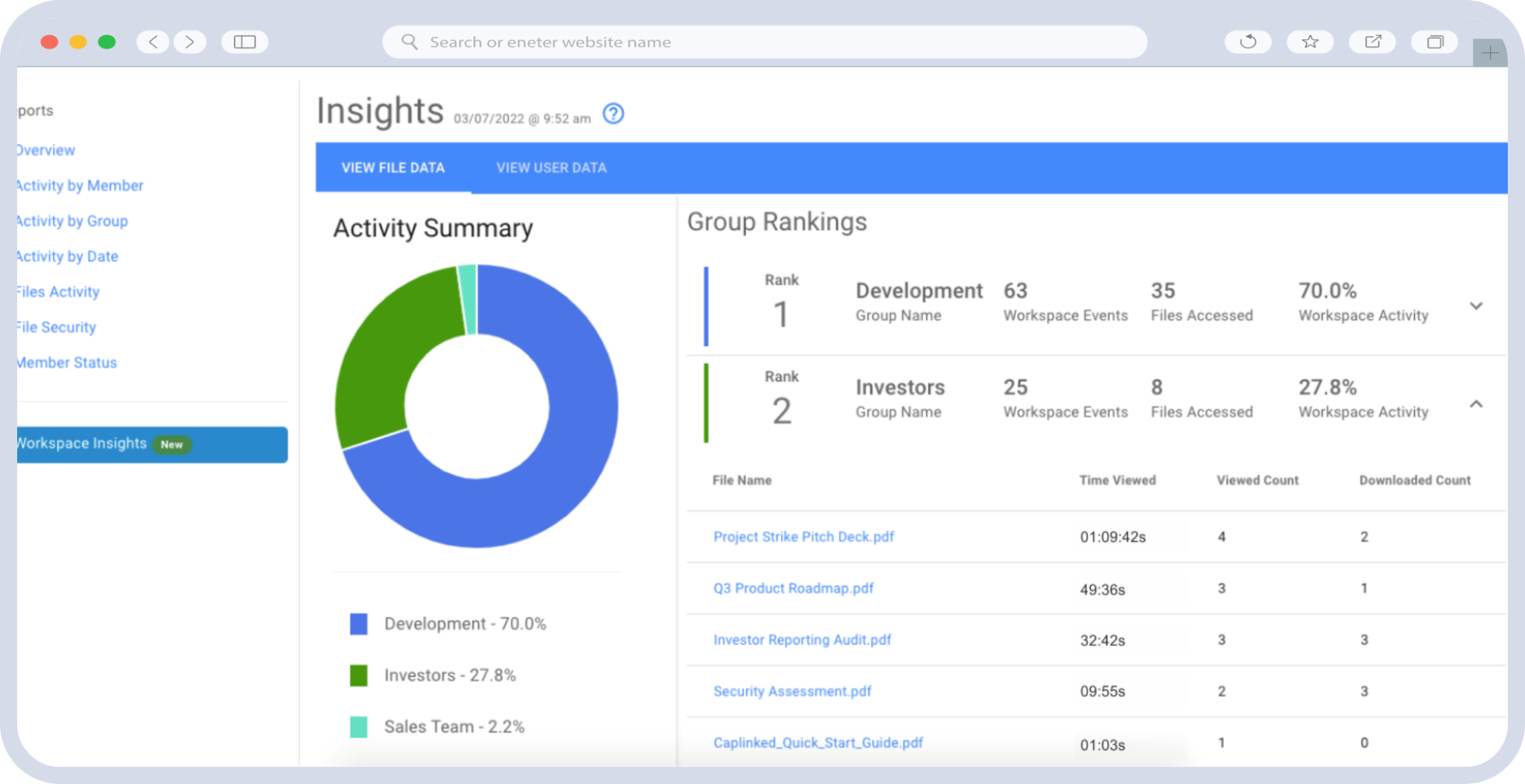
Analytics show who viewed which documents, when they accessed them, and how often they returned. That intelligence lets a team prioritize engaged parties and stop spending senior attention on a bidder who has opened three files in two weeks.
Fitting the rest of the stack
An open API and integrations connect the room to the systems the deal team already uses, and Concierge handles data migration, workspace setup, and stack integration when a lean team is running several processes at once. Transparent pricing and the full feature set are both published upfront.
| In a competitive deal environment, the firms that close fastest are the ones that removed the waiting, not the ones that worked longer hours.
Discover how to accelerate your deal velocity with a free trial. |
Frequently Asked Questions
What is deal velocity in M&A?
It is the speed at which a transaction moves from sourcing to close, measured across the whole deal cycle. High velocity usually comes from removing waiting time between stages rather than from working faster within any one of them.
How is M&A deal velocity different from sales deal velocity?
Sales deal velocity measures how fast revenue moves through a sales pipeline, calculated from opportunity count, deal size, win rate, and cycle length. M&A deal velocity measures an acquisition cycle running months and involving diligence, financing, and regulatory clearance.
What are the stages of the M&A deal process?
Sourcing and screening, initial contact and NDA, valuation and LOI, due diligence, negotiation and documentation, regulatory clearance, then signing and closing. Diligence is typically the longest stage and the one most open to compression.
What slows M&A deals down most?
An unprepared seller, above everything else. Disorganized data rooms, email-based Q&A, unclear internal decision rights, and regulatory review follow. The first three are within a buyer’s or seller’s control to fix before a process starts.
What are typical M&A fees by deal size?
Success fees commonly run 4% to 7% on deals under $50 million, 2% to 4% from $50 to $500 million, 1% to 2% up to $1 billion, and under 1% above that. Monthly retainers, usually credited against the success fee, sit alongside.
How much can a virtual data room speed up due diligence?
Published estimates put overall timeline compression at 30 to 50%, with PwC reporting a 40% average reduction in diligence timelines for firms running parallel VDR-enabled workflows. The largest gains are in document preparation, parallel review, and Q&A resolution.