Table of Contents
ToggleThe Challenge of Compliant Collaboration in the Defense Supply Chain
For prime contractors in the defense industry, managing the Request for Proposal (RFP) process with subcontractors is a complex and high-stakes endeavor. The need to collaborate effectively and efficiently is balanced against the stringent security and compliance requirements of the Department of Defense (DoD). With the full implementation of CMMC 2.0 and the increasing reliance on AWS GovCloud (US) for sensitive workloads, prime contractors face a new set of challenges in ensuring that their RFP workflows are both secure and compliant.
This guide will walk through the key considerations for secure RFP management on GovCloud, and how a solution like CapLinked can enable prime contractors to establish centralized, auditable, and compliant workflows with their subcontractors. We will explore the importance of maintaining intact audit trails, defining clear roles and permissions, and leveraging the power of a secure virtual data room (VDR) to meet the demands of CMMC and the Defense Federal Acquisition Regulation Supplement (DFARS).
The Intersection of RFPs, GovCloud, and CMMC
The RFP process inherently involves the sharing of sensitive information. This can include technical specifications, project requirements, and other forms of Controlled Unclassified Information (CUI). When this information is shared with subcontractors, it is essential that it is protected in accordance with the requirements of CMMC and DFARS.
AWS GovCloud provides a secure and compliant infrastructure for hosting sensitive workloads, but it is not a complete solution in itself. Prime contractors still need to implement the necessary controls and procedures to ensure that their RFP workflows are secure and compliant. This is where a VDR like CapLinked comes in.
Key Challenges in Traditional RFP Management
Traditional methods of RFP management, such as email and file-sharing services, are often inadequate for the needs of the defense industry. These methods typically lack the granular access controls, comprehensive audit trails, and centralized management capabilities required to meet the stringent requirements of CMMC. The key challenges include a lack of centralization, inadequate security, limited auditability, and complex user management.
When documents are scattered across multiple email threads and file-sharing services, it is difficult to maintain a single source of truth and to ensure that all stakeholders are working with the most up-to-date information. Email is an inherently insecure communication channel, and many commercial file-sharing services do not meet the security requirements of the DoD. Without a comprehensive audit trail, it is difficult to track who has accessed which documents and when. Managing user access and permissions across multiple systems can be a time-consuming and error-prone process.
A Modern Approach: Secure RFP Management with CapLinked on GovCloud
By leveraging CapLinked on GovCloud, prime contractors can overcome the challenges of traditional RFP management and establish a secure, centralized, and compliant workflow for collaborating with subcontractors.
Centralized Document Repository
CapLinked provides a single, secure repository for all RFP-related documents. This ensures that all stakeholders have access to the most up-to-date information and eliminates the confusion and version control issues associated with email and file-sharing services.
Granular Access Controls and Permissions
With CapLinked, prime contractors can set granular access controls to ensure that subcontractors only have access to the information they need to see. This is a critical requirement of CMMC and helps to protect against the unauthorized disclosure of CUI. Permissions can be set at the user, group, and document level, providing a high degree of control over who can view, download, and print sensitive information.
Comprehensive Audit Trails
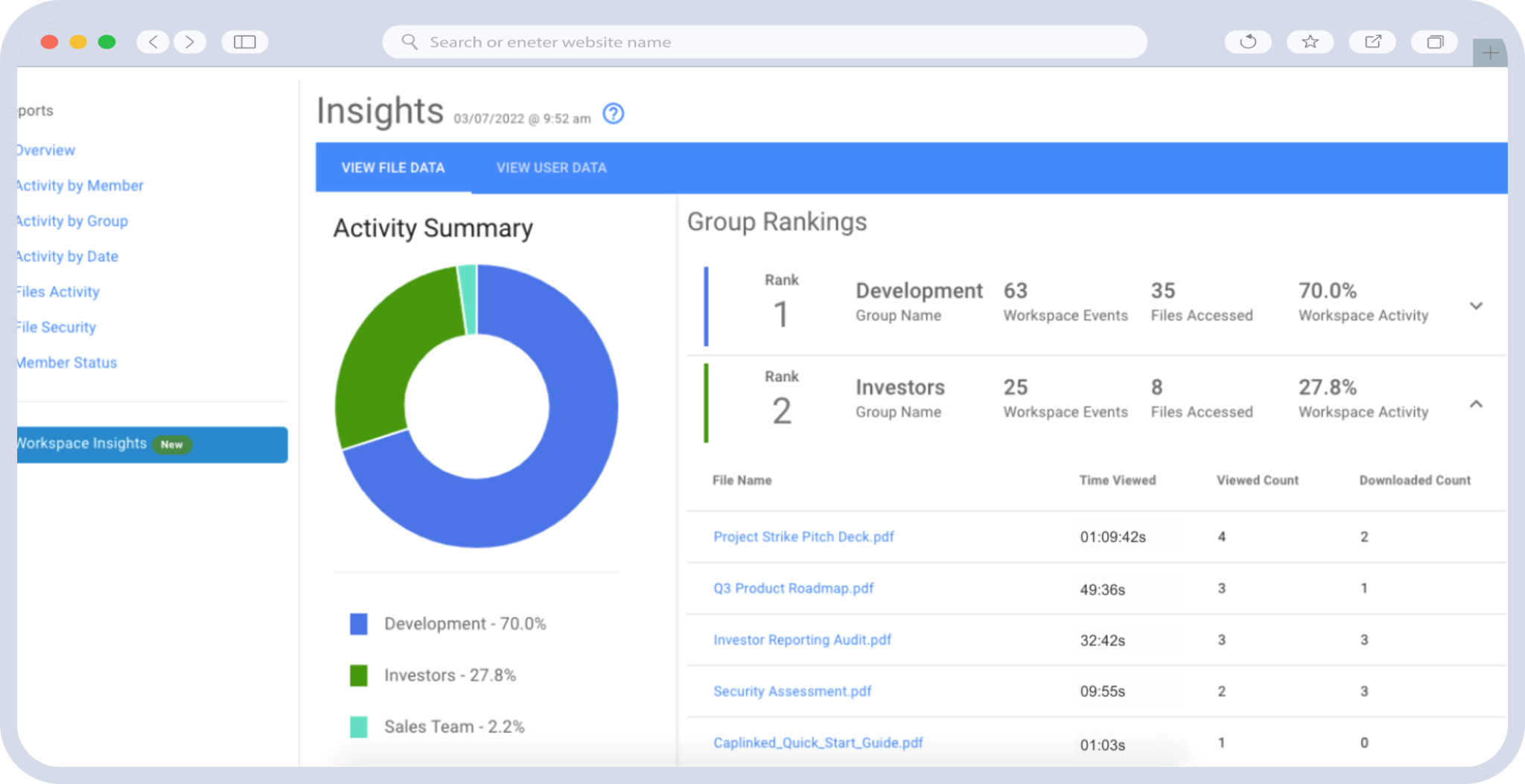
CapLinked maintains a complete and immutable audit trail of all document activity. This provides a detailed record of who has accessed which documents and when, and is essential for demonstrating compliance with CMMC. The audit trail can be easily exported for review by auditors and assessors.
Secure Q&A and Communication
CapLinked includes a secure Q&A module that allows prime contractors and subcontractors to communicate and ask questions in a secure and auditable environment. This eliminates the need for insecure email communication and ensures that all communication related to the RFP is captured in the audit trail.
Streamlined Workflow and User Management
CapLinked streamlines the entire RFP workflow, from initial document distribution to final proposal submission. The platform is easy to use and requires minimal training, which helps to ensure a smooth and efficient process for both prime contractors and subcontractors. User management is simplified through a centralized dashboard, making it easy to add and remove users and to manage their permissions.
Best Practices for Secure RFP Management on GovCloud
To ensure a secure and compliant RFP process on GovCloud, prime contractors should follow these best practices: develop a comprehensive RFP security plan that outlines the security controls and procedures that will be used to protect sensitive information throughout the RFP process. Use a secure VDR like CapLinked that provides the necessary security and compliance features to protect sensitive information and to meet the requirements of CMMC and DFARS. Implement granular access controls to ensure that subcontractors only have access to the information they need to see. Train your employees and subcontractors on the security procedures for the RFP process. Continuously monitor for threats and vulnerabilities in the RFP environment.
The Security Risks of Traditional RFP Management
Traditional RFP management methods, such as email and commercial file-sharing services, are fraught with security risks. These methods were not designed to handle the sensitive information that is often shared in the defense supply chain. Data leakage is a significant risk, as email is an inherently insecure communication channel, and it is all too easy for sensitive information to be accidentally or maliciously leaked. A single misaddressed email can have devastating consequences. Commercial file-sharing services often lack the granular access controls required to protect sensitive information, which can lead to unauthorized access to CUI and other sensitive data. Without a comprehensive audit trail, it is difficult to track who has accessed which documents and when, which makes it challenging to investigate security incidents and to demonstrate compliance with CMMC. Email is a common vector for malware and phishing attacks, and a successful attack can compromise the security of the entire RFP process.
How a VDR Mitigates These Risks
A VDR like CapLinked can help to mitigate these risks by providing a secure and controlled environment for managing the RFP process. All data is encrypted in transit and at rest, ensuring that it is protected from unauthorized access. A VDR allows you to set granular access controls, ensuring that only authorized personnel have access to specific documents. All documents can be watermarked with the user’s name, email address, and IP address, which helps to deter data leakage and to track the source of any unauthorized disclosures. A VDR provides a secure Q&A module that allows prime contractors and subcontractors to communicate and ask questions in a secure and auditable environment. A VDR provides a complete audit trail of all user activity, allowing you to see who has accessed which documents and when.
Tailoring RFP Management to Different Defense Contract Types
The defense industry is not a monolith. There are many different types of defense contracts, each with its own unique set of requirements and challenges. When managing RFPs, it is important to tailor your approach to the specific type of contract you are pursuing.
Fixed-price contracts are the most common type of defense contract. Under a fixed-price contract, the contractor agrees to deliver a product or service for a fixed price. This type of contract places the most risk on the contractor, as they are responsible for any cost overruns. When managing RFPs for fixed-price contracts, it is important to be as detailed as possible in your requirements. This will help to ensure that you receive accurate and competitive bids from subcontractors.
Cost-reimbursement contracts are used when the scope of work is not well-defined. Under a cost-reimbursement contract, the contractor is reimbursed for their allowable costs, plus a fee. This type of contract places the most risk on the government, as they are responsible for any cost overruns. When managing RFPs for cost-reimbursement contracts, it is important to focus on the subcontractor’s qualifications and experience. You want to be sure that you are working with a subcontractor that has a proven track record of success.
Time-and-materials contracts are a hybrid of fixed-price and cost-reimbursement contracts. Under a time-and-materials contract, the contractor is reimbursed for their labor costs at a fixed hourly rate, and for their materials at cost. This type of contract is often used for services such as engineering and technical support. When managing RFPs for time-and-materials contracts, it is important to clearly define the scope of work and the required labor categories.
Evaluating a VDR for Secure RFP Management
When selecting a VDR for secure RFP management, it is important to look for a solution that offers a comprehensive set of features and capabilities. The VDR should offer a robust set of security features, including end-to-end encryption, granular access controls, and watermarking. The VDR should be compliant with all relevant regulations, including CMMC, DFARS, and ITAR. The VDR should be easy to use for both prime contractors and subcontractors, as a clunky and difficult-to-use VDR can lead to frustration and delays. The VDR should include a secure Q&A module that allows prime contractors and subcontractors to communicate and ask questions in a secure and auditable environment. The VDR should provide a comprehensive set of reporting capabilities, including a complete audit trail of all user activity.
By carefully evaluating your options and choosing a VDR that meets your specific needs, you can ensure a secure and compliant RFP process.
The Broader Implications of CMMC for the Defense Supply Chain
CMMC is more than just a set of cybersecurity requirements. It is a fundamental shift in how the DoD approaches supply chain security. The goal of CMMC is to create a more secure and resilient defense industrial base, and a secure RFP process is a critical component of this effort.
By implementing a secure RFP process, prime contractors can not only meet the requirements of CMMC but also strengthen the security of the entire defense supply chain. A secure RFP process can help to reduce the risk of data breaches and the associated costs. It can improve collaboration with subcontractors and build stronger relationships. It can increase the quality of proposals by providing subcontractors with a secure and easy-to-use platform for accessing RFP documents and asking questions.
Conclusion: Building a Compliant and Competitive Edge
In the highly competitive and regulated defense industry, the ability to manage the RFP process in a secure and compliant manner is a critical success factor. By leveraging the power of CapLinked on GovCloud, prime contractors can establish a modern and efficient workflow that not only meets the stringent requirements of CMMC and DFARS but also provides a competitive edge. A secure and streamlined RFP process can lead to better collaboration with subcontractors, higher quality proposals, and a greater likelihood of winning new business.