Key Takeaways
- Choosing the best investor portal software starts with one question: are you controlling diligence access during a raise, or delivering statements, capital calls, and K-1s after close?
- An LP portal is only as accurate as the fund accounting behind it, so your administrator decision usually comes before your portal decision.
- First-time managers often buy a full LP portal months too early, when what the raise actually needs is a permissioned data room.
- Most investor portal vendors don’t publish pricing. In this list, AngelList, Agora, Cash Flow Portal, and CapLinked are the exceptions as of September 2026.
- If you’re an SEC-registered adviser, amended Regulation S-P makes your portal vendor a service provider you’re expected to oversee, including how fast it reports incidents to you.
- Capital call wire instructions belong inside an authenticated portal, not in the body of an email.
- A portal decides who can open a document, but only rights management decides what happens to a PDF after someone downloads it.
Table of Contents
ToggleThe best investor portal software is the one built for the job in front of you. A fundraising data room controls what prospective LPs see during diligence. An LP portal tied to fund administration delivers capital calls, statements, and K-1s after close. Real estate syndication platforms bundle both for property deals. Most funds need two of these tools.
You’re probably reading this because one of these is true:
- Your LPs keep emailing for statements and K-1s your team already sent
- An ODD questionnaire just asked how you control access to fund documents, and “a shared folder” doesn’t feel like a good answer
- You’ve sat through three portal demos and still can’t tell whether you need an LP portal, a data room, or both
The confusion is understandable. Search for investor portal software and you get products that share a label and very little else: data rooms built for fundraising, the LP-facing front end of a fund administrator, and real estate syndication suites with an investor login attached. Compare them feature by feature and you can end up paying for K-1 tooling six months before your first capital call.
We looked at what GPs, IR leads, and fund CFOs actually need from these tools, and it comes down to five things:
- Per-LP access control: Each LP, consultant, or ODD team sees only what it should, and you can publish, hold, or replace a document for one group without touching the others.
- A connection to your books: Statements and dashboards come from reconciled fund accounting, not from someone uploading PDFs by hand every quarter.
- Control after download: Watermarks tie a file to its reader, and protected copies can be revoked once they leave the platform.
- An exportable audit trail: You can show who viewed which document and when, in a format an ODD team or auditor will accept.
- Pricing you can see: A real number before the sales call, and no surprises as the fund grows.
By the end, you’ll know which job you need done first and which platforms fit it.
10 Best Investor Portal Software Platforms in 2026
Here’s a snapshot of the 10 platforms, grouped by the job each one does. Pricing appears only where the vendor publishes it.
| Tool | Job | Best for | Pricing |
|---|---|---|---|
| CapLinked | Fundraising data room | Controlled LP diligence during a raise | From $399/month, no long-term contract |
| Juniper Square | Admin-connected LP portal | PE, real estate, and private credit GPs wanting software plus fund admin | Contact sales |
| Carta | Admin-connected LP portal | VC and PE funds administered on Carta | Contact sales |
| AngelList | Admin-connected LP portal | Emerging VC funds, rolling funds, and SPVs | 0.1% to 0.15% of fund size plus $10,000 to $20,000 per year |
| Allvue | Admin-connected LP portal | PE, VC, and private debt on Allvue accounting | Contact sales |
| Dynamo Software | LP portal with IR tools | Alternatives managers wanting CRM-led investor relations | Contact sales |
| SS&C Intralinks FundCentre | Admin-connected LP portal | Larger managers already on Intralinks | Contact sales |
| AppFolio Investment Manager | Real estate syndication | Sponsors on AppFolio Property Manager | Not listed on product site |
| Agora | Real estate syndication | Real estate firms and syndicators | From $749/month |
| Cash Flow Portal | Real estate syndication | Syndicators and smaller real estate funds | From $499/month, billed yearly |
Table 1: Investor portal software at a glance, as of September 2026
CapLinked publishes this guide, so its entry sticks to the one job it actually does. We reviewed each vendor’s product and pricing pages, independent news coverage, and primary regulatory sources.
1. CapLinked
Best for: Fund managers who need a controlled data room for LP diligence during a raise.
CapLinked is a virtual data room built for controlled external disclosure. It covers the months before LPs commit, when prospects and ODD teams are reading your PPM, DDQ, and track record.
Key features:
- Per-LP access control: Access goes to permission groups, so each LP, consultant, or ODD team gets its own view, download, and upload rights.
- Control after download: FileProtect blocks printing and re-sharing and lets you revoke a downloaded copy when a prospect passes. Watermarks carry the viewer’s name, email address, and IP address.
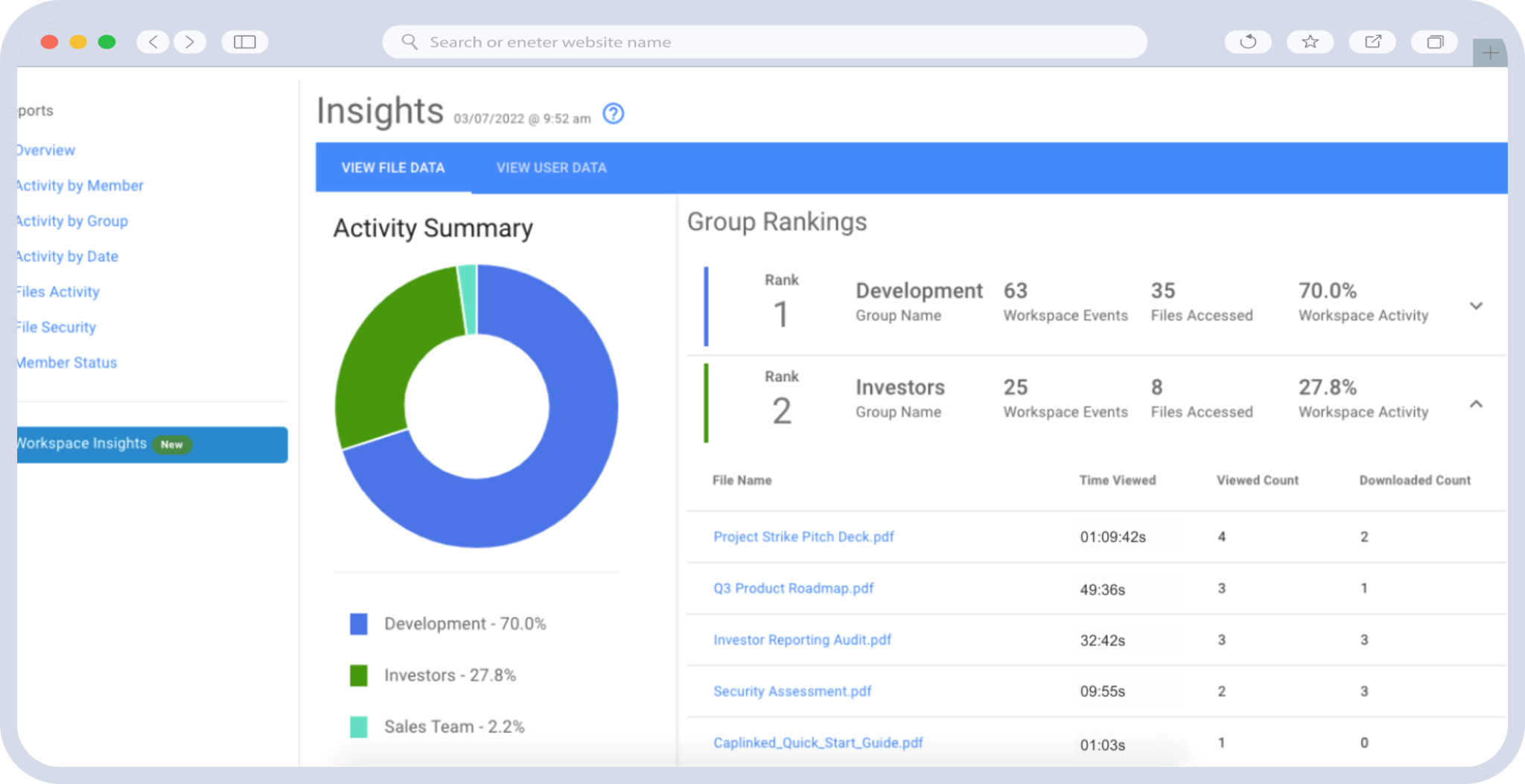
- Audit trail: Activity Tracker shows who viewed or downloaded each file, and for how long, with CSV export.
- Diligence Q&A: EZ Q&A routes DDQ follow-ups to named team members and turns repeated answers into a shared FAQ.
Pros:
- No plugins or downloads for your team or your LPs
- Revocable downloads and identity watermarks, which general file-sharing tools don’t offer
- Published flat pricing, with no long-term contract on Team
Cons:
- No capital calls, fund accounting, K-1 preparation, or investor KYC, so you’ll run it alongside your administrator’s LP portal
- Not built for ongoing quarterly reporting to committed LPs
Pricing: Team is $399 per month with no long-term contract and unlimited guest users. Enterprise starts at $500 per month or $5,000 per year, with a written-quote price match. A 14-day free trial is available (as of September 2026).
| Raising Fund I or Fund II? Set up your diligence room before the first LP meeting, with a separate permission group for every prospect. Start Your Free Trial |
2. Juniper Square
Best for: PE, real estate, and private credit GPs who want software and fund administration services from one provider.
Juniper Square combines fundraising, investor onboarding, reporting, and managed fund administration in one system, with more than 2,000 GPs on the platform. It closed a $130 million Series D in June 2025 to build JunieAI, an AI layer for GP workflows.
Key features:
- CRM and fundraising workflows tied to the investor record
- LP onboarding and subscription processing
- Investor portal for statements, notices, and reports
Pros:
- One vendor for software and administration
- Covers the raise and post-close reporting in one system
Cons:
- Started in real estate, so venture-only managers should check workflow fit
- A broad platform means an implementation project, not a quick switch-on
Pricing: Not published.
Worth checking: Which parts of the portal depend on using Juniper Square’s administration rather than your current administrator.
3. Carta
Best for: VC and PE funds already using Carta for fund administration or cap table management.
Carta’s LP portal sits on top of its fund administration and cap table products, so the numbers LPs see come from the same books your fund runs on.
Key features:
- Consolidated LP view of commitments and holdings, including deal IRR, schedule of investments, and transactions
- Document hub for K-1s, capital call and distribution notices, and LPAs
- Subscription document signing and LP KYC on the platform
Pros:
- LP data flows straight from Carta’s fund accounting
- You decide what each LP sees
Cons:
- Most of the value depends on Carta being your administrator
- Fund tax preparation is sold as an add-on
Pricing: Not published on the pages we reviewed.
Worth checking: What the LP experience looks like if you move administration elsewhere later.
4. AngelList
Best for: Emerging venture managers, rolling funds, and SPVs that want formation, administration, and an LP portal from one provider.
AngelList bundles fund formation, administration, and an LP portal for venture managers, and it publishes its fund pricing.
Key features:
- Fund administration and LP portal from one provider
- Fund taxes and K-1 preparation on the Full Service plan
- Valuation support and portfolio management tools
Pros:
- Published pricing
- Built around the needs of emerging managers and SPVs
Cons:
- Built primarily for venture
- The portal assumes AngelList is your administrator
Pricing: Institutional costs 0.1% of fund size plus $10,000 per year, and Full Service costs 0.15% plus $20,000 per year. Both carry a minimum fund size and a one-time implementation fee (as of September 2026).
Worth checking: The annual fee at your target fund size, since the percentage stays fixed for years one through 10.
5. Allvue
Best for: PE, VC, and private debt managers who want the portal on the same platform as fund accounting and portfolio monitoring.
Allvue puts its investor portal on the same platform as fundraising, portfolio monitoring, and fund accounting, so commitment data flows into LP records without anyone re-entering it.
Key features:
- Branded LP dashboards for reports, capital account statements, K-1s, and capital call notices
- One data model from fundraising through LP accounting
- Self-service preference settings for LPs
Pros:
- Fewer manual handoffs between accounting and investor reporting
- Essentials packages aimed at emerging PE and VC managers
Cons:
- The integration only pays off on Allvue’s accounting
- A heavier implementation than a standalone portal
Pricing: Not published.
Worth checking: A capital call traced from accounting entry to LP notice, live in the demo.
6. Dynamo Software
Best for: Alternatives managers who want the LP portal connected to CRM and investor relations workflows.
Dynamo builds its investor portal on top of a CRM and IR platform, so fundraising, onboarding, and document delivery share one investor record.
Key features:
- Tax Center for K-1 e-consent and delivery
- Onboarding with KYC, AML, and subscription documents through DocuSign
- Engagement tracking for logins and materials viewed
- Two-way document sharing and web forms for investor information requests
Pros:
- Strong IR and fundraising workflow depth
- Serves prospective and committed investors in one place
Cons:
- CRM-first, so statement data depends on your administrator’s feed
- Broad scope can stretch the setup timeline
Pricing: Not published.
Worth checking: One investor followed from onboarding to a published statement during the demo.
7. SS&C Intralinks FundCentre
Best for: Larger managers already using Intralinks for fundraising or data rooms who want investor reporting from the same vendor.
FundCentre is SS&C Intralinks’ fundraising and investor reporting suite. FundCentre Reporting is the investor portal formerly called InvestorVision. SS&C also runs fund administration, so larger managers can keep accounting and investor reporting within one group.
Key features:
- A single LP login across funds
- ILPA template support
- File splitting into investor-specific K-1s and statements
- A fundraising module with investor activity tracking and permissioning
Pros:
- Covers the raise and ongoing reporting with one vendor
- Designed for multi-fund managers
Cons:
- Expect an enterprise sales process
- Recent renaming makes the module lineup harder to read
Pricing: Not published.
Worth checking: Which FundCentre modules are actually in your quote.
8. AppFolio Investment Manager
Best for: Real estate sponsors who already run property operations on AppFolio.
AppFolio Investment Manager covers the real estate raise end to end, from promoting offerings and collecting contributions to calculating and paying distributions, with a CRM for tracking investor interest in new deals.
Key features:
- Offering promotion, interest tracking, and electronic contributions
- Waterfall calculations and electronic distributions
- A 24/7 investor dashboard with positions and invested and distributed capital
Pros:
- End-to-end workflow for real estate raises
- Connects to AppFolio Property Manager, so property data doesn’t need re-keying
Cons:
- Built for real estate only
- Pricing isn’t listed publicly
Pricing: Not listed on the product site as of September 2026.
Worth checking: How property data reaches investor reports if you don’t use AppFolio Property Manager.
9. Agora
Best for: Real estate firms and syndicators that want an investor portal, CRM, and fundraising tools together.
Agora bundles an investor portal, CRM, and fundraising suite in one subscription for real estate firms, with fund administration services available separately.
Key features:
- Investor portal, investor CRM, and fundraising suite
- Report builder and a library of ready-made templates
- Document and K-1 management
- Domestic ACH payments inside the platform
Pros:
- Published entry price
- One subscription covers most of a syndicator’s investor workflow
Cons:
- Built for real estate rather than PE or venture funds
- Fund administration is priced separately
Pricing: From $749 per month, plus a per-transaction fee for ACH payments (as of September 2026).
Worth checking: The cost of administration services alongside the platform, if you plan to outsource.
10. Cash Flow Portal
Best for: Syndicators and smaller real estate funds with a tighter budget.
Cash Flow Portal offers a branded investor portal for real estate syndication, with a higher tier that adds CRM, distribution payments, and underwriting tools.
Key features:
- Custom-branded investor portal and dashboards
- Document sharing with automated K-1 distribution
- Syndication Suite adds CRM, distribution tracking and payments, and AI underwriting
Pros:
- Lowest published entry price among the real estate platforms here
- Portal migration fee waived on Syndication Suite
Cons:
- Built for syndication rather than PE or venture fund structures
- Published prices assume yearly billing
Pricing: Syndication Portal starts at $499 per month and Syndication Suite at $699 per month, both billed yearly (as of September 2026).
Worth checking: Whether your plan supports fund structures if you raise a fund rather than deal by deal.
How to Choose the Right Investor Portal Software for Your Fund
Feature lists won’t separate these platforms, because most of them can store a PDF and put your logo on a login page. These five questions will.
1. Which job do you need done this year?
For a first-time fund, it’s usually the data room, whatever the portal vendors suggest. Before first close you have no capital accounts to report and no K-1s to send. What you do have is a stack of documents going to LPs, consultants, and operational due diligence teams, and their questionnaires will ask exactly how you control access to them. An admin-connected portal also only exists once your administrator is signed, which emerging managers often do late in the raise.
| Did You Know
LPs are rewarding familiarity right now. Five firms accounted for nearly 73% of US venture fundraising in Q1 2026, as LPs favored established managers over emerging ones, according to the Q1 2026 PitchBook-NVCA Venture Monitor. When allocators are this selective, a slow or disorganized diligence process gives them one more reason to wait for your Fund III. |
Here’s how the two jobs play out across a fund’s life, using an illustrative $75 million Fund I with 40 LPs rather than an industry benchmark.
| Stage | Documents in play | What you need |
|---|---|---|
| Pre-marketing | Teaser, deck, track record summary | Tracked links or a light data room |
| Diligence | PPM, DDQ, LPA draft, deal attribution, references, ODD materials | A permissioned data room with a group per LP, watermarks, and activity logs |
| First close | Subscription documents, side letters, KYC/AML | Your administrator’s onboarding workflow |
| Fund operations | Capital calls, statements, K-1s, quarterly letters | An admin-connected LP portal |
| Fund II raise | Fund I reporting history plus a new PPM | A data room again, with existing LPs and new prospects in separate groups |
Table 2: Which tool a hypothetical Fund I needs at each stage
The awkward stretch runs from first close to final close, which can last a year or more. Some LPs are funding capital calls while others are still working through your DDQ, and a committed LP and a prospect should never see the same side letter summary. A dedicated data room for financing keeps the raise separate from post-close reporting. If you’re still building the index, start with what belongs in an investor data room.
2. Where do the portal’s numbers come from?
When a demo opens with polished dashboards, ask who produces the numbers and who reconciles them to the general ledger. ILPA’s updated Reporting Template is meant to replace the 2016 version for funds still in their investment period during Q1 2026, and it asks for more granular fee and expense detail than most spreadsheets were built to produce. A portal can display that template, but your fund accounting has to generate it. If the answer is “your team uploads statements each quarter,” you’re buying a document viewer, not a reporting system.
3. What happens after a document leaves the portal?
Portal permissions stop at the download button. A prospect who passed on Fund II still has your PPM and track record deck, and a former LP’s analyst may still have old statements on a laptop. A watermark tied to the viewer’s identity discourages forwarding, and rights management that lets you revoke a downloaded file covers what the watermark can’t. Neither stops someone photographing a screen, so decide which documents are worth releasing as downloads at all. General storage tools weren’t designed for this, which is why enterprise file sharing platforms differ so much once post-download control is on the checklist, and why the ShareFile vs. Dropbox comparison matters to teams tempted to keep a shared folder running.
| Common Mistake
Sending capital call wire details by email. Business email compromise caused about $3.05 billion in reported US losses in 2025, second only to investment fraud, according to the FBI IC3 2025 Internet Crime Report. Keep wire details inside the authenticated portal, and confirm any change by calling a number you already have on file. |
Plenty of GPs launch a portal and keep emailing capital call notices anyway, because LPs are used to it and nobody wants to change the routine mid-fund. When an LP asks for wire details by email, point them to the portal instead. It’s a small annoyance for the LP, and that friction is exactly what protects them.
4. Can the vendor keep up with your security obligations?
Under amended Regulation S-P, SEC-registered advisers must run an incident response program, notify affected individuals of certain breaches within 30 days, and oversee service providers that handle customer information, including requiring them to report a breach within 72 hours. Smaller advisers had to comply by June 3, 2026. If any of your LPs are individuals, your portal vendor holds exactly the kind of information the rule protects, and a vendor that takes three weeks to tell you about an incident leaves you very little of your 30 days. Exempt reporting advisers may fall under similar FTC rules instead.
| Worth Knowing
Third parties were involved in 48% of confirmed breaches in Verizon’s 2026 dataset, a 60% jump from the year before, according to the 2026 Verizon Data Breach Investigations Report. A vendor’s security review deserves the same attention you give its feature list, starting with its SOC 2 report. |
Vendor demos are built to show the smooth path, so run the same script with every vendor and ask to see the awkward ones:
- Publish a quarterly pack to one LP group, then log in as an LP from a different group and confirm the pack isn’t visible.
- Replace a corrected capital account statement after publishing it. Check whether the LP is notified and whether the original version is kept.
- Remove a prospect who passed on the fund, then ask what happens to the documents that prospect already downloaded.
- Export the audit trail for one LP and one document, in the format you’d send to an ODD reviewer.
- Ask how fast the vendor will notify you of an incident, and whether it will share its SOC 2 report.
On the data room side, ask the same questions about permission groups and access controls. When an LP disputes whether a notice arrived, or an ODD team asks how you control access, the viewing log is your evidence, and our guide to data room audit trails explains what a complete record includes.
5. Will the price stay predictable as the fund grows?
Investor portal pricing follows four models, and most vendors in this category keep their numbers behind a sales call.
| Pricing model | How it works | Examples in this list |
|---|---|---|
| Bundled with fund administration | The portal comes with the administrator’s fee, usually priced on fund size | AngelList (published), Carta |
| Platform subscription | A monthly plan, usually billed yearly, with tiers by feature set | Agora, Cash Flow Portal |
| Custom enterprise quote | Priced by scope after a sales conversation | Juniper Square, Allvue, Dynamo, SS&C Intralinks |
| Flat-rate data room | A fixed monthly price, with no per-page billing | CapLinked |
Table 3: How investor portal software is priced, as of September 2026
One cost question comes up before any demo: does the fund or the management company pay? Your LPA decides, and the updated ILPA template makes the answer more visible to LPs, since it breaks out expenses allocated or paid to the GP and related persons. For the data room side, our breakdown of virtual data room pricing shows how flat-rate and per-page models compare, and current plan details are on the CapLinked pricing page.
| Running several funds or a continuous raise? Enterprise plans start at $500 per month, and CapLinked will match a comparable written quote. Get an Enterprise Quote |
Which Setup Fits Your Fund?
The right combination depends less on fund size than on who your LPs are and how you raise. Here’s how three common situations usually play out.
A first-time venture fund raising from angels and family offices
Your raise needs a permissioned data room from the first LP meeting, with a group per prospect and activity tracking so you know who has actually read the deck. After first close, a venture-focused administrator such as AngelList or Carta usually supplies the LP portal. Keep the data room for sensitive material the admin portal isn’t built to handle, like secure document sharing with prospects for Fund II.
A PE manager raising Fund III from institutional LPs
Institutional LPs will run detailed ODD and expect ILPA-format reporting, so the admin-connected portal matters more here. Allvue, Juniper Square, or FundCentre are typical choices, depending on who runs your accounting. The raise itself still needs a data room with Fund I and Fund II LPs in separate groups from new prospects, so side letter terms and reporting history stay compartmentalized.
A real estate sponsor raising deal by deal
A syndication platform like Agora, Cash Flow Portal, or AppFolio Investment Manager covers both jobs, since each deal is its own raise and its own reporting cycle. A separate data room earns its place when an institutional partner or JV investor runs formal diligence on a larger deal.
Choose by Job, Then by Fund Stage
Start with the job you need done this year, then pick the platform. If you’re raising, you need a controlled room where each prospect sees only what they should, and where you can see what they’ve read. Once the fund is operating, you need an LP portal fed by books someone reconciles every quarter. For most managers that means two tools, and forcing one to cover both jobs is how documents end up in the wrong inbox.
CapLinked handles the first job. It’s a data room for fundraising diligence, with a separate permission group for each LP, identity watermarks, revocable downloads, and activity tracking, running alongside your administrator’s LP portal. For a closer look at that stage, see our comparison of the best VDR services for fundraising.
| Ready to set up your diligence room? Start Your Free Trial |
Frequently Asked Questions
What is an investor portal?
An investor portal is a secure website where LPs access fund documents and data, such as statements, capital call notices, K-1s, and quarterly reports. Most are run by or connected to a fund administrator. Some serve prospective investors during fundraising instead.
What is the difference between an investor portal and a data room?
An LP portal serves committed investors across a fund’s life, delivering statements and notices from fund accounting. A data room serves prospects during a raise, controlling access to the PPM, DDQ, and track record with permissions, watermarks, and activity logs.
What should an LP portal include?
An LP portal should include capital account statements, capital call and distribution notices, K-1s, quarterly reports, and fund documents. It should also offer per-LP permissions, publishing controls, multi-factor authentication, an exportable audit trail, and data from reconciled fund accounting.
How much does investor portal software cost?
It depends on the model. Admin-bundled portals are usually priced on fund size. Real estate platforms that publish pricing start around $499 to $749 per month. Enterprise LP portals are quote-only, and some data rooms charge flat monthly rates.
Can Dropbox or SharePoint work as an investor portal?
They can store and share files, but they aren’t built for per-LP publishing, identity watermarks, revoking downloaded documents, or investor-level audit trails. Operational due diligence teams frequently ask about exactly those controls.
Do emerging managers need an investor portal?
Before first close, most emerging managers need a permissioned data room more than an LP portal. After close, the administrator’s portal usually covers statements, capital calls, and K-1s, so the choice of administrator often decides the portal.
Does Regulation S-P apply to investor portal vendors?
Regulation S-P applies to the SEC-registered adviser, not the vendor. The amended rule requires advisers to oversee service providers handling customer information, have them report breaches within 72 hours, and notify affected individuals within 30 days.