Key Takeaways
- Datasite does not publish a price list. Every engagement is custom-quoted, so the figure you get depends on your specific deal.
- Datasite pricing is based on the pages you upload, so document-heavy deals cost more, largely independent of deal size.
- A base quote covers the data room for a set duration. Extra storage, added users, AI modules, and project extensions are the common add-ons.
- Buyer-reported estimates place typical deal rooms in the five to six figures, but Datasite does not confirm these, so treat them as estimates.
- CapLinked publishes flat pricing, with Team at $399 per month as of September 2026, so you can budget the room before contacting sales.
Datasite prices every deal on a custom quote rather than a published plan. The cost is based on the number of pages you upload, plus storage, users, project duration, and any AI modules you add. This guide explains how a Datasite quote is built, what it typically covers, what usually costs extra, and how CapLinked’s published pricing compares.
If you are evaluating Datasite for an M&A process, one of your first questions is what it will cost. Datasite does not publish a price list, so this guide explains how its pricing works: the model it uses, what a quote typically includes, and what tends to be billed on top.
We build CapLinked, a virtual data room with published, flat-rate pricing, so we will also show where the two approaches differ and where each one fits. The aim is to help you read Datasite pricing clearly and budget your data room with fewer surprises.
Does Datasite Publish Pricing?
Datasite does not publish a public price list or self-serve plans. It is a sales-led product: every engagement begins with a call, a scoping conversation about your page count and timeline, and a custom quote. Even review-platform listings show its entry price as ‘contact us’ rather than a figure.
That does not make the cost unknowable. The pricing follows a clear model, and once you understand the inputs you can estimate the likely range for your deal and read a quote critically. The rest of this guide walks through how a Datasite quote is built.
How Datasite Pricing Works
Datasite pricing is built on one core input: the number of pages in your data room.
The per-page model
Datasite’s pricing traces back to a per-page model, where the cost of the room is tied to how many pages you upload. Every page of every document counts, so a 200-page contract is billed as 200 pages. On a document-heavy deal this adds up quickly. A mid-market company can produce several thousand pages once you include contracts, HR records, permits, and multiple years of financial statements, and much of that cost accrues before a bidder opens a file. Because the meter runs on volume, the cost can rise as you add or revise documents during due diligence.
The inputs that build a quote
Today Datasite is usually sold as a per-project or subscription quote rather than a raw page count, but page volume remains a central input. A quote is typically built from these:
| Input | How it affects the price |
|---|---|
| Page count | The volume of documents uploaded, still a core cost driver |
| Storage | Total data hosted, which large files and media raise quickly |
| Admin users | The number of administrators managing the room |
| Project duration | How long the room stays live, fixed at contract |
| AI modules | Which AI features are switched on, often priced as add-ons |
Table 1: The main inputs behind a Datasite quote
The products around the data room
Datasite Diligence is the data room, and it is what most people mean by Datasite. The company also sells related products: Datasite Prepare for organizing documents before a process opens, Datasite Acquire for buy-side pipeline management, and Datasite Outreach for the marketing phase of a sale. These are priced separately, so it is worth confirming which products a quote actually includes.
What’s Included, and What Usually Isn’t
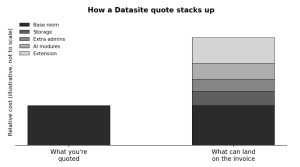
A base Datasite quote covers the data room itself for a defined period. Several costs that buyers expect to be included are often billed separately, and they are the main reason a final invoice can exceed the original quote.
| Often in the base quote | Often billed on top |
|---|---|
| Core data room and standard permissions | Storage beyond the contracted amount |
| A set number of administrators | Additional admin users |
| Standard support during the term | AI modules switched on as add-ons |
| The contracted project duration | Extensions and continuation periods |
| Standard file types | Page-count true-ups and special file handling |
Table 2: What a Datasite quote often includes, and what tends to be billed on top
Project extensions are the most common of these. M&A timelines frequently run longer than planned, and because a Datasite room is priced for a set duration, extending it adds cost. Storage overages, added administrators, page-count true-ups when new documents are uploaded, and handling for large or non-standard files can also appear on the final invoice.
| Did You Know
In a survey of senior M&A bankers, among those seeing extended due diligence timelines, 59% reported one to three months added to the process. On a duration-based room, that slip is exactly when a continuation charge lands. Source: SRS Acquiom and Mergermarket, M&A Due Diligence Study. |
What Does Datasite Cost in Practice?
Because Datasite quotes every deal individually, there is no single price, but buyer reports give a useful sense of scale. On document-heavy mid-market deals, buyers describe data-room costs reaching into the five figures over the life of a transaction, and large, multi-party processes can run into six figures once storage, users, extensions, and AI modules are included. These figures are buyer-reported and vary widely with page count, duration, and scope, and Datasite does not publish or confirm them, so treat them as estimates rather than a rate card.
To estimate your own likely cost and pressure-test a quote, confirm the following before you sign:
- The per-month rate for extending the room past the contracted duration
- The rate for adding documents during diligence, and whether there is a true-up reset
- Whether storage overage is billed, and at what rate
- Which AI features are in the base quote and which are paid add-ons
- Whether guest reviewers, bidders, and counsel consume paid user seats
- What special file handling, such as large media or spreadsheets, costs
With those answers you can compare quotes on the same terms and forecast the cost with more confidence. As an illustration, a single sell-side process on a document-heavy business might start with a base room, then add storage for the financial model and exhibits, a second and third administrator, and an AI module. If the deal then runs six weeks past the contracted term, a continuation charge applies. Each of these is a separate line, and together they can move the final number well above the initial quote.
| Common Mistake
Signing before the extension and page-count true-up rates are in writing. These are the two charges most likely to appear on a continuation invoice, and they are easier to negotiate before you commit than after the deal has slipped. |
| Compare a Firm Quote
CapLinked publishes its rates and will match a comparable written quote, so you can set a firm number next to your Datasite estimate. Get a quote. |
When Datasite Is Worth It, and When It’s Overkill
Datasite’s pricing reflects what it is: an enterprise platform built for large, complex transactions. For the right deal it is well worth the cost, and its strengths are clear:
- The default platform at major banks, with counterparty familiarity built in
- Strong project support and dedicated guidance during a live deal
- Mature Q&A and AI-assisted redaction and indexing across large uploads
- A deal-lifecycle suite spanning preparation, sale marketing, and buy-side work
Enterprise deal activity supports that position. Private equity alone holds roughly $1.3 trillion in buyout dry powder heading into a more active market, according to Bain, and firms running large processes generally have the procurement resources and budget a sales-led purchase assumes.
The fit weakens on smaller deals. For a founder fundraise, an SMB or mid-market sell-side, or routine add-on diligence, an enterprise platform and a per-page model can mean paying for capacity and cost you will not use. On independent review platforms, Datasite rates highly overall, with per-page pricing its most frequent criticism. If your deal sits below the enterprise tier, it is worth comparing total cost against a flat-rate option, and you can see how CapLinked and Datasite compare directly.
Where CapLinked Fits: Published, Flat-Rate Pricing
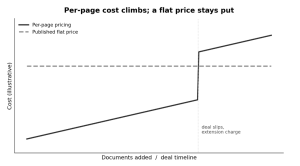
CapLinked takes the opposite approach to pricing. The rates are published, so you can budget the room before speaking to sales.
Team is $399 per month with no long-term contract as of September 2026. Enterprise starts at $500 per month or $5,000 per year with a custom quote and a written-quote price match. There are no per-page fees, so the cost does not rise with document volume or a longer timeline, and guest users are unlimited, so bidders and their counsel do not add to the price.
The entry plan includes controls that some providers reserve for higher tiers: FileProtect digital rights management, custom watermarking, structured Q&A, activity tracking, and SOC 2 security. The full detail is on the pricing page.
Figure 2: On a document-heavy deal that runs long, per-page cost climbs while a flat price stays level.
One capability worth separating from price is control after download. Encryption and permissions protect a document inside the room, while digital rights management governs it after a copy is downloaded: converting it to PDF, applying an identity watermark, and letting you revoke access later. This matters because insider incidents are among the most costly breaches. In IBM’s 2025 research, malicious-insider attacks were the most expensive category at $4.92 million. A bidder who leaves a process but keeps a downloaded file is exactly that exposure.
In fairness, Datasite carries counterparty familiarity at the largest banks and a broader deal-lifecycle suite that CapLinked does not match, and for the biggest, most complex processes that reach can be decisive. Both platforms treat platform security seriously. Where CapLinked differs is transparency: you can see the price before you commit, and it does not change because your deal grew larger or ran longer. Breach figure: IBM Cost of a Data Breach Report 2025.
| Start Your Free Trial
Running a smaller or first-time process? You can start a free trial and compare a flat price against your Datasite estimate. |
Reading a Datasite Quote With Confidence
Datasite does not publish a price, but its pricing is not a mystery. It is built on page count and duration, adjusted by storage, users, and AI modules, and most often increased by extensions. Understanding those inputs lets you estimate the cost and read a quote with a clear eye.
Before you sign, confirm the extension and true-up rates, check which AI features are included, and ask whether guest users are billed. Then compare the total against a provider that publishes its price. The goal is a cost you can predict and defend, whichever platform you choose.
Frequently Asked Questions
How much does Datasite cost?
Datasite does not publish a price; every deal is custom-quoted based on page count, storage, users, duration, and AI modules. Buyer-reported estimates range from the five figures on mid-market deals into six figures on large processes, but Datasite does not confirm these, so treat them as estimates.
Does Datasite use per-page pricing?
Yes, at its core. Datasite’s pricing is based on the number of pages you upload, so document volume is a primary driver. Modern engagements are packaged as a per-project or subscription quote, but page count remains central to the total.
Why doesn’t Datasite publish its pricing?
Datasite is a sales-led, quote-based product with no self-serve signup. Because cost depends on page count, duration, users, and modules, every engagement starts with a call and a custom quote rather than a fixed list price.
What is not included in a Datasite quote?
Common extras billed on top include additional storage, additional admin users, some AI modules, special file handling, and extensions when a deal runs long. Confirm each of these in writing before signing, since they are where invoices tend to exceed the estimate.
Is Datasite worth the cost?
For large, complex, or bank-led M&A processes, often yes: its support, Q&A, AI tooling, and deal-lifecycle suite are strong. For founder fundraises, SMB or mid-market sell-sides, and routine add-on diligence, it can be more platform and cost than the deal needs.
What is the difference between Datasite Diligence and the rest of the suite?
Datasite Diligence is the virtual data room itself. Datasite Prepare, Acquire, and Outreach are separate products for document preparation, buy-side pipeline work, and sale marketing. A quote may cover one or several, so confirm exactly which products it includes.
Are there virtual data rooms with published pricing?
Yes. Some providers publish flat rates you can check before contacting sales. CapLinked lists its Team plan at $399 per month with no long-term contract as of September 2026, with no per-page fees and unlimited guest users, so the cost does not swing with document volume.