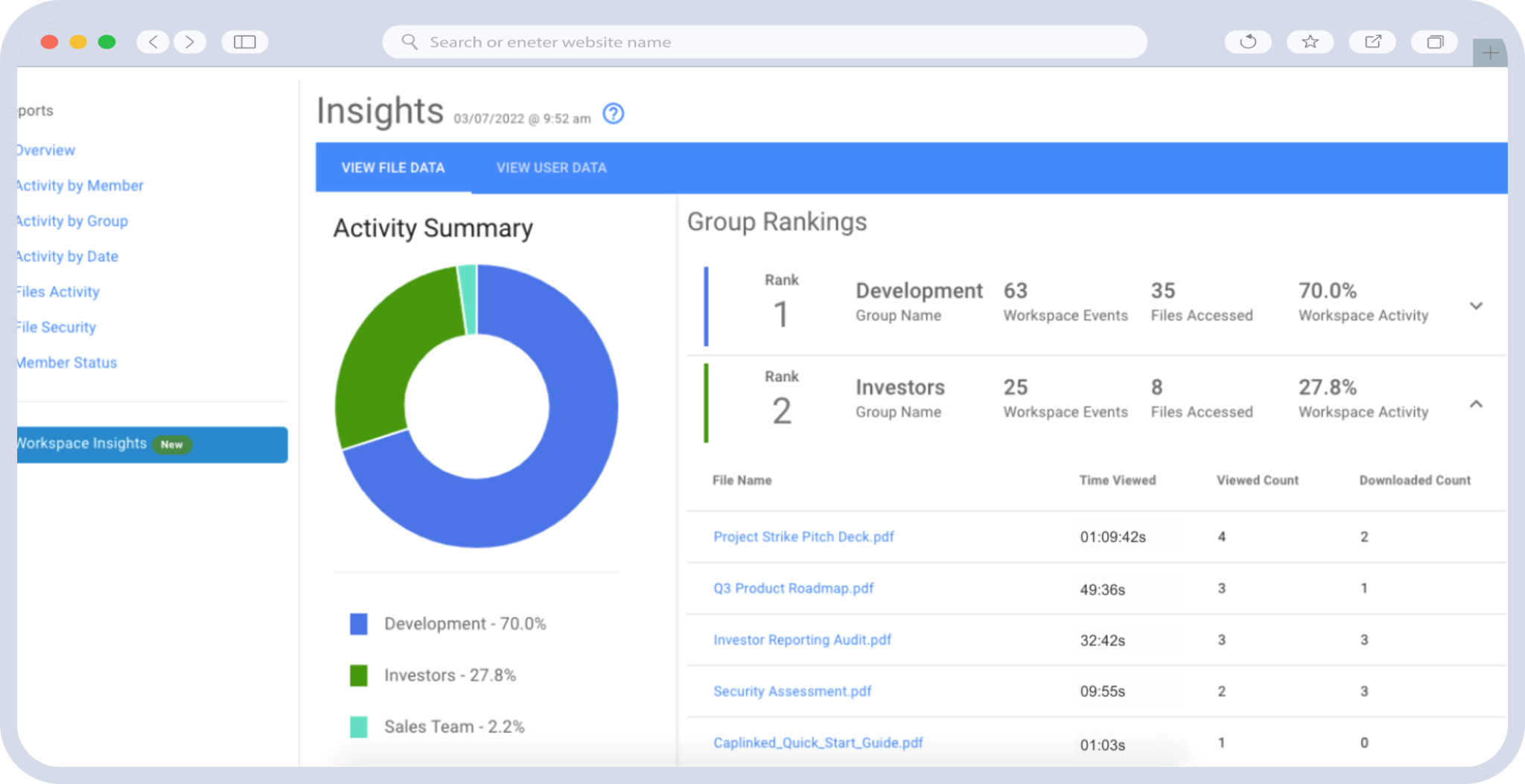
Summary: AWS GovCloud (US) is transforming how organizations approach secure collaboration by offering a cloud environment that goes beyond FedRAMP. With built-in support for top compliance regimes – including FedRAMP High, DoD SRG IL4/IL5, CMMC 2.0, CJIS, and ITAR – GovCloud provides a high-assurance platform for sensitive data. In 2026, even non-government enterprises are adopting GovCloud as a security signal and competitive advantage. This report explores the benefits of AWS GovCloud hosting, emerging private-sector trends, and how CapLinked’s Virtual Data Room (VDR) leverages GovCloud to enable secure collaboration, streamline regulated supply chains, and enhance investor readiness.
Table of Contents
ToggleAWS GovCloud (US): The High-Compliance Cloud Foundation
AWS GovCloud (US) is a specialized set of cloud regions designed to meet the most stringent U.S. government security standards[1]. Unlike standard commercial AWS regions, GovCloud is physically and logically isolated and operated exclusively by U.S. citizens on U.S. soil[1][2]. It was purpose-built to comply with – and often exceed – critical federal requirements such as FedRAMP High, DoD Impact Level 4/5, ITAR, and CJIS[3]. In practical terms, this means GovCloud’s infrastructure and operations have been vetted against hundreds of security controls, providing an environment where sensitive workloads can run with inherited compliance.
Key Compliance Standards Supported by AWS GovCloud: GovCloud’s credentials cover a broad range of U.S. regulatory regimes, making it a one-stop solution for high-compliance needs:
- FedRAMP High – GovCloud holds a FedRAMP High Joint Authorization Board (JAB) Provisional Authority to Operate, meaning its infrastructure meets the government’s highest baseline of cloud security controls[4][5]. Agencies and SaaS vendors can inherit these controls for their own FedRAMP authorizations.
- DoD SRG IL4/IL5 – The Department of Defense Cloud Security Requirements Guide (SRG) maps FedRAMP Moderate and High to Impact Levels 4 and 5 (sensitive unclassified data). GovCloud is one of few environments approved at IL4/5, enabling hosting of mission-critical defense data[6][7].
- CMMC 2.0 Compliance – For defense contractors working toward Cybersecurity Maturity Model Certification, GovCloud provides a ready foundation. By inheriting controls aligned with NIST 800-171 (the basis of CMMC), a GovCloud-hosted platform can more easily meet CMMC Level 2/3 requirements[8][9]. CapLinked’s GovCloud deployment, for example, implements role-based access, audit logging, and encryption mapped to 800-171 control families[10][11].
- CJIS – Law enforcement agencies and state governments trust GovCloud for Criminal Justice Information Services data. AWS GovCloud adheres to CJIS security policy by adding personnel background checks (e.g. FBI fingerprinting for admins) and enhanced controls to handle criminal justice information[12]. Multiple states’ Justice Departments partner with AWS so their systems in GovCloud meet CJIS requirements[12].
- ITAR – Under International Traffic in Arms Regulations, certain defense-related data must never be accessible to non-U.S. persons. GovCloud was designed with ITAR in mind: only U.S. personnel manage the infrastructure, and data never leaves U.S. soil[13][14]. GovCloud’s U.S.-only admins and isolated regions give companies confidence that export-controlled technical data (e.g. defense designs) remains in compliant boundaries.
By covering these regimes (as well as others like HIPAA for healthcare and IRS 1075 for tax data), AWS GovCloud offers a “one-stop shop” for compliance[15]. Few other cloud offerings provide such breadth of certifications[15]. This depth matters because enterprises in regulated sectors often face overlapping mandates – GovCloud’s full inheritance of AWS’s FedRAMP High controls and related standards means less effort to prove compliance across multiple frameworks[16][8].
Beyond Government: Private Sector Adoption of GovCloud
Traditionally, GovCloud was perceived as a domain for federal agencies and defense contractors. In 2026, that is changing. Non-government enterprises are adopting AWS GovCloud as a badge of security leadership, using it to meet contractual demands and signal trustworthiness to partners and customers[17][18]. Several trends underline this shift:
- Regulated Industries Embracing GovCloud: Sectors like finance, healthcare, energy, and legal services increasingly handle data subject to government-like controls. For example, a financial institution might use GovCloud to satisfy OCC and FINRA cybersecurity guidelines, or a healthcare company might host sensitive patient data in GovCloud to exceed HIPAA requirements[19][18]. In energy and utilities, GovCloud helps meet critical infrastructure protection standards (NERC CIP), while legal and consulting firms use it to ensure client data (including export-restricted info) stays under U.S. jurisdiction[18]. These industries view GovCloud not just as tech, but as a business enabler for compliance.
- Security Signaling to Stakeholders: Running enterprise applications on GovCloud sends a strong message to auditors, investors, and customers that security is taken seriously. Hosting in a FedRAMP High, IL5 environment provides a level of assurance difficult to achieve in commercial clouds[20][21]. This “security signaling” can differentiate companies in competitive bids or due diligence – much like a safety rating or quality certification. In proposals or investor decks, organizations now highlight GovCloud-backed systems as proof of robust cyber governance.
- Meeting Contract Pre-Requisites: An emerging reality is that certain contracts (especially with government or defense customers) explicitly require cloud systems to reside in compliant environments[22]. A defense manufacturer bidding on a project might need to show that all collaboration tools, like data rooms or file shares, are in GovCloud or an equivalent IL5 enclave. Even outside direct government work, large enterprises are adding similar clauses for their vendors. By choosing GovCloud, companies preempt these requirements, making themselves “contract-ready” and avoiding disqualification on security grounds[22][23].
In short, AWS GovCloud is no longer just for government – it’s becoming the gold standard for any organization that treats data security and compliance as non-negotiable[24][25]. As one industry analysis put it, GovCloud is “often a requirement” rather than an option for hosting certain data[22]. Enterprises that adopt GovCloud gain not only technical security but also a reputation edge in an era when data governance is tied to business reputation.
GovCloud vs. Commercial Cloud: Compliance Benefits at a Glance
What exactly does GovCloud offer that a commercial AWS or other cloud region cannot? The differences can be stark when it comes to high-stakes collaboration and audits. Key distinctions include:
| Aspect | Standard AWS Cloud | AWS GovCloud (US) |
|---|---|---|
| Data Residency | Multi-region, global options (data may reside outside U.S.) | U.S.-only regions (controlled data sovereignty)[26][27] |
| Admin Personnel | Global workforce, not restricted by nationality | U.S. citizens only, background-checked (ITAR-compliant ops)[28] |
| Baseline Compliance | FedRAMP Moderate (for some services) | FedRAMP High JAB P-ATO (full inherited controls)[5][29] |
| DoD Authorization | IL2 (public data) or self-attestations | DoD IL4/IL5 provisional authorization (for CUI/mission data)[30][29] |
| CJIS & Export Controls | Not inherently compliant | CJIS agreements in place; ITAR-support by design[30][26] |
| Isolation Level | Multi-tenant, global network | Isolated cloud (separate auth, network, region)[21][31] |
| Service Availability | Broad, but some services lack govt. certs | Broad service catalog with High-baseline certs[32][15] |
Table: Comparing commercial AWS vs. AWS GovCloud for high-compliance needs.
For enterprises, these differences translate into tangible compliance benefits. In GovCloud, all data stays within U.S. jurisdiction – a crucial point for meeting ITAR and avoiding legal complications around cross-border data transfer[21][31]. GovCloud’s strict personnel controls and separate systems reduce insider threat and supply chain risk that can be present in global clouds. Additionally, by inheriting a FedRAMP High and DoD IL5 baseline, companies drastically cut down the work needed to pass audits. Many security controls are already in place and documented, allowing teams to focus on application-level compliance. In essence, GovCloud offers a “compliance-ready” environment, whereas a commercial cloud would require layering on numerous extra controls and audits to reach the same level[16][8].
CapLinked’s GovCloud VDR: Secure Collaboration for Regulated Workflows
As a practical example of GovCloud’s impact, CapLinked – a leading secure Virtual Data Room provider – has deployed its platform on AWS GovCloud to serve customers with the highest compliance needs[33][34]. This GovCloud-hosted VDR combines the cloud’s inherited security with CapLinked’s application-level features to support secure collaboration in regulated supply chains and sensitive transactions.
Secure Supply Chain Collaboration (CMMC-Ready): By 2025, every company in the Department of Defense supply chain is expected to comply with CMMC 2.0 practices[35]. CapLinked’s GovCloud VDR directly addresses this by providing an audit-ready workspace for Controlled Unclassified Information (CUI) shared between primes and subcontractors[36]. For example, a defense prime contractor can use CapLinked to distribute technical data to subcontractors, knowing that all data stays in a GovCloud IL5 environment. Granular user permissions and U.S.-only access controls ensure only cleared U.S. persons can access documents[20][37]. Every document view and download is immutably logged, creating evidence for 800-171 and CMMC compliance audits[8][38]. This eliminates the insecure email and FTP exchanges that previously plagued defense projects. In effect, CapLinked on GovCloud simplifies compliance and collaboration simultaneously for the defense industry[39].
Investor & Due Diligence Readiness: Beyond government contracting, companies aiming to raise capital or be acquired also benefit from a GovCloud-backed data room. In sensitive deals – e.g. a tech startup with encryption IP courting investors, or a healthcare firm sharing HIPAA-regulated clinical data with a potential acquirer – using a GovCloud-hosted VDR provides an extra layer of trust. It signals to investors and buyers that the company has “its house in order” regarding data governance[40]. All due diligence materials can be pre-staged in a secure, compliant space, accelerating deal timelines while reducing risk[41]. CapLinked’s platform helps demonstrate “governance maturity” to counterparties by enforcing strict access control across bidders, lawyers, and consultants, and by providing evidence of every action via audit trails[41][42]. This not only protects the data during a deal, but also enhances the company’s credibility – a factor that can influence valuations and outcomes. In 2025 and beyond, cybersecurity and compliance are core due diligence points; using a FedRAMP-grade data room can turn compliance from a hurdle into a selling point[42].
Use Case Depth – From RFPs to M&As: CapLinked on GovCloud is deployed in a variety of high-stakes use cases: – Defense RFP Collaboration: Contractors respond to government RFPs by sharing proposals, budgets, and designs in a CapLinked GovCloud workspace. GovCloud’s IL5 authorization allows even sensitive controlled data (like ITAR technical drawings) to be included, speeding up proposal reviews under secure conditions. – M&A in Regulated Industries: When mergers involve banks, defense suppliers, or healthcare firms, there are reams of regulated data (banking compliance records, CUI docs, patient data) that must be reviewed. A GovCloud-based VDR lets the parties perform due diligence without violating laws. For instance, a bank acquisition team can examine a target’s loan files and SAR (Suspicious Activity Reports) within the VDR, confident that encryption and access rules meet FINRA and SOX standards. Regulators reviewing the merger see that proper controls were in place during diligence, smoothing approval. – Continuous Compliance Operations: Some CapLinked clients use their GovCloud data room not just for one-off deals, but as an ongoing secure document hub for compliance. A multi-state energy company, for example, keeps all its plant security manuals and incident reports in CapLinked. Auditors from federal agencies (EPA, FERC) are granted temporary access to specific folders during inspections. Because it’s GovCloud-hosted, the company can demonstrate that all records are stored in a FISMA-high environment, with full audit logs of access – greatly reducing audit overhead[38][23].
The Emerging Standard for 2026 and Beyond
In 2026, AWS GovCloud is reshaping the mindset around cloud collaboration: compliance is no longer an afterthought, but a core feature of the platform. Organizations that choose GovCloud gain a dual advantage – technical security and business credibility. They can pursue new opportunities (government contracts, partnerships, cross-border deals) that would otherwise be closed to them due to data requirements.
Platforms like CapLinked further translate that infrastructure into user-facing solutions, turning GovCloud’s raw security into streamlined workflows for end-users. The combination of GovCloud’s high-assurance architecture and CapLinked’s collaboration features creates an environment where teams can work freely without constantly worrying about violating a regulation or losing sensitive data. As one executive noted, “When compliance is the contract, CapLinked on GovCloud delivers the assurance enterprise buyers need”[24][43].
Conclusion: Going beyond FedRAMP means embracing a cloud that was built from the ground up for trust. AWS GovCloud (US) has proven to be that environment – fed by government requirements but now fueling private sector innovation in security. In the coming year, expect more enterprises to proactively opt for GovCloud-backed solutions to stay ahead of evolving regulations. The result is collaboration that’s not only faster and more efficient, but verifiably secure and compliant. The message for 2026 is clear: when it comes to critical data, GovCloud-enabled platforms like CapLinked are setting a new benchmark for safe, compliance-driven collaboration.
[1] [2] [3] [8] [9] [10] [11] [16] [17] [18] [19] [20] [21] [23] [24] [25] [26] [27] [29] [30] [31] [33] [34] [36] [37] [38] [43] [70] [79] [80] GovCloud vs. Commercial Cloud: What Enterprise Buyers Need to Know in 2025 | CapLinked
[4] [12] AWS GovCloud in Government: Adoption, FedRAMP VDRs, and Compliance: | CapLinked
https://www.caplinked.com/blog/aws-govcloud-in-government-adoption-fedramp-vdrs-and-compliance/
[5] [6] [7] [13] [14] [15] [22] [28] [32] FedRAMP High and AWS GovCloud: The Gold Standard for Secure Virtual Data Rooms | CapLinked
[35] [39] CapLinked Blog | Data Security Industry News & Trends
https://www.caplinked.com/blog/
[40] [44] [45] [46] [47] [48] [55] [56] [57] [67] [68] [69] [71] [72] [73] [74] Virtual Data Rooms in 2025: Compliance, Cross‑Border Collaboration, and New Use Cases | CapLinked
[41] [42] [66] [90] Governance Is the New Due Diligence: Why Compliance Is Now Core to Every Deal | CapLinked
[49] [50] [51] [52] [53] [54] [58] [59] [60] [61] [62] [63] [64] [65] [75] [76] [77] [78] [81] [82] [83] [84] [85] [86] [87] [88] [89] Beyond the AI Buzz: Debunking Competitor Hype in the Virtual Data Room Market | CapLinked