Key Takeaways
- Buy side vs sell side comes down to who you represent in the deal: the acquirer buying the business, or the owners selling it.
- The two sides want opposite outcomes on price, so most diligence friction traces back to that single fact.
- Buy-side due diligence looks for the problems a buyer would pay for, while sell-side diligence finds those problems first and decides how they are disclosed.
- The sell side usually builds and pays for the data room, which makes the buyer’s experience inside it the seller’s problem.
- Buyers still need their own record of what was shared, because the seller controls the room and can close it after the deal.
- In capital markets the same two terms mean something else, where buy-side firms invest money and sell-side firms create and sell securities.
Table of Contents
ToggleIn M&A, the buy side is the acquirer and the advisors working for it, while the sell side is the company being sold and the bankers, lawyers, and accountants running the sale. The buyer tests value and hunts for risk. The seller prepares the business, controls disclosure, and decides what each bidder sees and when.
Buy side vs sell side describes which client you are working for in a transaction. The buy side is the acquirer, together with its bankers, lawyers, accountants, and lenders. The sell side is the company being sold, its owners, and the advisors running the process. Both sides read the same documents and sit in the same negotiations, and they are pulling in opposite directions on price, timing, and how much gets disclosed.
This piece covers what each side is responsible for, how buy-side and sell-side due diligence differ in practice, where the two sides create work for each other, and what each one needs from a virtual data room. If you are about to run a process or join one, you should finish with a clear view of what your side owns.
What Do Buy Side and Sell Side Mean in M&A?
In an M&A deal, the buy side is the party acquiring a company or an asset, and the sell side is the party disposing of it. Advisors take their label from the client they represent on that mandate, not from the firm they work for. The same middle-market bank can run a sell-side auction in March and advise an acquirer on the buy side in April.
The two roles differ in goal, workload, and sequence. The sell side front-loads its work, since most of the effort happens before buyers arrive. The buy side back-loads its work, because the heavy lifting starts once access to the room is granted.
| Dimension | Buy side | Sell side |
|---|---|---|
| Client | The acquirer: a strategic buyer, private equity sponsor, or family office | The company being sold, its founders, or its shareholders |
| Core goal | Pay a defensible price and avoid inheriting problems | Maximize valuation and close with the business intact |
| Typical advisors | Buy-side banker, corporate counsel, quality of earnings team, technical and insurance specialists | Sell-side banker or broker, transaction counsel, tax advisor, vendor diligence team |
| Main constraint | Information asymmetry, since the seller knows the business better | Confidentiality, since every disclosure can be used to cut price |
| Diligence role | Requests, reviews, and prices what it finds | Prepares, stages, and answers |
| Data room role | Guest reviewer in the seller’s room, plus its own internal record | Administrator who builds the room and sets permissions |
Table 1: Buy side vs sell side in an M&A transaction at a glance.
The terms also carry a capital-markets meaning that has nothing to do with a specific deal. That version is covered further down, so career searchers get an answer without it interrupting the transaction detail.
How the Buy Side Works in an M&A Deal
Buy-side work exists to protect the acquirer from overpaying and from buying a liability it did not price. That mandate runs from the first target list through to integration planning, and it gets progressively more expensive to reverse at every stage.
Sourcing and screening targets
A buy-side team starts with a thesis: what capability, market, or customer base does the acquirer need, and what would it pay for. Screening turns that thesis into a target list, outreach tests which owners are willing to talk about, and only a small share of approaches reaches a signed LOI. Teams that run a repeatable M&A deal sourcing process tend to see proprietary opportunities before a banker packages them into a competitive auction.
Diligence, financing, and integration planning
Once an LOI is signed, the buy side runs financial, legal, commercial, tax, and technology workstreams in parallel, usually with external specialists in each. Bain notes that diligence is no longer only about validating a deal, since a rising bar for capital means it also has to confirm that an acquisition is the best use of that money. Financing structure and integration planning move alongside the review, because the cost of capital and the speed of integration both change what the buyer can justify paying.
Why information asymmetry shapes every buyer decision
The seller has lived with the business for years, and the buyer gets a few weeks in a data room. That gap is the buyer’s central problem, and it explains behavior that sellers often read as hostility. A buy-side team that finds 40 percent of revenue sitting with two customers is not being difficult when it asks for cohort data and contract renewal terms. It is quantifying an argument for a lower price, an escrow holdback, or an earnout, and it will do that with whatever evidence the room provides.
How the Sell Side Works in an M&A Deal
Sell-side work runs in the opposite direction. The objective is to find the same problems the buyer will find, fix what can be fixed, and control how the rest is disclosed and priced.
Preparing the business before buyers arrive
Preparation is where sell-side advisors earn their fee. That means a sell-side quality of earnings review, clean monthly financials, a contract register that flags change-of-control and auto-renewal clauses, and a cap table that reconciles. Finding a termination right in your largest customer contract six months before you list is a fixable issue, and finding it in week five of diligence is a price negotiation.
Creating competitive tension without losing control
The process itself is a controlled release of information: a blind teaser, an NDA, the confidential information memorandum, indications of interest, then a shortlist that gets deeper access. Competitive tension comes from running several credible bidders on the same clock, and it only holds if every party receives consistent information at a consistent pace.
| Did You Know
Global M&A reached US$3.19 trillion of announced value in the first seven months of 2026, up 36 percent year on year, while LSEG describes a market where growth is driven by a relatively small number of transactions and participants. Headline value is concentrating in large deals, so a middle-market seller is competing harder for buyer attention than the totals suggest. Source: LSEG, August 2026 |
Staging disclosure so the wrong bidder never sees the wrong file
Staged disclosure is standard practice on the sell side, and it is the part first-time sellers most often get wrong. Corporate records, historical financials, and a summary cap table support a credible offer. Account-level customer revenue, employee compensation schedules, proprietary pricing models, and detailed process documentation can wait until an LOI and an exclusivity period are in place. In a competitive process, at least one bidder is usually a competitor.
Buy-Side vs Sell-Side Due Diligence
Buy-side due diligence is an investigation run for the acquirer to test value and surface risk, while sell-side due diligence, often called vendor diligence, is a self-examination the seller commissions before going to market. Both review the same categories of information, and the difference is who receives the findings and what they are allowed to do with them.
| Buy-side due diligence | Sell-side due diligence | |
|---|---|---|
| Purpose | Validate the thesis, price risk, plan integration | Find issues early, fix them, and prepare the disclosure story |
| Who commissions it | The acquirer | The seller or its advisor |
| Timing | Mainly after the LOI, during confirmatory diligence | Before the process opens, typically 6 to 12 months out |
| Typical output | Diligence report, revised valuation, negotiation points, day-one plan | Vendor diligence report, quality of earnings, clean data room, disclosure schedules |
| Effect on price | Findings support a reduction, a holdback, or an earnout | Prepared answers protect the number the seller went to market with |
| Main risk | Missing a liability that surfaces after close | Disclosing too much, too early, to the wrong party |
Table 2: How buy-side and sell-side due diligence differ in purpose, timing, and output.
Timelines set the stakes on both sides. Bain’s analysis of integration timelines shows that deals above $10 billion take roughly seven months from announcement to close, and middle-market processes compress the same workstreams into a far shorter window. Every unanswered question consumes part of that window, which is why preparation quality shows up in the final price rather than only in the calendar.
Where the Two Sides Collide During Diligence
Most deal friction is not caused by bad faith. It comes from four predictable collisions between a buyer who wants everything now and a seller who is releasing information in a specific order.
- The request list versus the index. Buyer counsel sends a numbered request list that rarely matches the seller’s folder structure, so files get requested twice and answered twice.
- Q&A volume. Four bidders asking overlapping questions through email threads produces four slightly different answers, and inconsistent answers become a disclosure problem later.
- Clean-team and redaction requests. Pricing, customer names, and salary data often need redaction or a restricted group before a competitor-adjacent bidder can review them.
- Ownership of the record. The seller owns the room, so the buyer needs its own copy of what it received and when, particularly if a reps and warranties claim arrives after close.
One point is worth stating plainly, because most buy side vs sell side comparisons avoid it: the buyer’s experience inside the room is the seller’s problem. A buyer who cannot find the lease schedule does not lower its standards, it slows down and asks again. Delay creates uncertainty, uncertainty gets priced, and the seller pays for it in the final number.
Data Room Needs on the Buy Side vs Sell Side
Both sides work in the same due diligence data room, and they use almost none of the same features. The sell side is administering access and watching engagement, while the buy side is reading, searching, and assembling a record. Reviewing the data room features deal teams need from your own side of the table is a faster way to choose a platform than comparing full feature lists.
What the sell side needs from a data room
Sell-side priorities are administrative control and evidence. Permission groups are the foundation, since access granted per counterparty rather than per person is what allows a deal lead to compare one bidder against another later. In CapLinked, view, download, and upload rights are set per group and cascade to subfolders, and access can expire on a set date.
- Identity-carrying watermarks. Up to seven watermarks per page, each adjustable for size, opacity, color, and position, carrying viewer name, email address, and IP address.
- Control after the download. FileProtect converts protected files to PDF, blocks printing and re-sharing, and allows access to be revoked later, which matters when a bidder walks away holding copies.
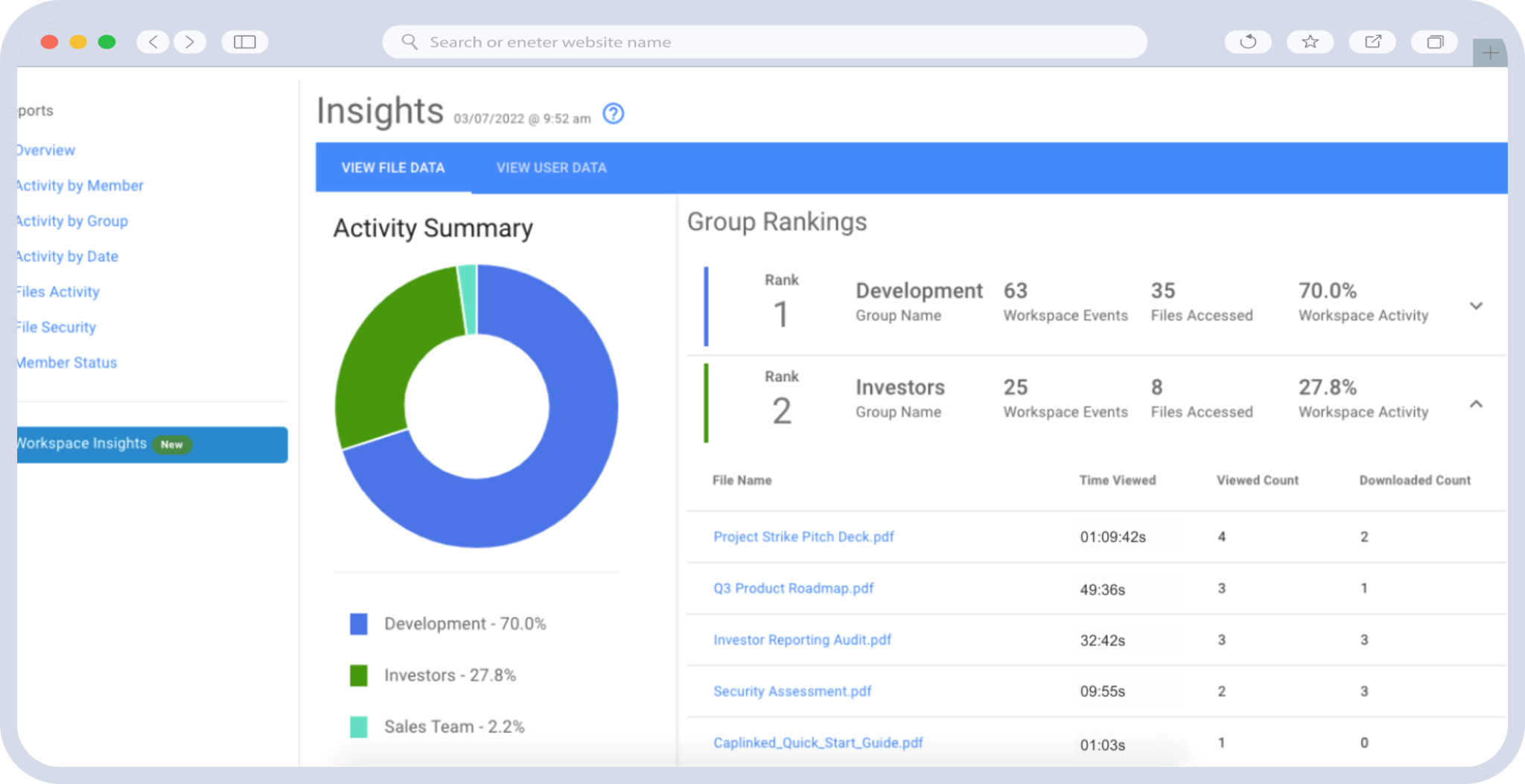
- Engagement reporting. Activity Tracker charts logins, views, downloads, and view duration by group, by document, and by named individual, and exports to CSV at every level.
- Structured Q&A. EZ Q&A routes questions to named administrators, tracks status, and promotes an answer to a shared FAQ so the same question is answered once.
- A scheduled end date. Workspace expiry revokes room access and protected downloads at midnight on the date you set.
Read engagement data carefully. A bidder spending 40 minutes in the legal folder shows attention, not intent, and a quiet bidder may simply have delegated the review to counsel. Activity data is useful for sequencing follow-up calls and for the post-close access record. It is not a prediction of who will bid.
What the buy side needs from a data room
Buy-side priorities are retrieval and comprehension. Reviewers land in a structure someone else designed, often with several thousand files, and their first constraint is finding things. Full-text search with optical character recognition makes scanned material searchable by content, and automatic indexing keeps numbering consistent when the seller moves folders mid-process.
Reading load is the second constraint. CapLinked’s AI Document Summary produces a structured summary of a document in roughly 30 to 60 seconds and can surface inconsistencies inside it, such as a figure that changes between sections. Administrators control which permission groups can use it, and the summary inherits the same document protection as the file.
Serial acquirers also run a workspace of their own. The seller’s room closes after the deal, and the acquirer still needs its request lists, findings, internal analysis, and the version of every document it relied on, kept somewhere it controls.
What both sides need regardless of role
Some requirements do not change with your seat. Both sides need a complete audit trail that exports cleanly, enforceable two-factor authentication, 256-bit encryption at rest and in transit, and SOC 2 or SSAE 18 Type II attestation on the platform. An attestation covers the provider’s controls rather than your transaction, so permissions and disclosure discipline remain your responsibility. Broader security controls matter most in asset sales and carve-outs, where documents move between more parties than a single-entity sale.
| Capability | Why the sell side cares | Why the buy side cares |
|---|---|---|
| Permission groups | Keeps bidders apart and makes per-bidder reporting possible | Confirms the review team sees a consistent set of files |
| Watermarking | Deters redistribution and traces a leaked page | Signals that the process is being run properly |
| FileProtect DRM | Revokes downloads after a bidder exits | Clarifies what can be retained after close |
| Activity Tracker | Shows which bidders are engaged and produces the access record | Shows internal reviewers what has and has not been covered |
| EZ Q&A | Answers one question once across every group | Creates a searchable record of what was asked and answered |
| OCR search and indexing | Reduces repeat requests for files already uploaded | Cuts retrieval time across thousands of documents |
Table 3: The same data room capability serves a different purpose on each side of the deal.
| Worth Knowing
The global average cost of a data breach rose 12 percent to a record $4.99 million in 2026, with detection, escalation, and lost business making up close to two thirds of the total. Deal documents sitting in personal inboxes and consumer file-sharing folders are part of that exposure. Source: IBM Cost of a Data Breach Report 2026 |
| Running several mandates a year?
CapLinked publishes flat pricing, matches comparable written quotes, and includes DRM, Q&A, and activity reporting on the entry plan. Get an Enterprise Quote. |
Buy Side vs Sell Side in Finance and Careers
Outside a specific transaction, the same terms describe two halves of the capital markets. Buy-side firms invest capital: asset managers, pension funds, mutual funds, hedge funds, and private equity firms. Sell-side firms create, promote, and sell securities to those investors, which covers investment banks, brokerages, and research desks. The buy-side and sell-side career distinction follows the same split.
Two common questions follow from that. Private equity is buy side when it invests, and it hires a sell-side advisor when it exits a portfolio company. Investment banking is sell side in the capital-markets sense, and an individual banker can still run a buy-side M&A mandate for an acquirer. The label describes the role in the engagement rather than a permanent identity, which is also why data rooms in investment banking get configured differently from one deal to the next.
Setting Up the Room for the Side You Are On
Knowing which side you are on settles most of the setup questions. If you are selling, your work is done before buyers arrive: prepare the business, build the index, decide what each group sees at each stage, and keep answers consistent. If you are buying, your work starts at access: read fast, keep your own record, and price what the room does not explain.
CapLinked runs both patterns in one platform. Sell-side teams get permission groups per counterparty, custom watermarking, FileProtect for control after download, EZ Q&A for structured diligence questions, and Activity Tracker for group-level engagement. Buy-side teams get OCR search, automatic indexing, AI Document Summary, and their own workspaces that stay open across transactions. The full feature set runs in the browser, with no plugin or download on the guest side, which matters when the other side’s counsel has to be productive on day one.
Pricing is published rather than quoted on request. The Team plan is $399 per month with 5GB of storage, unlimited guest users, and no long-term contract, and it includes watermarking, FileProtect, EZ Q&A, Activity Tracker, and OCR search.
Enterprise starts at $500 per month or $5,000 per year, adds Concierge Services, SAML-based single sign-on, IP whitelisting, PDF redaction, and a 99.9 percent uptime SLA, and comes with a written-quote price match. More than 250,000 professionals across 75 or more countries use the platform, including teams at Bank of America, Deloitte, KPMG, Moelis, and KeyBank.
Compare the published pricing against your last invoice, or start a 14-day free trial and build the room before the process opens.
Buy Side vs Sell Side FAQ
Is private equity buy side or sell side?
Private equity is buy side when it acquires companies and invests capital. The same firm becomes the sell side when it exits a portfolio company, and it usually hires a sell-side banker to run that process.
Is investment banking buy side or sell side?
Investment banking sits on the sell side of capital markets, since banks create and sell securities. In M&A, an individual banker can run a buy-side mandate for an acquirer or a sell-side mandate for a seller.
What is sell-side due diligence?
Sell-side due diligence, also called vendor diligence, is a review the seller commissions before going to market. It surfaces issues early, supports the asking price, and shapes what gets disclosed and when.
Who sets up the data room in an M&A deal?
The sell side normally builds and administers the data room, including folder structure, permission groups, and Q&A. CapLinked workspaces are configured by the seller or its advisor before bidders are invited.
Does the buyer or seller pay for the data room?
The seller usually pays, since the seller runs the process. Buyers often keep a separate workspace for their own diligence record, which they pay for themselves.
Can one firm work on both the buy side and the sell side?
Yes. Most advisory firms take both mandates, though not on the same transaction. The label reflects the client in that engagement, not a permanent designation.
What should sellers hold back until after the LOI?
Hold back account-level customer revenue, employee compensation schedules, pricing models, and detailed process documentation. Share corporate records, historical financials, and a summary cap table earlier to support a credible offer.