Key Takeaways
- A leveraged buyout acquires a company using borrowed money, secured against the target’s own assets and cash flows
- The old 80% debt rule no longer holds. Sponsors now write far larger equity checks
- Returns come from three places: paying down debt, growing earnings, and exiting at a higher multiple
- The best targets are dull and predictable, with steady cash flow and little existing debt
- A management buyout is an LBO led by the people already running the company
- The financing runs across a whole capital stack, and every lender is a separate party with separate access needs
Table of Contents
ToggleA leveraged buyout is the acquisition of a company using a significant amount of borrowed money, where the target’s own assets and cash flows secure and repay the debt. Private equity sponsors use them to buy businesses far larger than their equity alone would allow, then improve performance, pay down the borrowing, and sell.
Think of it as a mortgage on a company. You put down a deposit, borrow the rest, and the asset itself secures the loan. The difference is that a house does not generate the cash to repay its own mortgage, and an LBO target is expected to do exactly that.
That expectation is the whole risk. Everything else, the structure, the diligence, the covenants, exists to test whether the target really can carry the debt being put on it.
How Does a Leveraged Buyout Work?
The sponsor contributes equity, arranges debt against the target, and uses the combined pool to buy the company. The target’s cash flow then services that debt while the sponsor works on the business, usually for four to six years, before an exit.
This lets an acquirer make a large purchase without committing a proportionate amount of its own capital, relying on the target’s assets, and sometimes its own, to secure the borrowing.
How the debt and equity stack up
Debt at 70% to 90% of the purchase price described the buyout era of the 1980s through the 2000s, and the balance has since inverted. Average equity contributions reached 52% in the first quarter of 2025, against a 41% average across the decade through 2021.
Expensive debt is the reason. When borrowing costs rise, the target can support less of it against the same earnings, and the sponsor covers the gap out of the fund. Purchase price multiples have not fallen far enough to offset that, running at 11.7x in the first quarter of 2025 against 11.0x across 2024.
| Layer | Position | What it costs and expects |
|---|---|---|
| Senior secured debt | First claim on assets. Term loans from banks or direct lenders | Cheapest money in the structure, tightest covenants |
| High-yield bonds | Behind senior debt, ahead of everything else | Higher coupon, looser covenants, longer tenor |
| Mezzanine debt | Subordinated, often with equity warrants attached | Expensive, sometimes paid in kind rather than cash |
| Sponsor equity | Last in line, first to absorb losses | The residual. Carries the upside and the downside |
Order matters when something goes wrong. Senior lenders are repaid first and the sponsor is repaid last, which is why the equity earns the return when the deal works and disappears when it does not.
Where Leveraged Buyouts Returns Actually Come From
Three levers, and a sponsor is usually pulling all of them at once.
- Debt paydown. Every dollar of borrowing repaid from cash flow converts into equity value, even if the business is worth exactly what it was at entry
- Earnings growth. Growing EBITDA raises the exit price at any given multiple. This is the lever that has become decisive
- Multiple expansion. Selling at a higher multiple than you paid. Pleasant when it happens, and not something to underwrite
The mix has shifted hard toward the middle one. Bain’s Global Private Equity Report 2026 frames it as “12 is the new 5”: a deal that needed roughly 5% annual EBITDA growth to produce a 2.5x return now needs closer to 10% or 12%. Cheap debt and rising multiples used to do the work. The business has to do it now.
Sponsors measure the result two ways. MOIC is the multiple of invested capital, simply what came back divided by what went in. IRR is that return expressed as an annual rate, so it rewards getting the money back sooner. A 2.5x MOIC over four years is a far better IRR than the same 2.5x over eight.
Why and When Do Leveraged Buyouts Happen?
Private equity firms pursue leveraged buyouts under several circumstances.
- Improving underperforming companies: providing the capital and strategic oversight to revitalize a business not reaching its potential
- Ownership change or succession: facilitating a transition where a founder or family wants liquidity without disrupting operations. A management buyout is the common version
- Funding growth: backing companies with solid fundamentals that lack the resources to expand
- Market consolidation: acquiring competitors or complementary businesses to build scale and competitive position
What Are the Types of Leveraged Buyouts?
The label covers several structures, distinguished mostly by who is doing the buying.
| Type | Who buys | When it is used |
|---|---|---|
| Management buyout (MBO) | The existing management team | Succession, or a division management believes is undervalued by its parent |
| Management buy-in (MBI) | An outside management team | A business with weak leadership but sound fundamentals |
| BIMBO | Existing management plus incoming managers | Where continuity matters but the team needs strengthening |
| Public-to-private | A sponsor taking a listed company private | When public market pressure is holding back a longer-term plan |
| Secondary buyout | One sponsor selling to another | A common exit route when an IPO window is closed |
| Divisional buyout or spinoff | A sponsor buying a carved-out division | When a parent is divesting a non-core unit |
The spinoff variant carries an extra complication, because a carved-out division has no standalone financial history and often depends on parent services that end at completion.
Leveraged Buyout vs Management Buyout
These are not alternatives. A management buyout is a leveraged buyout in which the buyer happens to be the incumbent management team, and it uses the same debt-heavy structure.
| Leveraged buyout | Management buyout | |
|---|---|---|
| Who leads | An external sponsor or acquirer | The team already running the business |
| Information advantage | Built through diligence | Already held, which creates its own conflict |
| Common friction | Price and diligence findings | Management negotiating against the owner it works for |
| Financing | Sponsor equity plus layered debt | The same, usually with a sponsor backing the team |
Our guide to the management buyout process covers the conflict question in more depth, since it is the part that most often derails these deals.
| An LBO runs diligence and lender financing in parallel, each party needing a different view of the same documents. Start Your Free Trial |
|---|
What Makes a Good Leveraged Buyouts Target?
The profile is unglamorous by design. A sponsor is underwriting the ability to service debt, not a growth story.
- Stable, predictable cash flows: the first requirement, because those cash flows repay the debt
- Strong market position: a defensible position suggests profitability will hold through the hold period
- Low existing debt: a clean balance sheet leaves room for the new borrowing
- Asset-rich: tangible assets give lenders collateral and improve the terms available
- A clear improvement path: through market expansion, product development, or operational improvement
- Capable management: a team that can run the business through the post-acquisition changes
Cyclical businesses, heavy capex requirements and customer concentration all work against a target here, because each one threatens the cash flow the structure depends on.
How an Leveraged Buyouts Runs, Step by Step
- Identify the target. Market research against the criteria above: cash flow, position, growth path
- Preliminary assessment. Early diligence on public financials, industry position and competitive advantage
- Structure the financing. Determine the debt and equity mix and approach lenders. On larger deals this runs in parallel with diligence rather than after it
- Make an offer. Usually through a letter of intent that secures exclusivity
- Negotiate. Price, conditions and
- Confirmatory diligence. A detailed review of financial records, legal exposure and operations. Lenders run their own review alongside the sponsor’s, which is where an LBO diverges from a straightforward acquisition
- Close. Execute documents, draw the debt, transfer funds and ownership
Leveraged Buyout Examples
| Deal | Year | What it shows |
|---|---|---|
| Electronic Arts, $55 billion | 2026 | The largest completed LBO to date. Roughly $36 billion of equity against $20 billion of debt, an equity share well above even the current market average |
| RJR Nabisco, $25 billion | 1989 | The deal that defined the era and the genre. Heavily debt-financed, fiercely contested, and the subject of Barbarians at the Gate |
| TXU / Energy Future Holdings, $45 billion | 2007 | Held the record for nearly two decades, then filed for bankruptcy in 2014 when gas prices moved against the thesis. The cautionary case |
| Hilton Hotels, $26 billion | 2007 | Bought at the top, hit by the financial crisis, restructured and eventually one of the most profitable buyouts ever. Timing and patience both mattered |
TXU and Hilton are worth reading together. Both were large, both were bought at the peak, both ran into the same crisis. One went through bankruptcy and one produced an exceptional return, and the difference was whether the underlying business could carry its debt long enough to recover.
The Benefits and Risks of Leveraged Buyouts
| Benefits | Risks |
|---|---|
| Amplified equity returns, because a smaller equity base captures the full gain in enterprise value | Default risk, because the debt is fixed and the cash flow is not |
| Larger acquisitions than the buyer’s own capital would allow | Rate sensitivity, where a rise in borrowing costs squeezes coverage |
| Interest on the debt is tax-deductible, lowering the effective cost | Aggressive cost-cutting that can damage customer and supplier relationships |
| Operational discipline, since debt service forces a rigorous look at the business | Short-term focus, with R\&D and training underinvested to meet obligations |
| Room for strategic restructuring, including divesting non-core assets | A weakened credit rating that limits future borrowing capacity |
The failure mode has a name. An overleveraged deal is one where the debt made sense under the model’s assumptions and does not survive contact with reality, usually a downturn, a rate move, or an earnings miss. The equity is wiped out first, and the lenders take the business.
How a Data Room Handles an LBO Capital Stack
An LBO is not a two-party diligence exercise. Alongside the sponsor and the target, there is a senior lender or a syndicate, possibly a high-yield desk, possibly a mezzanine provider, plus co-investors and every adviser attached to them. Each one is separately underwriting the same business and asking for a different cut of the same documents.
That is the coordination problem worth solving, and it is not the same as keeping files safe. The senior lender needs the credit agreement and the debt schedule but has no business seeing the equity waterfall. A co-investor needs the model and the diligence reports. The high-yield desk needs the offering material. Run this on email and you are manually policing who received which version of what, across a dozen firms, while the financing clock runs.
Group-based permissions in a virtual data room (VDR) solve it structurally. One scoped group per capital provider, each seeing only its own materials, with permissions set at folder level and revocable at any point. The structure holds as parties join and drop out of the syndicate, which they do.
Questions arrive from every one of those parties at once. EZ Q\&A routes each to the right person to answer, keeps the thread attached to the document it concerns, and leaves a clean record of what was asked and answered. Without it, the same question about a customer contract gets answered three times by three people to three lenders.
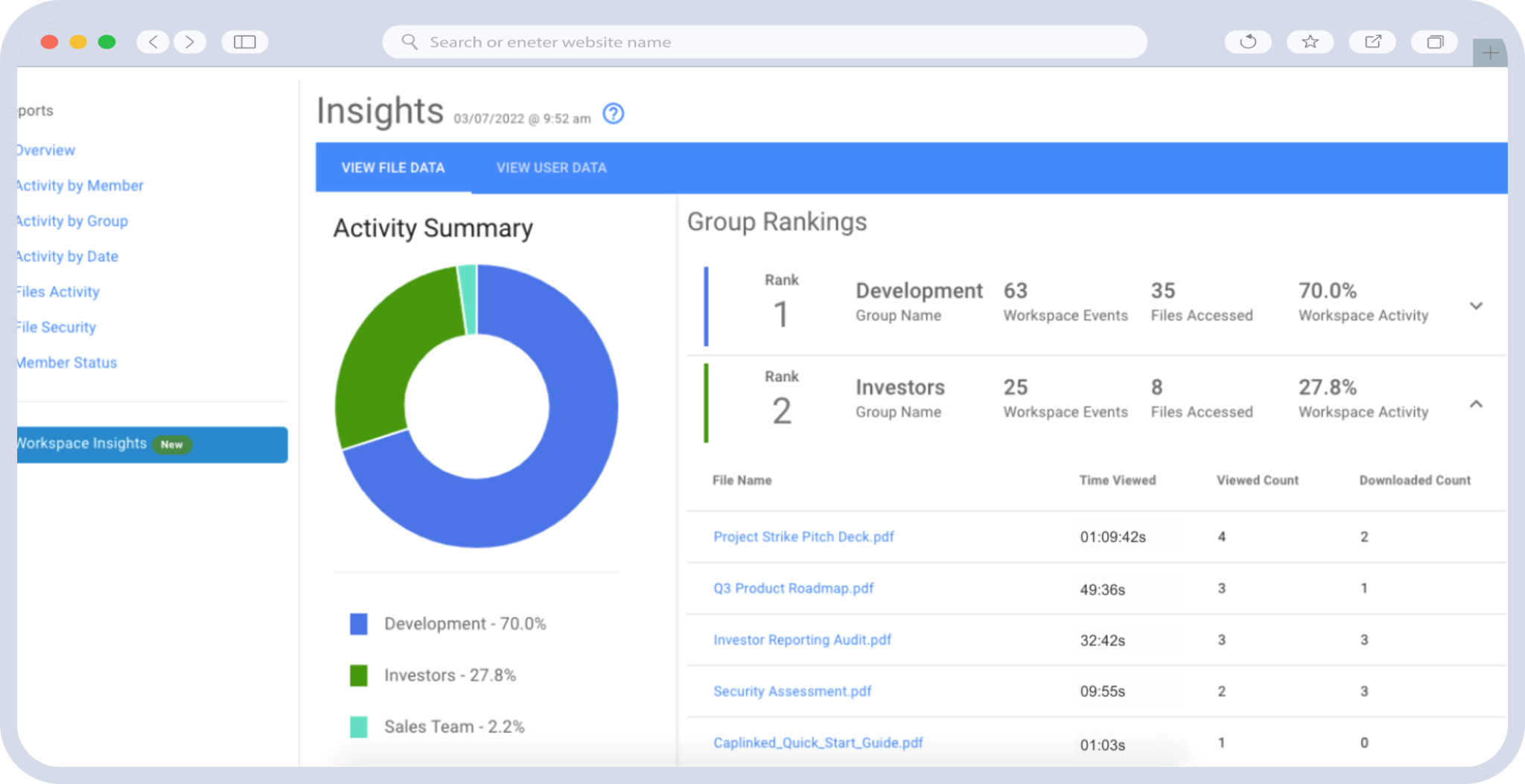
The access logs carry a reading too. Activity Tracker records which lenders and sponsors opened which documents and when, so you can see who is genuinely working through the material. Treat it as engagement data rather than intent: a lender reading the credit agreement three times may be building conviction or building objections, and the log cannot tell you which. It sits alongside financing document workflows and the diligence workstreams running in parallel.
The underlying protections are worth stating precisely, since these terms get used interchangeably when they should not be. Encryption covers the file: 256-bit AES at rest, SSL/TLS in transit. Access control is separate, set per folder, with files private by default and access revocable. The audit trail is separate again, archiving every document interaction in the Workspace. None of the three substitutes for the others.
| Coordinating diligence across a syndicate, co-investors and their advisers? |
|---|
Leveraged Buyout FAQ
What is a leveraged buyout?
The acquisition of a company using a significant amount of borrowed money, where the target’s own assets and cash flows secure and repay the debt. Private equity sponsors use them to buy businesses larger than their equity alone would fund.
How much debt is typical in an LBO?
Less than it used to be. The old rule of 70% to 90% reflects the buyout era of the 1980s and 1990s. Average equity contributions reached 52% in the first quarter of 2025, meaning debt now covers slightly under half the purchase price on a typical deal.
What is the difference between an LBO and an MBO?
A management buyout is a type of leveraged buyout, distinguished by who leads it. In an MBO the existing management team acquires the business, usually backed by a sponsor, using the same debt-heavy structure.
Why do private equity firms use leveraged buyouts?
Leverage lets a firm acquire a company far larger than its equity would allow, and it amplifies the return on that equity. Debt interest is also tax-deductible, which lowers the effective cost of the capital.
What is the biggest risk in an LBO?
Being unable to service the debt. The borrowing is fixed and the cash flow is not, so a downturn, a rate rise or an earnings miss can push a viable business into distress. The equity is wiped out before the lenders take a loss.
What was the largest leveraged buyout ever?
The $55 billion take-private of Electronic Arts, completed in August 2026 by a consortium led by Saudi Arabia’s Public Investment Fund with Silver Lake and Affinity Partners. It surpassed the 2007 TXU deal of roughly $45 billion.