Legal departments supporting federal contractors operate under a unique set of pressures. They’re not just navigating complex contract law or managing third-party negotiations—they’re also accountable for safeguarding Controlled Unclassified Information (CUI), International Traffic in Arms Regulations (ITAR) data, and audit logs that could be subject to federal investigation.
In 2026, with heightened cybersecurity expectations, the rise of CMMC 2.0, and growing use of continuous monitoring by federal agencies, legal teams are increasingly expected to act as guardians of compliance—not just interpreters of contracts. That means how sensitive documents are handled, accessed, and archived during contract drafting, negotiation, and execution now carries serious operational and regulatory implications.
The good news? A new class of secure collaboration platforms—especially those hosted in AWS GovCloud (US) and aligned with FedRAMP High and DoD SRG IL4/IL5—makes it possible to meet those expectations without reverting to clunky, slow, or fragmented legacy systems.
Table of Contents
ToggleLegal Workflows Meet National Cyber Standards
Most legal teams are used to managing confidentiality through NDAs, role-specific access to shared drives, and the occasional redlined PDF. But in the context of federal defense contracts, that’s not enough. Today’s requirements—driven by federal procurement standards and national cybersecurity policy—demand systems that:
- Segregate sensitive files by classification level
- Control access based on identity, geography, and purpose
- Log every interaction with unalterable time stamps
- Encrypt data at rest and in transit with FedRAMP-approved ciphers
Legal operations that touch federal contracts now intersect directly with zero trust architecture, CMMC 2.0 controls, and DFARS clauses like 252.204-7012.
Platforms like CapLinked, hosted on AWS GovCloud, offer a modern solution: legal teams can securely create, review, and share documents in an environment designed for federal-grade assurance. That means every file lives in a FedRAMP High-aligned region, every user can be verified and segmented, and every access can be traced.
Common Use Cases: Legal Teams in the Defense Ecosystem
Contract Negotiation with Primes and Agencies
Government prime contractors often involve internal and external legal counsel in reviewing terms, pricing, clauses, and modifications. When negotiating a DFARS-governed or ITAR-relevant subcontract, legal teams need to:
- Review classified exhibits securely
- Track redlines and markups across parties
- Control downstream access (so a sub doesn’t see a prime’s internal notes)
In a secure VDR like CapLinked, legal teams can:
- Create workspaces by contract ID or program name
- Assign granular permissions for each stakeholder
- Enable Q&A modules for clarifications while maintaining separation
Export Controls and ITAR Agreements
When legal is reviewing contracts that include technical data governed by ITAR or EAR, they must ensure that such data:
- Is only accessible by U.S. persons
- Is stored on infrastructure that meets U.S. export control laws
- Cannot be downloaded or shared without logging and enforcement
GovCloud-based platforms provide the necessary environment. Legal administrators can enforce “view-only” settings, watermark access by user ID, and revoke access—even after download—with file-based DRM.
Subcontractor Collaboration
When primes issue subcontracts or teaming agreements, legal teams must:
- Share relevant documents (NDAs, clauses, flowdowns)
- Control redline versions and audit trails
- Support access for third-party legal counsel without over-sharing
Instead of insecurely emailing PDFs, they can create shared folders in a FedRAMP High-aligned VDR, limit visibility, and maintain audit trails for every version.
Bid Protest Documentation and Litigation Support
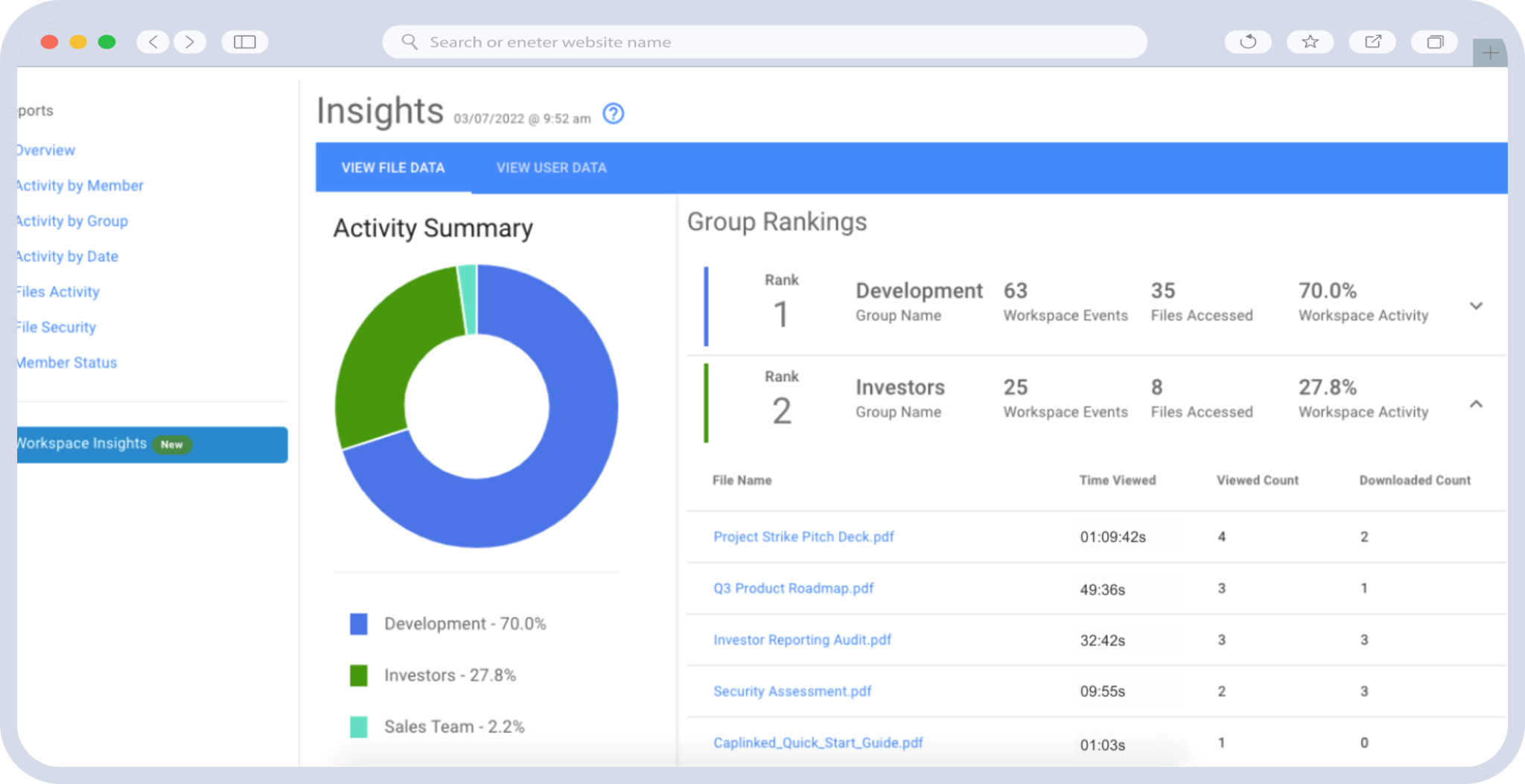
If a protest is filed, or legal needs to support FOIA or GAO inquiries, the ability to trace exactly who saw what, when, becomes critical. VDRs like CapLinked automatically log all file activity and allow exports by user, folder, or time period—making it easier to compile responsive materials.
Compliance Alignment: From CMMC to DFARS to FedRAMP
Legal operations often intersect with compliance in ways that go beyond redlines or citations. In 2026, they’re increasingly expected to be part of the defense posture.
- CMMC 2.0: Legal workflows handling CUI must align with NIST SP 800-171.
- DFARS 252.204-7012: Requires contractors (and subs) to report cyber incidents and secure DoD information.
- FedRAMP High: Platforms like CapLinked, hosted on AWS GovCloud, inherit controls that meet FedRAMP High baselines.
Legal teams using platforms that align with these frameworks are able to:
- Reduce procurement delays (IT security teams approve faster)
- Ensure defensibility in audits or litigation
- Avoid disqualifications in RFP responses
Key Features Legal Teams Should Demand
When evaluating document-sharing platforms, legal departments supporting federal contracts should prioritize:
- GovCloud or IL4/IL5-hosted architecture
- Audit-ready activity logging with export capability
- Granular permissions and DRM, including view-only and print control
- Watermarking, document expiry, and redaction support
- FedRAMP and CMMC documentation support
- U.S.-person-only infrastructure administration
- Easy external access for co-counsel and regulators, with traceability
CapLinked offers all of the above, plus API integrations for automating matter management, and dedicated support for complex legal workspaces.
Conclusion: From Legal Risk to Competitive Advantage
In 2026, legal teams that support federal contractors are no longer simply back-office risk mitigators—they are operational linchpins in securing deals, ensuring compliance, and enabling fast, defensible contract execution. By embracing secure collaboration tools that meet the highest federal standards, legal departments can:
- Reduce exposure to compliance and data handling risks
- Collaborate more efficiently across subs, primes, and agencies
- Shorten deal cycles by improving security confidence
- Position their organization as a trustworthy, audit-ready partner
CapLinked helps legal teams not only keep pace with evolving federal compliance expectations, but also turn document governance into a competitive advantage.
Frequently Asked Questions
No. These platforms are not authorized for FedRAMP High data and do not support ITAR or DoD IL5 requirements. Learn more about FedRAMP-authorized tools at fedramp.gov.
Not necessarily. But any legal activity involving CUI, ITAR, or DFARS-governed data benefits from being conducted in a compliant VDR environment to reduce risk and ensure defensibility.
Virtual data rooms offer fine-grained access control, detailed logging, audit export features, and user-based watermarking that consumer-grade platforms lack. They are purpose-built for regulated and sensitive collaboration.
Yes. Platforms like CapLinked offer intuitive interfaces that let legal admins set up workspaces, invite users, apply permissions, and manage compliance without needing engineering support.
If your legal workflows involve federal contracts, CUI, or export-controlled data, then yes—FedRAMP High or IL4/5-aligned infrastructure is often required or strongly recommended.
CapLinked provides white-glove onboarding, secure workspace templates, and U.S.-person support staff familiar with defense and legal workflows.