Key Takeaways
- Trade secret protection during M&A starts with controlling disclosure, not simply choosing a secure file-sharing platform.
- The safest approach is to identify the most sensitive information before diligence begins, then disclose it in stages as the buyer pool narrows.
- Separate permission groups, clean teams, redaction, download restrictions, watermarking, and DRM each address a different exposure point. None of them replaces the others.
- A virtual data room can enforce access boundaries and preserve evidence of document activity, but it cannot undo information an authorized reviewer has already seen.
- Access should be removed as soon as a bidder, advisor, or reviewer no longer has a legitimate deal purpose, and the activity record should be preserved before the workspace is closed.
Table of Contents
ToggleM&A due diligence creates an unusual trade secret protection problem: you have to disclose valuable confidential information without turning that disclosure into broader access than the deal requires. Customer economics, pricing logic, source code, formulas, product roadmaps, supplier terms, technical processes, and operating methods may all be material to a buyer while still being information you would never circulate outside a transaction.
The practical question is therefore not whether to use a virtual data room. It is how to structure the disclosure so the fewest necessary people see the most sensitive information, for the shortest necessary period, with clear evidence of who received access.
The eight data secret protection controls below focus on that job. The protection strategy starts with the deal team deciding what should be shared, when, and with whom; the VDR should enforce those decisions rather than define them.
What Trade Secret Protection Requires During Due Diligence
Under U.S. trade secret law, protected information generally must derive economic value from not being generally known and must be subject to reasonable measures to preserve secrecy. The USPTO identifies reasonable efforts to maintain secrecy as part of the trade secret test.
For a deal team, that requirement is operational. NDAs matter, but so do who received access, whether disclosure was staged, whether competitor-sensitive material was isolated, whether downloads were limited, and whether access was removed when it was no longer needed. The pattern of protection matters more than any single security switch.
8 Practical Ways to Protect Trade Secrets and Sensitive Data
1. Identify and classify trade secrets before the data room opens
Do not wait until a bidder asks for a sensitive document to decide how sensitive it is. Before diligence begins, identify the information that would create the most commercial damage if it reached a competitor or remained with a failed bidder.
Separate ordinary confidential deal material from the smaller set of information that deserves tighter treatment. That may include source code, formulas, unreleased product plans, customer-level pricing or margins, proprietary models, manufacturing processes, supplier economics, technical specifications, or other information whose value depends on secrecy.
A simple classification gives the data room administrator something concrete to enforce instead of treating every folder as equally sensitive.
- Standard confidential: normal diligence material that can be shared with the approved bidder group.
- Restricted: information that should be limited to a smaller buyer or advisor group.
- Highly restricted: trade-secret or competitively sensitive material that may require a clean team, redaction, aggregation, or later-stage disclosure.
2. Release sensitive information in stages instead of all at once
The strongest trade secret control is often timing. The FTC recommends tailoring disclosure to the stage of the sale process, particularly when bidders may be competitors. Early-stage bidders generally need enough information to decide whether to continue, not the same depth of information required for confirmatory diligence.
That suggests a staged model: share summary information with the broader buyer pool, release more detailed commercial material after serious bids are received, and reserve the most sensitive technical or customer-level information for the preferred bidder or a restricted review group.
Staging reduces the number of people who ever receive the highest-risk material. It also avoids relying on revocation as the primary safeguard after disclosure has already happened.
| Deal stage | Typical audience | Examples of information | Protection approach |
|---|---|---|---|
| Initial review | Broad buyer pool under NDA | Company overview, summary financials, high-level product information | View-only where practical; watermarking; no access to restricted set |
| Indicative bids | Shortlisted bidders | More detailed contracts, operating data, selected customer information | Separate bidder groups; redaction or aggregation; limited downloads |
| Confirmatory diligence | Preferred bidder | Detailed agreements, supplier terms, selected technical documents | Tighter folder/file permissions; DRM where needed; close monitoring |
| Restricted review | Clean team, outside counsel, or specifically approved specialists | Source code, formulas, customer-level pricing/margins, proprietary processes | Separate restricted group; minimal membership; no download or DRM-protected download where appropriate |
3. Separate access by bidder, advisor, and deal role
One broad permission group is convenient for administration and weak for trade secret protection. A bidder should not automatically inherit the same access as its outside counsel, technical advisor, lender, or clean-team reviewer.
Use folder- and file-level permissions to mirror the transaction structure. In CapLinked, you can set view, edit, and download rights for users and groups, keep files private until access is granted, and revoke access when a bidder or advisor no longer needs the material.
Use that granularity to mirror the transaction structure. Keep each bidder in its own permission boundary, give advisors only the material relevant to their work, and create separate restricted groups for information that should not reach the broader buyer team.
4. Use clean teams when the buyer is also a competitor
When a strategic buyer competes with the seller, some information can create both trade secret and antitrust risk. The FTC recommends clean teams or third-party consultants for competitively sensitive information and states that clean-team members should not include personnel responsible for competitive planning, pricing, or strategy.
A clean team is not simply a VDR folder. It is a defined legal and operating protocol that determines who may review the information, what they may report back to the business, and how the information is handled if the deal does not close.
The VDR then enforces that boundary. Approved clean-team members can sit in a restricted permission group while pricing, sales, strategy, and other commercial personnel remain outside it.
5. Redact, aggregate, or mask information before sharing it
Sometimes the buyer needs the commercial answer without needing the underlying identity or detail. Customer-level data, employee information, pricing schedules, supplier terms, and similar records can often be redacted or aggregated before they reach the broader diligence group.
The goal is not to hide information the buyer legitimately needs. It is to answer the diligence question with the least sensitive version of the data that still supports the decision.
Be careful with visual redaction. Covering text with a shape or changing the font color can leave underlying information recoverable. Use a proper redaction workflow and verify the exported document before upload.
6. Limit downloads and use watermarking or DRM for high-risk files
Every local copy expands the disclosure perimeter. If a reviewer only needs to inspect a document, view-only access may be more appropriate than allowing an unrestricted download.
For files that do need to leave the browser, use dynamic watermarking and FileProtect DRM. Watermarking can identify the user accessing a file, while DRM-protected downloads require CapLinked credentials and can be set to expire or revoked later.
These controls solve different problems. Watermarking can deter casual redistribution and make a leaked page more attributable. DRM can preserve some control over a protected downloaded copy. Neither can erase information an authorized reviewer has already read, memorized, photographed, or independently recorded.
7. Keep sensitive questions and follow-up documents inside the controlled workspace
Trade secret exposure does not happen only through the document library. It can also happen when diligence questions move into email, chat, or ad hoc file transfers and the deal team starts answering with attachments outside the permission structure.
Keep diligence questions inside the same controlled workspace. With EZ Q\&A, you can keep questions, responses, and related files inside the deal room instead of scattering sensitive follow-up material across individual inboxes.
The same access discipline should apply to answers as to source documents. A response containing customer-level pricing, technical details, or other trade secrets should not automatically be visible to every bidder simply because the original question was broadly shared.
8. Monitor access, revoke it promptly, and preserve the record
Access should have an end point. Remove a bidder when it drops out, remove an advisor when its work ends, and narrow permissions when the deal moves from a broad review to a preferred-bidder process.
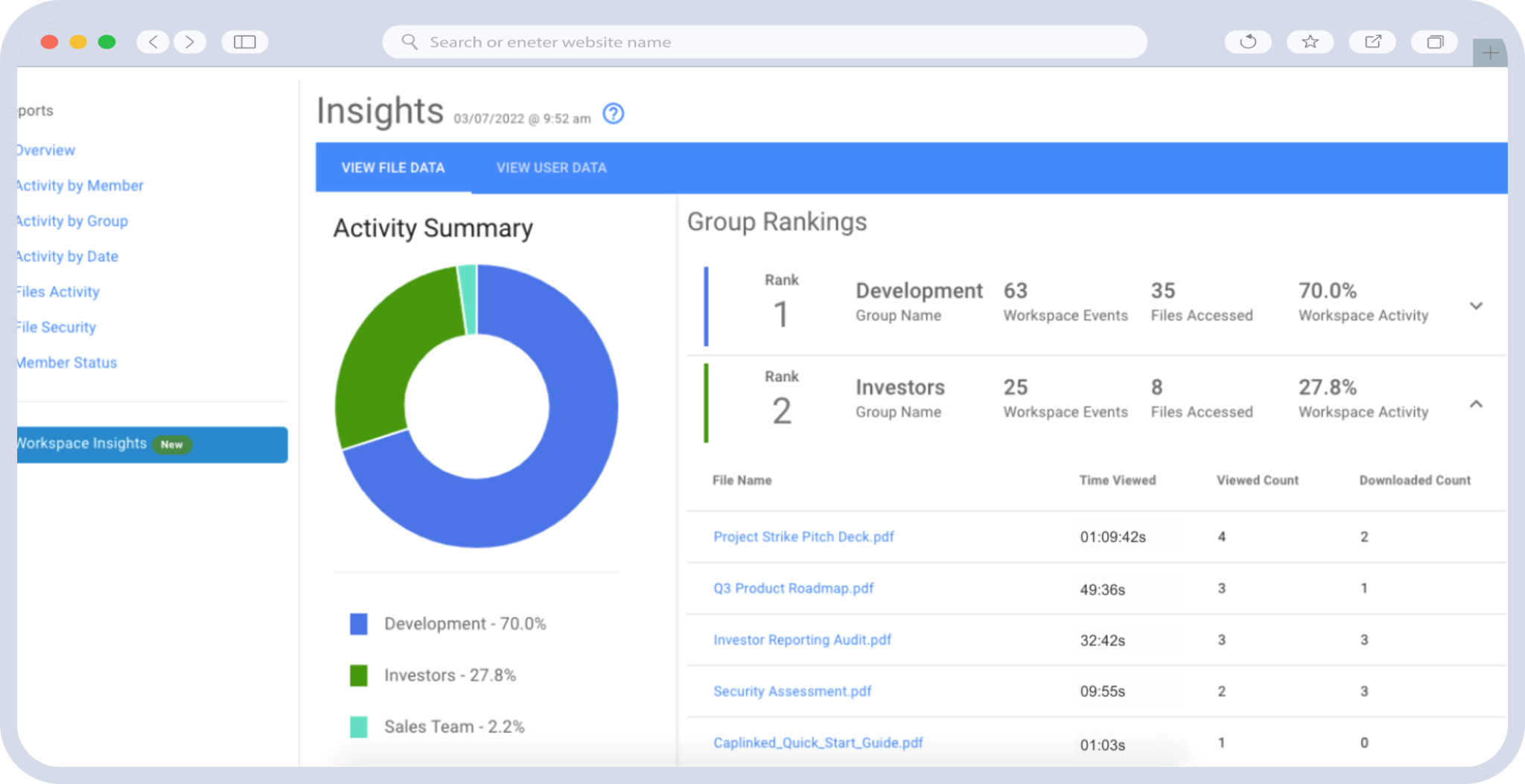
Use the Activity Tracker and audit trail to record workspace and document interactions, including views and downloads. That history can help the deal team reconstruct who had access to sensitive material and when.
Treat the audit trail as evidence of the controls you operated, not as proof of what happened after a reviewer saw the information. Before the workspace is archived or closed, preserve the reports and access records your legal team wants retained with the transaction file.
Match Each Trade Secret Risk to the Right Protection Method
| Risk | Primary protection method | Supporting VDR control |
|---|---|---|
| Too many bidders see highly sensitive information | Stage disclosure and restrict the highly sensitive set | Separate permission groups and folder/file access |
| A competitor gains current pricing, customer, or strategy information | Use a clean team; redact or aggregate where possible | Restricted clean-team group; no-download permissions |
| A document is forwarded outside the intended group | Limit downloads and use contractual restrictions | Dynamic watermarking and FileProtect DRM |
| A withdrawn bidder retains access | Remove access immediately when the deal purpose ends | Group/user revocation; DRM revocation for protected downloads |
| Sensitive details leak through diligence follow-up | Keep questions and supporting files inside the controlled process | Permission-aware Q\&A and document sharing |
| A later dispute arises over what was disclosed | Preserve transaction records | Activity Tracker and audit history |
What a Virtual Data Room Cannot Protect for You
A VDR can reduce unnecessary access and enforce the boundaries you configure. It cannot decide whether a buyer truly needs a trade secret, whether a clean-team member is appropriate, whether a disclosure creates antitrust risk, or whether a particular redaction is legally sufficient.
It also cannot reverse knowledge. If an authorized reviewer legitimately sees a formula, pricing methodology, or technical process, removing the account later does not erase what that person learned. That is why the most important controls happen before disclosure: classify the information, narrow the audience, stage the release, and use contractual or clean-team restrictions where appropriate.
A VDR can enforce the disclosure strategy you choose; it cannot choose that strategy for you.
To see how these controls work in a live deal room, start a free trial or request an enterprise quote.
Frequently Asked Questions
What are the best ways to protect trade secrets during M\&A due diligence?
Identify sensitive information before the room opens, disclose it in stages, separate access by bidder and role, use clean teams for competitor-sensitive material, redact or aggregate where possible, restrict downloads, use watermarking or DRM for high-risk files, keep Q\&A inside the controlled workspace, and remove access promptly when it is no longer needed.
Can a virtual data room stop a buyer from stealing a trade secret?
No. A VDR can limit who gets access, restrict downloads, add watermarking or DRM, and preserve activity records. It cannot guarantee that an authorized reviewer will not remember, photograph, or misuse information already seen. Disclosure controls and legal agreements still matter.
When should highly sensitive trade secrets be shared with a buyer?
As late as the deal allows while still giving the buyer enough information to complete legitimate diligence. Highly sensitive information may be reserved for a preferred bidder, outside counsel, technical specialists, or a clean team instead of being released to the full buyer group.
What information should go to a clean team?
Information that is necessary for diligence but could create competitive harm if it reached the buyer’s operating personnel. Depending on the deal, that may include current or forward-looking pricing, customer-level data, margins, strategic plans, or other competitively sensitive information. Counsel should determine the clean-team scope for the specific transaction.
Does watermarking prevent trade secret leaks?
Not by itself. Watermarking can discourage redistribution and help associate a viewed or downloaded document with a specific account. It does not physically prevent someone who can view a document from photographing or manually recording the information.
Does revoking a DRM-protected file undo disclosure?
No. Revocation can prevent a protected downloaded copy from being reopened, but it cannot erase information the reviewer already saw. That is why staged disclosure and limited access are more important than relying on revocation after the fact.
Why does the audit trail matter for trade secret protection?
It can help show which users accessed sensitive documents, when they accessed them, and whether they downloaded them. That record supports accountability and can help reconstruct the disclosure history if questions arise later.