Key Takeaways
- Commercial due diligence tests whether a target’s revenue will hold up, by examining its market, customers, and competitive position.
- It runs alongside financial and legal due diligence, not on top of them. Finance checks whether the numbers are real, legal checks what the company is bound to, and CDD checks whether the numbers will keep coming.
- CDD usually starts once a letter of intent is signed and takes three to six weeks inside a diligence window that commonly runs 30 to 90 days.
- Most buyers commission an independent strategy or transaction-advisory firm, because lenders and investment committees discount findings the buyer produced itself.
- The four common types are buyer-initiated, vendor-initiated (VCDD), red flag, and top-up, and each carries a different scope and depth.
- A CDD report typically covers market sizing, customer evidence, competitive position, a revenue forecast view, risks, and an answer on whether the deal thesis holds.
- CDD reads what is in the data room, so a well-organized, permissioned, tracked room shortens the whole exercise.
Commercial due diligence is the independent assessment of whether a target company’s revenue will continue, by testing its market, its customers, and its competitive position against the assumptions in the deal model. It answers one question: Is this business as commercially sound as the seller says it is?
It is one workstream among several due diligence. Financial due diligence verifies that the reported numbers are accurate. Legal due diligence establishes what the company owns and owes. Commercial due diligence looks outward, at the market and the customers, and asks whether those numbers will hold. The three run in parallel and feed each other, but they are not the same exercise and are usually run by different teams.
Let’s find out how commercial due diligence differs from others.
What Is Commercial Due Diligence?
With the definition established, the more useful question is what CDD buys a dealmaker that the other workstreams do not.
Commercial Due Diligence (CDD), like all of the various types of due diligence, is vital because it critically informs decision-making, reduces transactional risks, and can significantly influence negotiation outcomes. It extends beyond financial evaluation, diving into the business’s commercial context to ensure an informed and reliable acquisition or investment decision.
By identifying strengths, weaknesses, opportunities, and threats, CDD helps stakeholders make strategic decisions that can lead to long-term success.
What Does Commercial Due Diligence Actually Cover?
Here are the key components of commercial due diligence, and where each one hands off to another workstream.
| Workstream | Core question | Who typically owns it |
|---|---|---|
| Commercial | Will the revenue continue? | Strategy or transaction-advisory firm |
| Financial | Are the reported numbers accurate? | Transaction services or accounting firm |
| Legal | What does the company own and owe? | Deal counsel |
| Operational | Can the business deliver at this scale? | Buyer’s ops team or specialist advisers |
Market assessment
Market assessment is a critical tool for understanding a company’s industry landscape. It involves evaluating the market size, growth potential, competitors, and market trends relevant to the company. This includes understanding the company’s market share, its customer base, and its position relative to competitors.
For instance, a company with a large market share in a rapidly growing industry may have a significant competitive advantage. However, if the industry is characterized by intense competition, the company may face challenges in maintaining its market position.
This is the heart of commercial due diligence. Everything else supports it.
Operational evaluation
Operational evaluation involves analyzing a company’s operational efficiency, including aspects like the supply chain, production processes, and technology infrastructure. It also involves reviewing management practices, employee skills, and operational risks that could affect the company’s performance.
For instance, a well-managed supply chain and efficient production processes can contribute to lower costs and higher profitability. On the other hand, operational inefficiencies or outdated technology could hinder a company’s performance and competitiveness.
Financial analysis
Financial analysis provides a comprehensive overview of a company’s financial health by evaluating its revenue trends, profitability, cash flow, and financial risks. This allows your company to examine financial statements, budgets, and forecasts in detail.
This data helps in understanding the company’s financial position, its ability to meet financial obligations, and its potential for future growth. For instance, a company consistently exhibiting increasing revenue and profit margins could indicate a strong financial position. Conversely, declining revenue trends or high levels of debt could signal potential financial instability.
Where the boundary sits: Financial due diligence verifies these figures. Commercial due diligence reads them and asks whether the market and customer base will sustain them. A CDD team will use the quality of earnings work rather than repeat it.
Legal and regulatory review
The legal and regulatory review process involves examining a company’s compliance with laws and regulations. This includes reviewing contracts, intellectual property rights, and any ongoing litigation.
The objective is to assess the impact of regulatory environments and potential changes on the company’s operations and market position. For example, changes in regulations could require a company to modify its operations, which could impact its profitability. Additionally, any ongoing litigation could pose financial and reputational risks to the company.
Where the boundary sits: Deal counsel runs the legal review. The commercial angle is narrower, covering whether regulation constrains the market opportunity or raises the cost of serving it.
| Trust CapLinked to protect your confidential information and streamline your workflow. |
Where Commercial Due Diligence Fits in the Deal, and How Long It Takes
CDD does not run at the start of a deal. It runs once a buyer has decided the target is worth the spend and has secured the access to prove it.
- Before the LOI. A buyer may run a light desk-based screen using public information, analyst reports, and its own market knowledge. There is no management access and no confidential data, so conclusions stay directional.
- At LOI and exclusivity. This is the trigger. The letter of intent grants an exclusivity window, commonly 30 to 60 days, and the full CDD scope is commissioned against that clock.
- During confirmatory diligence. CDD runs in parallel with financial, legal, tax, and technical workstreams. Findings cross-feed. A customer concentration flag from CDD sends the financial team back to revenue-by-customer, and a contract term found by counsel changes how the commercial team reads renewal risk.
- Into negotiation. A weak commercial finding is price leverage. It shows up as a valuation adjustment, an earn-out, a specific indemnity, or a walk-away.
- After signing. The CDD output becomes the input to integration planning and the first hundred days, because it already contains the customer, pricing, and competitor picture the new owner needs.
On timing: the overall diligence period for mid-market deals commonly runs 30 to 90 days from LOI, with six to twelve weeks being the standard band for deals in the $50 million to $500 million range. Commercial due diligence itself usually takes three to six weeks inside that window. A tight, well-scoped red flag review can be done in two. Cross-border deals, regulated industries, and targets with poor data readiness push everything longer.
The single biggest variable is not deal size. It is how quickly the seller answers. A target that takes three weeks to respond to document requests has spent the buyer’s diligence period for them, which is why sellers who prepare a secure document sharing environment before the process starts consistently close faster.
How the Commercial Due Diligence Process Works, Step by Step
Commercial due diligence is a comprehensive review of a business from a financial, legal, operational, and market perspective. This process aims to identify potential risks and opportunities, offering a clear overview of the business’s health.
The section above sets out what gets examined. This one sets out when, and in what order. The five stages run in sequence, though in practice they overlap heavily once the data room is open. Steps 2 and 3 are the points at which the adjacent financial and legal workstreams feed into the commercial picture rather than the commercial team repeating that work.
Step 1. Preliminary assessment
Before diving into the specifics, a preliminary assessment offers an initial overview of the target company. This stage includes understanding the business model, its primary revenue streams, and key cost drivers. It also involves an elementary review of the industry the business operates in, its competitive landscape, and general market trends.
Step 2. Financial analysis
A significant part of the due diligence process is the financial analysis, which involves a detailed examination of the company’s financial records and performance. This includes analysis of financial statements such as balance sheets, income statements, and cash flow statements. The objective here is to evaluate the company’s profitability, liquidity, and financial stability. Key financial ratios are calculated to assess the financial performance and position of the company.
Step 3. Legal due diligence
The legal due diligence phase involves examining the legal structure of the company, ensuring compliance with laws and regulations in its operating regions. A thorough review of all legal documents, including contracts, leases, licenses, and agreements, is conducted to identify potential liabilities or legal risks. This also involves evaluating employment contracts, labor relations, and compliance with employment laws to identify any potential issues or liabilities.
Step 4. Market assessment
A market assessment follows to evaluate market conditions, potential risks, and opportunities. This includes an analysis of the industry size, growth rates, key trends, and competitive landscape. The company’s market position, its market share, and competitive positioning are also evaluated.
This is also where primary research happens: customer interviews, churn and win-loss analysis, channel partner conversations, and reference calls. Desk research tells you what the market looks like. Primary research tells you whether this company deserves its place in it.
Step 5. Operational evaluation
The final step is an operational evaluation where the day-to-day business operations are analyzed. This involves assessing the strength of intellectual property rights, patents, trademarks, and copyrights, ensuring they are valid, enforceable, and not infringing on others’ rights. Compliance with industry-specific regulations and standards is also checked. Additionally, the impact of any upcoming regulatory changes on the company’s business is assessed.
Who Actually Runs Commercial Due Diligence?
Most buyers do not run CDD in-house. They commission an independent strategy consultancy or the transaction-advisory arm of an accounting firm, and the reason is credibility rather than capability. A lender underwriting acquisition debt, or an investment committee approving the deal, will discount findings the buyer produced about a business it has already decided it wants. Third-party independence is what makes the conclusions bankable.
A typical engagement team has four layers:
- Partner or director. Owns the client relationship, sets the scope against the deal thesis, and presents findings to the investment committee. Involved at the start and the end, lightly in between.
- Engagement manager. Runs the project day to day, owns the workplan and the interim readouts, and makes the judgment calls on what constitutes a finding versus noise.
- Consultants. Do the analytical work: market sizing, competitor benchmarking, customer segmentation, forecast modeling, and the bulk of the primary interviews.
- Analysts. Handle desk research, data room extraction, survey administration, and the underlying data build.
Specialist industry advisers and expert networks are often layered on for sector-specific questions. On smaller deals the whole team may be three people, and on large-cap deals it can run to fifteen across several regions.
Buyers who acquire regularly, particularly private equity firms and serial corporate acquirers, often keep a standing panel of advisers and a repeatable diligence template. For those teams, enterprise-level information control across concurrent processes stops one deal’s materials leaking into another’s.
What Are the Types of Commercial Due Diligence?
The label covers four distinct exercises. Who commissions the work sets the scope, the depth, and who is allowed to read the result.
Buyer-initiated CDD
This is the default. The acquirer commissions the work to test its own investment thesis before committing capital. Scope is the widest of the four, findings are written for the buyer’s investment committee and lenders, and the report is confidential to the buyer. This is what most people mean when they say commercial due diligence.
Vendor commercial due diligence (VCDD)
The seller commissions an independent CDD report before going to market and shares it with all bidders. It speeds up a competitive process, reduces the number of times management answers the same question, and lets the seller find and address weaknesses before a buyer does. The trade-off is credibility: buyers know who paid for it, so serious bidders will still run a top-up review of their own.
Red flag CDD
A compressed review designed to surface deal-breakers fast, usually in one to two weeks. It is common early in a competitive auction, where a buyer needs to decide whether to bid at all before committing to a full-scope engagement. The output is a short list of material risks rather than a complete market picture.
Top-up CDD
A targeted follow-on to existing work, most often used by a buyer who has read a vendor report and wants independent verification of the two or three assumptions on which its valuation actually turns. The scope is narrow, the timeline is short, and it costs considerably less than commissioning from scratch.
What Goes Into a Commercial Due Diligence Report?
A CDD report is a decision document, not a research summary. Its job is to give an investment committee enough to approve, reprice, or walk away. Most follow a broadly similar structure.
- Executive summary and verdict. The thesis, the answer, and the two or three findings that would change the decision. It is written last, read first, and is often the only part the committee reads in full.
- Market sizing and growth outlook. This covers the addressable market, historic and forecast growth, the drivers behind it, and how the target’s own growth compares.
- Competitive positioning. This sets out who the target competes with, where it wins and loses, its pricing position, and whether its advantage is defensible or a timing artifact.
- Customer analysis. This examines concentration, retention and churn, satisfaction, switching costs, and what customers said in interviews rather than what management said they would say.
- Revenue forecast assessment. The management plan tested against market evidence, with a view on which assumptions hold and which do not.
- Risks and mitigations. These are ranked by materiality, and each carries a note on whether it is a price issue, a structure issue, or a walk-away.
- Value creation opportunities. These include pricing headroom, cross-sell, geographic or segment expansion, and anything else that supports the buyer’s post-close plan.
- Methodology and sources. This records interview counts, data sources, and the limitations on the work, so readers can judge how much weight each conclusion carries.
Why Commercial Due Diligence Is Worth the Spend
Commercial due diligence offers numerous advantages to a potential buyer, such as:
Informed negotiation tactics
A clear understanding of the target’s business model and the buyer’s intended integration approach gives the purchaser a negotiation advantage. Commercial due diligence supports a defensible valuation and sharpens the view of where value actually sits in the transaction.
Easier financing
Alongside necessary financial due diligence, commercial due diligence can ease the acquirer’s capital acquisition process, potentially at a more favorable cost, to finalize the transaction. The due diligence report gives banks and other investors a clearer read on the investment’s potential, which makes their participation easier to secure.
Better forecasting and business planning
Commercial due diligence offers a detailed analysis of the target company’s products and services, enabling the assessment of continued revenue and profit potential, which is crucial for shaping a comprehensive business plan. This allows prospective buyers to more effectively predict successes and anticipate business challenges, thereby improving strategic planning and decision-making.
A clearer read on competitive and market dynamics
The due diligence process provides a comprehensive understanding of market forces and trends, including competitor activities, impacting the target company’s growth potential. This increased market awareness allows for more accurate strategic planning and risk mitigation.
A head start on the first hundred days
The findings do not stop being useful at close. A CDD report already contains the customer map, the pricing picture, the competitor set, and the growth levers the new owner needs on day one. Buyers who treat it as an integration input rather than a gate-check document get several weeks of planning for free, and the value creation section usually becomes the backbone of the hundred-day plan.
Where Commercial Due Diligence Falls Short
CDD reduces risk. It does not remove it, and treating a clean report as a guarantee is how buyers get surprised.
- It is a snapshot. Findings reflect the market as it stood during a three-to-six-week window. A competitor launch, a regulatory shift, or a demand shock after close is outside its reach.
- It depends on what the seller provides. An incomplete data room or a management team managing the narrative limits what any adviser can conclude. Gaps in the evidence become caveats in the report.
- Customer interviews carry bias. References supplied by management are self-selected. Independent outreach is better but harder, and in concentrated markets it risks signaling the deal.
- Forecasts remain judgment calls. Testing a management plan against market evidence improves the odds. It does not make the forecast right.
- It cannot price cultural and integration risk. Commercial logic can be sound while the deal still fails on people, systems, or management retention.
- Time and budget cap the scope. In competitive auctions, buyers routinely accept a narrower review to stay in the process, and narrower scope means more unexamined ground.
Your Commercial Due Diligence Checklist
Use these as the question set for the engagement. The image version below is available as a download.
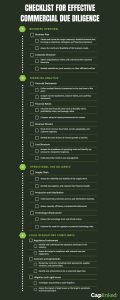
Market
- How large is the addressable market, and what is the evidence for the number?
- What is the historic and forecast growth rate, and what drives it?
- Which regulatory or structural changes could reshape demand in the next three years?
Customers
- What share of revenue sits with the top five and top ten customers?
- What are the retention, churn, and net revenue retention rates by segment?
- Why do customers choose this company, and what would make them leave?
- How long are contracts, and what are the renewal and termination terms?
Competition
- Who are the direct competitors, and how has share moved over three years?
- Where does the company win and lose, and on what basis?
- How defensible is the advantage, whether through switching costs, IP, scale, brand, or none of these?
Commercial model
- How is pricing set, and is there headroom or pressure?
- What is the revenue mix across recurring, repeat, and one-off?
- What does customer acquisition cost, and how long is the payback?
- How dependent is the business on specific channels or partners?
Forecast
- What assumptions underpin the management plan, and which are unsupported by market evidence?
- How has the company performed against its own forecasts historically?
- What is the downside case, and what triggers it?
Deal implications
- Which findings change the price, and by how much?
- Which findings need a structural fix such as an earn-out or an indemnity?
- Which findings are walk-aways?
How a Virtual Data Room Supports Commercial Due Diligence
Commercial due diligence is only as fast as the evidence it can reach. The commercial team needs customer contracts, churn data, pricing schedules, and sales pipeline reports, while the financial and legal teams pull on the same files at the same time, and none of them should see everything. Run that over email and you get version confusion, no record of who saw what, and a seller answering the same question four times.
CapLinked’s due diligence virtual data room is built for exactly that. Granular permissions let the seller open the customer contract folder to the commercial adviser without exposing the cap table.
EZ Q&A threads every question against the document it refers to, so the same clarification is answered once and visible to whoever is entitled to see it rather than scattered across four inboxes.
FileProtect digital rights management restricts printing, forwarding, and downloading, and allows remote shred after a bidder drops out. Full audit trails record every view, which matters when a finding is later challenged.
Certification-backed security underpins it, an open API and integrations connect the room to the systems the deal team already uses, and Concierge handles room setup and administration when a lean team is running several processes at once. Rooms launch without plugins, bulk upload indexes documents automatically, and permission templates mean the structure does not need rebuilding for the next deal.
The full feature set and pricing are published upfront, and the virtual data room overview covers how the platform fits alongside the rest of a deal stack.
Whether you are running mergers and acquisitions, assessing a new venture, or managing contract negotiations, CapLinked adapts to the size of the process, from a single-workstream review to a multi-bidder auction.
| Your next strategic move awaits, powered by precision, guided by CapLinked.
Discover CapLinked with a 14-day free trial. |
Frequently Asked Questions
What is commercial due diligence in simple terms?
It is an independent check on whether a target company’s revenue will keep coming, based on its market, its customers, and its competitive position. It tests the story behind the numbers rather than the numbers themselves.
What is the difference between commercial and financial due diligence?
Financial due diligence verifies that the reported figures are accurate and sustainable as accounting. Commercial due diligence looks outward at the market and customers and asks whether those figures will hold. They run in parallel and are usually done by different firms.
How long does commercial due diligence take?
Typically three to six weeks, inside an overall diligence window that commonly runs 30 to 90 days from the letter of intent. A red flag review can be done in one to two weeks. Cross-border and regulated deals run longer.
Who conducts commercial due diligence?
Usually an independent strategy consultancy or the transaction-advisory arm of an accounting firm, with a team running from partner through engagement manager to consultants and analysts. Independence is what makes the findings credible to lenders and investment committees.
What is vendor commercial due diligence?
A CDD report commissioned by the seller before going to market and shared with bidders. It speeds up a competitive process, though most serious buyers will still run a narrower top-up review of their own.
How much does commercial due diligence cost?
It scales with scope, deal size, and timeline rather than following a fixed rate. A red flag review sits at the low end, a full-scope multi-geography engagement at the high end. Most buyers scope it as a percentage of the risk it is meant to retire.