Key Takeaways
- The best data room for startups depends on the stage of your raise
- At the pitch stage you can share a deck on a free or low-cost tool, but real due diligence needs permissions, an audit trail, and control after download
- Flat, published pricing with no long-term contract fits a raise better than per-page billing or a year lock-in for a two-month process
- CapLinked gives startups a data room at a flat $399 per month with DRM, watermarking, an audit trail, and Q&A included, plus unlimited investor guests
- SecureDocs and Digify cost less for a simple single-investor room, and free tools are fine at the earliest stage, so match the tool to the round
- An audit trail shows which investors actually opened the financials, which changes who you follow up with and when
- Ownership matters on your shortlist, since Ansarada and Firmex are both owned by Datasite
Table of Contents
ToggleThe best data room for startups depends on the stage of your raise. A founder sharing a deck with a few angels needs something very different from a company opening its financials, legal files, and cap table to several investors and their lawyers during Series A due diligence. This guide compares the data rooms worth considering at each stage, with real pricing, the controls that matter, and honest notes on where a free tool is enough.
It is written for founders and the people who end up building the room: an ops lead, a chief of staff, a fractional CFO. By the end you will know what belongs in a startup data room, when a shared Drive folder stops being enough, and which tool fits the round you are running.
When Does a Startup Actually Need a Data Room?
A data room earns its place when the way you share documents starts to affect how a raise goes. That happens in two distinct stages, and most roundups blur them together, which is how founders end up paying for a diligence platform to send a pitch deck, or trying to run real diligence out of a folder.
The pitch stage
Early on, the job is simple: share a deck and a short teaser with investors, and see who opened it. A free or low-cost tool covers this well. You are not exposing much yet, and the value is knowing which investors read past the first slide so you can prioritize follow-up.
The due diligence stage
Once an investor is serious, the job changes. Several investors and their counsel need access to financials, legal documents, and the cap table at the same time, often with different levels of access, and you need a record of who saw what. This is where permissions, an audit trail, and control after download stop being nice-to-haves. A shared folder cannot segregate access per investor, cannot revoke a downloaded file after an investor passes, and cannot produce the access record their lawyers may ask for.
Table 1. What a startup needs from a data room at each stage of a raise
| Stage | What you share | What you need | What fits |
|---|---|---|---|
| Pitch | Deck, short teaser | Sharing plus who-opened-it tracking | Free or low-cost deck tool |
| Diligence | Financials, legal, cap table | Per-investor permissions, audit trail, control after download | A flat-rate virtual data room |
| Series A and up | Full package, multiple parties | Segregated access, Q&A, watermarking, revocation | A data room with structured Q&A |
| Worth Knowing
A tight process matters more in a hard market. US venture fundraising in 2025 was one of the most difficult in a decade, with $66.1 billion in new commitments, the lowest total since 2018, according to the PitchBook-NVCA Venture Monitor. When investors are selective, a professional, well-run room is one of the few parts of the process you fully control. |
Best Data Rooms for Startups: The Short Answer
If you want the shortlist before the detail, here is where founders tend to land.
- Best all-round for a raise: CapLinked, for its flat published pricing, controls included at the base tier, and no long-term contract.
- Cheapest simple room: SecureDocs or Digify, for a single-investor round where you do not need heavy Q&A or post-download revocation.
- Best free to prepare: Ansarada, which lets you build a room at no cost until you invite an outside guest or 90 days pass.
Which publish pricing? CapLinked, SecureDocs, and Digify publish plan pricing on their own sites. iDeals and Firmex are quote-led, and Ansarada uses a quote builder.
The 7 Best Data Rooms for Startups Raising Capital
The list runs from the balanced pick for a funded raise to the free baseline most founders start on. It reflects fit for a startup raise rather than a single quality score.
1. CapLinked
CapLinked is a virtual data room built around fast setup and control that survives download, sold at a published flat rate rather than by quote. For a startup, it hits the balance point: the controls a diligence stage needs, at a price you can approve without a sales cycle or a year contract.
Common challenges CapLinked resolves
- A room goes live in minutes with no plugins for an investor’s IT to block, and drag-and-drop upload with automatic indexing gets your documents organized fast
- Control continues after a file is downloaded, because FileProtect digital rights management can revoke access to a saved copy and remote shred can remove it if an investor passes
- Per-investor permission groups keep each party’s access separate, and watermarks carry viewer identity on every page
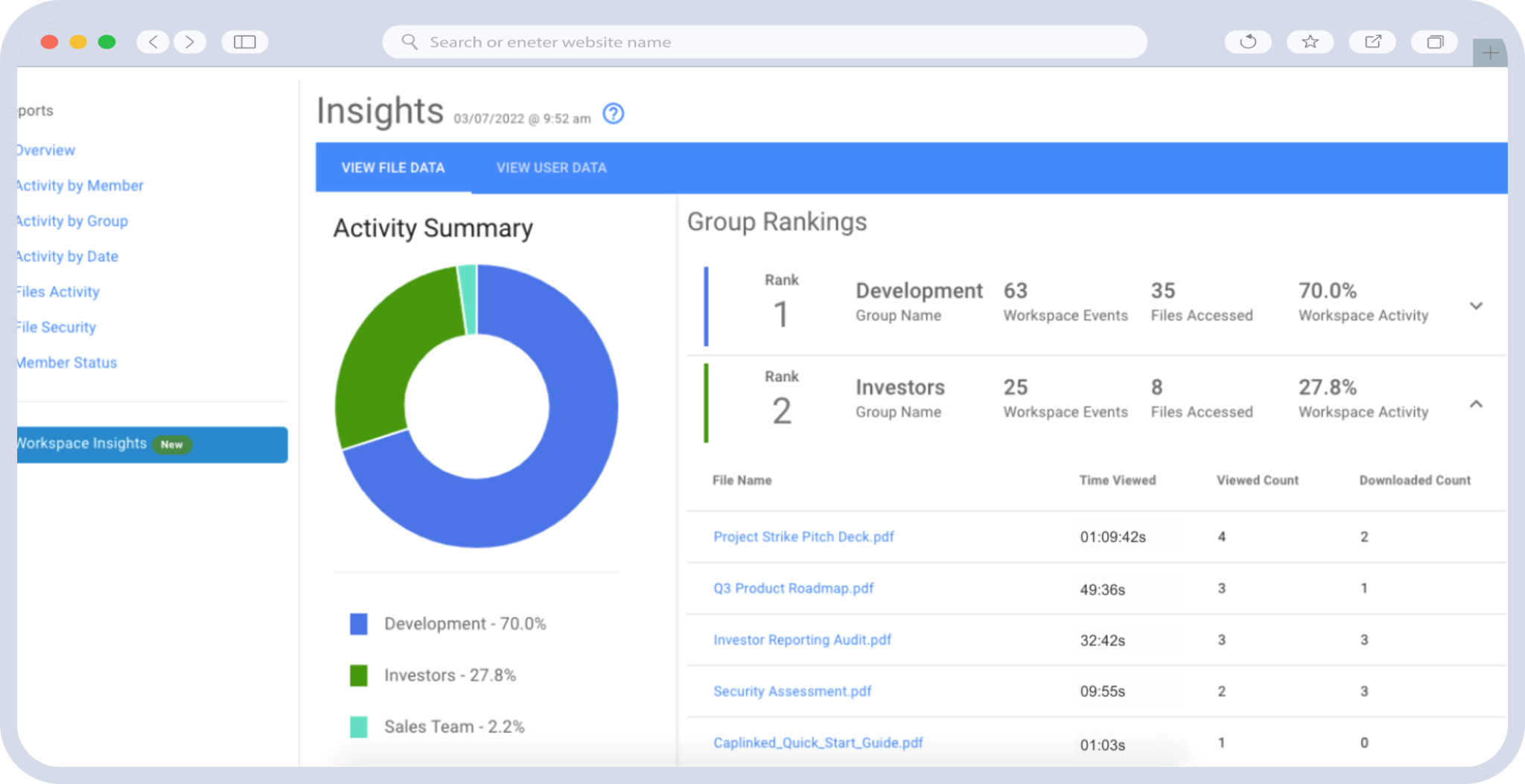
- An audit trail shows exactly which investors opened the financials and for how long
CapLinked pros
- Published flat pricing with no long-term contract. A real number on a public page, and no year lock-in for a two-month raise.
- Unlimited guest users. Every investor, advisor, and lawyer you invite is included, so cost does not climb with your reviewer list.
- Controls included at the base tier, including DRM, watermarking, audit trail, and EZ Q&A, rather than sold as upgrades
- SOC 2 and SSAE 18 Type II, ISO 27001, HIPAA, and 256-bit encryption, documented on the security page
CapLinked cons
- The Enterprise tier is a published starting point with the final number quoted
- No pitch-deck analytics or fundraising CRM, which live in separate pitch-stage tools
CapLinked is ideal for
Seed and Series A founders running real due diligence with several investors, who want predictable pricing and the controls a diligence stage needs without an enterprise contract.
CapLinked pricing
Team is $399 per month with 5GB storage, unlimited guest users, and no long-term contract. Enterprise starts at $500 per month or $5,000 per year with a written-quote price match. See the pricing page.
2. SecureDocs
SecureDocs is a flat-rate data room built around speed and simplicity, and one of the few providers that publishes its price. It targets founders who want a working room fast without a procurement process.
Common challenges SecureDocs resolves
- Removes the sales call, since pricing is published on its own site
- Stands up a simple room quickly for a single-investor process
- Keeps cost predictable with flat billing and unlimited users
SecureDocs pros
- Published flat pricing and an online trial
- Unlimited users and documents included
- Fast, simple setup
SecureDocs cons
- No post-download revocation, so control ends once a file is downloaded
- Limited structured Q&A, which constrains a competitive multi-investor round
- Thin permission templating across staged investor groups
SecureDocs is ideal for
A single seed round or one-off diligence process with one investor group rather than several.
SecureDocs pricing
Publishes flat-rate pricing, from about $250 per month on an annual plan.
3. Digify
Digify is a flat-rate document security and data room tool priced per account rather than per user, and it includes post-download protection at a price point where that is unusual.
Common challenges Digify resolves
- Publishes pricing and offers an online trial, so there is no sales cycle
- Provides post-download protection well below enterprise price points
- Prices per account, so reviewer count does not drive cost
Digify pros
- Affordable published pricing with a short online trial
- Post-download control unusual at its price
- ISO 27001 certified, and popular with early-stage founders
Digify cons
- Lighter structured Q&A and audit depth than a diligence-focused room
- Thin permission templating across staged groups
- Built more for secure sharing than for running a competitive round
Digify is ideal for
Founders sharing confidential documents with a small number of investors where post-download control still matters.
Digify pricing
Publishes flat pricing, from about $140 per month billed per account, with a short online trial.
4. Ansarada
Ansarada is a data room with the most founder-friendly preparation economics on this list, since a room costs nothing until the deal actually goes live. That inverts the usual pressure to delay building the room.
Common challenges Ansarada resolves
- Removes the cost of preparing early, since it is free until you invite your first outside guest or 90 days pass
- Gives less experienced founders structure through deal-readiness tooling
- Includes unlimited users on every plan, so reviewer count never drives cost
Ansarada pros
- Free to build until go-live, which is a real advantage during preparation
- Unlimited users on all plans
- Fast setup with no plugin requirements
Ansarada cons
- Storage tiers bite on document-heavy rooms, with overage charged separately
- The 90-day clock starts at room creation, not first upload
- Pricing sits behind a quote builder, and it is owned by Datasite
Ansarada is ideal for
Founders with a long preparation runway before going to market, who want to build and structure the room at no cost first.
Ansarada pricing
Quote-led, with a free-until-live model. Owned by Datasite.
5. iDeals
iDeals is a storage-based data room known for support quality, sold through a sales-led process. It is more room than a seed round needs, but founders running a larger or more complex raise value the hand-holding during a live process.
Common challenges iDeals resolves
- Bills on storage rather than per page, which removes the preparation penalty of per-page models
- Supports multi-party diligence with full permissioning and post-download control
- Provides responsive support across time zones during a live raise
iDeals pros
- Strong support and ease-of-use scores across a large review base
- Storage-based pricing avoids per-page surprises
- Polished interface for external reviewers
iDeals cons
- No published pricing, so you cannot budget without a quote conversation
- Project minimums are commonly reported, which can reduce flexibility on a short raise
- Heavier than an early-stage round usually needs
iDeals is ideal for
Series A and later founders, or advisory teams, who value hands-on support and are comfortable with a sales-led purchase.
iDeals pricing
Not published. Quote-led, described as usage-based on storage.
6. Firmex
Firmex is a mature lower-middle-market data room with unusually strong structured Q&A, sold per project or by subscription. Its strength shows up in competitive rounds where investor questions need routing and a single answer of record.
Common challenges Firmex resolves
- Keeps multi-party Q&A coherent through purpose-built routing and assignment
- Provides full permissioning and post-download control
- Offers project-scoped billing for teams that prefer not to hold a subscription
Firmex pros
- Q&A depth built for competitive, multi-party processes
- Long lower-middle-market track record
- Fair cost-value reputation among advisors
Firmex cons
- Project billing carries timing risk if the raise closes early or runs long
- Owned by Datasite, worth noting on a shortlist
Firmex is ideal for
Founders running a competitive round with many investors asking questions, where structured Q&A is the priority.
Firmex pricing
Not published. Per-project or subscription billing. Owned by Datasite.
7. Google Drive and Dropbox (the free baseline)
Most founders start here, and for the pitch stage that is fine. A shared folder plus a deck-sharing analytics tool (the best known is DocSend, owned by Dropbox) covers early conversations. The trouble starts when diligence gets serious.
Where it works
- Sharing a deck and early materials at no extra cost
- Deck tools add who-opened-it analytics for the pitch stage
- Familiar to everyone, with nothing to set up
Where it falls short for a raise
- Links are easy to forward past the investor you intended
- No per-investor permissions, no post-download revocation, and no exportable audit trail an investor’s counsel may expect, a gap the guidance on secure document sharing walks through
- No structured Q&A, so investor questions scatter across email
Best for
The earliest pitch conversations, before any investor asks for a real data room.
Pricing
Free to low cost, bundled with the storage plan you already have. Deck-sharing analytics tools add a low monthly fee.
Startup Data Room Pricing Comparison
For a founder, the pricing model matters more than the headline number.
- Flat and per-account pricing stay predictable.
- Per-page billing makes the invoice depend on how much you upload.
- Quote-led pricing means you cannot budget until you finish a sales call, and a year contract is a poor fit for a raise that may take two months.
Table 2. Startup data room pricing at a glance, as of September 2026
| Provider | Starting price / model | Published? | Cost driver to check |
|---|---|---|---|
| CapLinked | $399/mo, flat | Yes | Storage above 5GB |
| SecureDocs | ~$250/mo (annual), flat | Yes | Plan term |
| Digify | ~$140/mo, per account | Yes | Feature tier |
| Ansarada | Free until go-live, then quote | No | Storage tier, 90-day clock |
| iDeals | Not published, quote | No | Storage, project minimum |
| Firmex | Not published, project or subscription | No | Early close or extension |
| Google Drive / Dropbox | Free to low, bundled | Yes | Upgrade for real controls |
Read the model, not just the price. A cheap room that locks you into a year, or a free folder that leaves you without an audit trail when an investor’s lawyer asks for one, can cost more than the predictable monthly line you were trying to avoid.
| Practical Tip
Controlled access is cheap insurance for the documents in a raise. The 2025 IBM Cost of a Data Breach Report put the global average breach at $4.44 million, and found intellectual property carried the highest per-record cost of any data type at $178. A cap table, a model, and product IP are exactly the material you want scoped, tracked, and revocable, not sitting in a forwardable link. |
What Belongs in a Startup Data Room
Investors expect a predictable structure, and a room that is easy to move through signals a company that is run well. Organize by folder, and hold the most sensitive material back until interest is real.
- Corporate and legal. Incorporation documents, bylaws, board consents, key customer and supplier contracts, and your cap table.
- Financials. Historical statements, your model and projections, and the metrics investors expect, such as revenue, growth, burn, and runway.
- Product and technology. A product overview, roadmap, and a summary of intellectual property and any patents.
- Market and traction. Pipeline, retention or cohort data, and how you position against the alternatives.
- Team. An org chart, key hires, and founder backgrounds.
- Hold the sensitive items back. A detailed cap table and signed customer contracts can wait until an investor is serious, which is where staged access and per-investor permissions help.
A room built this way, with document management that keeps versions straight, answers most of what an investor asks before they ask it.
Matching a Data Room to Your Round
There is no universal winner, since the right choice shifts with the stage and shape of your raise.
Table 3. Which data room fits which round
| Round / stage | What matters most | What fits |
|---|---|---|
| Pre-seed pitch | Cheap sharing plus deck analytics | Google Drive with a deck tool |
| Seed diligence | Predictable price, real controls | CapLinked, SecureDocs, Digify |
| Series A, multiple investors | Per-party access, Q&A, audit trail | CapLinked or iDeals |
| Preparing early, no budget yet | Free preparation | Ansarada |
| Competitive round, heavy Q&A | Structured question routing | Firmex or CapLinked |
For a raise that reaches real diligence, a financing data room with per-investor permissions and an audit trail is the point where a founder outgrows a shared folder, and the guidance on running due diligence covers how to keep that process tight.
Why CapLinked Works for a Raise
For the diligence stage of a raise, CapLinked lines up with what a founder actually needs: predictable cost and real control, without an enterprise contract.
The price is published and flat at $399 per month, with no hidden fees and no long-term contract, so a two-month raise does not commit you to a year. Unlimited guest users mean every investor and their advisors are included. The controls a diligence stage needs, per-investor permissions, watermarking, an audit trail, revocation through FileProtect, and structured Q&A, are in the base plan rather than upsold. A room is live in minutes with no plugins for an investor’s IT to block, and you can verify all of it before spending anything through a trial that starts without a call.
Where CapLinked is not the answer, this guide has said so. A pre-seed founder sharing a deck should use a free tool. A bare single-investor room can run cheaper on SecureDocs or Digify. For a raise that has reached real due diligence, the case for CapLinked is a room that is controlled, trackable, and priced so you can approve it yourself.
Compare it on the features that matter for your round.
| Get your data room live before your next investor call
Start a 14-day free trial with no sales call, or get an enterprise quote for a larger or regulated raise with a written price match. |
Frequently Asked Questions
Do startups need a data room to raise?
Not at the pitch stage, where a shared folder and a deck tool are enough. Once an investor moves to due diligence and their counsel needs access to financials, legal documents, and the cap table, a real data room becomes worth it.
What should be in a startup data room?
Corporate and legal documents, financials and your model, a product and technology overview, market and traction data, and team information. Hold the most sensitive items, such as a detailed cap table and signed contracts, until an investor is serious.
Is Google Drive enough for a startup data room?
For early pitch sharing, yes. For real diligence, no, because it cannot set per-investor permissions, revoke a downloaded file after an investor passes, or produce the exportable audit trail their lawyers may request.
How much does a data room cost for a startup?
Flat-rate rooms run from roughly $140 to $400 per month. Some tools are free to prepare or free at the pitch stage. Quote-led providers price against your storage and deal scope, so the only reliable figure is your own quote.
When should a startup set up a data room?
Set up a lightweight sharing tool as soon as you pitch, and stand up a real data room when an investor signals serious interest or asks for one. Building it a little early keeps you from scrambling once diligence starts.
What is the difference between a deck-sharing tool and a data room?
A deck-sharing tool tracks who viewed your pitch. A data room controls a full document set during and after diligence, with per-investor permissions, watermarking, revocation, structured Q&A, and an audit trail. The two serve different stages of a raise.
How fast can a startup set up a data room?
A modern data room can be live in minutes. Plugin-free platforms let investors open documents in a browser with no downloads, which removes the delay that plugin requirements and IT approvals otherwise add.