Key Takeaways
- IP licensing lets another party use your intellectual property while you keep ownership
- Licensing is not selling. An assignment transfers ownership, a license only grants permission
- The 3 license types are exclusive, non-exclusive and sole, and they differ on who else may use the IP
- An IP license agreement turns on scope, territory, term, royalties, quality control and termination
- Licensors are usually paid through an upfront fee, running royalties, minimum guarantees or milestones
- Sharing patents and trade secrets with a prospective licensee is the point of highest exposure in the deal
Table of Contents
ToggleIntellectual property (IP) is one of your organization’s most valuable assets, and knowing how to license it as well as protect it is key. IP licensing can be profitable for both the owner and the licensee, but only if you understand the process and keep control of the assets while the deal is being negotiated.
Global filings keep climbing. WIPO reported record patent and design filings for 2024, which means more registered rights sitting on more balance sheets waiting to be monetized.
This guide covers what IP licensing is, which assets can be licensed, the license types, what belongs in the agreement, how royalties are set, the process end to end, and how to protect the IP while a prospective licensee is reviewing it.
What Is IP Licensing?
IP licensing is an agreement that allows a company, the licensee, to use and market the intellectual property of another company, the licensor. In exchange, the licensee typically pays the licensor a fee or a royalty on products sold.
Nestlé’s licensing of the Starbucks name for bottled and canned coffee drinks is a clean example. Nestlé uses its global manufacturing and distribution network to make and sell the products, and Starbucks receives royalties on the sales.
The distinction that matters most is ownership. A license grants permission and can expire, be limited by territory, or be terminated. An assignment sells the asset outright and the original owner keeps nothing. Licensing is how owners earn from IP without parting with it.
What Types of IP Can Be Licensed?
Almost any protected asset can be licensed, though registered rights are easier to license and command better terms because their boundaries are documented.
Patents
The United States Patent and Trademark Office grants patents and registers trademarks. Registering a product or process protects the inventor from others making or profiting from the same item. Patents are the backbone of technology and pharmaceutical licensing, where the licensee pays to manufacture a protected invention.
Trademarks
A trademark distinguishes a product name, graphic element or catchphrase from similar products. Most major brands hold a trademarked name and logo. Trademark licensing is what franchising runs on, and it is why quality control clauses matter so much: a licensee damaging the mark damages the licensor’s core asset.
Copyright
The rights creators hold over written, musical, artistic or visual work. Publishing, music, software and film all run on copyright licenses, usually split by format, territory and term. Our guide to copyright licensing covers those splits in more detail.
Trade secrets
Proprietary confidential information such as formulas, practices and processes. Entire brands rest on them, Coca-Cola and KFC among them. Trade secrets are licensable but carry a particular risk: unlike a patent, protection depends on the information staying secret, so disclosure during negotiation can destroy the asset.
Industrial designs and geographical indications
Industrial design covers the look of a mass-produced product, and Apple’s iPhone is the standard example. Geographical indications tie a product to its origin, which is why only sparkling wine from one French region may be sold as Champagne, and only spirits from certain Mexican states as Tequila. Both are licensable, though far less commonly than the first four.
What Are the Types of IP Licenses?
Licenses are classified by how many parties may use the IP and whether the licensor may keep using it. There are 3 main types.
| License type | Who may use the IP | Typical use |
|---|---|---|
| Exclusive | Only the licensee. The licensor gives up its own right to use | High-value single-partner deals, often with the highest royalties |
| Sole | The licensee and the licensor, but no one else | A middle path where the owner keeps operating in its own market |
| Non-exclusive | Any number of licensees at once | Software, standards-based technology and broad distribution |
Exclusivity drives price. A licensee paying for exclusivity is buying the absence of competition, so it will pay more and will usually expect performance obligations in return.
In-licensing and out-licensing
Out-licensing is granting rights in IP you own, and it is a revenue strategy. In-licensing is acquiring the right to use someone else’s IP, and it is a build-versus-buy decision. The same agreement is described either way depending on which side of the table you sit.
What Goes Into an IP License Agreement?
An IP license agreement defines exactly what the licensee may do, where, for how long, and what happens when the arrangement ends. These clauses carry the weight.
| Clause | What it settles |
|---|---|
| Grant and scope | Which specific IP is licensed and which uses are permitted |
| Territory | The countries or regions where the license applies |
| Term | How long the license runs and how it renews |
| Exclusivity | Whether the license is exclusive, sole or non-exclusive |
| Royalties and fees | What is paid, when, and on what basis |
| Quality control | Standards the licensee must meet, critical for trademarks |
| Sublicensing | Whether the licensee may grant rights onward, and on what terms |
| Reporting and audit | How sales are reported and the licensor’s right to verify |
| Warranties and indemnity | Who carries the risk if a third party claims infringement |
| Termination | What ends the agreement and what happens to inventory and data |
Reporting and audit rights are the clause first-time licensors most often underweight. A running royalty is only as reliable as your ability to check the sales figure it is calculated from.
How Do IP Licensing Royalties Work?
Royalties are the payment mechanism, and most agreements combine several. The right structure depends on how much certainty each side needs and when.
- Upfront fee: a lump sum on signing, which compensates the licensor for the option value and signals licensee commitment
- Running royalty: a percentage of net sales, the most common structure, aligning both sides to commercial success
- Minimum guarantee: a floor the licensee owes regardless of sales, which protects the licensor against a partner who takes exclusivity and then underinvests
- Milestone payments: sums triggered by defined events such as regulatory approval or a first commercial sale, standard in pharmaceutical licensing
Rates vary widely by industry and are shaped by the strength of the underlying right, how much the licensee still has to invest, whether the license is exclusive, and how much competing technology exists. Published rate benchmarks exist, but they are a starting position rather than an answer.
What Are the Benefits and Risks of IP Licensing?
Licensing earns money from an asset you already own without building the operation needed to exploit it. That is the case for it, and it is a strong one. The risks are mostly about control.
| Benefits | Risks |
|---|---|
| Speed to market through the licensee’s existing distribution network | Loss of control over how the IP is used and presented |
| Cost savings, since the licensor makes no capital investment in distribution | Brand dilution if a licensee’s quality slips |
| Royalty revenue that continues through the term of the deal | Under-monetizing through an overly permissive or long agreement |
| Ownership retained, so the asset can be licensed again elsewhere | Creating a future competitor who has learned your technology |
| Geographic reach without establishing a local entity | Disclosure risk to trade secrets during negotiation |
How to License Your IP, Step by Step
The process runs from knowing what you own through to policing the agreement after signature. Five stages cover it.
- Inventory and value the portfolio. Identify what your IP consists of, then decide which parts you plan to license and which stay in-house. You cannot price what you have not catalogued.
- Find and vet a licensee. Select partners with a proven track record, real experience in the field, and values compatible with your own. The licensee must have the distribution or manufacturing mechanism to make the partnership work.
- Run due diligence both ways. Assess their financial stability and their capacity to perform, and expect the same scrutiny of your rights. Our guide to IP due diligence covers what gets examined.
- Negotiate and draft. Settle the revenue model, territories, exclusivity, sublicensing rights and reporting requirements, then agree benchmarks for success including the royalty rate and contract length.
- Manage and monitor. Track reported sales against expectations, enforce quality standards, and audit when the numbers warrant it. An unmonitored license tends to underperform quietly.
| Sharing patents, formulas or technical specifications with a prospective licensee? A workspace keeps control of the documents while they are being reviewed. |
|---|
IP Licensing Examples
Three arrangements, one per IP type, showing how the structures work in practice.
| Example | IP type | How it works |
|---|---|---|
| Starbucks and Nestlé | Trademark | Nestlé manufactures and distributes packaged coffee under the Starbucks name and pays royalties on sales |
| ARM and chipmakers | Patent and technology | ARM designs processor architectures and licenses them non-exclusively, earning a fee per chip shipped rather than manufacturing anything |
| Book publishing rights | Copyright | An author grants a publisher rights split by format, language and territory, so the same work can be licensed many times over |
Notice the pattern. In each case the owner keeps the asset and earns from someone else’s operation, which is the whole argument for licensing over selling.
How a Virtual Data Room Protects IP During Licensing
A virtual data room (VDR) is a controlled online workspace for sharing confidential documents with outside parties. In licensing, it solves a specific problem: the prospective licensee has to see the patents, specifications and technical know-how before agreeing terms, and may then walk away holding everything they were shown.
That exposure is sharpest with trade secrets, where protection depends on the information staying confidential. A signed non-disclosure agreement is a remedy after the fact. Access control is a remedy before it.
CapLinked applies control at file level rather than at the door. FileProtect restricts printing, copying and forwarding, and revokes access to a document after it has been downloaded, which matters when negotiations end without a deal.
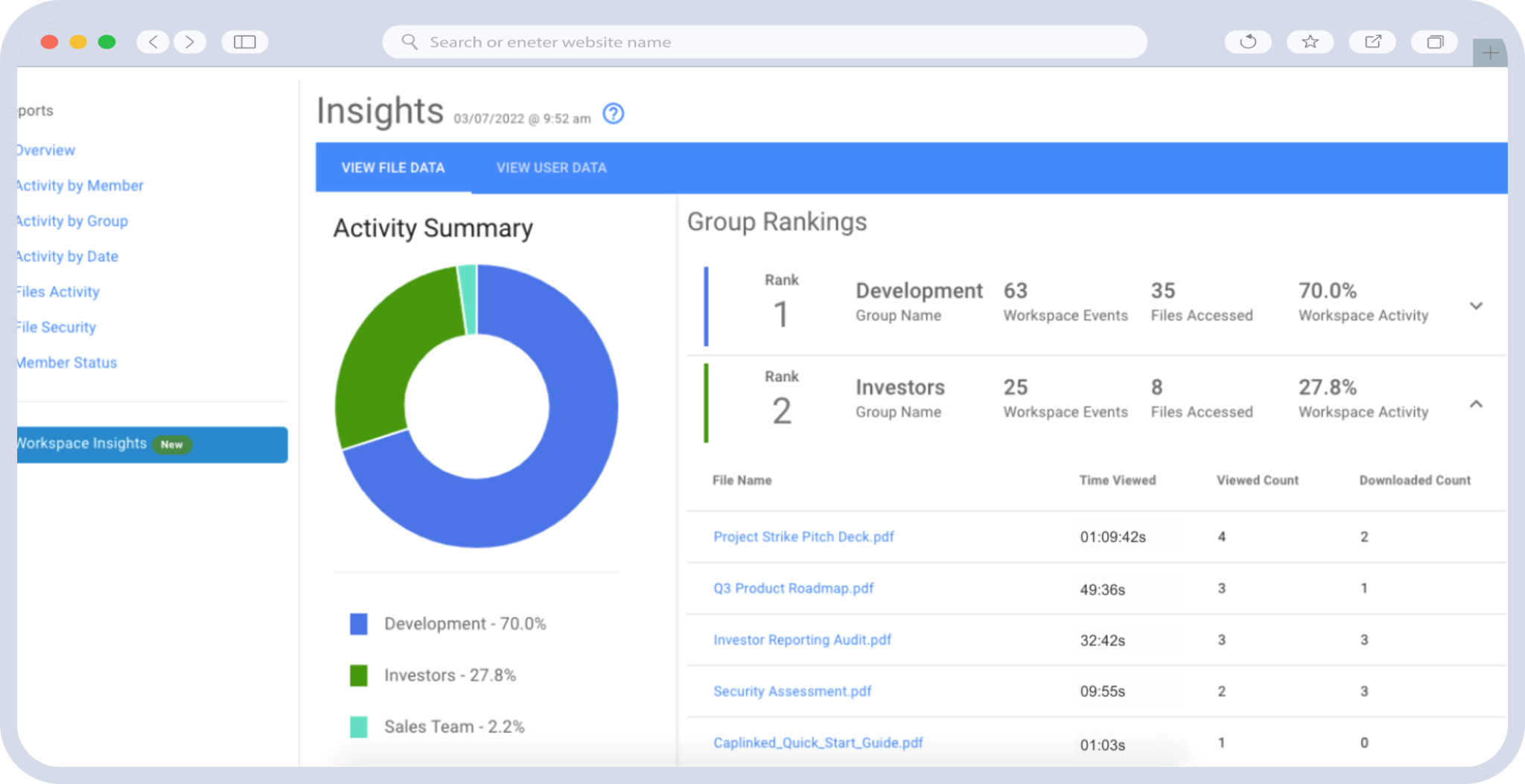
Custom watermarks carry the viewer’s identity across every page, so a photographed screen is traceable to a person. Activity Tracker records who opened which document and when, which tells you which prospective licensee is genuinely working through the technical file. Granular permissions let you open the patent folder without exposing the formula.
The security controls sit on the entry plan rather than the top tier: 256-bit encryption at rest and in transit, SOC 2 compliance, and AWS infrastructure. The security page lists the full certification set.
Workspaces deploy in minutes with no plugin on either side, which matters when a licensee’s counsel refuses to install software. Pricing is published rather than quote-gated, and the Team plan runs at $399 per month including watermarking, FileProtect and EZ Q\&A.
| Running a licensing negotiation or IP due diligence review this quarter? |
|---|
IP Licensing FAQ
What is IP licensing?
A contract in which the owner of intellectual property grants another party permission to use it under agreed terms, usually for a fee or royalty. The owner keeps ownership throughout.
What is the difference between licensing and selling IP?
Licensing grants permission and can be limited by time, territory and use, and it can end. Selling, known as assignment, transfers ownership permanently and the original owner retains nothing.
What is the difference between an exclusive and non-exclusive license?
An exclusive license permits only one licensee to use the IP, and the licensor gives up its own right to use it. A non-exclusive license lets the owner grant the same rights to any number of parties at once.
How are IP licensing royalty rates set?
Rates depend on the industry, the strength of the underlying right, how much the licensee still has to invest, and whether the license is exclusive. Published benchmarks exist by sector, but they are a negotiating starting point rather than a standard.
How do you protect IP while sharing it with a potential licensee?
Combine a non-disclosure agreement with controlled access. Share documents through a permissioned workspace, apply watermarks that identify the viewer, and use rights management that lets you revoke access after download if talks end.
Can trade secrets be licensed?
Yes, and they frequently are. The complication is that a trade secret is protected only while it stays secret, so disclosure controls during negotiation carry more weight than they do for registered rights.