Key Takeaways
- An indemnification clause makes one party responsible for another party’s specified losses
- The indemnitor pays. The indemnitee is protected
- It appears in nearly every commercial contract, not only in M&A agreements
- Caps, baskets and survival periods decide how much protection the clause actually gives
- In private M&A, insurance has largely displaced the traditional seller indemnity
- What each side was shown during diligence is often what a later dispute turns on
Table of Contents
ToggleMost contract disputes are arguments about who pays. The indemnification clause is where the parties answer that question before it arises, which is why it is one of the most heavily negotiated provisions in any agreement.
It is also widely misunderstood, partly because it is usually paired with the phrase “hold harmless” and partly because the numbers that determine how much protection it gives, the caps and thresholds, sit further down the contract.
This guide covers what an indemnification clause does, how it works mechanically, the types, an annotated example, the terms parties fight over, how to negotiate it, and how it operates in M\&A, where insurance has changed the picture substantially in the last few years.
What Is an Indemnification Clause?
An indemnification clause obligates one party to compensate another for losses or damages, either already incurred or arising in the future. The party giving the protection is the indemnitor. The party receiving it is the indemnitee.
A scenario makes it concrete. A service business uses a tech startup’s app to charge customers a monthly subscription. An error causes the app to withdraw more than the agreed fee from customers’ accounts. Money has to be refunded and damages may be owed. Which party carries that burden, the service business or the startup?
That is the question the indemnification clause answers, and it answers it before anyone knows the error will happen. The clause does not prevent the loss. It decides in advance who absorbs it.
These provisions are used far beyond M\&A. They appear in supplier agreements, software licenses, construction contracts, leases and professional services engagements, which is why understanding the general mechanics matters before looking at any specific context.
Indemnification vs Hold Harmless: Are They the Same?
In most contracts they function as one obligation, and the phrase “indemnify and hold harmless” is standard drafting. Whether the two words mean different things is genuinely contested.
One view treats hold harmless as redundant, a belt-and-braces phrase that adds nothing beyond indemnification. Another view, followed in some states, treats them as distinct: indemnify covers reimbursement for losses actually suffered, while hold harmless additionally protects against being brought into the claim at all.
The practical answer is that the label matters less than the drafting. A clause that defines its covered losses precisely and states whether a duty to defend applies does not depend on which of the two words carries the weight.
How an Indemnification Clause Works
Four components determine what the clause actually does.
The trigger event
What has to happen before the obligation activates. Common triggers include a breach of contract, a breach of a representation or warranty, negligence, or a third-party claim arising from the indemnitor’s conduct. A narrow trigger protects the indemnitor. A broad one protects the indemnitee.
Scope of covered losses
Which costs the indemnitor pays. Direct damages are almost always included. The negotiation is over the edges: consequential and indirect losses, lost profits, regulatory fines, and attorney fees. Silence here is expensive, because it invites the dispute the clause exists to prevent.
The duty to defend
Separate from the duty to pay, and often more valuable. A duty to defend means the indemnitor takes on the legal defense as the claim proceeds, rather than reimbursing the indemnitee afterwards. It shifts both the cost and the control of litigation strategy.
First-party and third-party claims
Third-party indemnity covers claims brought against the indemnitee by an outsider, which is the classic use. First-party indemnity covers losses the indemnitee suffers directly at the indemnitor’s hands, which effectively converts the clause into a general damages remedy. Indemnitors usually resist it.
A claims and notice process sits alongside these: how quickly the indemnitee must give notice, in what form, and what happens if it is late. Missed notice deadlines defeat otherwise valid claims.
One-Way, Mutual and Broad-Form Indemnities
| Type | Who indemnifies whom | Typical context |
|---|---|---|
| One-way | A single party gives the protection | Where bargaining power is uneven, such as a vendor indemnifying a large enterprise customer |
| Mutual | Both parties indemnify each other for their own conduct | Partnerships, joint ventures and agreements between comparable parties |
| Broad-form | The indemnitor covers losses including those caused by the indemnitee’s own negligence | Construction and high-risk services. Unenforceable in several states |
| Limited-form | The indemnitor covers only losses attributable to its own conduct | The most common and most defensible position |
Broad-form indemnity is the one to read carefully. Agreeing to cover the other side’s own negligence is a substantial transfer of risk, and several states restrict or void it by statute, particularly in construction.
Indemnification Clause Example
A plain-English clause with its parts labeled. Illustrative only, and not a template to sign.
| “The Vendor shall indemnify, defend and hold harmless the Client from and against any and all third-party claims, losses, damages, liabilities and reasonable attorney fees arising out of or resulting from the Vendor’s breach of this Agreement or its negligent acts or omissions, provided that the Client gives the Vendor written notice of any such claim within 30 days of becoming aware of it.” |
|---|
| Phrase | What it does |
|---|---|
| “indemnify, defend and hold harmless” | Establishes the obligation and includes a duty to defend, not only to reimburse |
| “third-party claims” | Limits the clause to outside claims, excluding first-party losses |
| “losses, damages, liabilities and reasonable attorney fees” | Defines the scope of covered losses, with fees qualified by reasonable |
| “breach of this Agreement or its negligent acts or omissions” | Sets the trigger events, and limits them to the Vendor’s own conduct |
| “written notice within 30 days” | The notice condition. Miss it and the claim may fail regardless of merit |
| Indemnity terms are negotiated against what diligence surfaced. The record of that disclosure lives in the data room. |
|---|
Caps, Baskets and Survival Periods
These three terms decide how much the clause is actually worth, and they are negotiated harder than the operative language above.
| Term | What it does | Who it favors |
|---|---|---|
| Cap | Sets the maximum the indemnitor can be required to pay | The indemnitor |
| Basket or deductible | Sets a minimum threshold before any claim can be made | The indemnitor |
| Survival period | Sets how long after closing a claim can still be brought | The indemnitor, when short |
| Escrow or holdback | Reserves part of the price to fund claims | The indemnitee |
| Carve-outs | Exempts certain claims from caps and baskets, typically fraud and fundamental representations | The indemnitee |
Baskets come in two forms and the difference is material. A tipping basket pays from the first dollar once the threshold is crossed. A true deductible pays only the excess above it. On a $1 million threshold and a $1.2 million claim, that is the difference between recovering $1.2 million and recovering $200,000.
How to Negotiate an Indemnification Clause
Both sides are negotiating the same four things from opposite directions.
- Limit the trigger to third-party claims where you can. First-party indemnity turns the clause into a general damages remedy and is the single largest expansion of exposure
- Define covered losses tightly. Exclude consequential damages and lost profits explicitly. Vague loss definitions are where indemnity claims become litigation
- Set the cap proportionate to the deal, not to the fear. An uncapped indemnity on a modest contract is a red flag, and in practice it is often unenforceable in commercial terms because the indemnitor cannot pay
- Read the carve-outs. Fraud and fundamental representations sitting outside the cap is standard and reasonable. A long list of additional carve-outs quietly returns the cap to nothing
- Check the notice mechanics. A short notice window with strict form requirements can defeat a valid claim, and it is easy to concede without noticing
- Match survival to the risk. Tax and environmental exposures surface years later. A 12 month survival period on those is protection in name only
Indemnification Clauses in M\&A
Because M\&A involves two parties combining, the indemnification clause carries particular weight. Sellers work to limit future liability for the assets they are selling, while buyers work to limit exposure to issues that arose under previous ownership, as noted by Arnold & Porter.
The legal language is much the same as elsewhere. What differs is the funding mechanism. In M\&A, part of the purchase price is commonly placed in a third-party escrow, and much of the clause deals with which claims are capped at the escrow amount and which are not. It sits alongside the other elements of a valid contract the agreement has to satisfy.
Four questions an effective M\&A indemnification clause answers:
- Are there specific exceptions to the escrow cap?
- Are claims caused by fraud or intentional bad actors capped at the overall purchase price rather than the escrow cap?
- Do breaches of intellectual property go beyond escrow?
- What is the survival period, the time after closing in which parties can still bring a claim?
The clause is closely tied to the representations and warranties, which are themselves backed by the disclosure record produced during due diligence. What the seller disclosed, and what the buyer was shown, is what the indemnity is negotiated against.
How RWI Changed M\&A Indemnification
Representations and warranties insurance has moved from a rising trend to the default structure in private company M\&A, and it has reorganized how the indemnification clause works.
The 2025 ABA Deal Points Study found that 63% of deals referenced RWI, up from 55% in the 2023 study and 29% in the 2016 to 2017 study. On 41% of deals the representations no longer survive closing at all, up from 30%, which follows directly from the shift to insurance.
Where RWI is in place, the seller-side cap collapses. The median indemnity cap on RWI deals is 0.25% of transaction value, which is usually just the policy deductible, against traditional caps in the 8% to 12% range. The risk of unknown liabilities moves from the seller to an insurer.
Caps themselves have moved in the opposite direction from the trend this page previously reported. Goulston & Storrs’ analysis of the 2025 Study records the mean indemnity cap as a percentage of transaction value rising from just over 6% in 2021 to 16.79% in 2025, as the private M\&A market turned more buyer friendly.
How a Data Room Supports Indemnification Negotiations
Indemnification terms are not negotiated in the abstract. Caps, baskets, survival periods and escrow are set against what diligence surfaced, and the representations they secure are backed by the disclosure record.
That record matters after signing as much as before it. When a claim is brought, the argument frequently turns on what the buyer was actually shown and when. The 2025 Study found that 69% of deals stay silent on sandbagging, meaning the agreement does not say whether a buyer can claim on a breach it already knew about. Where the contract is silent, the question falls back on the evidence, and the evidence is the disclosure record.
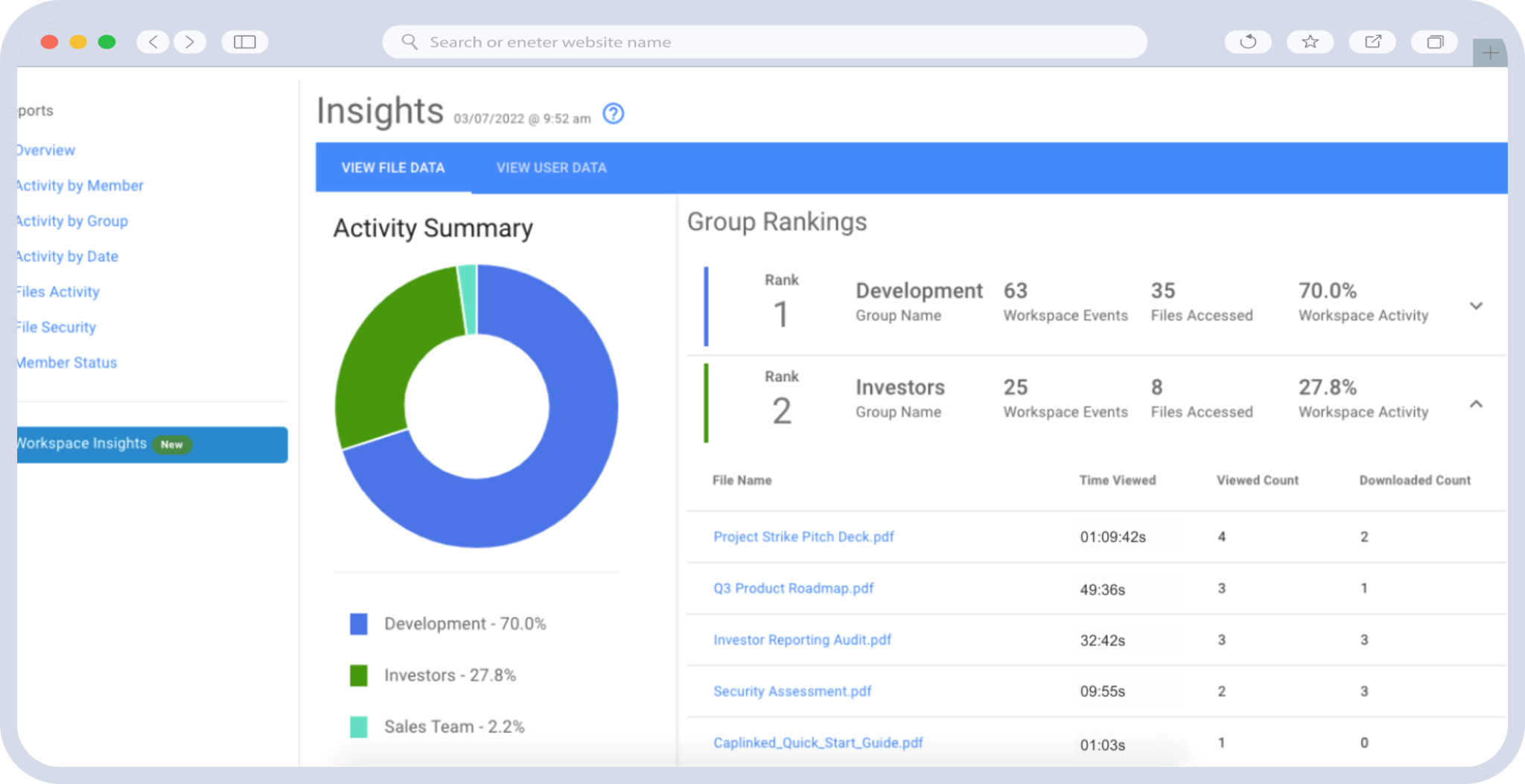
A virtual data room (VDR) is where that record is created. CapLinked’s Activity Tracker logs who opened which document and when, at group, file and individual level, and the log exports. That is the evidentiary trail behind a representation, and it is the lead reason a data room belongs in this conversation at all.
Around it: drag-and-drop upload with automatic indexing keeps disclosure schedules and their supporting documents organized and findable, which matters when a schedule has to be defended two years later. EZ Q\&A routes questions clarifying a representation to the right person and records every clarification, so negotiating a carve-out leaves a trail rather than an inbox.
Signed NDAs and disclaimers captured before access establish that a party accepted confidentiality terms before seeing anything. Legal compliance and secure document sharing cover the access controls around all of it, and the security page lists the certification set.
To be clear about the boundary: a data room is not a contract management system, a clause library, or anywhere you draft. It holds the diligence record the clause is negotiated against, and produces the log of what was disclosed. That is the whole of its role here.
| Running diligence that indemnity terms will be negotiated against? |
|---|
Indemnification Clause FAQ
What is an indemnification clause?
A contract provision in which one party agrees to compensate another for specified losses, damages or liabilities. It allocates risk by deciding in advance who carries the cost when something goes wrong, and it appears in nearly all commercial agreements.
What is the difference between indemnify and hold harmless?
They are usually paired and function as one obligation. Some states treat them as distinct, with indemnify covering reimbursement for losses suffered and hold harmless additionally protecting against being drawn into the claim. Precise drafting matters more than the label.
What is an indemnity cap?
The maximum amount the indemnifying party can be required to pay. Certain claims, typically fraud and breaches of fundamental representations, are usually carved out and sit above the cap.
What is a basket in an indemnification clause?
A minimum threshold before claims can be made. A tipping basket pays from the first dollar once crossed, while a true deductible pays only the excess above it. On a $1 million threshold, that difference is substantial.
Is an indemnification clause the same as insurance?
No. Indemnification is a contractual promise between the parties, backed only by the indemnitor’s ability to pay. Insurance transfers risk to a third-party insurer. In M\&A they increasingly work together through representations and warranties insurance.
What is a survival period?
How long after closing a party can still bring an indemnification claim. Fundamental representations usually survive longer than general ones. On 41% of deals in the 2025 ABA study, representations do not survive closing at all.