Key Takeaways
- A startup data room is the organized set of documents you share with investors during diligence
- Investors ask for one after a good meeting, so build it before you start pitching
- Six folders cover almost every request: financials, legal, cap table, market, product, team
- The room should be lean at pre-seed and detailed at Series A. Right-size it to your stage
- What you leave out matters as much as what you include
- Source code, full customer lists and unredacted contracts stay out until an investor is serious
- Who opens which document tells you where interest sits, and where it does not
Table of Contents
ToggleA startup data room is the organized, access-controlled set of documents a founder shares with investors during fundraising diligence. It holds financials, corporate records, the cap table, market evidence, product detail and team information. Unlike a shared drive, it lets you control who sees which folder and when.
Most founders build one after an investor asks. By then the request has a deadline attached, the folder structure gets improvised, and the version of the financial model that goes in is whichever one was open at the time.
The second mistake is worse and less discussed. Founders overcorrect by putting everything in, including the things that give away the most and protect the least: the full customer list, the source repository, unredacted contracts with named terms. That material has no place in a first-round room, and once an investor has seen it you cannot take the knowledge back.
What follows covers what belongs in each folder, how the room should change between pre-seed and Series A, what to hold back and why, and how to organize it so a partner can find the revenue build without emailing you.
What Is a Startup Data Room?
The term covers two things founders often conflate. One is the fundraising room described above, built for investor diligence. The other is a broader corporate repository used for audits, board reporting and eventually an acquisition. They overlap, and the fundraising room is usually the first version of the second.
What separates it from a shared folder is permission structure and record. You decide which investor sees which folder, you change that as conversations progress, and you can see who opened what. A link to a shared drive gives you none of those three.
It also does a job founders underrate: it answers questions before they are asked. A partner who can find the cohort data without emailing you has one fewer reason to delay, and the room itself signals that the company keeps its records in order. Our guide to the advantages of a virtual data room covers the wider case.
Why Investors Ask for One
The reasons condense to four, and all of them are really about removing friction from a process the investor controls.
- Diligence moves faster. A reviewer working through an organized room is not waiting on you for each document, which removes the single biggest source of delay in a raise
- It signals an organized team. First impressions carry weight here. A room that is complete and current suggests the company handles its records the same way, and a chaotic one raises a question the investor did not previously have
- Sensitive material stays controlled. Financial records, proprietary technology and customer information move under permissions rather than as email attachments
- One version of the truth. Everyone reviews the same model and the same contract, so nobody is arguing from a superseded file
| Did You Know
Megadeals of $100 million or more captured 87.5% of the $412.7 billion US startups raised in the first half of 2026, according to the PitchBook-NVCA Venture Monitor. Most founders are competing for what is left, which is why diligence rigor at seed and Series A has gone up rather than down in a record funding year. |
When Should You Open an Investor Data Room?
Have a lean version ready before the first pitch. The request usually arrives within days of a meeting that went well, and the gap between “can you send over your materials” and actually sending them is read as a signal whether you intend it that way or not.
Founders disagree about whether to share it upfront or wait for interest, and both positions have merit.
| Approach | Case for it | Case against |
|---|---|---|
| Share upfront with the deck | Removes a step, signals preparation, and speeds a fast-moving process | Gives away detail to investors who were never going to engage, including ones who compete with you through a portfolio company |
| Wait for demonstrated interest | Keeps your negotiating position intact and limits disclosure to people who have earned it | Adds a delay at exactly the moment momentum matters most |
| Staged access | A lean room shared early, with deeper folders unlocked after a second meeting | Requires you to actually manage permissions rather than send one link |
Staged access is the practical answer for most raises, and it is the approach the rest of this guide assumes. It gets you the speed benefit without handing your cohort economics to a fund that took the meeting out of curiosity.
What to Include in a Startup Data Room
Six folders cover nearly every request an early-stage investor will make. Build them in this order, name them consistently, and put a short index document at the top level so a reviewer knows what exists without opening each folder.
Financials
Historical statements, the operating model, and the assumptions behind it. Include profit and loss by month, a balance sheet, cash flow, current burn and runway, and the revenue build showing how the forecast is constructed. If you have revenue, add retention or cohort data. Investors read the assumptions tab before the summary.
Legal and corporate
Certificate of incorporation, bylaws, board consents and minutes, prior financing documents, and any material agreements. Include IP assignment agreements for every founder and employee, since a missing assignment is one of the few findings that stops a round outright.
Cap table and equity
A current cap table showing fully diluted ownership, the option pool and what remains unallocated, all outstanding SAFEs or convertible notes with their caps and discounts, and any side letters. Reconcile it against your financing documents before anyone else does.
Market and traction
Market sizing with the working shown, competitive positioning, and the traction metrics that matter for your model: growth rate, pipeline, usage, retention. Two or three customer references with contact permission carry more weight than a longer list without it.
Product
A product overview, roadmap, architecture summary and security posture. Enough for a technical partner to understand what you have built and how it scales. Not the repository itself, which is covered further down.
Team
Founder and key hire biographies, the current org chart, the hiring plan tied to the use of proceeds, and employment agreements for the leadership team. If a key person is part-time or advisory, say so here rather than letting it surface in a reference call.
| Worth Knowing
Artificial intelligence accounted for 86% of all US venture dollars in the first half of 2026, per the Q2 2026 Venture Monitor. If you are not in that category, benchmark your round size and timeline against companies that are not either, or you will misread what a normal process looks like. |
How the Room Changes by Stage
A pre-seed room proving too much looks as odd as a Series A room proving too little. Right-size it.
| Stage | What the room carries | What is not expected yet |
|---|---|---|
| Pre-seed | Incorporation documents, founder IP assignments, cap table, deck, product demo, early usage or pipeline evidence | Audited financials, cohort analysis, detailed contracts |
| Seed | The above plus a 24 to 36 month model, monthly management accounts, key customer agreements, hiring plan | Audited statements, full commercial contract set |
| Series A | The above plus cohort and retention analysis, unit economics, revenue by customer, all material contracts, option plan documentation, any regulatory correspondence | Little. Expect the room to be tested rather than skimmed |
The pattern is that early rounds are underwritten on the team and the market, and later rounds on the numbers. Build the folder that matches the question being asked.
What to Keep Out of the Room
This is the section founders most often get wrong, and it costs more than a thin financials folder ever will. Some material gives away the company\u2019s advantage while proving very little about its value.
- Source code and technical specifications. A product summary and architecture overview answer the question. Repository access does not belong in a fundraising room at any stage
- Full customer lists with named contacts. Provide counts, segments and concentration. Give named references individually, with the customer\u2019s permission
- Employee personal data. Salary bands and headcount by function, not individual records. Personal data carries obligations that survive the raise
- Unredacted commercial contracts. Redact pricing and named terms in the early folder. Most customer agreements also carry confidentiality obligations you would be breaching
- Trade secrets and formulations. If the advantage is a process rather than a patent, disclosure destroys it. Describe the result, not the method
- Anything you have not read recently. An outdated model or a superseded board deck in the room creates a discrepancy an investor will find and ask about
None of this is about hiding problems. Material issues should be disclosed, and disclosed early, because a problem found late costs more than the same problem raised upfront. The distinction is between candor about risk and disclosure of the things that make the company hard to copy.
How to Build and Organize It
The structure matters more than the software. A reviewer should be able to find the revenue build in under a minute without asking.
- Build the folder tree first. Six top-level folders matching the sections above, numbered so they hold their order across systems
- Name files consistently. Date, document type, version. “2026-06 Management Accounts v3” beats “financials_FINAL_updated(2)”
- Add an index at the top level. One page listing what is in each folder and what is deliberately excluded, so nobody hunts for something that was never there
- Set permissions before anyone is invited. Decide which groups see which folders, and what each can do beyond viewing
- Keep it current during the raise. A month-old model in an active process is worse than no model. Update monthly accounts as they close
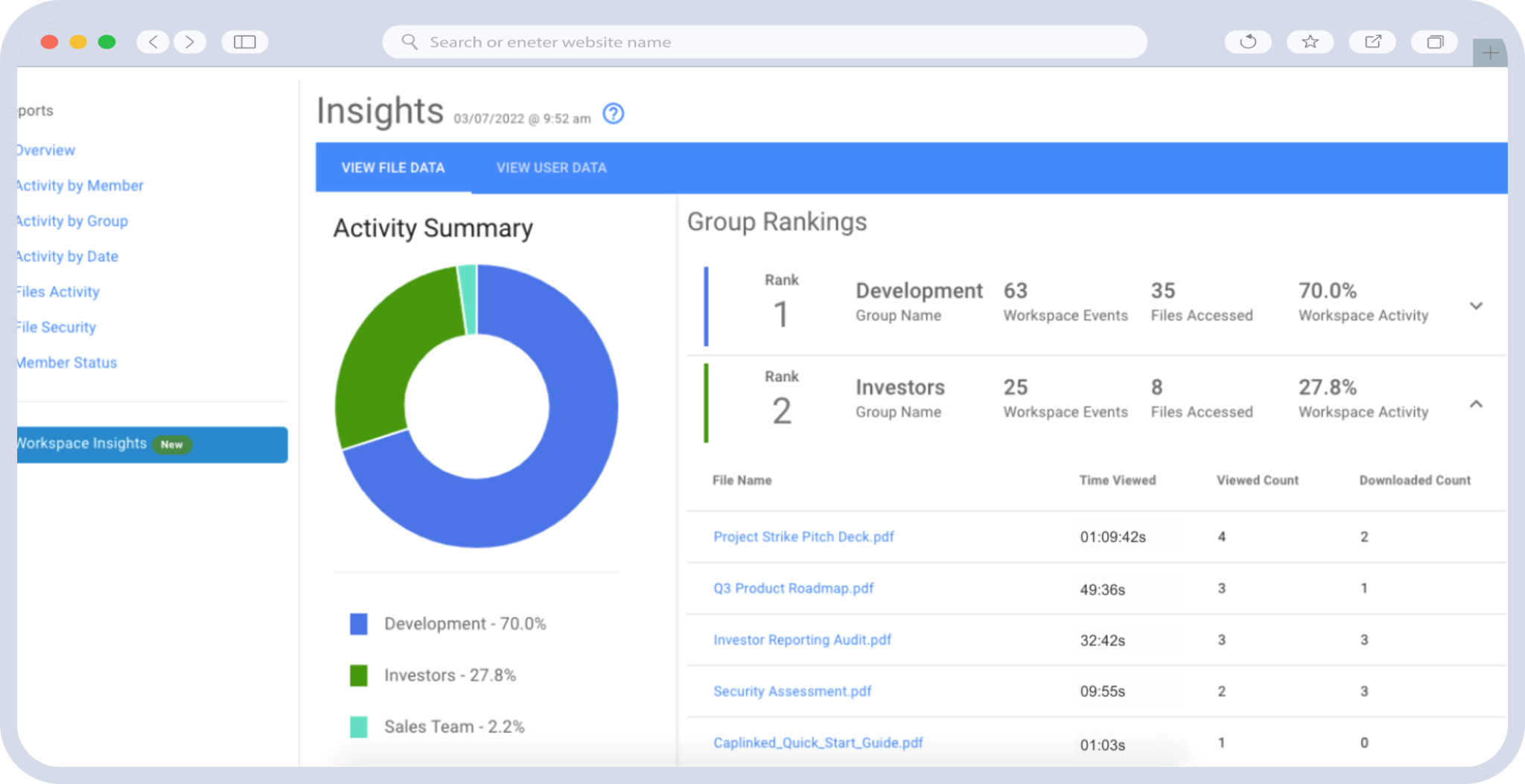
- Watch the access record. Who opened what, and when, tells you where a conversation actually sits. Treat it as engagement data and nothing more
That last point deserves a caveat, because founders over-read it. Heavy activity on the financials folder means someone is working, not that a term sheet is coming. Light activity might mean disengagement, or that an associate has already extracted what the partner asked for. The log tells you what was opened. It cannot tell you why, or what anyone concluded.
| Common Mistake
First-time fund formation is on pace for its lowest year since 2016, the Q2 2026 Venture Monitor reports. Fewer new funds means fewer first cheques from managers still building a portfolio, so the assumption that a thin room can be fixed after a verbal commitment is a riskier bet than it was three years ago. |
Where CapLinked Fits for Founders
Most of what a founder needs from a data room is unglamorous: a place to put the folders, control over who sees which one, and a record of what happened. A shared drive struggles for a reason that has little to do with encryption, since it treats every viewer identically and tells you nothing afterward.
Group permissions in a virtual data room handle staged access directly. A first-meeting group sees the deck, the incorporation documents and top-line metrics. A group that has taken a second meeting sees the model and the contracts. You change the group rather than rebuilding a folder or resending a link.
Access control and encryption are separate protections and it is worth keeping them apart. Encryption covers the file: 256-bit AES at rest, SSL/TLS in transit. Permissions decide who reaches it, set per folder with files private by default and access revocable after the fact. FileProtect digital rights management extends control to documents already downloaded, which matters when a fund passes and still has your model on a laptop.
Activity Tracker records document-level views and downloads. Used properly it tells you which investors are working through the material and which folders draw the most time, which is useful for timing a follow-up. Used carelessly it becomes a story you tell yourself about who is going to lead. Secure document sharing and the underlying security controls cover the rest, and the same room carries into acquisition diligence later without a rebuild.
CapLinked meets HIPAA and HITECH requirements and is independently assessed against SOC 2, which matters for founders in regulated categories. Platform compliance is not the same as your company being compliant, and any vendor implying otherwise is overselling. Published pricing starts below the enterprise tier, which is the practical question at seed.
| Building an investor room before your next raise? |
Startup Data Room FAQ
What is a startup data room?
An organized, access-controlled set of documents founders share with investors during fundraising diligence. It typically holds financials, corporate records, the cap table, market evidence, product detail and team information.
When should I share my data room with investors?
Have a lean version ready before you start pitching. Requests usually follow a good first meeting, and delay reads as disorganization. Share deeper folders once an investor demonstrates real interest.
What should I include in a startup data room?
Six folders cover most requests: financials, legal and corporate, cap table and equity, market and traction, product, and team. Depth should match your stage rather than the longest checklist you can find.
Can I use Google Drive as a data room?
It works for very early raises. What it lacks is per-investor permissions, control over downloaded files, and a document-level access record. Those gaps matter more as the number of investors grows.
What should I keep out of my data room?
Source code, full customer lists with named contacts, employee personal data, unredacted commercial contracts, and trade secrets. Describe the result rather than the method until an investor is genuinely committed.
How does a data room differ at pre-seed versus Series A?
Pre-seed rooms carry incorporation documents, the cap table and early evidence. Series A rooms add cohort analysis, unit economics, revenue by customer and full contracts, because later rounds are underwritten on numbers.
Does investor activity in the data room predict a term sheet?
No. Access logs show which documents were opened and when. They cannot show why, or what the reviewer concluded. Treat the data as a prompt for follow-up rather than a forecast.