Every failed deal has a story, and more often than not, that story begins with a disorganized data room. Missing financial statements, unsigned compliance certificates, expired licenses—these are the landmines that blow up timelines, erode buyer confidence, and ultimately kill transactions. Whether you’re navigating an M&A deal in financial services, a Series B in tech, or a portfolio acquisition in commercial real estate, the documents you need in your virtual data room vary dramatically by industry. Yet most due diligence guides treat every deal the same. This one doesn’t. Below, you’ll find industry-specific checklists—built from real transaction patterns—so you know exactly what to upload, when, and why it matters.
Table of Contents
ToggleWhy Industry-Specific Due Diligence Checklists Matter
A generic due diligence checklist is better than no checklist at all, but it’s not good enough when regulatory frameworks, deal structures, and risk profiles differ so fundamentally across sectors. A healthcare company facing HIPAA scrutiny has almost nothing in common with a SaaS startup preparing for acquisition, yet both need a VDR that’s organized, complete, and audit-ready.
According to the U.S. Securities and Exchange Commission, due diligence is the investigation and analysis that a reasonable investor would conduct before making an investment decision. The scope of that investigation depends entirely on the nature of the business. A virtual data room is the infrastructure that makes that investigation possible at scale—providing secure file sharing, granular access controls, and a complete audit trail of every document interaction.
Research from McKinsey & Company has highlighted that poor due diligence preparation is among the leading reasons large transactions fail to close. The implication is clear: organizing your data room with the right documents—tailored to your industry—isn’t administrative busywork. It’s a strategic imperative.
The Universal Foundation: Documents Every VDR Needs
Before diving into industry-specific requirements, every virtual data room should include a baseline set of corporate and financial documents. Think of this as your foundation layer—the documents that any buyer, investor, or auditor will expect regardless of sector.
- Corporate formation documents: Articles of incorporation, bylaws, operating agreements, certificates of good standing
- Cap table and equity records: Shareholder agreements, option grants, warrant schedules, convertible note details
- Financial statements: Three to five years of audited financials, interim statements, tax returns (federal, state, and local)
- Material contracts: Customer agreements, vendor contracts, partnership agreements, leases
- Litigation and legal: Pending or threatened litigation, settlement agreements, regulatory correspondence
- Insurance policies: D&O, general liability, E&O, cyber liability, key person coverage
- HR and organizational: Employee roster, organizational chart, executive employment agreements, benefit plan summaries
With this foundation in place, you can layer on the industry-specific documents that make or break due diligence in your particular sector.
Financial Services Due Diligence Checklist
Financial services transactions—whether involving banks, insurance companies, asset managers, or fintech firms—face some of the most rigorous regulatory scrutiny of any sector. Buyers and regulators alike will demand comprehensive documentation of compliance frameworks, capital adequacy, and risk management protocols.
Regulatory and Compliance Documents
- Current licenses and registrations (SEC, FINRA, state insurance departments, OCC charters)
- Most recent regulatory examination reports and management responses
- Anti-money laundering (AML) and Bank Secrecy Act (BSA) compliance programs
- Know Your Customer (KYC) policies and procedures
- Suspicious Activity Reports (SARs) filing history and trends
- Consumer compliance audit reports (TILA, RESPA, ECOA, FCRA)
- CFPB correspondence and any consent orders or enforcement actions
Financial and Risk Documents
- Capital adequacy ratios and stress testing results
- Loan portfolio analysis, including delinquency and charge-off rates
- Investment portfolio composition and mark-to-market valuations
- Interest rate risk modeling and sensitivity analyses
- Cybersecurity risk assessments and incident response plans
- Third-party vendor management program documentation
The Office of the Comptroller of the Currency (OCC) provides detailed guidance on the documentation required for bank mergers and acquisitions. If your transaction involves a regulated depository institution, OCC requirements should form the backbone of your VDR structure.
Actionable Tip
Create a dedicated “Regulatory” folder at the top level of your virtual data room with sub-folders for each regulator. Financial services buyers prioritize regulatory risk above almost everything else—make it the easiest section to navigate.
Healthcare Due Diligence Checklist
Healthcare transactions introduce a unique layer of complexity: patient data privacy, complex reimbursement structures, and licensing requirements that vary by state and facility type. Whether you’re acquiring a hospital system, a physician practice group, or a digital health startup, your VDR must address clinical, regulatory, and operational risk simultaneously.
Regulatory and Licensing Documents
- State healthcare facility licenses and certificates of need
- Medicare and Medicaid provider enrollment and certification
- DEA registrations and controlled substance licenses
- Joint Commission or equivalent accreditation reports
- HIPAA compliance program documentation, including most recent risk assessment
- Business Associate Agreements (BAAs) with all third-party vendors handling PHI
- Stark Law and Anti-Kickback Statute compliance opinions and self-disclosures
Clinical and Operational Documents
- Physician and provider credentialing files
- Malpractice claims history and current coverage
- Payer contracts and reimbursement rate schedules
- Revenue cycle management reports (days in A/R, denial rates, payer mix)
- Clinical outcomes data and quality metrics (HEDIS, CMS Star Ratings)
- Electronic health record (EHR) system documentation and data migration plans
- Patient volume and utilization trend data
The U.S. Department of Health and Human Services (HHS) outlines the Privacy Rule requirements that directly impact how healthcare organizations store, share, and manage protected health information during transactions. Your virtual data room must enforce access controls that align with HIPAA’s minimum necessary standard—a capability that general-purpose file sharing tools simply cannot guarantee.
Actionable Tip
Never upload unredacted patient data into a VDR. Use de-identified datasets for clinical and financial analyses, and ensure your secure file sharing platform supports dynamic watermarking and view-only permissions for sensitive compliance documents. CapLinked’s permission controls allow you to restrict downloading, printing, and screenshotting at the individual document level—critical for HIPAA-sensitive transactions.
Technology Due Diligence Checklist
Technology deals—whether venture capital rounds, growth equity investments, or strategic acquisitions—demand a different kind of scrutiny. The value often lives in intellectual property, recurring revenue metrics, and the defensibility of the technology stack. Buyers want to understand not just what the company has built, but whether it can protect and scale what it’s built.
Intellectual Property and Technology Documents
- Patent portfolio with filing dates, jurisdictions, and prosecution status
- Trademark and copyright registrations
- Open-source software audit reports and license compliance
- Source code escrow agreements
- Technology architecture documentation and system dependency maps
- Third-party software licenses and SaaS vendor agreements
- Data processing agreements (DPAs) and GDPR compliance records
SaaS and Revenue Metrics
- Monthly and annual recurring revenue (MRR/ARR) trend data
- Customer churn and net revenue retention rates
- Customer acquisition cost (CAC) and lifetime value (LTV) analyses
- Top 20 customer contracts with renewal terms and concentration analysis
- Pipeline and bookings data
- Product roadmap and R&D expenditure breakdown
Cybersecurity and Data Privacy
- SOC 2 Type II audit reports
- Penetration testing results (most recent 12 months)
- Incident response plan and breach notification history
- Data retention and deletion policies
- Employee security training records
Actionable Tip
Tech due diligence moves fast. Structure your virtual data room with a “Technical Diligence” section separate from legal and financial documents, and grant your acquirer’s technical team direct access. This prevents bottlenecks where engineering reviewers wait on legal advisors—and vice versa—to access the documents they need. CapLinked’s group-based permissions make this segmentation seamless.
Real Estate Due Diligence Checklist
Real estate transactions—whether single-asset acquisitions, portfolio deals, or REIT formations—are document-intensive in ways that other industries are not. Physical property condition, environmental risk, tenant relationships, and zoning compliance all require extensive documentation that often exists in disparate formats and locations.
Property and Title Documents
- Title commitments, title insurance policies, and exception documents
- Surveys (ALTA/NSPS) and legal descriptions
- Zoning compliance letters and entitlement documentation
- Environmental site assessments (Phase I and Phase II)
- Property condition assessment reports
- FEMA flood zone determinations
- Certificates of occupancy and building permits
Financial and Tenant Documents
- Rent rolls (current and historical, trailing 12 months)
- All executed lease agreements with amendments and guarantees
- Tenant estoppel certificates
- Operating expense budgets and actuals (trailing 3 years)
- Capital expenditure history and forward projections
- Property tax bills and assessment appeals
- Property management agreements and vendor service contracts
Debt and Structure Documents
- Existing mortgage documents, loan agreements, and promissory notes
- Subordination, non-disturbance, and attornment (SNDA) agreements
- Partnership or joint venture agreements governing the property entity
- Ground lease agreements (if applicable)
Actionable Tip
For portfolio deals involving multiple properties, create a sub-folder structure within your VDR that mirrors the portfolio—one folder per asset, with a consistent internal structure across all properties. This allows buyers to compare properties side by side and speeds up the underwriting process dramatically. CapLinked’s bulk upload and drag-and-drop folder creation make this setup efficient even for portfolios with dozens of assets.
Best Practices for Organizing Your Virtual Data Room
Regardless of industry, a well-organized virtual data room follows several universal principles that accelerate due diligence and signal professionalism to counterparties.
1. Use a Logical, Numbered Index
Adopt a numbered folder hierarchy (1.0 Corporate, 2.0 Financial, 3.0 Legal, etc.) that mirrors the structure your advisors and buyers expect. This reduces the learning curve for anyone entering the data room and ensures consistency if additional folders are added mid-process.
2. Apply Consistent Naming Conventions
Every document should follow a standardized naming format—such as [Category]_[Description]_[Date]. “3.1_Lease_Agreement_123MainSt_2024-06-15.pdf” is infinitely more useful than “Scan_042.pdf.” This small discipline pays enormous dividends in secure file sharing efficiency.
3. Set Granular Permissions from Day One
Not every participant needs access to every document. Set role-based permissions at the folder level before inviting users. Management presentations might be open to all parties, while sensitive employee data or customer contracts should be restricted to specific due diligence workstreams.
4. Pre-Populate Q&A Responses
Anticipate the questions buyers will ask by populating a Q&A log with answers to the most common due diligence inquiries for your industry. This proactive approach reduces back-and-forth and keeps the deal moving forward.
5. Monitor Engagement Analytics
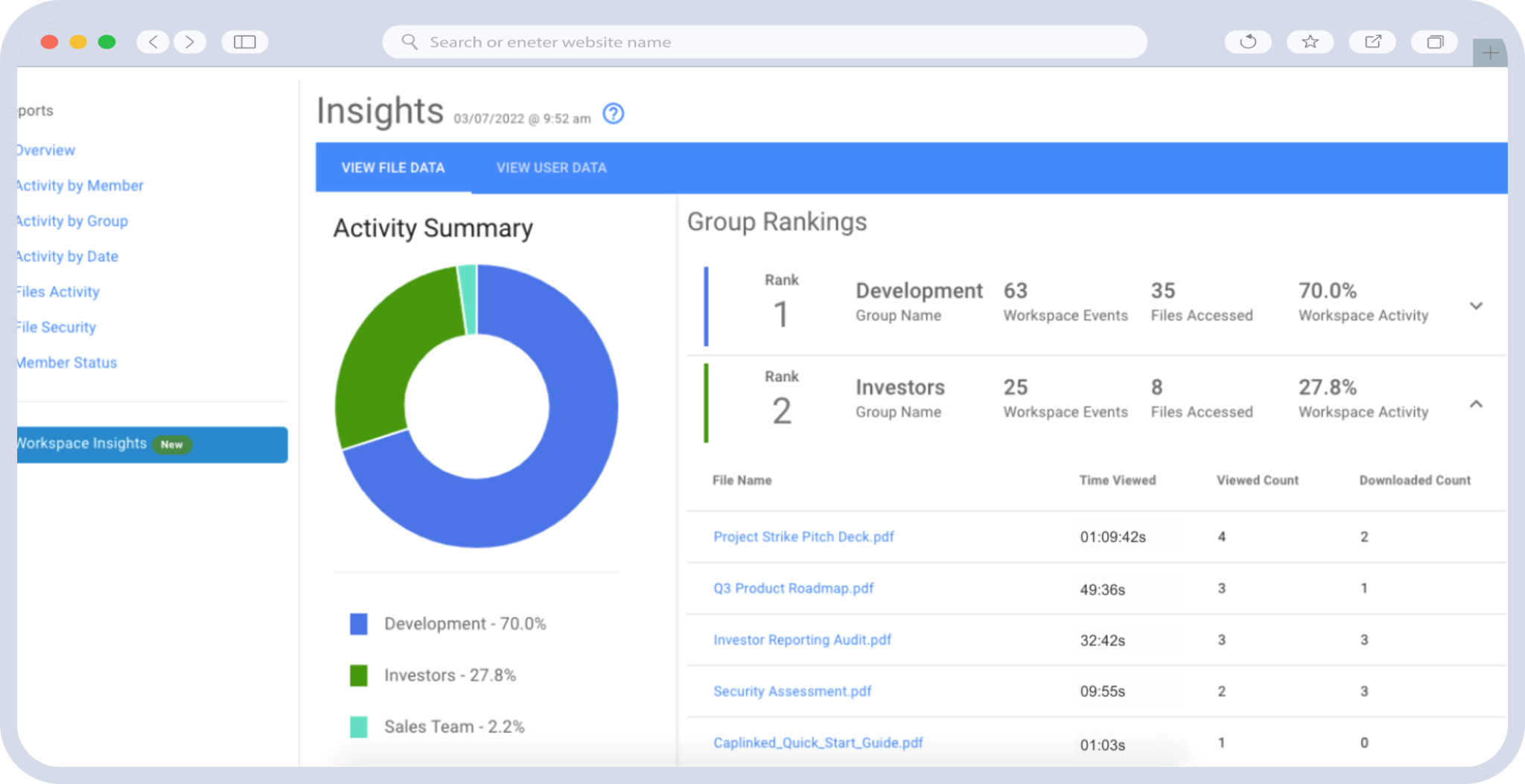
Modern virtual data rooms like CapLinked provide real-time analytics showing which documents have been viewed, by whom, and for how long. Use this intelligence to gauge buyer interest, identify areas of concern, and proactively address potential sticking points before they become deal-breakers.
Why CapLinked for Industry-Specific Due Diligence
CapLinked’s virtual data room platform is built specifically for high-stakes transactions where security, organization, and speed matter. With features including 256-bit encryption, dynamic watermarking, granular permission controls, full audit trails, and an intuitive interface that requires zero training, CapLinked helps deal teams across financial services, healthcare, technology, and real estate close transactions faster and with greater confidence.
Whether you’re managing a single deal or running multiple concurrent transactions, CapLinked’s flexible workspace model and flat-rate pricing eliminate the unpredictable costs that plague legacy VDR providers.
Ready to organize your next deal? Start a free trial of CapLinked and see how a purpose-built virtual data room transforms your due diligence process from a liability into a competitive advantage.
Frequently Asked Questions
A virtual data room is a secure online platform used to store, organize, and share confidential documents during due diligence for transactions such as mergers and acquisitions, fundraising, and audits. It provides features like encryption, access controls, audit trails, and dynamic watermarking to protect sensitive information while enabling multiple parties to review documents simultaneously.
A virtual data room for M&A due diligence should include corporate formation documents, audited financial statements, tax returns, material contracts, intellectual property records, litigation files, insurance policies, HR documentation, and regulatory compliance records. The specific documents vary by industry—financial services transactions require regulatory examination reports, healthcare deals need HIPAA compliance documentation, and technology acquisitions demand IP audits and SaaS metrics.
A VDR is purpose-built for secure file sharing during confidential transactions, offering granular permission controls, dynamic watermarking, complete audit trails showing who viewed which document and for how long, and the ability to revoke access even after files have been downloaded. General cloud storage platforms lack these security and compliance features, making them unsuitable for due diligence involving sensitive financial, legal, or regulatory documents.
Due diligence document requirements vary by industry because each sector is governed by different regulatory frameworks, risk profiles, and value drivers. Financial services companies must demonstrate compliance with banking regulators and AML laws, healthcare organizations must prove HIPAA compliance and clinical quality, technology companies must document intellectual property ownership and cybersecurity posture, and real estate transactions require environmental assessments and tenant documentation. A virtual data room should be organized to reflect these industry-specific requirements.
With a modern virtual data room platform like CapLinked, initial setup can be completed in a matter of hours—including folder structure creation, document upload, and user permission configuration. The more time-consuming element is gathering and organizing the documents themselves, which is why using an industry-specific due diligence checklist before setup significantly accelerates the process. Most deal teams aim to have their VDR fully populated one to two weeks before granting buyer access.
A virtual data room for due diligence should include 256-bit AES encryption, two-factor authentication, granular user permissions at the document and folder level, dynamic watermarking, view-only access options that prevent downloading or printing, complete audit trails, remote document shredding capabilities, and compliance certifications such as SOC 2 and ISO 27001. These features ensure that sensitive information is protected throughout the transaction lifecycle while maintaining a defensible record of all document activity.