Table of Contents
ToggleExecutive Summary
Mergers and acquisitions remain one of the most complex, high-stakes processes in the business world. A typical M&A transaction involves thousands of documents, dozens of stakeholders across multiple time zones, and a due diligence process that historically stretches anywhere from three to six months. Every additional day a deal remains open carries tangible costs—advisory fees, management distraction, market exposure, and the ever-present risk of deal fatigue leading to collapse.
Virtual data rooms (VDRs) have fundamentally transformed how deals get done. By replacing physical data rooms, fragmented file-sharing tools, and sequential review workflows with secure, centralized, and intelligent digital platforms, VDRs have compressed M&A timelines by an estimated 30–50%, turning what were once six-month marathons into streamlined processes measured in weeks. According to Deloitte’s M&A Trends Survey, technology-enabled due diligence is now cited as one of the top three factors driving faster deal execution among corporate development teams.
This comprehensive guide quantifies the time savings and efficiency gains that VDRs deliver across every phase of the M&A process. We examine how parallel workflows, real-time collaboration, advanced search and filtering, and the elimination of physical logistics combine to accelerate deal closing. Through concrete case studies, ROI calculations, and expert insights, we demonstrate why deal management software powered by VDR technology is no longer a convenience—it is a competitive necessity for dealmakers seeking to reduce their virtual data room M&A timeline and deploy capital faster.
The Anatomy of M&A Timelines: Where Delays Occur
Understanding the Traditional M&A Process
Before quantifying the impact of VDRs, it’s essential to understand where time is consumed—and wasted—in a traditional M&A transaction. The standard M&A lifecycle consists of five core phases:
- Strategy and Target Identification: 2–8 weeks
- Initial Due Diligence and LOI Negotiation: 2–6 weeks
- Comprehensive Due Diligence: 4–12 weeks (the largest variable)
- Negotiation and Definitive Agreement: 2–6 weeks
- Regulatory Approval and Closing: 2–12 weeks
According to SRS Acquiom’s M&A Deal Terms Study, the median time from signing a letter of intent to closing a private-target acquisition in the U.S. is approximately 65 days, though complex transactions routinely extend beyond 120 days. Bain & Company’s research on M&A projects that within five years, every single step of the M&A process will be enabled by generative AI, creating a widening performance gap between technology-enabled dealmakers and traditional practitioners.
The Hidden Cost of Every Additional Day
Time is not a neutral factor in M&A. Each day a deal remains open carries quantifiable costs:
- Advisory and Legal Fees: Investment banking, legal, and accounting fees for a mid-market deal typically range from $2–5 million. With advisory teams billing at $500–$1,500 per hour, even a two-week delay can add $200,000–$500,000 in professional fees.
- Management Distraction: Harvard Business Review research estimates that senior executives spend 30–50% of their time on transaction-related activities during active M&A processes. Every additional week represents lost productivity in running the core business.
- Market and Competitive Risk: Extended timelines increase the probability of adverse market events, competitive intelligence leaks, or changes in regulatory environments that can erode deal value or cause transactions to collapse entirely.
- Carrying Costs: For leveraged transactions, financing commitments carry commitment fees (typically 25–50 basis points annually on undrawn amounts), and interest rate movements during extended timelines can materially alter deal economics.
- Deal Fatigue: According to McKinsey & Company’s M&A research, approximately 10–15% of announced deals fail to close, with protracted timelines being a contributing factor in many failed transactions.
When a $100 million acquisition is delayed by 30 days, the combined carrying costs, advisory fees, and opportunity costs can easily exceed $500,000. For billion-dollar transactions, the figure escalates into the millions. This economic reality makes M&A process efficiency not just an operational preference but a financial imperative.
How Virtual Data Rooms Compress the M&A Timeline
Parallel Workflows: The End of Sequential Review
In the era of physical data rooms, due diligence was inherently sequential. Legal teams would fly to a location, review documents in a controlled setting, and then yield the room to financial analysts, followed by operational reviewers. This serial approach meant that a due diligence process involving five workstreams could take five times longer than any single workstream required.
VDRs fundamentally eliminate this bottleneck. With a virtual data room, all due diligence workstreams—legal, financial, operational, tax, environmental, IT, and HR—can proceed simultaneously. Multiple buyer teams, advisors, and specialists can access the same document repository concurrently, each with permission sets tailored to their specific role and information needs.
The impact is dramatic. A due diligence process that required 12 weeks of sequential physical review can be compressed to 4–6 weeks of parallel virtual review. According to PwC’s Global M&A Industry Trends, firms that adopted VDR-enabled parallel workflows reported a 40% average reduction in due diligence timelines compared to traditional methods.
Real-Time Collaboration and Communication
Modern VDRs function as more than document repositories—they serve as comprehensive deal management software platforms. Built-in Q&A modules allow buyers to submit questions directly within the data room, tagged to specific documents or sections. Sellers can assign questions to subject matter experts, track response times, and ensure that no inquiry falls through the cracks.
This structured communication eliminates the delays inherent in email-based Q&A processes, where questions get lost in inboxes, responses lack context, and version control becomes a nightmare. Real-time notifications ensure that stakeholders are immediately alerted to new uploads, responses, or permission changes, enabling the continuous momentum that accelerates deal closing.
The Q&A feature alone can save weeks. In traditional processes, the back-and-forth of due diligence questions and answers—often involving hundreds of discrete inquiries—can stretch over 4–6 weeks. With VDR-enabled Q&A workflows, this same volume of inquiry can be resolved in 1–3 weeks, as questions are routed directly, responses are linked to source documents, and audit trails maintain accountability for response times.
Intelligent Document Organization and Search
A typical M&A data room contains between 5,000 and 50,000 documents, depending on the size and complexity of the target company. In a physical data room or a basic cloud storage solution, locating a specific contract, financial statement, or regulatory filing could take hours.
Enterprise-grade VDRs address this challenge through multiple mechanisms that dramatically improve due diligence speed:
- Smart Filters: Users can instantly filter files based on document type, date range, upload date, status, or custom tags, reducing search time from hours to seconds.
- Full-Text Search (OCR): Optical character recognition technology enables searching within scanned documents, PDFs, and images—not just filenames—ensuring that no relevant information is overlooked.
- Auto-Indexing: Standardized folder structures aligned with industry-standard due diligence checklists ensure that buyers know exactly where to find specific categories of information.
- AI-Powered Document Classification: Emerging VDR capabilities use machine learning to automatically categorize, tag, and even summarize documents, enabling reviewers to prioritize their efforts on the most critical materials.
The cumulative effect of these features on the virtual data room M&A timeline is substantial. EY’s Transaction Advisory research found that deal teams using advanced VDR search and organization tools spent 60% less time locating and verifying documents compared to teams using basic file-sharing platforms.
Elimination of Physical Logistics
The operational overhead of physical data rooms was staggering. Printing, organizing, and securing tens of thousands of pages; booking dedicated facilities; arranging travel for review teams; staffing the room with monitors; and managing access logs—all of these activities consumed time and budget that contributed nothing to deal analysis.
VDRs eliminate this entire category of delay. Documents can be uploaded and made available to global buyer teams within minutes, not days. The environmental and logistical constraints of physical space—limited hours, limited capacity, geographic restrictions—simply cease to exist. A financial advisor in London, a legal team in New York, and an operational consultant in Singapore can all review the same materials simultaneously, at any hour, from any device.
For cross-border transactions, which the Institute for Mergers, Acquisitions and Alliances (IMAA) reports constitute approximately 30–40% of global M&A activity, the elimination of travel logistics alone can save 1–2 weeks per transaction.
Quantifying the Time Savings: Data and Case Studies
Benchmark Data: VDR vs. Traditional Due Diligence Timelines
While every transaction is unique, aggregate data paints a compelling picture of VDR-driven acceleration. The following benchmarks are drawn from industry surveys, practitioner reports, and platform analytics:
- Document Preparation Phase: Traditional methods require 3–6 weeks to organize and prepare a data room. VDR platforms with template structures and bulk upload capabilities reduce this to 1–2 weeks—a 50–67% improvement.
- Buyer Review Phase: Sequential physical review typically takes 6–10 weeks. Parallel VDR review compresses this to 3–5 weeks—a 50% improvement.
- Q&A Resolution: Email-based Q&A processes average 4–6 weeks. VDR Q&A modules reduce this to 1–3 weeks—a 50–75% improvement.
- Overall Due Diligence Timeline: End-to-end, VDR-enabled due diligence averages 4–8 weeks compared to 10–20 weeks for traditional processes.
A Boston Consulting Group analysis of M&A value creation found that deals closed in the top quartile of speed delivered 15–25% higher returns to acquirers than slower transactions, attributing the difference to faster synergy capture, reduced market uncertainty, and lower transaction costs.
Case Study 1: Mid-Market Technology Acquisition
A private equity firm acquired a SaaS company with $50 million in annual recurring revenue. The target had complex IP agreements, international customer contracts across 12 jurisdictions, and a regulatory compliance history spanning five years.
Without VDR (estimated timeline): The firm’s advisors estimated that physical data room processes and fragmented digital workflows would require 14–16 weeks of due diligence, given the volume and complexity of documentation (approximately 18,000 files).
With VDR (actual timeline): Using an enterprise VDR with AI-powered search, automated indexing, and parallel access for six distinct buyer workstreams, the entire due diligence process was completed in 5.5 weeks. The Q&A module processed 847 questions with an average response time of 18 hours.
Time Saved: 8.5–10.5 weeks
Cost Savings: Approximately $1.2 million in reduced advisory fees, plus an estimated $800,000 in earlier revenue synergy capture from accelerated integration planning that began during the compressed due diligence period.
Case Study 2: Cross-Border Healthcare Merger
Two healthcare companies—one based in the United States and one in Germany—pursued a merger of equals valued at $2.3 billion. The transaction involved regulatory approvals in multiple jurisdictions, HIPAA and GDPR compliance documentation, and clinical trial data spanning decades.
Without VDR (estimated timeline): Given the cross-border complexity, advisors projected a 20–24 week due diligence process using traditional methods, with significant time allocated to coordinating physical document access across continents.
With VDR (actual timeline): The VDR enabled simultaneous access for legal, regulatory, financial, and clinical teams across eight countries. Granular permission settings ensured that German regulatory counsel could access only GDPR-relevant materials while U.S. healthcare attorneys accessed HIPAA documentation. The entire due diligence was completed in 11 weeks.
Time Saved: 9–13 weeks
Cost Savings: Approximately $4.5 million in advisory and legal fees, plus the avoidance of an estimated $8 million in financing commitment fee escalation that would have occurred if the deal had extended into the following quarter.
Case Study 3: Sell-Side Auction Process for a Manufacturing Company
A family-owned manufacturing company with $120 million in revenue engaged an investment bank to run a competitive auction process with 14 initial bidders, narrowing to 4 finalists.
Without VDR (estimated timeline): Managing physical data room access for 14 bidder teams—each requiring separate scheduled access periods—would have required 10–14 weeks for the initial review phase alone.
With VDR (actual timeline): All 14 bidder teams received simultaneous access to Phase 1 materials within 48 hours of signing NDAs. The four finalists received expanded access to Phase 2 materials in a separate, permission-controlled section. The seller’s audit trail provided real-time visibility into which bidders were most actively engaged, enabling the advisory team to focus negotiation efforts strategically. Total auction process: 7 weeks from data room opening to final binding offer.
Time Saved: 5–9 weeks
Strategic Value: The compressed timeline maintained competitive tension among bidders, ultimately resulting in a final purchase price 12% above initial indications of interest—a direct financial benefit of maintaining deal momentum through VDR-enabled process efficiency.
ROI Analysis: The Financial Case for VDR-Accelerated M&A
Direct Cost Savings
The direct cost savings from VDR adoption in M&A are measurable and significant:
- Physical Data Room Elimination: Renting, staffing, and maintaining a physical data room for a mid-market transaction costs $50,000–$150,000. VDR subscriptions for equivalent periods typically cost $5,000–$25,000—a 70–95% reduction.
- Travel Cost Reduction: For cross-border deals, eliminating the need for review teams to travel to physical locations saves $100,000–$500,000 per transaction in travel, accommodation, and per diem expenses.
- Advisory Fee Reduction: With legal and financial advisory teams billing at $500–$1,500 per hour, compressing timelines by even 4–6 weeks yields savings of $300,000–$2 million on a typical mid-market deal.
- Printing and Logistics: Producing, organizing, and shipping physical document sets can cost $20,000–$50,000 per transaction—costs that VDRs eliminate entirely.
Indirect Value Creation
Beyond direct cost savings, VDR-accelerated timelines create substantial indirect value:
- Faster Capital Deployment: Private equity firms that close deals 6 weeks faster can deploy committed capital sooner, improving internal rates of return (IRR). For a $200 million fund, deploying capital 6 weeks earlier on a 5-year hold period can improve fund-level IRR by 50–100 basis points, translating to millions in additional carried interest.
- Reduced Deal Failure Risk: Mergermarket intelligence data indicates that the probability of deal failure increases approximately 2–3% for every additional month a transaction remains in due diligence. By compressing timelines, VDRs materially reduce the risk of failed transactions.
- Accelerated Synergy Capture: Faster closing enables earlier integration, which means revenue and cost synergies are realized sooner. On a deal with $20 million in projected annual synergies, closing 8 weeks earlier translates to approximately $3 million in incremental value capture in the first year.
- Competitive Advantage in Auction Processes: Buyers who can complete due diligence faster gain a significant advantage in competitive auction processes, as sellers favor bidders who demonstrate the ability to close quickly and with certainty.
Total ROI Calculation: A Mid-Market Example
Consider a representative mid-market acquisition valued at $150 million:
- VDR Cost: $15,000 (annual subscription, enterprise tier)
- Direct Cost Savings: $650,000 (advisory fees, travel, physical room, printing)
- Time Saved: 7 weeks
- Indirect Value Creation: $1.8 million (accelerated synergy capture, reduced carrying costs, improved IRR)
- Total Value Generated: $2.45 million
- ROI: 16,233%
While the specific numbers vary by transaction size and complexity, the directional conclusion is clear: VDR technology delivers extraordinary return on investment in M&A transactions, making it one of the highest-ROI technology investments a dealmaking organization can make.
Key VDR Features That Drive M&A Timeline Compression
Security and Compliance Infrastructure
Security concerns can add weeks to M&A timelines if they generate objections, renegotiations, or information-sharing delays. Enterprise-grade VDRs address this proactively with robust security infrastructure:
- Advanced Encryption: 256-bit AES encryption for data at rest and in transit, meeting the highest international standards for data protection.
- Granular Permissions: Folder-level, document-level, and even page-level access controls ensure that each stakeholder sees only the information appropriate to their role, eliminating the delays associated with manual redaction or separate document sets.
- Two-Factor Authentication: Adds an additional security layer without creating meaningful friction for authorized users.
- Dynamic Watermarking: Deters unauthorized distribution while allowing legitimate review to proceed unimpeded.
- Compliance Certifications: SOC 2 Type II, ISO 27001, GDPR compliance, and HIPAA compatibility provide immediate assurance to all parties, eliminating the weeks of security review that might otherwise be required.
As noted by the U.S. Securities and Exchange Commission’s guidance on cybersecurity, firms involved in M&A transactions handle some of the most sensitive nonpublic information in the financial markets. VDRs that meet the highest security standards eliminate the negotiation delays that arise when parties disagree on information security protocols.
Comprehensive Audit Trails
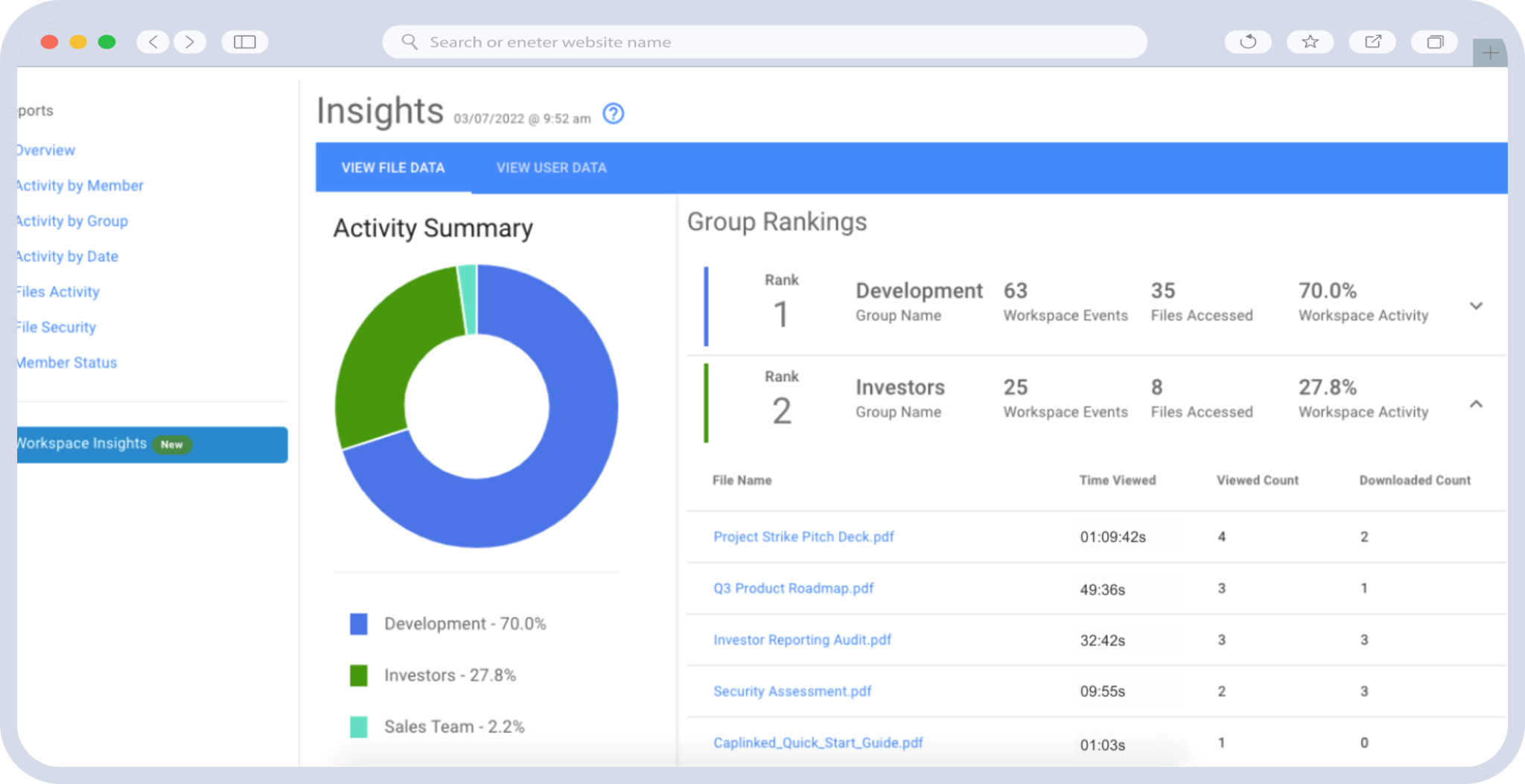
VDR audit trails serve dual purposes in accelerating M&A timelines. First, they satisfy regulatory and governance requirements without the need for manual logging—a process that can consume days of administrative effort in physical data rooms. Second, and perhaps more strategically, they provide sell-side teams with real-time intelligence on buyer engagement.
Comprehensive audit trails track every user login, document view, download, print, and time spent on each document. This granular visibility enables sell-side advisors to:
- Identify which bidders are most actively engaged and likely to submit compelling offers
- Detect areas of concern by monitoring which document categories receive disproportionate attention
- Proactively address potential issues before they become deal-delaying negotiation points
- Optimize the auction timeline by understanding when bidders have completed their reviews
AI-Enabled Due Diligence Acceleration
The next frontier in VDR-driven timeline compression is artificial intelligence. AI-enabled VDRs are beginning to transform due diligence from a manual, document-by-document review process into an intelligent, exception-based analysis. By automating routine review tasks and improving information accessibility, AI-enabled VDRs can materially reduce due diligence timelines.
Key AI capabilities emerging in leading VDR platforms include:
- Automated Document Classification: Machine learning algorithms categorize uploaded documents into standard due diligence categories, reducing the seller’s preparation time by 40–60%.
- Contract Analysis: AI extracts key terms, obligations, change-of-control provisions, and risk factors from thousands of contracts in hours rather than weeks.
- Anomaly Detection: Algorithms flag inconsistencies between documents, missing files, or data points that deviate from expected patterns, enabling reviewers to focus their limited time on the highest-risk areas.
- Intelligent Summarization: AI-generated summaries of lengthy documents allow senior decision-makers to quickly assess relevance before committing to detailed review.
Bain & Company’s research on AI in M&A suggests that AI-powered tools can reduce the time spent on document review in due diligence by up to 70%, representing the single largest opportunity for timeline compression in the M&A process.
Mobile Access and Global Availability
M&A deals don’t pause for business hours, time zones, or travel schedules. Modern VDRs support full mobile access, enabling deal participants to review documents, respond to Q&A inquiries, and approve access requests from any device, anywhere in the world. This 24/7 availability eliminates the dead time that accumulates when decision-makers are unreachable or unable to access critical deal materials.
When a data room is easy to use, supports mobile access, and keeps every file organized, it builds trust with investors and advisors while protecting sensitive documents at every stage of the deal. This trust translates directly into timeline efficiency, as parties spend less time on procedural objections and more time on substantive deal analysis.
Best Practices for Maximizing VDR-Driven Timeline Compression
Pre-Deal Preparation
The most significant opportunity to accelerate M&A timelines through VDR technology actually occurs before the deal process formally begins:
- Maintain an “Always-Ready” Data Room: Companies that anticipate potential transactions should maintain a continuously updated VDR with current corporate documents, financial statements, material contracts, and compliance records. This “state of readiness” can eliminate 2–4 weeks from the deal timeline when a transaction opportunity arises.
- Use Standardized Folder Structures: Align your data room organization with widely accepted due diligence checklists (such as those published by the American Bar Association’s Business Law Section). Familiar structures reduce buyer learning curves and accelerate review.
- Pre-Populate Q&A: Anticipate common due diligence questions and prepare responses in advance. Some VDR platforms allow sellers to include FAQ documents within relevant folders, preemptively addressing inquiries before they’re formally asked.
During the Deal Process
- Staged Disclosure: Use VDR permission controls to implement phased information access. Release preliminary materials to all interested parties in Phase 1, then expand access for shortlisted bidders in Phase 2. This approach maintains competitive tension while ensuring that deeper diligence materials are available the moment they’re needed.
- Monitor Engagement Metrics: Leverage audit trail data to identify bottlenecks in real time. If a key advisory team hasn’t accessed critical documents after a week, a proactive outreach can prevent weeks of delay later in the process.
- Assign Q&A Ownership: Designate specific team members as responsible for each Q&A category, with defined response time SLAs (e.g., 24–48 hours). VDR platforms that track response times create accountability that keeps the process moving.
- Enable Offline Access Where Appropriate: For reviewers who may need to work during travel or in areas with limited connectivity, ensure your VDR supports secure offline document access to prevent gaps in the review process.
Post-Closing Continuity
The VDR’s utility doesn’t end at closing. Forward-thinking organizations use the same platform to manage post-merger integration documentation, maintaining the momentum and organizational discipline that drove a successful closing. Integration teams can access historical due diligence materials, track remediation of issues identified during diligence, and manage the ongoing document exchange that characterizes the critical first 100 days of integration.
The Future of VDR-Accelerated M&A
AI-Native Deal Platforms
The convergence of VDR technology with artificial intelligence, machine learning, and advanced analytics is creating a new category of deal management software that goes far beyond document storage. These platforms are beginning to function as intelligent deal advisors, capable of identifying risks, suggesting negotiation strategies based on comparable transaction data, and predicting deal outcomes based on engagement patterns within the data room.
The dealmakers who master artificial intelligence, blockchain infrastructure, and data science will close bigger transactions faster, identify better targets with greater certainty, and unlock value creation mechanisms that traditional M&A professionals can neither see nor execute. Technology is fundamentally restructuring dealmaking across three specific dimensions: information advantage in sourcing and diligence, transaction infrastructure that reduces friction, and operational acceleration in post-merger integration.
Blockchain and Smart Contracts
Emerging integrations between VDR platforms and blockchain technology promise to further compress M&A timelines by automating escrow releases, condition-precedent verification, and closing mechanics through smart contracts. When due diligence milestones are met—verified by VDR audit trail data—smart contracts can automatically trigger the next phase of the transaction without waiting for manual confirmations.
Predictive Analytics
Next-generation VDRs will leverage the vast datasets generated by thousands of transactions to provide predictive insights: estimated time to close based on current engagement patterns, probability-weighted risk assessments based on document review behavior, and benchmark data showing how a deal’s due diligence pace compares to similar transactions.
Conclusion: Key Takeaways
The evidence is unambiguous: virtual data rooms represent one of the most impactful technology investments available to M&A professionals seeking to accelerate deal closing and improve transaction outcomes. The key takeaways from this analysis are:
- VDRs compress M&A timelines by 30–50% through parallel workflows, real-time collaboration, intelligent search, and the elimination of physical logistics. A due diligence process that historically required 10–20 weeks can be completed in 4–8 weeks with VDR-enabled processes.
- The financial impact is substantial and quantifiable. Direct cost savings range from $500,000 to $5 million per transaction, while indirect value creation through faster capital deployment, reduced deal failure risk, and accelerated synergy capture multiplies the total benefit.
- ROI exceeds 10,000% on a per-transaction basis when considering the full spectrum of time savings, cost reductions, and strategic value creation relative to VDR platform costs.
- Security and compliance features eliminate procedural delays by providing immediate assurance to all parties, removing weeks of negotiation over information-sharing protocols.
- AI-enabled capabilities represent the next frontier, with potential to reduce document review time by up to 70% and transform due diligence from a manual, exhaustive process to an intelligent, exception-based analysis.
- Competitive advantage accrues to early adopters. In auction processes, buyers who demonstrate the ability to complete diligence quickly and confidently win more deals at better prices. Sellers who provide efficient, well-organized data rooms attract more bidders and achieve higher valuations.
For organizations seeking to improve M&A process efficiency and gain a competitive edge in an increasingly fast-paced dealmaking environment, investing in a best-in-class VDR platform is not optional—it is essential. The question is no longer whether to use a virtual data room, but how to extract maximum value from one.
Frequently Asked Questions
Virtual data rooms typically reduce M&A due diligence timelines by 30–50%. A process that traditionally requires 10–20 weeks using physical data rooms and fragmented digital tools can be completed in 4–8 weeks with a VDR. The time savings come from enabling parallel workstreams (multiple buyer teams reviewing simultaneously), real-time Q&A collaboration, intelligent document search and filtering, and the complete elimination of physical logistics such as travel, printing, and facility management. In cross-border transactions, the savings are even more pronounced, with VDRs routinely eliminating 9–13 weeks from the overall timeline.
The ROI of VDR adoption in M&A is exceptionally high, often exceeding 10,000% on a per-transaction basis. For a representative mid-market deal valued at $150 million, a VDR costing $15,000 annually can generate $650,000 in direct cost savings (reduced advisory fees, eliminated travel and physical room expenses) and $1.8 million in indirect value creation (accelerated synergy capture, reduced carrying costs, improved IRR from faster capital deployment), yielding total value of approximately $2.45 million. Even for smaller transactions, the elimination of physical data room costs ($50,000–$150,000) alone typically exceeds VDR subscription costs by a factor of 5–10x.
Enterprise-grade VDRs provide multiple layers of security that exceed what physical data rooms or standard file-sharing tools can offer. Key features include 256-bit AES encryption for data at rest and in transit, granular permissions at the folder, document, and page level, two-factor authentication, dynamic watermarking, comprehensive audit trails tracking every login, view, download, and print action, and compliance certifications such as SOC 2 Type II, ISO 27001, GDPR, and HIPAA. These built-in security measures actually accelerate deal timelines by eliminating weeks of negotiation over information-sharing protocols that often occur when parties lack confidence in the security infrastructure.
The VDR features with the greatest impact on M&A timeline compression are: (1) granular permission controls that enable simultaneous multi-party access without compromising information barriers; (2) built-in Q&A modules with assignment, tracking, and notification capabilities that replace slow email-based communication; (3) full-text search with OCR that reduces document location time from hours to seconds; (4) comprehensive audit trails that provide real-time buyer engagement intelligence; (5) bulk upload and auto-indexing to minimize data room preparation time; and (6) mobile access that ensures deal continuity regardless of participant location or schedule. Emerging AI capabilities including automated document classification and contract analysis represent the next frontier in acceleration.
In sell-side auction processes, VDRs provide three critical advantages that accelerate deal closing. First, they enable simultaneous access for all bidders from the moment NDAs are signed, eliminating the scheduling bottlenecks that plague physical data rooms—14 bidder teams can begin review on the same day rather than waiting weeks for sequential access. Second, permission-controlled staged disclosure allows sellers to manage phased information release efficiently, expanding access for shortlisted bidders without creating new data rooms. Third, audit trail analytics provide sell-side advisors with real-time intelligence on which bidders are most engaged, enabling strategic allocation of management presentation time and negotiation resources. Case studies show that VDR-enabled auctions achieve 5–9 weeks of timeline compression compared to traditional processes, with the maintained competitive tension contributing to final purchase prices 10–15% above initial indications.
Yes, and this is an increasingly important application. Forward-thinking organizations use the same VDR platform that housed due diligence materials to manage post-merger integration (PMI) documentation. Integration teams can reference historical due diligence materials, track remediation of issues identified during diligence, manage ongoing document exchange between merging entities, and maintain a centralized repository for integration milestones and deliverables. Using the VDR through the full deal lifecycle—from preparation through closing and into integration—preserves institutional knowledge, maintains organizational discipline, and ensures continuity that accelerates synergy realization during the critical first 100 days after closing.