Table of Contents
ToggleExecutive Summary
Virtual data rooms (VDRs) have become the operational backbone of modern deal-making, but treating every transaction the same way is a costly mistake. An M&A sell-side process demands a fundamentally different VDR workflow than a Series B fundraise, a litigation discovery exercise, or a bankruptcy asset sale. Yet most guides offer generic advice—”organize your folders” and “set permissions”—without addressing the distinct timelines, stakeholder dynamics, regulatory requirements, and document taxonomies that each deal type demands.
This guide closes that gap. Drawing on industry data, practitioner insights, and real-world deal patterns, we provide comprehensive, actionable virtual data room workflows for five core transaction types—M&A, PE/VC fundraising, litigation and regulatory investigations, asset sales, and bankruptcy proceedings—across four high-stakes industries: healthcare, technology, real estate, and financial services. Each section includes specific folder structures, permission hierarchies, Q&A protocols, timeline benchmarks, and checklists that deal teams can implement immediately.
The global virtual data room market was valued at approximately $2.67 billion in 2023 and is projected to reach $5.32 billion by 2030, reflecting a compound annual growth rate (CAGR) of 10.3%, according to Fortune Business Insights. As transaction volumes grow and regulatory scrutiny intensifies, the competitive advantage belongs to teams that customize their VDR workflows to the specific deal at hand—not those who rely on one-size-fits-all setups.
Why Virtual Data Room Workflows Must Be Deal-Specific
The Cost of Generic VDR Setups
According to Deloitte’s M&A Trends report, due diligence-related delays are among the top three reasons deals fail to close on time. A significant contributor? Poorly organized data rooms that force reviewers to waste hours searching for documents, submitting redundant Q&A requests, and re-requesting access to materials they should have been granted from the outset.
Different transactions involve different stakeholders with different information needs. A private equity buyer performing operational due diligence needs deep access to employee data, customer contracts, and technology infrastructure documentation. A venture capital investor evaluating a seed-stage startup needs cap table clarity, IP ownership evidence, and burn rate projections. A litigation team responding to a subpoena needs custodian-organized, Bates-stamped documents with defensible chain-of-custody logs.
When deal teams apply the same VDR structure to every scenario, they create friction, increase risk, and undermine confidence among counterparties.
The Strategic Advantages of Tailored Workflows
Customizing VDR workflows to the specific deal type delivers measurable advantages:
- Faster time to close: Properly structured data rooms reduce due diligence timelines by 20–40%, according to McKinsey’s M&A practice research.
- Reduced deal fatigue: Organized workflows minimize back-and-forth Q&A, keeping bidder engagement high throughout the process.
- Stronger compliance posture: Industry-specific folder taxonomies ensure that regulated documents (HIPAA records, SEC filings, environmental disclosures) are properly segregated and access-controlled.
- Better audit defensibility: Granular activity tracking tied to deal-specific permission structures creates a clear evidentiary trail.
- Higher deal valuations: Sellers who present well-organized data rooms signal operational maturity, which directly influences buyer confidence and willingness to pay premium multiples.
VDR Workflows for M&A Transactions
Sell-Side M&A: Managing the Process
Sell-side M&A represents the most common and complex VDR use case. The sell-side team—typically the company, its investment bank, and legal counsel—controls the data room and must manage access for multiple bidders simultaneously while maintaining information asymmetry between process stages.
Recommended folder taxonomy (top-level):
- 1.0 Corporate Overview & Organization
- 2.0 Financial Information (audited statements, projections, working capital analysis)
- 3.0 Tax (federal, state, international filings and correspondence)
- 4.0 Material Contracts & Agreements
- 5.0 Intellectual Property
- 6.0 Employee & Benefits Information
- 7.0 Real Property & Leases
- 8.0 Environmental, Health & Safety
- 9.0 Regulatory & Compliance
- 10.0 Litigation & Disputes
- 11.0 Insurance
- 12.0 IT & Cybersecurity
- 13.0 Customer & Supplier Information
Permission hierarchy: Implement at least three tiers of access. Phase 1 (preliminary due diligence) grants access to the Confidential Information Memorandum, management presentations, and high-level financials. Phase 2 (detailed due diligence) opens granular operational, legal, and financial documents to shortlisted bidders. Phase 3 (confirmatory due diligence) provides the final buyer with access to the most sensitive materials—employee compensation details, customer-level revenue data, and pending litigation specifics.
Q&A workflow: Route all bidder questions through a centralized Q&A module with topic-based categorization. Assign subject matter experts (legal, finance, operations) as responders. Set SLA targets—48 hours for standard queries, 24 hours during final-round diligence. Use the Q&A log as a living record that informs the disclosure schedules of the definitive purchase agreement.
Timeline benchmark: A well-managed sell-side M&A data room typically operates for 8–16 weeks from initial population to signing. According to SRS Acquiom’s deal data, the median time from letter of intent to closing for middle-market transactions is approximately 60–75 days, with the data room active throughout.
Buy-Side M&A: Maximizing Diligence Efficiency
Buy-side teams face a different challenge: they need to review, analyze, and risk-assess massive volumes of documents under time pressure, often competing against other bidders. The best virtual data room for buy-side deal teams maintains stable performance so reviewers can work without interruption, even when processing thousands of documents simultaneously.
Buy-side VDR best practices:
- Mirror the seller’s taxonomy internally: Create a parallel internal workspace that maps to the seller’s folder structure, enabling your diligence teams to annotate findings, flag issues, and cross-reference documents without exposing their notes to the seller.
- Deploy AI-powered review tools: Modern VDR platforms now incorporate OCR, intelligent document processing, data extraction, and large language models to automate the analysis of contracts, financial statements, and regulatory filings. These tools can surface change-of-control provisions, assignment clauses, and undisclosed liabilities far faster than manual review.
- Track reviewer activity: Use audit trail data to ensure all workstreams are progressing. If the environmental diligence team hasn’t accessed the EHS folder in a week, that’s a process risk that the deal lead needs to address.
- Prepare a diligence findings report template: Structure your output around red flags, yellow flags, and confirmatory items, linked directly to specific documents in the VDR by index number.
VDR Workflows for PE/VC Fundraising
Understanding the Fundraising Data Room Difference
The distinction between M&A and fundraising data rooms is critical, yet frequently overlooked. In fundraising, the company is not being sold—it is selling equity or debt to investors. The document set is narrower, the timeline is compressed, and the audience (institutional investors, venture capital firms, limited partners) has different expectations for presentation quality and information density.
As noted in NVCA’s annual yearbook data, U.S. venture capital firms deployed $170.6 billion across more than 15,000 deals in 2023. Institutional investors expect to have access to an enterprise-grade virtual data room to securely review key documentation and intellectual property before committing capital.
Fundraising VDR Folder Structure
Recommended taxonomy for Series A–C fundraising:
- 1.0 Company Overview (pitch deck, executive summary, one-pager)
- 2.0 Corporate Documents (certificate of incorporation, bylaws, board minutes, stockholder agreements)
- 3.0 Capitalization (cap table, option pool summary, convertible instruments, SAFE/note summaries)
- 4.0 Financials (historical P&L, balance sheet, cash flow; projections; monthly burn rate; bank statements)
- 5.0 Intellectual Property (patents, trademarks, key IP assignments, open-source audit)
- 6.0 Material Contracts (customer agreements, vendor agreements, partnership deals)
- 7.0 Team (org chart, key employee bios, employment agreements, vesting schedules)
- 8.0 Product & Technology (architecture overview, product roadmap, security certifications)
- 9.0 Legal & Compliance (pending litigation, regulatory filings, data privacy policies)
- 10.0 Metrics & KPIs (ARR/MRR trends, cohort analyses, NPS data, churn rates)
Key workflow differences from M&A:
- Investor-first sequencing: Order documents within folders to tell a compelling narrative. Lead with the pitch deck and executive summary, then progress to supporting financials and legal documentation. Investors reviewing multiple deals simultaneously will appreciate a logical flow that respects their time.
- Lighter permission tiers: Most fundraising processes use two tiers—preliminary access (deck and high-level financials) and full access (complete data room for investors who have signed an NDA and expressed serious interest).
- Speed of setup: Fundraising data rooms should be fully populated before the first investor meeting. A Bain & Company Global Private Equity Report emphasizes that GP-LP trust is built through transparency and operational readiness. A well-organized VDR signals exactly that.
- Timeline: Most fundraising VDRs are active for 4–10 weeks, significantly shorter than M&A processes.
LP Due Diligence for Fund Managers
When private equity or venture capital fund managers are raising a new fund, limited partner (LP) due diligence requires a distinct VDR workflow. LPs evaluate track record, governance, compliance, and operational infrastructure—not company-level metrics.
LP-focused folder structure:
- 1.0 Fund Documents (LPA, subscription agreements, side letter templates)
- 2.0 Track Record (deal-by-deal IRR, MOIC, DPI; portfolio company summaries)
- 3.0 Team & Governance (bios, org chart, investment committee structure, succession planning)
- 4.0 Compliance & Regulatory (SEC Form ADV, compliance manual, AML/KYC policies)
- 5.0 Operational Infrastructure (fund admin, auditor, legal counsel, IT/cybersecurity)
- 6.0 ESG & Responsible Investment (ESG policy, DEI data, portfolio impact metrics)
- 7.0 References (LP references, co-investor references)
VDR Workflows for Litigation and Regulatory Investigations
The Litigation Data Room: A Different Animal
Litigation and regulatory investigation data rooms share the secure document management infrastructure of deal-oriented VDRs but serve a fundamentally different purpose. Here, the goal is not to facilitate a transaction but to organize, produce, and defend a body of evidence under legal standards that may include Federal Rules of Civil Procedure (FRCP) requirements for electronic discovery.
Key workflow requirements:
- Custodian-based organization: Unlike deal data rooms organized by subject matter, litigation VDRs are typically organized by custodian (the person or department from whom documents were collected). This structure supports defensibility during discovery disputes.
- Bates numbering and production tracking: Every document produced must be uniquely identified. The VDR must support sequential Bates stamping and maintain a production log that tracks which documents were produced to which party, on what date, and in what format.
- Privilege logging: Documents withheld on the basis of attorney-client privilege or work product doctrine must be logged with sufficient detail (date, author, recipients, subject matter) to satisfy court requirements. The VDR should integrate with or export to a privilege log template.
- Redaction capabilities: Litigation data rooms require robust, defensible redaction tools. As noted by Trenam Law, some VDRs have advanced features such as digital redaction to efficiently remove sensitive data within documents, thereby mitigating the risk of violating data and privacy laws and third-party confidentiality agreements.
- Chain of custody audit trails: Every access event, download, edit, and export must be logged with timestamps and user identification. This audit trail may become evidence itself.
Regulatory Investigation Workflow
When responding to a regulatory investigation—from the SEC, DOJ, FTC, or state attorneys general—the VDR workflow must prioritize compliance with preservation obligations and production deadlines.
Recommended workflow:
- Step 1: Litigation hold implementation. Before populating the VDR, issue and document a litigation hold to all relevant custodians. The VDR should serve as the centralized repository for all preserved materials.
- Step 2: Collection and processing. Collect documents from identified custodians using forensically defensible methods. Process and de-duplicate before uploading to the VDR.
- Step 3: Review and categorization. Use tiered review—first-pass review for responsiveness, second-pass review for privilege, quality control review for production readiness.
- Step 4: Production. Export production sets in the format specified by the requesting party (typically TIFF with load files or native format). Maintain a complete production log in the VDR.
- Step 5: Ongoing supplementation. Regulatory investigations often span months or years. The VDR must support rolling productions and version control as new documents are identified.
VDR Workflows for Asset Sales and Bankruptcy Proceedings
Distressed Asset Sales Under Section 363
Asset sales in bankruptcy proceedings under Section 363 of the U.S. Bankruptcy Code impose unique VDR requirements. The debtor must provide sufficient information for qualified bidders to evaluate assets, but the process operates under court supervision with strict deadlines and bidding procedures.
Key VDR workflow elements:
- Bid procedure compliance: The data room access timeline must align with the court-approved bid procedures order. Typically, qualified bidders must execute an NDA and provide proof of financial capacity before receiving VDR access.
- Asset-centric organization: Unlike corporate M&A, where the data room covers the entire enterprise, a Section 363 sale VDR is organized around the specific assets being sold—real property, equipment, IP portfolios, customer contracts, or individual business units.
- Assumed and rejected contracts: A critical section of any bankruptcy VDR should clearly identify which contracts the buyer will assume (and associated cure costs) versus those being rejected. This information directly impacts bid valuation.
- Compressed timelines: Section 363 sales often operate on 30–60 day timelines from bid procedures order to auction. The VDR must be fully populated before marketing begins, with no delays for document collection.
Bankruptcy Creditor Communication
In Chapter 11 proceedings, the VDR also serves as a communication hub between the debtor, the official committee of unsecured creditors, secured lenders, and potential acquirers. Permission structures must be meticulously managed to prevent information leakage between parties with competing interests.
Permission groups typically include:
- Debtor’s professionals (full access)
- Creditors’ committee and advisors (access to financial and operational data, restricted from competitive bid information)
- Potential acquirers (access to diligence materials, restricted from creditor communications)
- Court-appointed professionals (limited access to specific workstreams)
Industry-Specific VDR Customizations
Healthcare and Life Sciences
Healthcare transactions carry heightened regulatory complexity. VDR workflows must account for:
- HIPAA compliance: Protected health information (PHI) must be segregated in a separate, access-restricted folder with enhanced audit logging. Ensure the VDR provider offers HIPAA-compliant infrastructure, including Business Associate Agreements (BAAs).
- FDA regulatory files: For pharmaceutical and medical device companies, include 510(k) clearances, PMA approvals, clinical trial data, and adverse event reports in a dedicated regulatory section.
- Stark Law and Anti-Kickback compliance: Physician compensation arrangements and referral relationships require careful documentation and reviewer access controls to avoid antitrust exposure during competitive bidding processes.
- State licensing and CON requirements: Healthcare facility transactions often require Certificate of Need (CON) approvals. Include state-by-state licensing documents in a geographic sub-structure.
Technology Companies
Technology M&A and fundraising workflows demand specialized attention to intellectual property and data privacy:
- Source code and IP protection: Never place source code directly in the VDR. Instead, provide architecture documentation, code audit summaries, and third-party code review reports. Source code review, if required, should occur in a separate, escrow-controlled environment.
- Open-source compliance: Include a complete open-source software audit, identifying all open-source components, their licenses, and any copyleft obligations that could affect the buyer’s intended use of the technology.
- Data privacy and GDPR: For companies processing EU personal data, include Data Protection Impact Assessments (DPIAs), data processing agreements, GDPR compliance documentation, and records of processing activities.
- SaaS metrics: Tech-specific data room sections should include ARR/MRR waterfalls, net revenue retention rates, customer acquisition costs, logo and revenue churn cohort analyses, and infrastructure cost breakdowns.
- SOC 2 and security certifications: Include SOC 2 Type II reports, penetration test summaries, and incident response plans in a dedicated security section.
Real Estate
Real estate transactions—whether portfolio sales, REIT M&A, or single-asset dispositions—require property-centric VDR organization:
- Property-by-property structure: Organize the top-level taxonomy by individual property or asset, with consistent sub-folders for each: title and survey, environmental (Phase I/II reports), zoning and entitlements, leases, rent rolls, operating statements, capital expenditure history, and property condition assessments.
- Tenant information management: Lease abstracts should be prominently positioned within each property folder, with full lease documents available for detailed review. Include estoppel certificates and SNDAs where available.
- Environmental liability: Phase I and Phase II environmental site assessments are critical diligence documents. Organize these chronologically with clear notation of any recognized environmental conditions (RECs).
- Portfolio-level analytics: Provide a portfolio summary dashboard with property-level NOI, occupancy rates, weighted average lease terms (WALT), tenant concentration, and capital reserve analysis.
Financial Services
Financial services transactions—bank M&A, insurance company acquisitions, fintech investments—operate in the most heavily regulated environment:
- Regulatory approval documentation: Include all communications with prudential regulators (OCC, FDIC, Federal Reserve, state insurance commissioners) and regulatory examination reports. Access to examination reports should be limited to the most senior members of the buyer’s team and their legal counsel.
- Loan portfolio data: For bank transactions, loan tape data must be anonymized and organized by asset class (CRE, C&I, residential, consumer). Include delinquency stratifications, loss severity analyses, and concentration reports.
- Capital and liquidity: Provide detailed capital adequacy calculations, stress test results, and liquidity coverage ratio documentation in a dedicated section.
- BSA/AML compliance: Bank Secrecy Act and anti-money laundering compliance documentation—including SAR filing statistics, CTR volumes, and recent exam findings—is essential. This section requires the most restrictive access controls in the entire data room.
Advanced VDR Workflow Optimization
AI-Powered Due Diligence Workflows
The integration of artificial intelligence into virtual data rooms is transforming deal management workflows. AI-enabled VDRs bring together advanced technologies to automate and augment the analysis of documents, including OCR, intelligent document processing, data extraction, large language models, and retrieval-augmented generation.
Practical AI workflow applications:
- Automated contract analysis: AI can extract key terms—change of control provisions, assignment restrictions, termination for convenience clauses, and renewal terms—from hundreds of contracts in hours rather than weeks.
- Financial statement extraction: AI tools can pull structured data from financial statements and populate comparison templates automatically, accelerating financial due diligence.
- Anomaly detection: Machine learning models can flag inconsistencies between disclosed information and supporting documentation—a revenue figure in the CIM that doesn’t match the audited financials, or an employee count that conflicts with the benefits census data.
- Intelligent Q&A routing: AI can analyze incoming Q&A questions and automatically route them to the appropriate subject matter expert based on topic classification, reducing response times.
Q&A Management Best Practices Across Deal Types
The Q&A module is arguably the most strategically important workflow component of any VDR. It’s where value is created and deals are won or lost:
- M&A Q&A: Categorize questions by diligence workstream (financial, legal, tax, operational, environmental, IT). Establish a review committee to approve all responses before release, as Q&A responses can become binding representations.
- Fundraising Q&A: Investor questions tend to cluster around unit economics, go-to-market strategy, competitive differentiation, and team capability. Pre-populate an FAQ document addressing the most common questions to reduce repetitive inquiries.
- Litigation Q&A: In litigation contexts, Q&A is replaced by formal meet-and-confer protocols. The VDR should log all production-related communications with opposing counsel for potential court review.
Security and Compliance Framework
Regardless of deal type, every VDR workflow must incorporate robust security measures. According to IBM’s Cost of a Data Breach Report 2024, the average cost of a data breach reached $4.88 million globally. In the context of deal-making, a breach can destroy transaction value entirely.
Minimum security requirements for any VDR workflow:
- 256-bit AES encryption at rest and in transit
- Multi-factor authentication (MFA) for all users
- Dynamic watermarking on viewed and downloaded documents
- Granular permissions at the document level (view only, download, print, save)
- IP address restrictions and session timeout controls
- SOC 2 Type II certification for the VDR provider
- ISO 27001 compliance for international transactions
- Comprehensive audit trails with exportable reports
Implementation Checklist: From Setup to Close
Regardless of deal type, the following universal implementation workflow ensures a smooth VDR process:
- Week 1–2: Planning. Define deal type, identify stakeholders, select VDR provider, establish folder taxonomy based on transaction-specific templates, and assign internal document owners for each section.
- Week 2–3: Population. Collect and upload documents, apply consistent naming conventions (e.g., “2.3.1_Company_Audited_Financials_FY2024.pdf”), verify completeness against a master document request list, and perform quality control review.
- Week 3–4: Configuration. Set up permission groups aligned to deal phases, configure watermarking and download restrictions, test access with a pilot user from each stakeholder group, and activate Q&A module with routing rules.
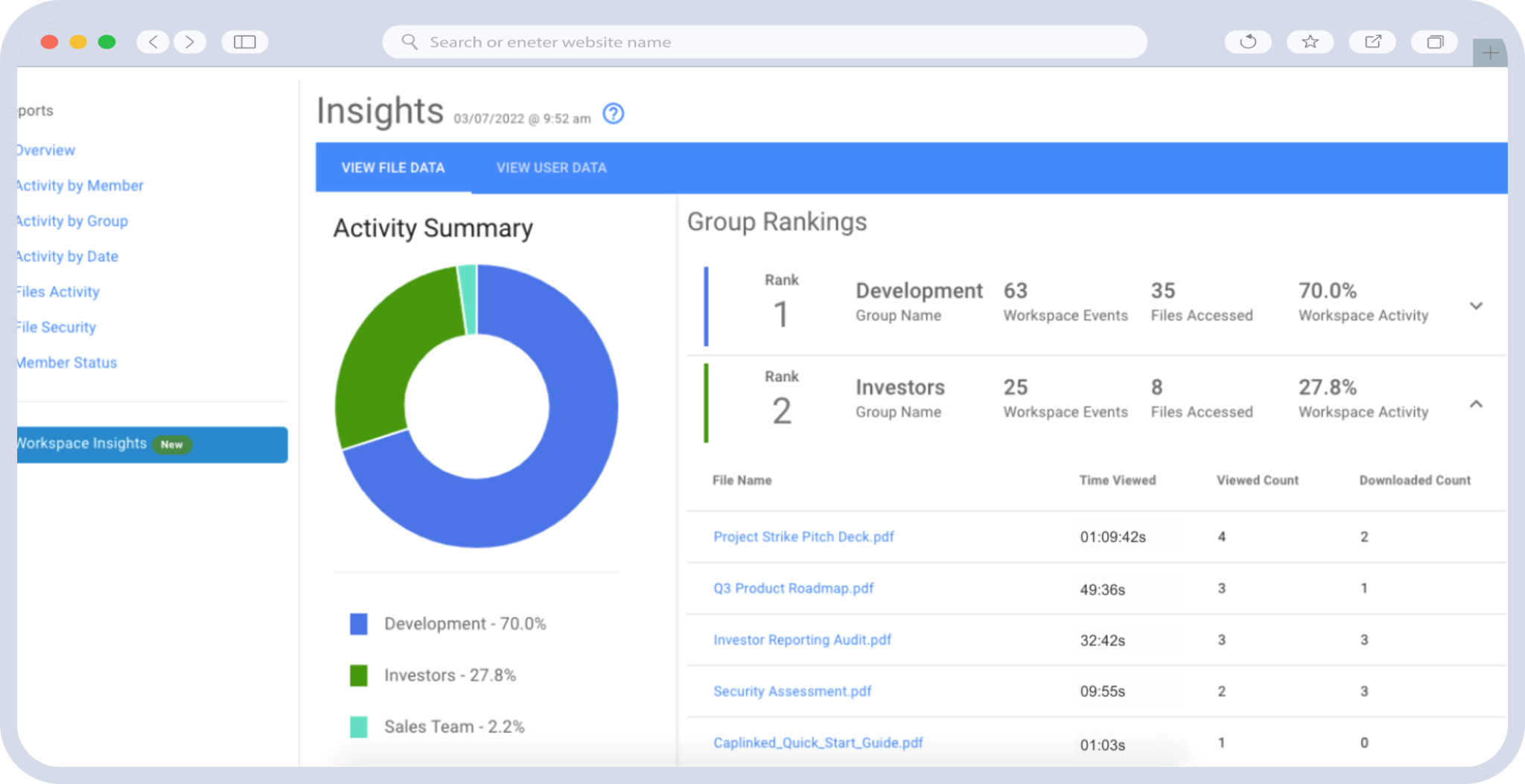
- Week 4+: Live management. Monitor activity dashboards daily, respond to Q&A within SLA targets, upload supplemental documents as they become available, generate weekly activity reports for the deal team, and manage permission escalation as the deal progresses through phases.
- Close: Archival. Export complete audit trail, archive the data room per document retention policy, and prepare a closing index that maps all disclosed documents to the representations and warranties of the definitive agreement.
Conclusion: Key Takeaways
Virtual data room workflows are not one-size-fits-all. The difference between a deal that closes efficiently and one that stalls in diligence often comes down to how well the VDR was structured for the specific transaction type, industry context, and stakeholder dynamics at play.
The essential takeaways from this guide:
- Match your VDR structure to your deal type. M&A sell-side, buy-side, fundraising, litigation, asset sales, and bankruptcy proceedings each require distinct folder taxonomies, permission hierarchies, Q&A protocols, and timeline management approaches.
- Customize for your industry. Healthcare, technology, real estate, and financial services transactions carry unique regulatory, compliance, and documentation requirements that must be reflected in the VDR architecture.
- Invest in setup time to save close time. Teams that spend an additional week properly structuring their data room consistently report shorter overall deal timelines, fewer diligence re-trades, and higher counterparty satisfaction scores.
- Leverage AI and automation. AI-powered document analysis, automated contract extraction, and intelligent Q&A routing are no longer future capabilities—they are available now and deliver measurable efficiency gains.
- Security is non-negotiable. Every workflow should incorporate enterprise-grade encryption, granular permissions, dynamic watermarking, and comprehensive audit trails as baseline requirements, not premium features.
- Treat the VDR as a strategic asset, not a filing cabinet. A well-organized data room signals operational maturity, builds trust with counterparties, and directly impacts deal outcomes—including valuation.
By implementing the deal-specific workflows, industry customizations, and best practices outlined in this guide, deal teams can transform their virtual data room from a passive document repository into an active competitive advantage.
Frequently Asked Questions
M&A virtual data room workflows are broader and more complex, typically involving 12–15 top-level folder categories covering every aspect of a business (financial, legal, tax, operational, environmental, IT, HR). They operate on 8–16 week timelines with three or more permission tiers that escalate as bidders advance through the process. Fundraising VDR workflows are narrower, focused on 8–10 categories emphasizing cap table structure, financial projections, IP ownership, and key metrics. Fundraising data rooms typically operate on 4–10 week timelines with two permission tiers and prioritize narrative sequencing to tell a compelling investment story.
A healthcare M&A virtual data room should follow a standard M&A taxonomy with additional industry-specific sections for HIPAA compliance documentation (including BAAs and PHI handling policies), FDA regulatory files (510(k) clearances, PMA approvals, clinical trial data), Stark Law and Anti-Kickback compliance materials, physician compensation arrangements, state-by-state licensing documents, and Certificate of Need (CON) approvals. Protected health information must be segregated in a separate, access-restricted folder with enhanced audit logging, and the VDR provider must offer HIPAA-compliant infrastructure.
Litigation data rooms differ from deal data rooms in three fundamental ways. First, they are organized by custodian (the person or department from whom documents were collected) rather than by subject matter, which supports defensibility during discovery disputes. Second, they require Bates numbering, production tracking, and privilege logging capabilities that are unnecessary in deal contexts. Third, they demand forensically defensible chain-of-custody audit trails where every access event, download, and export is logged with timestamps and user identification, because the audit trail itself may become evidence.
Essential VDR security features across all deal types include 256-bit AES encryption at rest and in transit, multi-factor authentication for all users, dynamic watermarking on viewed and downloaded documents, granular document-level permissions (view, download, print, save), IP address restrictions, session timeout controls, and comprehensive exportable audit trails. The VDR provider should hold SOC 2 Type II certification and, for international transactions, ISO 27001 compliance. For healthcare deals, HIPAA compliance with BAA support is required. For financial services, additional access controls around regulatory examination reports and BSA/AML documentation are necessary.
Setup timelines vary significantly by deal type. A fundraising VDR can be fully populated and configured in 1–2 weeks if the company maintains organized records. A sell-side M&A data room typically requires 2–4 weeks for full setup, including document collection from multiple departments, quality control review, and permission configuration. Litigation data rooms may take 2–6 weeks depending on the volume of custodian collections and the complexity of processing and review. Bankruptcy Section 363 sale data rooms often must be set up within 1–2 weeks due to compressed court-supervised timelines, which requires advance preparation before the bid procedures order is entered.
AI is transforming VDR workflows in four key areas. Automated contract analysis uses natural language processing to extract critical terms—change of control provisions, assignment restrictions, termination clauses—from hundreds of contracts in hours rather than weeks. Financial statement extraction pulls structured data from documents and populates comparison templates automatically. Anomaly detection flags inconsistencies between disclosed information and supporting documentation. Intelligent Q&A routing analyzes incoming questions and automatically assigns them to the appropriate subject matter expert based on topic classification. These capabilities are particularly impactful in large M&A transactions where the document volume can exceed tens of thousands of files.