A single data breach during an M&A transaction can obliterate deal value overnight, expose proprietary trade secrets to competitors, and trigger regulatory penalties that dwarf the cost of the deal itself. With IBM’s 2024 Cost of a Data Breach Report placing the average breach cost at $4.88 million—and financial services breaches running significantly higher—virtual data room security is no longer a checkbox exercise. It’s a strategic imperative. Yet a surprising number of dealmakers still evaluate VDR platforms based on user interface, storage capacity, and price, while glossing over the security certifications and compliance frameworks that actually determine whether their most sensitive deal data is protected. This guide walks M&A professionals, legal teams, and corporate development leaders through the critical compliance standards, encryption protocols, and vendor evaluation criteria that separate genuinely secure virtual data rooms from platforms that merely claim to be.
Table of Contents
ToggleWhy Virtual Data Room Security Is the Foundation of Every M&A Deal
M&A transactions involve the exchange of an organization’s most sensitive information: financial statements, intellectual property portfolios, employee records, customer contracts, litigation histories, and strategic plans. This information flows between multiple parties—buyers, sellers, legal counsel, financial advisors, and regulators—each with different access requirements and risk profiles.
The consequences of inadequate virtual data room security extend far beyond data loss. Breached deal information can trigger stock price manipulation, competitive intelligence leaks, regulatory investigations, and the complete collapse of buyer confidence. In cross-border transactions, non-compliance with data protection regulations like GDPR can result in fines of up to 4% of annual global turnover, as outlined by the European Commission’s data protection framework.
For these reasons, VDR compliance requirements should be the first—not the last—criterion in any platform evaluation. Understanding what standards exist, what they certify, and how to verify them gives dealmakers a concrete framework for protecting their transactions.
Core Security Certifications Every VDR Must Have
Not all security certifications carry equal weight, and not all VDR providers pursue the same ones. The certifications below represent the gold standard for M&A data protection, and any serious virtual data room vendor should hold at least two of them.
SOC 2 Type II: The Trust Benchmark for Cloud-Based Services
SOC 2 (Service Organization Control 2) is an auditing framework developed by the American Institute of Certified Public Accountants (AICPA) that evaluates how a service provider manages data based on five Trust Services Criteria: security, availability, processing integrity, confidentiality, and privacy.
There’s a critical distinction between SOC 2 Type I and Type II. A Type I report evaluates the design of controls at a single point in time. A Type II report—the one you should demand from any VDR vendor—evaluates the operational effectiveness of those controls over a sustained period, typically six to twelve months. This means an independent auditor has verified that the provider consistently enforces the security measures it claims to have in place.
What to ask your VDR vendor: Request the most recent SOC 2 Type II report. Confirm the audit period, the Trust Services Criteria covered, and whether any exceptions or qualified opinions were noted. A vendor that hesitates to share this report—or only holds a Type I certification—should raise immediate red flags.
ISO 27001: The Global Standard for Information Security Management
ISO 27001 is an internationally recognized standard published by the International Organization for Standardization (ISO) that specifies the requirements for establishing, implementing, maintaining, and continually improving an information security management system (ISMS). Unlike SOC 2, which is predominantly U.S.-focused, ISO 27001 has global applicability and is particularly important for cross-border M&A transactions.
ISO 27001 certification requires organizations to systematically identify information security risks, design comprehensive controls to mitigate them, and adopt an ongoing management process to ensure those controls remain effective. The certification is granted by accredited third-party auditors and must be renewed through regular surveillance audits.
Why it matters for M&A: When European or Asia-Pacific counterparties are involved in a deal, ISO 27001 certification signals that your VDR provider meets internationally recognized secure file sharing standards—not just domestic ones. It also demonstrates a culture of continuous security improvement rather than one-time compliance.
SOC 2 vs. ISO 27001: Which Matters More?
The short answer is both. SOC 2 Type II and ISO 27001 are complementary, not competing, certifications. SOC 2 provides detailed assurance about specific controls and their operational effectiveness, while ISO 27001 validates the broader security management system. A VDR provider holding both certifications demonstrates a comprehensive commitment to data protection that satisfies stakeholders on both sides of the Atlantic.
Regulatory Compliance Frameworks for Industry-Specific M&A Deals
Beyond foundational security certifications, certain industries and transaction types require compliance with specific regulatory frameworks. Failing to verify your VDR’s alignment with these frameworks can expose your organization to significant legal and financial liability.
GDPR: Mandatory for Any Transaction Involving EU Data Subjects
The General Data Protection Regulation governs how personal data of EU residents is collected, processed, stored, and transferred. In M&A transactions, due diligence data rooms routinely contain employee records, customer databases, and vendor information that falls squarely under GDPR’s scope—even when the acquiring company is based outside the EU.
A GDPR-compliant virtual data room must provide:
- Data residency controls: The ability to specify where data is physically stored, with EU-based hosting options
- Right to erasure capabilities: Mechanisms to permanently delete personal data upon request or deal termination
- Data processing agreements: Formal contracts that define the VDR provider’s role as a data processor under Article 28
- Lawful basis documentation: Tools that help deal parties document the legal basis for processing personal data during due diligence
- Breach notification protocols: Automated systems that support the 72-hour notification requirement under Article 33
HIPAA: Non-Negotiable for Healthcare M&A
Healthcare mergers, acquisitions, and partnerships involve protected health information (PHI) that falls under the Health Insurance Portability and Accountability Act. The U.S. Department of Health and Human Services’ HIPAA Security Rule mandates specific administrative, physical, and technical safeguards for electronic PHI.
A HIPAA-compliant VDR must offer:
- Business Associate Agreements (BAAs): Legally binding contracts that establish the VDR provider’s obligations for safeguarding PHI
- End-to-end encryption: Both in transit and at rest, meeting or exceeding AES 256-bit standards
- Access controls and audit trails: Granular, role-based permissions with immutable logs of every access event
- Automatic session timeouts and device restrictions: To prevent unauthorized access from unattended or unapproved devices
Organizations conducting healthcare M&A without a HIPAA-compliant virtual data room risk violations that carry penalties of up to $2.13 million per violation category per year, in addition to potential criminal liability.
Additional Regulatory Considerations
Depending on your industry and jurisdiction, your VDR may also need to comply with:
- FINRA and SEC requirements for financial services transactions, including record retention and supervisory controls
- ITAR and EAR regulations for defense and technology deals involving export-controlled data
- CCPA/CPRA for transactions involving California consumer data
- FedRAMP for deals involving U.S. government contracts or data
Encryption Standards and Technical Security Controls
Compliance certifications validate a VDR provider’s security management systems and processes. But the underlying technical controls—particularly encryption—are what actually protect your data from unauthorized access.
Encryption: The Non-Negotiable Minimum
Every virtual data room used for M&A should implement AES 256-bit encryption at rest and TLS 1.2 or higher encryption in transit. AES 256-bit is the same encryption standard used by intelligence agencies and financial institutions worldwide. Anything less is unacceptable for high-stakes transactions.
Beyond baseline encryption, look for these advanced protections:
- Dynamic watermarking: Visible and invisible watermarks on viewed and downloaded documents that trace leaks to specific users
- Remote shred / expiry: The ability to revoke access to downloaded documents after the deal closes or falls through
- Two-factor and multi-factor authentication (MFA): Required for all users, not just administrators
Access Controls and Audit Trails
Granular access controls are fundamental to due diligence security. A properly configured VDR should allow administrators to set permissions at the folder, document, and even page level. Permissions should include view-only, print, download, upload, and administrative tiers—with the ability to customize these for each user or user group.
Comprehensive audit trails are equally critical. Every action within the data room—document views, downloads, prints, login attempts (successful and failed), permission changes, and Q&A interactions—should be logged with timestamps, IP addresses, and user identification. These logs serve dual purposes: real-time security monitoring during the deal and post-deal evidence of proper data governance.
Infrastructure Security
Evaluate your VDR provider’s infrastructure with the same rigor you’d apply to any enterprise cloud vendor:
- Data center certifications: SOC 1/SOC 2 certified facilities with redundant power, cooling, and connectivity
- Geographic redundancy: Data replicated across multiple geographically separated data centers for disaster recovery
- Penetration testing: Regular third-party penetration tests with results available to customers upon request
- 99.95%+ uptime SLAs: Guaranteed availability backed by financial penalties for downtime
- Intrusion detection and prevention systems (IDS/IPS): Real-time monitoring for unauthorized access attempts
How to Evaluate VDR Vendors on Security Credentials: A Practical Checklist
When evaluating virtual data room providers for your next M&A transaction, use this actionable checklist to separate vendors with genuine security credentials from those offering little more than marketing promises.
Certification and Compliance Verification
- Does the vendor hold a current SOC 2 Type II report? When was the most recent audit completed?
- Is the vendor ISO 27001 certified? Is the certificate issued by an accredited certification body?
- Can the vendor provide a HIPAA Business Associate Agreement if your deal involves healthcare data?
- Does the vendor offer GDPR-compliant data residency options and data processing agreements?
- Has the vendor undergone independent third-party penetration testing within the last twelve months?
Technical Security Assessment
- What encryption standards are used at rest and in transit?
- Does the platform support multi-factor authentication for all users?
- Can permissions be set at the individual document level?
- Does the platform offer dynamic watermarking and remote document expiry?
- Are audit trails comprehensive, immutable, and exportable?
Operational Security Practices
- What is the vendor’s incident response plan, and what is the average notification time for security events?
- Does the vendor conduct regular employee security training and background checks?
- What is the vendor’s data retention and destruction policy post-deal?
- Does the vendor maintain cyber liability insurance?
Common Security Mistakes M&A Teams Make—and How to Avoid Them
Even sophisticated deal teams make avoidable security errors that put transactions at risk. Here are the most common pitfalls and how to sidestep them:
Using consumer-grade file sharing tools: Platforms like Google Drive, Dropbox, and email lack the granular access controls, audit trails, and compliance certifications required for M&A data protection. Using them for due diligence is the equivalent of leaving confidential deal documents in an unlocked conference room.
Granting overly broad permissions: The principle of least privilege should govern every data room. Users should only access the specific documents relevant to their role in the transaction. Blanket access dramatically increases the attack surface and the risk of inadvertent disclosure.
Failing to revoke access promptly: When advisors leave a deal team, when a bidder is eliminated, or when the transaction closes, access should be revoked immediately. Delayed deprovisioning is one of the most common—and preventable—sources of post-deal data exposure.
Ignoring the vendor’s security history: Ask vendors directly about past security incidents, how they were handled, and what changes resulted. A vendor that claims a flawless security record may simply lack the monitoring capabilities to detect incidents.
Protect Your Next Deal with a Security-First Virtual Data Room
Virtual data room security is not a feature—it’s the foundation upon which every successful M&A transaction is built. From SOC 2 Type II and ISO 27001 certifications to GDPR and HIPAA compliance, the standards outlined in this guide represent the minimum threshold for any platform entrusted with sensitive deal data.
CapLinked’s virtual data room platform is built from the ground up for secure, compliant M&A transactions. With enterprise-grade encryption, granular access controls, comprehensive audit trails, and the security certifications that institutional dealmakers demand, CapLinked gives buyers, sellers, and advisors the confidence to share sensitive information without compromising data protection.
Start a free trial of CapLinked to experience how a security-first virtual data room protects your most critical transactions—or contact our team to discuss your specific compliance requirements.
Frequently Asked Questions
What is virtual data room security, and why does it matter for M&A transactions?
Virtual data room security refers to the combination of encryption standards, access controls, compliance certifications, and audit capabilities that protect sensitive documents shared during transactions. It matters for M&A because due diligence involves exchanging highly confidential financial, legal, and operational data between multiple parties, and a breach can destroy deal value, trigger regulatory penalties, and expose trade secrets to competitors.
What security certifications should a virtual data room have for M&A?
At minimum, a virtual data room used for M&A should hold SOC 2 Type II certification and ISO 27001 certification. SOC 2 Type II verifies that the provider’s security controls are operationally effective over time, while ISO 27001 validates a comprehensive information security management system recognized globally. For healthcare or financial services deals, additional compliance with HIPAA or FINRA/SEC requirements is essential.
How does GDPR affect virtual data room compliance in cross-border M&A deals?
GDPR applies whenever a transaction involves personal data of EU residents, regardless of where the acquiring company is based. A GDPR-compliant virtual data room must offer EU data residency options, data processing agreements, right-to-erasure capabilities, and 72-hour breach notification support. Non-compliance can result in fines of up to 4% of annual global turnover.
What encryption standards should a secure virtual data room use?
A secure virtual data room should use AES 256-bit encryption for data at rest and TLS 1.2 or higher for data in transit. These are the same encryption standards used by government agencies and major financial institutions. Additional protections such as dynamic watermarking, multi-factor authentication, and remote document expiry further strengthen virtual data room security.
How do you evaluate a VDR vendor’s security credentials before signing a contract?
Request the vendor’s most recent SOC 2 Type II report and ISO 27001 certificate, confirm they are current, and review any noted exceptions. Ask about third-party penetration testing frequency, incident response protocols, data retention policies, and whether the vendor can provide HIPAA BAAs or GDPR data processing agreements. A credible vendor will share this documentation transparently and without hesitation.
What is the difference between SOC 2 Type I and SOC 2 Type II for virtual data rooms?
SOC 2 Type I evaluates whether a vendor’s security controls are properly designed at a single point in time, while SOC 2 Type II evaluates whether those controls are operationally effective over a sustained period of six to twelve months. For M&A transactions, SOC 2 Type II is the preferred standard because it provides ongoing assurance that virtual data room security measures are consistently enforced, not just theoretically sound.
Frequently Asked Questions
The appropriate retention period depends on the transaction type, applicable regulations, and contractual obligations. As a general guideline, most M&A practitioners maintain VDR access for a minimum period aligned with the indemnification survival period specified in the purchase agreement—typically 12 to 24 months for general representations and up to six years for fundamental representations such as tax and authority. Financial records should generally be retained for at least seven years per IRS guidelines, and environmental records may require retention for 30 years or more. Organizations should develop a retention schedule that addresses each document category individually, rather than applying a single blanket retention period.
Access for non-winning bidders should be revoked promptly upon their elimination from the process or, at the latest, upon deal closing. Before revoking access, generate a final activity report for each user documenting what they accessed during the process. If NDA provisions require the return or destruction of confidential information, send formal notices to each bidder's legal counsel confirming access revocation and requesting certification of destruction of any downloaded materials. The VDR's audit trail provides documentation of what each party accessed, which may be relevant if confidentiality disputes arise later.
Organizations should conduct a data mapping exercise to identify any personal data contained within the VDR—employee records, customer information, and third-party contact details are common examples. Under GDPR Article 5, personal data must not be retained longer than necessary for the purpose for which it was processed. Establish lawful bases for continued retention (e.g., legitimate interest in defending potential legal claims, compliance with legal obligations), document these bases, and implement technical measures including encryption, access controls, and automated deletion triggers when retention periods expire. For cross-border transactions, ensure that any transfer of archived data complies with applicable data transfer mechanisms such as Standard Contractual Clauses.
A VDR platform suitable for full lifecycle management should offer read-only archive mode (preventing modifications while preserving access), continued encryption and security controls in archive state, preserved audit trails and activity logs, searchability and efficient document retrieval, granular access controls that can be maintained and updated during the retention period, automated notifications for retention period expirations, and the ability to generate secure export packages or destruction certificates. CapLinked's platform provides all of these capabilities, enabling organizations to transition seamlessly from active deal management to long-term secure archiving without migrating data to separate systems.
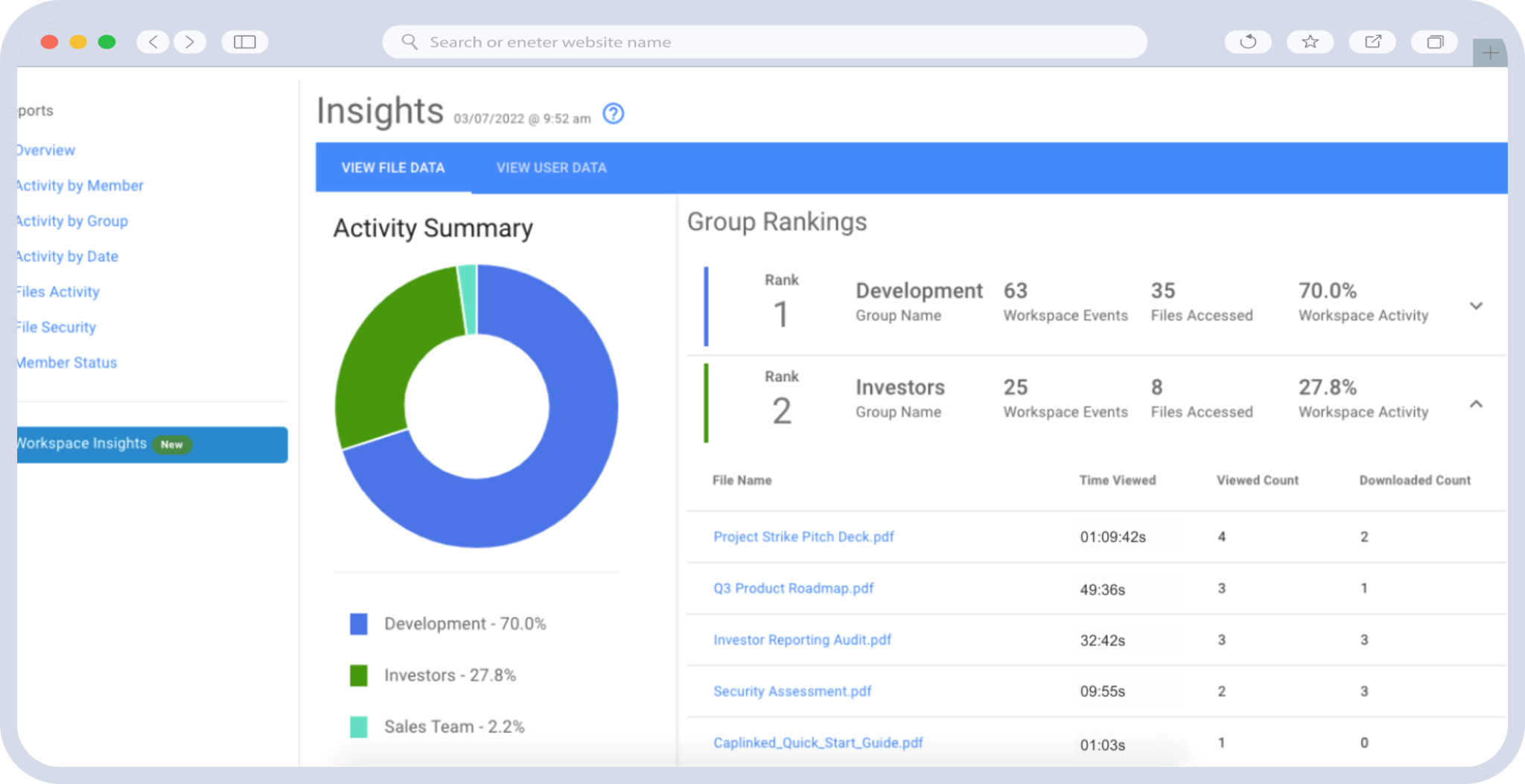
Post-transaction analysis of VDR analytics yields actionable insights across several dimensions. Review document access patterns to identify which areas received the most scrutiny—these often correspond to buyer concerns that could be proactively addressed in future transactions through improved documentation or operational remediation. Analyze Q&A logs to build a library of frequently asked questions and approved responses that can be deployed in future data rooms, significantly reducing response times. Evaluate the folder structure and document organization for usability, incorporating feedback from buyers and advisors to refine your taxonomy. Finally, use activity timing data to understand how long due diligence actually takes across different document categories, enabling more accurate process timeline planning for future transactions.
Failing to properly close down a VDR after a deal creates several material risks. Continued unauthorized access to sensitive business information exposes the organization to potential data breaches, competitive intelligence leakage, and confidentiality violations. Indefinite retention of personal data without a lawful basis can result in regulatory penalties—GDPR fines can reach up to €20 million or 4% of global annual turnover, whichever is higher. In litigation, an unmanaged data room may become subject to broad discovery requests, with the absence of proper retention and deletion protocols potentially giving rise to adverse inference arguments. Additionally, ongoing VDR subscription costs for unused data rooms represent a direct and unnecessary financial expense. A disciplined wind-down protocol mitigates all of these risks while preserving the data and records that have genuine long-term value.