The M&A market in 2026 is surging. As David Dubner, Global COO of M&A in Investment Banking, recently noted, “The fundamental drivers of M&A — the availability of capital in the public and private markets, the resurgence of the IPO market, the desire to continue to position strategically — these forces are all in play in 2026.” With deal volume accelerating, the pressure on M&A professionals to execute due diligence faster, more securely, and with greater precision has never been higher. And at the center of every successful transaction sits a critical technology decision: choosing the right virtual data room for M&A. Select the wrong platform, and you risk leaked documents, sluggish due diligence, and deal-killing delays. Select the right one, and you gain a competitive advantage that compresses timelines, strengthens confidentiality, and instills confidence in every stakeholder at the table. This guide gives you a complete, practical framework for making that decision.
Table of Contents
ToggleWhy a Virtual Data Room Is Non-Negotiable for Modern M&A
A virtual data room (VDR) is a secure, cloud-based platform purpose-built for storing, sharing, and managing confidential documents during high-stakes transactions. While generic file-sharing tools like Google Drive or Dropbox may work for everyday collaboration, they lack the granular security controls, audit trails, and compliance frameworks that M&A deals demand.
According to the U.S. Securities and Exchange Commission, companies involved in mergers and acquisitions must maintain strict controls over material non-public information. A purpose-built VDR provides the infrastructure to meet these obligations — from watermarked document views to role-based access permissions — while simultaneously accelerating the due diligence process.
For private equity firms, investment banks, corporate development teams, and legal advisors, a deal management platform is no longer a convenience. It’s a fiduciary necessity.
The Decision-Making Framework: How to Evaluate a Virtual Data Room for M&A
Not all VDRs are created equal. Below is a structured framework organized around the five pillars that matter most when comparing due diligence software for M&A transactions. Use this as your evaluation checklist before signing any contract.
1. Security and Compliance
Security is the foundation. A data breach during an active deal can destroy value, invite regulatory scrutiny, and erode trust permanently. When conducting your VDR comparison, prioritize these security capabilities:
- End-to-end encryption: Data should be encrypted both in transit (TLS 1.2+) and at rest (AES-256). This is the baseline, not a premium feature.
- Granular permission controls: Look for role-based access that goes beyond simple read/write permissions. The best platforms offer document-level controls including view-only, print-disabled, download-restricted, and time-limited access.
- Dynamic watermarking: Every document view should be traceable with user-specific watermarks that include name, IP address, and timestamp.
- Two-factor authentication (2FA): Non-negotiable for any platform handling deal-sensitive materials.
- Compliance certifications: Verify SOC 2 Type II, ISO 27001, and GDPR compliance. For deals involving healthcare or financial data, confirm HIPAA or FINRA-ready infrastructure. The National Institute of Standards and Technology (NIST) Cybersecurity Framework provides an excellent benchmark for evaluating vendor security posture.
- Comprehensive audit trails: Every action — document views, downloads, permission changes, login attempts — must be logged and exportable for legal and regulatory review.
2. User Experience and Collaboration Tools
Security means nothing if your deal team and counterparties can’t use the platform efficiently. Cumbersome interfaces slow down due diligence, frustrate bidders, and can even discourage competitive offers. Evaluate these usability factors:
- Intuitive navigation: Can a first-time user — an external counsel, a junior analyst, a board member — find and review documents without training? The best platforms feature drag-and-drop uploads, automatic index numbering, and intelligent search.
- Q&A module: A built-in question-and-answer workflow is essential for managing buyer inquiries. Look for features like question assignment, status tracking, bulk export, and integration with the document index.
- Bulk upload and folder structure: M&A data rooms often contain thousands of files. The platform should support bulk uploads, automatic OCR for scanned documents, and customizable folder templates aligned with standard due diligence checklists.
- Mobile access: Deal professionals work across time zones and devices. Responsive design or dedicated mobile apps are critical for keeping reviews on track.
- Multi-language support: For cross-border transactions, ensure the interface and notifications support the languages your counterparties use.
3. Deal Management and Workflow Features
A modern virtual data room for M&A should do more than store files — it should actively manage the deal process. Key M&A software features to look for include:
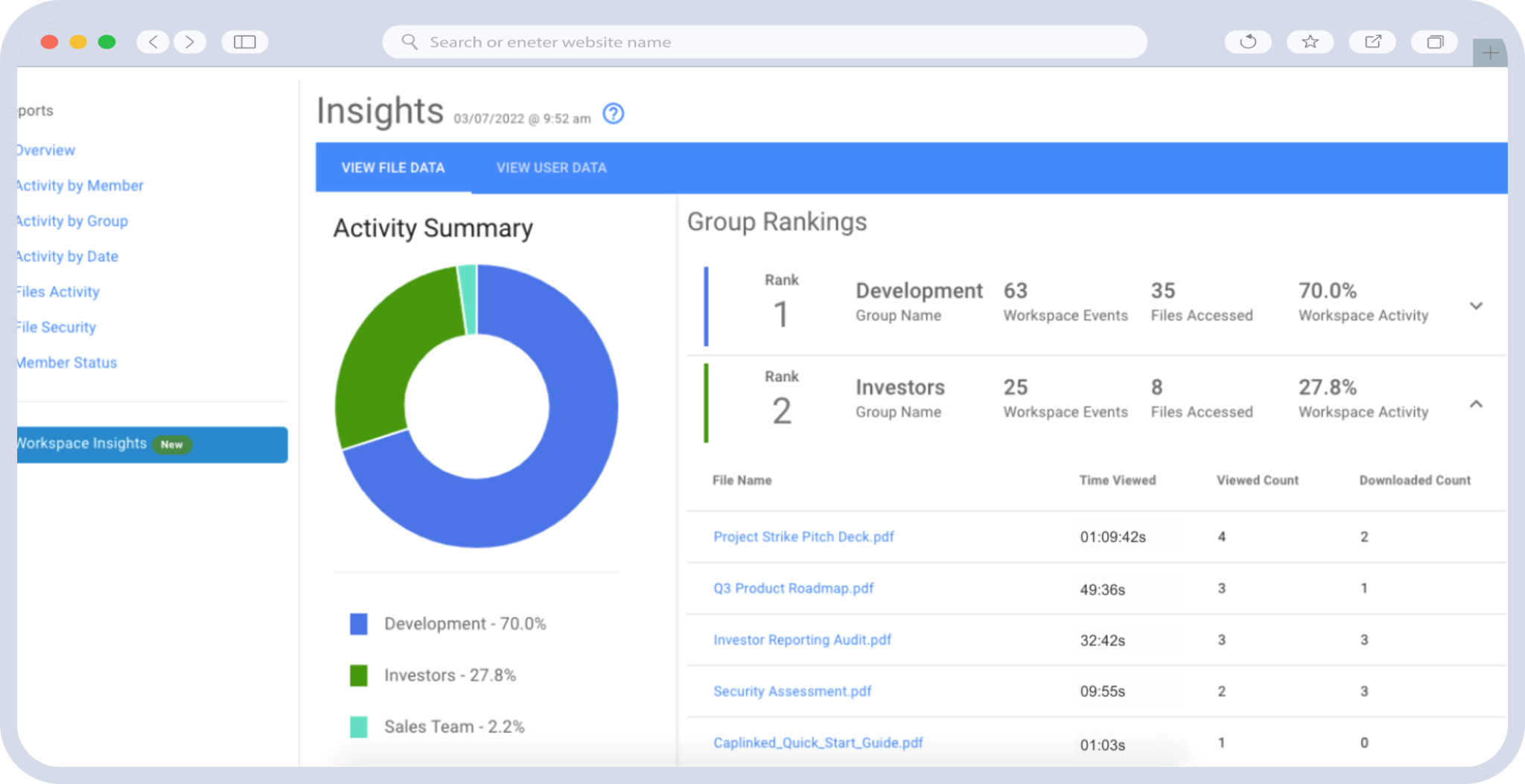
- Activity dashboards and analytics: Real-time reporting on which documents have been viewed, by whom, and for how long. These insights help sell-side advisors gauge buyer interest and tailor follow-up strategies.
- Stage-based access: The ability to control which documents are visible at each phase of the deal — initial marketing, first-round due diligence, final bid — without creating entirely separate data rooms.
- Task management: Integrated task assignments and checklists keep deal teams organized, especially when managing multiple workstreams across legal, financial, tax, and operational due diligence.
- Version control: Automatic versioning ensures that all parties are reviewing the most current document while preserving a complete history of revisions.
- Redaction tools: Built-in redaction allows sensitive information to be selectively obscured without altering source documents — critical when different bidder groups have different levels of clearance.
4. Integration and Scalability
Your VDR doesn’t operate in isolation. It needs to fit within your broader technology ecosystem. Consider:
- API access: Does the platform offer APIs for integrating with your CRM, project management tools, or internal compliance systems?
- Single sign-on (SSO): Enterprise-grade SSO integration (SAML 2.0, OAuth) simplifies access management for large deal teams.
- Scalability: Can the platform handle the data volume and user count of your most complex deals? Some providers charge per-page or per-user, creating unpredictable costs as transactions scale. Look for unlimited storage and user models.
- Multi-project support: Firms running multiple concurrent deals need the ability to manage several data rooms under a single administrative umbrella.
5. Pricing Transparency and Total Cost of Ownership
VDR pricing models vary significantly across the market, and the cheapest option is rarely the best value. The International Bar Association has emphasized the importance of evaluating technology investments on total cost of ownership rather than sticker price alone. Here’s what to watch for:
- Flat-rate vs. per-page pricing: Per-page pricing can spiral quickly on document-heavy deals. Flat-rate or unlimited models offer predictability.
- Hidden fees: Ask about charges for additional users, storage overages, data migration, custom branding, training, and post-deal archival access.
- Contract flexibility: Some deals close in weeks; others take months. Ensure the provider offers monthly billing options and doesn’t lock you into rigid annual contracts unless the economics justify it.
- Setup and support costs: Does the vendor provide dedicated project management support? Is 24/7 customer service included or billed separately?
- ROI beyond the platform fee: Factor in time savings from efficient document management, reduced legal risk from robust audit trails, and the competitive advantage of a professional, well-organized data room that attracts stronger bids.
Your M&A Data Room Evaluation Checklist
Before making your final decision, use this practical checklist to score each platform you’re considering. Rate each criterion on a scale of 1–5 and weight categories based on your specific deal requirements:
- Security: Encryption standards, access controls, watermarking, 2FA, compliance certifications, audit trails
- Usability: Interface intuitiveness, Q&A workflow, search functionality, mobile access, onboarding speed
- Deal management: Analytics dashboards, stage-based access, task management, version control, redaction
- Integration: API availability, SSO support, CRM compatibility, multi-project management
- Pricing: Model transparency, contract flexibility, hidden fees, included support, overall ROI
- Vendor stability: Years in market, client references in your industry, uptime SLA guarantees, data sovereignty options
As recommended by U.S. Department of Defense procurement guidelines for handling controlled information, and broadly applicable to private sector best practices, always verify that your vendor can demonstrate compliance with the specific regulatory frameworks governing your transaction.
Common Mistakes When Choosing a VDR for M&A
Even experienced deal professionals make avoidable errors when selecting secure file sharing for deals. Here are the most common pitfalls:
- Choosing based on brand name alone: The biggest vendor isn’t always the best fit. A mid-market deal doesn’t need the same infrastructure as a $10 billion cross-border merger — and shouldn’t pay for it.
- Ignoring the end-user experience: If your bidders struggle to navigate the data room, they may submit lower offers or withdraw entirely. Always run a pilot with real users before committing.
- Overlooking post-deal access: Many transactions require continued access to data room documents after closing for integration, regulatory filings, or dispute resolution. Confirm archival policies and costs upfront.
- Skipping reference checks: Ask vendors for references from clients who used the platform for transactions similar in size, complexity, and industry to yours.
- Failing to test support responsiveness: Submit a support ticket during your trial period. Measure response time. During a live deal, a 24-hour wait for technical support is unacceptable. According to Harvard Business Review’s coverage of M&A due diligence trends, technology failures during active deals are among the top preventable causes of transaction delays.
Why CapLinked Is Built for M&A Professionals
CapLinked was designed from the ground up as a virtual data room for M&A — not retrofitted from a generic file-sharing tool. The platform delivers enterprise-grade security with SOC 2 compliance, dynamic watermarking, and granular permission controls, wrapped in an interface that deal teams and counterparties can navigate immediately without training.
With flexible pricing models that scale with your transaction, robust analytics that give sell-side advisors real-time visibility into buyer engagement, and a Q&A workflow that streamlines due diligence communications, CapLinked provides the infrastructure to run faster, more secure, and more professional deals.
Whether you’re managing a single divestiture or running a multi-asset auction process, CapLinked’s deal management platform gives you the control, security, and insights you need to close with confidence.
Ready to see how CapLinked can power your next transaction? Start your free trial today or request a personalized demo to walk through the platform with a deal technology specialist. Your next close starts with the right data room.
Frequently Asked Questions
What is a virtual data room for M&A?
A virtual data room for M&A is a secure, cloud-based platform used to store, share, and manage confidential documents during mergers and acquisitions. It provides features like granular access controls, audit trails, dynamic watermarking, and Q&A workflows specifically designed to support the due diligence process and protect sensitive deal information throughout the transaction lifecycle.
How much does a virtual data room for M&A cost in 2026?
Virtual data room pricing in 2026 varies widely depending on the provider and pricing model. Flat-rate plans typically range from $400 to $2,000+ per month, while per-page pricing can cost $0.40 to $0.85 per page. The total cost depends on storage needs, user count, deal duration, and included features. Always evaluate total cost of ownership, including setup fees, overage charges, and post-deal archival access.
What security features should I look for in an M&A data room?
Essential security features for an M&A data room include AES-256 encryption at rest, TLS encryption in transit, two-factor authentication, role-based granular permissions, dynamic watermarking, and comprehensive audit trails. The platform should also hold SOC 2 Type II and ISO 27001 certifications and comply with GDPR and any industry-specific regulations relevant to your transaction.
How does a virtual data room for M&A differ from Dropbox or Google Drive?
Unlike generic file-sharing services, a virtual data room for M&A provides deal-specific features such as granular document-level permissions, dynamic watermarking, detailed audit trails, built-in Q&A modules, and compliance with financial regulatory standards. These capabilities are critical for protecting material non-public information and meeting the fiduciary obligations that govern M&A transactions.
What are the most important features to compare when choosing M&A due diligence software?
When comparing M&A due diligence software, focus on five key areas: security and compliance certifications, user experience and collaboration tools like Q&A workflows, deal management features including analytics dashboards and stage-based access controls, integration capabilities with your existing tech stack, and pricing transparency with flexible contract terms. Scoring each vendor across these categories provides a structured, objective basis for your decision.
How long does it take to set up a virtual data room for an M&A deal?
Most modern virtual data rooms can be set up within 24 hours, and many platforms like CapLinked allow you to create a fully structured data room in under an hour. The timeline depends on the volume of documents to upload and the complexity of your permission structure. Providers that offer pre-built folder templates based on standard due diligence checklists can significantly accelerate setup time.
Frequently Asked Questions
The appropriate retention period depends on the transaction type, applicable regulations, and contractual obligations. As a general guideline, most M&A practitioners maintain VDR access for a minimum period aligned with the indemnification survival period specified in the purchase agreement—typically 12 to 24 months for general representations and up to six years for fundamental representations such as tax and authority. Financial records should generally be retained for at least seven years per IRS guidelines, and environmental records may require retention for 30 years or more. Organizations should develop a retention schedule that addresses each document category individually, rather than applying a single blanket retention period.
Access for non-winning bidders should be revoked promptly upon their elimination from the process or, at the latest, upon deal closing. Before revoking access, generate a final activity report for each user documenting what they accessed during the process. If NDA provisions require the return or destruction of confidential information, send formal notices to each bidder's legal counsel confirming access revocation and requesting certification of destruction of any downloaded materials. The VDR's audit trail provides documentation of what each party accessed, which may be relevant if confidentiality disputes arise later.
Organizations should conduct a data mapping exercise to identify any personal data contained within the VDR—employee records, customer information, and third-party contact details are common examples. Under GDPR Article 5, personal data must not be retained longer than necessary for the purpose for which it was processed. Establish lawful bases for continued retention (e.g., legitimate interest in defending potential legal claims, compliance with legal obligations), document these bases, and implement technical measures including encryption, access controls, and automated deletion triggers when retention periods expire. For cross-border transactions, ensure that any transfer of archived data complies with applicable data transfer mechanisms such as Standard Contractual Clauses.
A VDR platform suitable for full lifecycle management should offer read-only archive mode (preventing modifications while preserving access), continued encryption and security controls in archive state, preserved audit trails and activity logs, searchability and efficient document retrieval, granular access controls that can be maintained and updated during the retention period, automated notifications for retention period expirations, and the ability to generate secure export packages or destruction certificates. CapLinked's platform provides all of these capabilities, enabling organizations to transition seamlessly from active deal management to long-term secure archiving without migrating data to separate systems.
Post-transaction analysis of VDR analytics yields actionable insights across several dimensions. Review document access patterns to identify which areas received the most scrutiny—these often correspond to buyer concerns that could be proactively addressed in future transactions through improved documentation or operational remediation. Analyze Q&A logs to build a library of frequently asked questions and approved responses that can be deployed in future data rooms, significantly reducing response times. Evaluate the folder structure and document organization for usability, incorporating feedback from buyers and advisors to refine your taxonomy. Finally, use activity timing data to understand how long due diligence actually takes across different document categories, enabling more accurate process timeline planning for future transactions.
Failing to properly close down a VDR after a deal creates several material risks. Continued unauthorized access to sensitive business information exposes the organization to potential data breaches, competitive intelligence leakage, and confidentiality violations. Indefinite retention of personal data without a lawful basis can result in regulatory penalties—GDPR fines can reach up to €20 million or 4% of global annual turnover, whichever is higher. In litigation, an unmanaged data room may become subject to broad discovery requests, with the absence of proper retention and deletion protocols potentially giving rise to adverse inference arguments. Additionally, ongoing VDR subscription costs for unused data rooms represent a direct and unnecessary financial expense. A disciplined wind-down protocol mitigates all of these risks while preserving the data and records that have genuine long-term value.