Every week a deal closes late—or falls apart entirely—because someone emailed the wrong version of a confidential financial model, a buyer’s counsel couldn’t access a critical contract over the weekend, or an audit trail simply didn’t exist. These aren’t hypotheticals. They are the hidden costs that erode deal value when M&A teams rely on email, generic cloud storage, or outdated on-premise file shares. Understanding virtual data room ROI isn’t just an IT discussion; it’s the business case that separates disciplined deal teams from those bleeding time, money, and risk exposure at every stage of due diligence.
In this analysis, we quantify the cost-benefit equation CFOs and deal advisors actually care about: how a purpose-built virtual data room reduces deal timelines, eliminates compliance vulnerabilities, and delivers measurable VDR cost savings compared to alternatives like email attachments, Box, Dropbox, or physical data rooms.
The True Cost of “Good Enough” File Sharing in M&A
Many organizations default to the tools they already have—email, Dropbox, Google Drive, or Box—reasoning that an existing subscription means zero incremental cost. That reasoning collapses under scrutiny the moment confidential deal documents enter the workflow.
Email: The Most Expensive “Free” Tool in M&A
Standard email protocols were never designed for the security, version control, or auditability that M&A due diligence demands. According to the Cybersecurity and Infrastructure Security Agency (CISA), email attachments remain one of the most common vectors for data breaches, and basic encryption during transmission provides only a thin layer of protection for sensitive financial records.
- No granular permissions: Once a PDF leaves your outbox, you cannot revoke access, restrict printing, or prevent forwarding.
- No audit trail: You have no verifiable record of who viewed which document, when, or for how long—a gap that can become a liability in regulatory inquiries.
- Version chaos: Multiple attachments create multiple versions, and a single outdated spreadsheet circulating among buyer counsel can delay closing by days or weeks.
- Storage limits and search friction: Finding the correct executed agreement inside a mailbox with 50,000 messages is not due diligence efficiency—it’s archaeology.
Consumer Cloud Storage: Better, but Not Built for Deals
Platforms like Box, Dropbox, and Google Drive improve collaboration over email, but they lack the deal-specific architecture that M&A workflows require. They typically offer folder-level permissions at best, limited watermarking, no built-in Q&A workflows, and audit logs that fall short of what legal and compliance teams need to satisfy regulatory obligations. As the U.S. Securities and Exchange Commission has emphasized, companies involved in transactions must maintain robust controls over material nonpublic information—controls that generic file-sharing tools were simply not engineered to provide.
Physical Data Rooms: A Relic with Real Costs
Before VDRs, sellers rented conference rooms, printed thousands of pages, hired security guards, and flew buyers in for multi-day review sessions. Adjusted for inflation, a physical data room for a mid-market deal could easily run $50,000–$100,000 once you factor in printing, courier services, travel, facility rental, and the supervision required to prevent unauthorized copying. The time cost was even steeper: buyers reviewed documents sequentially, meaning a single transaction with five interested parties could stretch the diligence phase by weeks.
Quantifying Virtual Data Room ROI: The Metrics That Matter
Calculating virtual data room ROI requires looking beyond the subscription line item and measuring impact across four dimensions: time savings, risk reduction, operational cost avoidance, and deal-outcome improvement.
1. Deal Timeline Compression
Speed is value in M&A. Every additional week a deal stays open introduces market risk, employee uncertainty, and potential for competitive leaks. Benchmarking data from Q1 2026, drawn from 283 anonymized deals tracked by the Peony research platform, indicates that the average data room cost came in at approximately $249 per month—a fraction of the hourly rate of a single M&A attorney. When a VDR’s structured index, permission templates, and AI-powered document organization eliminate even one week of back-and-forth, the savings in professional fees alone can exceed the platform’s annual cost by a factor of ten or more.
Deal teams using purpose-built VDRs consistently report setup times measured in hours rather than days, instant buyer onboarding via secure link invitations, and parallel review capability that lets multiple bidders conduct diligence simultaneously without interfering with one another.
2. Legal and Compliance Risk Reduction
A single unauthorized disclosure of material nonpublic information can trigger regulatory investigations, breach-of-confidentiality claims, or deal collapse. The Federal Trade Commission (FTC) and other regulatory bodies have been increasing enforcement around data handling, and the consequences of inadequate controls extend well beyond fines—they include reputational damage and loss of counterparty trust.
Virtual data rooms mitigate these risks through:
- Granular, document-level permissions that control who can view, download, print, or share each file.
- Dynamic watermarking that deters leaks by embedding user identity into every viewed page.
- Comprehensive audit logs that record every action, creating a defensible compliance record.
- Remote shred and access revocation capabilities that let sellers cut off access instantly if a bidder drops out or a deal term changes.
When you assign even a conservative dollar figure to the probability-weighted cost of a data breach or compliance violation, the VDR cost savings from risk avoidance alone justify the investment for most mid-market and enterprise transactions.
3. Operational Cost Avoidance
Consider the fully loaded cost of managing due diligence without a VDR. Internal teams spend hours organizing folders, responding to ad-hoc document requests via email, tracking who has received which version, and manually compiling activity reports for deal leadership. According to a McKinsey Global Institute report, knowledge workers spend nearly 20% of their work week searching for internal information or tracking down colleagues who can help with specific tasks. In a deal context—where dozens of workstreams run in parallel and timelines are compressed—that inefficiency is amplified dramatically.
A well-configured virtual data room eliminates or reduces these operational drains:
- Auto-indexing classifies and organizes uploaded documents into the correct diligence categories, saving hours of manual folder management.
- Built-in Q&A workflows route buyer questions to the right subject-matter experts and keep a threaded record, eliminating scattered email chains.
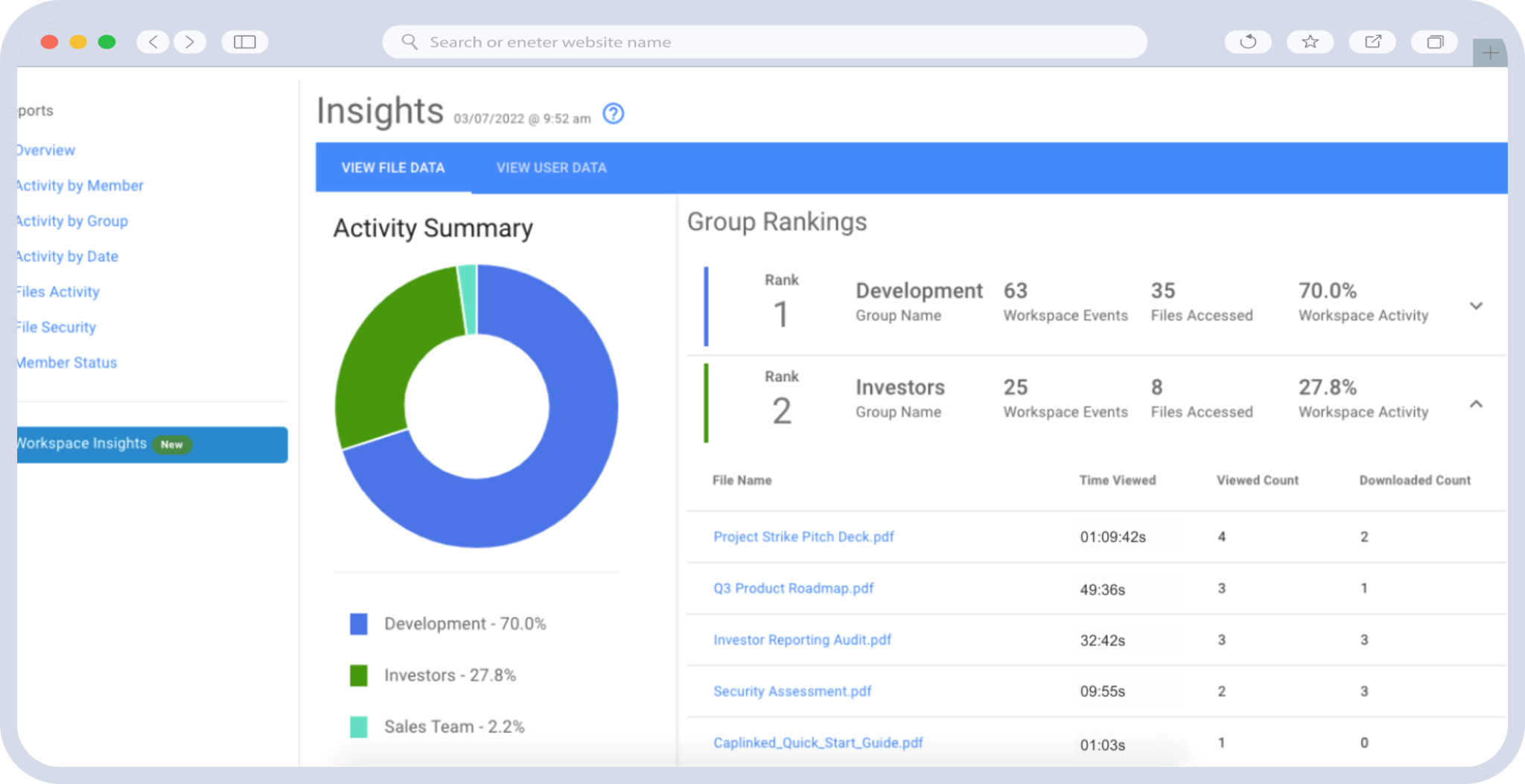
- Real-time activity dashboards show deal leads which sections buyers are reviewing most—intelligence that informs negotiation strategy and resource allocation.
- Bulk upload and drag-and-drop functionality lets teams populate a data room with thousands of documents in minutes rather than days.
4. Deal-Outcome Improvement
This is the dimension most often overlooked in virtual data room ROI calculations, yet it may carry the highest value. A well-organized, professionally presented data room signals to buyers that the seller is sophisticated, transparent, and prepared. This perception directly influences bid confidence and, by extension, valuation. Conversely, a disorganized diligence process—missing documents, slow responses, access confusion—raises red flags that can lead buyers to lower their offers or walk away entirely.
Deal advisors consistently report that transactions supported by structured VDR environments experience fewer re-trades (downward price adjustments after initial agreement) and smoother paths to closing. When the difference between a clean close and a 5% purchase-price reduction on a $50 million deal is $2.5 million, the M&A software investment in a virtual data room delivers an ROI that is difficult to overstate.
Head-to-Head Comparison: VDR vs. Email, Cloud Storage, and Physical Data Rooms
The following comparison highlights the critical differentiators across the most common due diligence document management approaches:
- Security and access control: VDRs offer document-level permissions, dynamic watermarking, two-factor authentication, and fence-view protection. Email offers basic TLS encryption. Consumer cloud platforms offer folder-level permissions. Physical rooms rely on supervised access and sign-in sheets.
- Audit trail and compliance: VDRs provide timestamped, user-level activity logs exportable for regulatory review. Email provides only sent/received metadata. Cloud platforms offer basic file-access logs. Physical rooms depend on manual sign-in logs.
- Collaboration and Q&A: VDRs include structured Q&A modules with role-based routing and deadline tracking. Email scatters questions across inboxes. Cloud platforms may offer comments but lack deal-specific workflow. Physical rooms require in-person or phone-based Q&A.
- Scalability: VDRs support unlimited users and terabytes of documents with consistent performance. Email degrades with large attachments. Cloud platforms scale but lack deal-specific features. Physical rooms don’t scale at all without additional space and staff.
- Cost predictability: Modern VDRs—like CapLinked—offer transparent, flat-rate pricing. Email appears free but carries hidden risk and labor costs. Cloud platforms charge per-seat or per-storage with potential overage fees. Physical rooms carry highly variable and often unpredictable costs.
When evaluating secure file sharing vs email for any transaction involving confidential data, the comparison consistently favors a purpose-built VDR across every dimension that matters to deal outcomes.
Building Your Virtual Data Room ROI Business Case
If you’re presenting the case for a VDR investment to your CFO, deal committee, or board, structure the analysis around these four pillars:
Step 1: Calculate Your Current Diligence Costs
Inventory every cost associated with your last transaction’s due diligence process: legal fees for document management, internal staff hours spent organizing and distributing files, travel costs for physical reviews, IT support for access issues, and any costs related to data incidents or delays. Most teams are surprised by the total.
Step 2: Estimate Time Savings
Map each phase of your diligence workflow—document collection, organization, buyer onboarding, Q&A, and closing—and estimate how many hours a VDR’s automation, structured indexing, and parallel access would save. Multiply by the blended hourly rate of the professionals involved.
Step 3: Quantify Risk Reduction
Work with your legal and compliance teams to assign a probability-weighted cost to the data security and regulatory risks inherent in your current approach. Even a modest reduction in the probability of a breach or compliance violation can represent significant expected-value savings.
Step 4: Factor in Deal-Outcome Impact
While harder to quantify precisely, the correlation between diligence quality and deal outcomes is well-established among experienced M&A practitioners. Frame this as the potential upside: reduced re-trade risk, faster closing, and stronger buyer confidence.
When these four pillars are calculated honestly, the virtual data room ROI for even a single mid-market transaction almost always exceeds 10x to 50x the platform cost—making it one of the highest-return investments a deal team can make.
Why CapLinked Delivers Maximum VDR ROI
CapLinked was purpose-built for the demands of M&A, capital raises, and complex business transactions. Our platform combines enterprise-grade security—including 256-bit encryption, granular document permissions, dynamic watermarking, and comprehensive audit trails—with an intuitive interface that deal teams can deploy in minutes, not days.
With transparent, predictable pricing, CapLinked eliminates the budget uncertainty that plagues many M&A software investments. Our customers consistently report faster deal timelines, reduced administrative overhead, and greater confidence from both buy-side and sell-side participants.
Ready to see how CapLinked can deliver measurable ROI on your next transaction? Start a free trial or request a demo to experience the platform that leading deal teams trust for secure, efficient due diligence.
Frequently Asked Questions
What is virtual data room ROI and how is it measured?
Virtual data room ROI measures the financial return a deal team gains from investing in a VDR compared to alternative methods like email, consumer cloud storage, or physical data rooms. It is typically measured across four dimensions: deal timeline compression (reduced professional fees and market risk), legal and compliance risk reduction, operational cost avoidance (fewer staff hours on manual document management), and deal-outcome improvement (fewer re-trades and higher buyer confidence). Most mid-market transactions see a 10x to 50x return on VDR investment when all four dimensions are accounted for.
How much does a virtual data room cost for M&A due diligence?
Virtual data room costs for M&A due diligence vary by provider, deal complexity, and feature requirements, but benchmarking data from Q1 2026 shows average VDR costs starting at approximately $249 per month for standard transactions. Enterprise and cross-border deals with larger document volumes and multilingual requirements may cost more. Compared to the fully loaded cost of managing due diligence through email or physical data rooms—which can run tens of thousands of dollars when professional fees, labor, and risk exposure are included—VDR pricing delivers significant cost savings.
Why is a virtual data room more secure than email or Dropbox for M&A?
A virtual data room provides document-level permission controls, dynamic watermarking, two-factor authentication, remote access revocation, and comprehensive audit trails that email and consumer cloud platforms like Dropbox lack. Email relies on basic encryption during transmission and offers no control over documents once sent. Dropbox and similar platforms provide folder-level permissions but do not support deal-specific security features like fence-view protection, user-level activity tracking, or the granular access controls that regulatory bodies expect for handling material nonpublic information during M&A transactions.
How does a virtual data room reduce M&A deal timelines?
Virtual data rooms reduce M&A deal timelines by enabling parallel buyer access, AI-powered document indexing, structured Q&A workflows, and instant user onboarding. Instead of sequentially sharing documents via email or scheduling in-person reviews, multiple bidders can conduct due diligence simultaneously without interference. Built-in Q&A modules route questions to the right experts and track response deadlines, eliminating delays caused by scattered email threads. These efficiencies can compress the diligence phase by days or weeks, directly reducing professional fees and market exposure.
What should CFOs consider when evaluating virtual data room ROI for their organization?
CFOs evaluating virtual data room ROI should calculate the fully loaded cost of their current due diligence process—including legal fees, internal staff hours, IT support, travel, and risk-related expenses—and compare it against VDR subscription costs plus the estimated savings in time, labor, and risk reduction. They should also consider the deal-outcome impact: well-organized data rooms correlate with fewer purchase-price re-trades and faster closings. Transparent, predictable VDR pricing is essential to avoid the budget overruns common with opaque per-page or usage-based models.
Who benefits most from using a virtual data room in M&A transactions?
Investment bankers, private equity firms, corporate development teams, legal advisors, and CFOs managing sell-side or buy-side transactions benefit most from virtual data rooms. Sell-side teams benefit from structured document presentation, controlled access, and buyer activity intelligence. Buy-side teams benefit from efficient document review, organized Q&A, and reliable audit trails. Any organization handling confidential financial, legal, or operational documents during a transaction—regardless of deal size—gains measurable value from the security, efficiency, and professionalism a VDR provides.
Frequently Asked Questions
How long should a virtual data room remain active after a deal closes?
The appropriate retention period depends on the transaction type, applicable regulations, and contractual obligations. As a general guideline, most M&A practitioners maintain VDR access for a minimum period aligned with the indemnification survival period specified in the purchase agreement—typically 12 to 24 months for general representations and up to six years for fundamental representations such as tax and authority. Financial records should generally be retained for at least seven years per IRS guidelines, and environmental records may require retention for 30 years or more. Organizations should develop a retention schedule that addresses each document category individually, rather than applying a single blanket retention period.
What is the best way to handle data room access for bidders who did not win the deal?
Access for non-winning bidders should be revoked promptly upon their elimination from the process or, at the latest, upon deal closing. Before revoking access, generate a final activity report for each user documenting what they accessed during the process. If NDA provisions require the return or destruction of confidential information, send formal notices to each bidder’s legal counsel confirming access revocation and requesting certification of destruction of any downloaded materials. The VDR’s audit trail provides documentation of what each party accessed, which may be relevant if confidentiality disputes arise later.
How should organizations ensure compliance with GDPR and other data protection regulations when archiving VDR contents?
Organizations should conduct a data mapping exercise to identify any personal data contained within the VDR—employee records, customer information, and third-party contact details are common examples. Under GDPR Article 5, personal data must not be retained longer than necessary for the purpose for which it was processed. Establish lawful bases for continued retention (e.g., legitimate interest in defending potential legal claims, compliance with legal obligations), document these bases, and implement technical measures including encryption, access controls, and automated deletion triggers when retention periods expire. For cross-border transactions, ensure that any transfer of archived data complies with applicable data transfer mechanisms such as Standard Contractual Clauses.
What features should a VDR platform offer to support post-closing archival needs?
A VDR platform suitable for full lifecycle management should offer read-only archive mode (preventing modifications while preserving access), continued encryption and security controls in archive state, preserved audit trails and activity logs, searchability and efficient document retrieval, granular access controls that can be maintained and updated during the retention period, automated notifications for retention period expirations, and the ability to generate secure export packages or destruction certificates. CapLinked’s platform provides all of these capabilities, enabling organizations to transition seamlessly from active deal management to long-term secure archiving without migrating data to separate systems.
How can deal teams use VDR analytics from completed transactions to improve future deal performance?
Post-transaction analysis of VDR analytics yields actionable insights across several dimensions. Review document access patterns to identify which areas received the most scrutiny—these often correspond to buyer concerns that could be proactively addressed in future transactions through improved documentation or operational remediation. Analyze Q&A logs to build a library of frequently asked questions and approved responses that can be deployed in future data rooms, significantly reducing response times. Evaluate the folder structure and document organization for usability, incorporating feedback from buyers and advisors to refine your taxonomy. Finally, use activity timing data to understand how long due diligence actually takes across different document categories, enabling more accurate process timeline planning for future transactions.
What are the risks of not properly closing down a virtual data room after a transaction?
Failing to properly close down a VDR after a deal creates several material risks. Continued unauthorized access to sensitive business information exposes the organization to potential data breaches, competitive intelligence leakage, and confidentiality violations. Indefinite retention of personal data without a lawful basis can result in regulatory penalties—GDPR fines can reach up to €20 million or 4% of global annual turnover, whichever is higher. In litigation, an unmanaged data room may become subject to broad discovery requests, with the absence of proper retention and deletion protocols potentially giving rise to adverse inference arguments. Additionally, ongoing VDR subscription costs for unused data rooms represent a direct and unnecessary financial expense. A disciplined wind-down protocol mitigates all of these risks while preserving the data and records that have genuine long-term value.