Table of Contents
ToggleExecutive Summary
Mergers and acquisitions remain one of the most complex, high-stakes endeavors in the business world. In 2025 alone, global M&A deal volume reached approximately $3.5 trillion, with thousands of transactions requiring meticulous due diligence across financial, legal, operational, and regulatory dimensions. Yet despite the availability of sophisticated virtual data room (VDR) technology, many deal teams still struggle with a fundamental gap: they have the platform but lack a structured, repeatable framework for using it effectively.
This comprehensive guide bridges that gap. It provides M&A deal teams—whether on the buy side or sell side—with actionable, industry-specific due diligence virtual data room checklists and step-by-step workflows they can implement immediately. Drawing on industry best practices, regulatory requirements, and insights from seasoned dealmakers, this resource is designed to reduce deal timelines, minimize human error, and ensure no critical documents or issues are overlooked during the review process.
Inside, you will find a complete document review checklist organized by due diligence category, a phased deal management workflow from pre-deal preparation through closing, industry-specific addenda for healthcare, technology, real estate, and financial services transactions, and a set of VDR best practices for deals that maximize platform ROI. Whether you are advising on a $10 million acquisition or a multi-billion-dollar merger, this framework will help your team execute with precision and confidence.
Why a Structured Due Diligence Framework Matters
The Cost of Unstructured Due Diligence
According to a study published by Harvard Business Review, between 70% and 90% of mergers and acquisitions fail to create value for the acquiring company. While strategic misalignment is often cited as the primary culprit, a significant proportion of deal failures stem from inadequate due diligence—missed liabilities, undiscovered regulatory exposure, or incomplete financial analysis that only comes to light after closing.
The M&A due diligence process is inherently complex. A typical mid-market transaction involves the review of 500 to 2,000 documents across dozens of categories. Enterprise-scale deals can involve tens of thousands of documents. Without a structured framework, deal teams face several critical risks:
- Document gaps: Critical items such as change-of-control provisions, pending litigation, or environmental liabilities are overlooked.
- Timeline delays: Disorganized data rooms lead to repeated information requests, slowing the process by weeks or even months.
- Security breaches: Improper access controls expose sensitive information to unauthorized parties.
- Valuation errors: Incomplete financial data leads to inaccurate modeling and mispriced deals.
- Post-close disputes: Missing or incomplete representations give rise to indemnification claims and earnout disagreements.
The Virtual Data Room Advantage
A due diligence virtual data room eliminates the inefficiencies of physical data rooms and ad hoc file-sharing solutions. Modern VDR platforms like CapLinked provide granular permission controls, real-time activity tracking, automated indexing, Q&A workflows, and audit trails—all of which are essential for managing the complexity of the M&A due diligence process.
Research from Deloitte’s annual M&A Trends Report consistently finds that deal teams leveraging purpose-built VDR platforms close transactions faster and with greater confidence in their diligence findings. The key differentiator, however, is not the technology alone—it is how the technology is deployed within a disciplined workflow.
Phase 1: Pre-Deal Preparation and VDR Setup
Step 1: Define the Scope and Objectives of Due Diligence
Before uploading a single document, deal teams must align on the scope of the diligence exercise. This is driven by the nature of the transaction (asset purchase vs. stock purchase vs. merger), the industry, the size of the target, and the risk appetite of the acquirer or investor.
Key questions to answer at this stage include:
- What are the primary deal drivers and value thesis?
- What are the known risk areas (regulatory, environmental, litigation, IP)?
- Which functional teams will participate (legal, financial, tax, HR, IT, environmental)?
- What is the anticipated timeline for the diligence phase?
- Are there industry-specific regulatory requirements that must be addressed (e.g., HIPAA for healthcare, SOX for public companies)?
Step 2: Select and Configure the VDR Platform
Choosing the right VDR is a critical decision that has downstream effects on every phase of the deal. According to a checklist published by SRS Acquiom, a common misconception among deal parties is that all leading VDRs are essentially the same—and that all are “good enough.” In reality, meaningful differences in security architecture, user experience, reporting capabilities, and integration options can materially impact deal outcomes.
When evaluating a VDR platform, prioritize the following capabilities:
- Granular permission controls: The ability to restrict access at the folder, document, and even page level. Not all participants should see the same information.
- Dynamic watermarking and DRM: Protect documents from unauthorized distribution with viewer-specific watermarks and download restrictions.
- Q&A workflow management: A built-in system for routing questions from buyers to sellers and tracking response status.
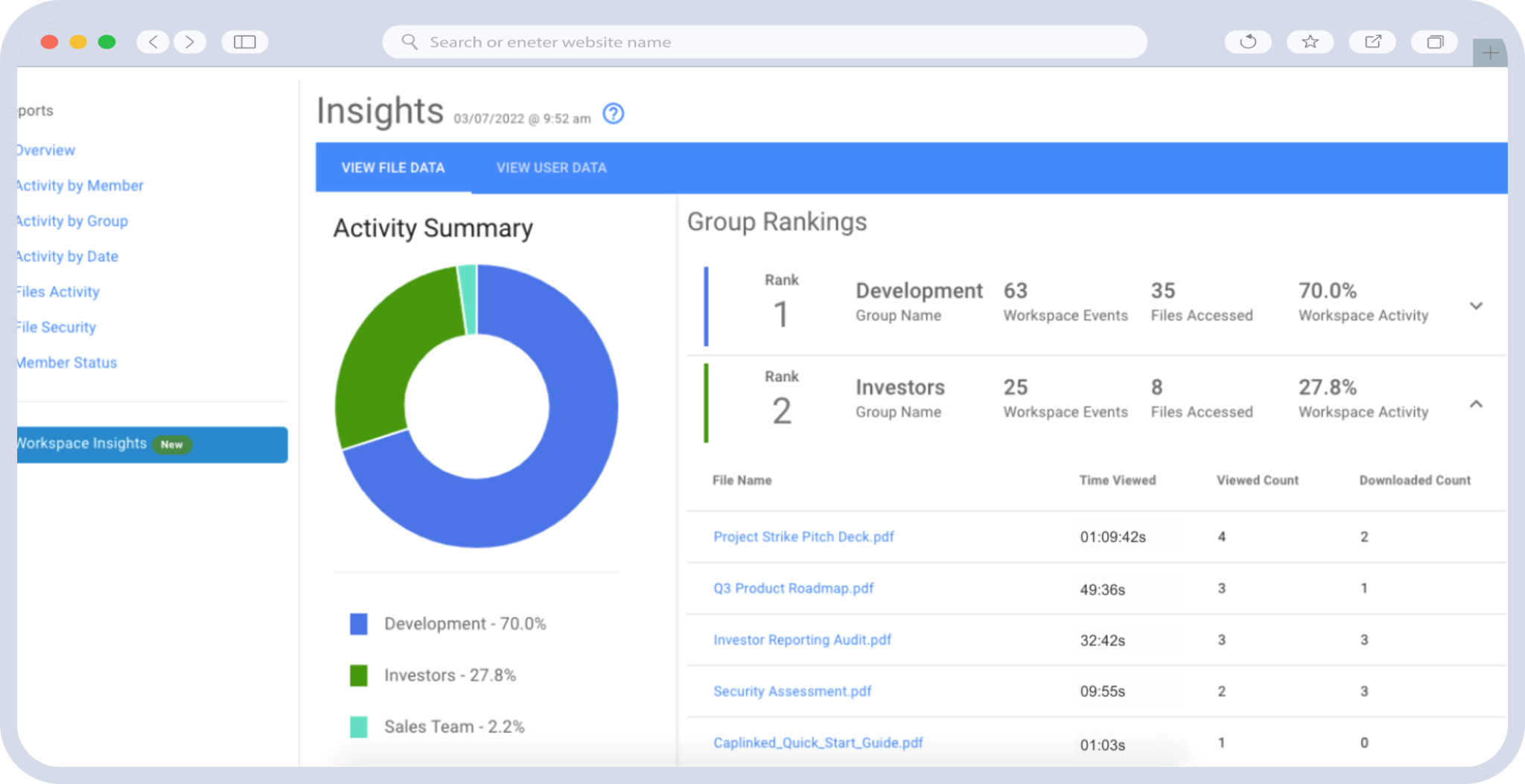
- Activity analytics and audit trail: Real-time dashboards showing who accessed what documents, when, and for how long—critical for gauging buyer interest and protecting against future claims.
- Bulk upload and auto-indexing: Tools that allow large document sets to be uploaded, indexed, and organized efficiently.
- SOC 2 Type II and ISO 27001 certification: Non-negotiable security standards for handling sensitive deal information.
- Multi-device accessibility: Ensure participants can access the data room securely from any device, anywhere in the world.
Step 3: Establish the Folder Structure
A well-organized folder structure is the backbone of an effective deal management workflow. It determines how quickly reviewers can locate documents, how efficiently sellers can respond to diligence requests, and how thoroughly the diligence record is preserved.
The recommended top-level folder structure for a standard M&A transaction includes the following categories, each of which will be detailed in the comprehensive checklist below:
- 1.0 Corporate Organization and Formation
- 2.0 Financial Information
- 3.0 Tax Information
- 4.0 Material Contracts and Agreements
- 5.0 Intellectual Property
- 6.0 Real Estate and Physical Assets
- 7.0 Employment and Human Resources
- 8.0 Litigation and Legal Proceedings
- 9.0 Regulatory and Compliance
- 10.0 Insurance
- 11.0 Environmental
- 12.0 Information Technology and Cybersecurity
- 13.0 Customers and Revenue
- 14.0 Debt and Financing
Phase 2: The Comprehensive Due Diligence Document Checklist
The following document review checklist provides a detailed inventory of items that should be uploaded to the virtual data room for each category. This checklist is designed to be comprehensive for general M&A transactions; industry-specific addenda are provided in a later section.
1.0 Corporate Organization and Formation
- Articles of Incorporation, Certificate of Formation, or equivalent organizational documents
- Bylaws, Operating Agreement, or Partnership Agreement (including all amendments)
- Certificates of good standing from the state of formation and each state of qualification
- Organizational chart showing all subsidiaries, affiliates, and joint ventures
- Minutes of board of directors and shareholder meetings (past 5 years)
- Written consents in lieu of meetings
- Stockholder agreements, voting agreements, or registration rights agreements
- Capitalization table showing all equity interests, options, warrants, and convertible instruments
- Stock certificates and transfer ledger
- List of all jurisdictions where the company is authorized to do business
- Powers of attorney
2.0 Financial Information
- Audited financial statements for the past 3–5 fiscal years
- Unaudited interim financial statements (monthly or quarterly) for the current fiscal year
- Management-prepared financial projections and budgets
- Revenue breakdown by product line, geography, and customer segment
- Accounts receivable and accounts payable aging schedules
- Working capital analysis and historical trends
- Capital expenditure schedules (historical and projected)
- Detailed general ledger and chart of accounts
- Audit management letters and responses
- Description of accounting policies and any recent changes
- Schedule of all intercompany transactions and balances
- Debt schedules including all outstanding loans, lines of credit, and notes payable
3.0 Tax Information
- Federal, state, and local tax returns for the past 3–5 years
- All correspondence with tax authorities, including notices, audit letters, and assessments
- Tax provision workpapers
- Transfer pricing documentation and policies
- Sales and use tax filings and exemption certificates
- Property tax assessments and payment records
- Tax elections (e.g., S-Corp election, Section 338 elections)
- Net operating loss and tax credit carryforward schedules
- Analysis of any uncertain tax positions (FIN 48 / ASC 740)
4.0 Material Contracts and Agreements
- Customer contracts (especially those representing >5% of revenue)
- Vendor and supplier agreements
- Distribution, licensing, and franchise agreements
- Joint venture and partnership agreements
- Government contracts and subcontracts
- Non-compete, non-solicitation, and exclusivity agreements
- Guarantees and indemnification agreements
- Any contracts with change-of-control provisions
- Agreements with related parties or affiliates
- Letters of intent, memoranda of understanding, and term sheets for pending transactions
5.0 Intellectual Property
- Schedule of all patents, patent applications, and patent prosecution files
- Trademark registrations, applications, and associated agreements
- Copyright registrations
- Trade secret protection policies and documentation
- IP licensing agreements (inbound and outbound)
- Software development agreements and source code escrow arrangements
- Open-source software usage policies and compliance records
- IP assignment agreements from founders, employees, and contractors
- Records of any IP infringement claims (made or received)
6.0 Real Estate and Physical Assets
- Deeds, titles, and surveys for owned properties
- Lease agreements for all leased properties (including amendments and subleases)
- Zoning and land use permits
- Property appraisals and environmental site assessments (Phase I and Phase II)
- Fixed asset register and depreciation schedules
- Equipment lease agreements
- Maintenance and service contracts for facilities and equipment
7.0 Employment and Human Resources
- Employee roster with titles, tenure, compensation, and reporting structure
- Executive employment agreements and severance arrangements
- Employee benefit plans (health, retirement, equity compensation) and plan documents
- 401(k) and pension plan audits and compliance filings (Form 5500)
- Collective bargaining agreements and union-related documents
- Employee handbook and policies
- OSHA citations, workplace safety records, and workers’ compensation claims
- Records of any employment-related litigation, EEOC complaints, or investigations
- Contractor and consulting agreements
- Organizational chart and headcount trends over time
- Key person risk assessment
8.0 Litigation and Legal Proceedings
- Schedule of all pending or threatened litigation, arbitration, or administrative proceedings
- Settlement agreements and consent decrees
- Legal opinions related to material matters
- Regulatory investigation correspondence
- Outside counsel engagement letters and legal fee summaries
9.0 Regulatory and Compliance
- Industry-specific licenses, permits, and registrations
- Regulatory filings and correspondence with government agencies
- Anti-bribery and anti-corruption policies (FCPA, UK Bribery Act compliance)
- Data privacy policies and GDPR/CCPA compliance documentation
- Sanctions and export control compliance records
- Environmental compliance permits and records
- Internal audit reports and compliance assessments
10.0 Insurance
- Schedule of all insurance policies (general liability, D&O, E&O, property, cyber, key person)
- Claims history for the past 5 years
- Insurance broker contact information and correspondence
- Loss runs and actuarial reports
11.0 Environmental
- Phase I and Phase II environmental site assessments
- Environmental permits and compliance records
- Remediation plans and monitoring reports
- Hazardous materials handling and disposal records
- Environmental litigation or enforcement actions
12.0 Information Technology and Cybersecurity
- IT systems architecture and infrastructure documentation
- Software licenses and SaaS subscriptions
- Cybersecurity policies, incident response plans, and penetration test results
- History of data breaches or cybersecurity incidents
- Disaster recovery and business continuity plans
- Third-party IT vendor agreements and SLAs
- SOC 2 reports and other security certifications
13.0 Customers and Revenue
- Top 20 customer list with revenue contribution and contract terms
- Customer concentration analysis
- Customer churn and retention metrics (past 3 years)
- Sales pipeline and backlog reports
- Pricing schedules and discount policies
- Customer satisfaction surveys or Net Promoter Score data
14.0 Debt and Financing
- Loan agreements, credit facilities, and promissory notes
- Indentures and bond documentation
- Subordination and intercreditor agreements
- UCC filings and lien searches
- Correspondence with lenders regarding covenant compliance
- Debt maturity schedules and interest rate summaries
Phase 3: The Step-by-Step Deal Management Workflow
Having a comprehensive checklist is necessary but not sufficient. Deal teams also need a deal management workflow that sequences activities, assigns responsibilities, and creates accountability. The following workflow assumes a typical sell-side M&A process, but it can be adapted for buy-side diligence, capital raises, and other transaction types.
Stage 1: Pre-Marketing Preparation (Weeks 1–4)
- Assemble the deal team: Identify the internal project manager, outside counsel, financial advisors, and any third-party diligence providers.
- Conduct a pre-diligence audit: Review the checklist above against available documents. Identify gaps early and begin remediation.
- Configure the VDR: Set up the folder structure, upload initial documents, and apply watermarks and access restrictions.
- Create a diligence tracker: Use a spreadsheet or integrated VDR tool to track which documents have been uploaded, which are pending, and who is responsible for each item.
- Prepare management presentations and a seller’s data book: Compile key narratives, financial summaries, and strategic positioning documents.
Stage 2: Initial Buyer Access (Weeks 5–8)
- Establish tiered access levels: Grant preliminary access to a limited set of non-sensitive documents for initial-round buyers. Reserve sensitive materials (customer lists, proprietary technology details, employee data) for later stages.
- Monitor engagement: Use VDR analytics to track which buyers are actively reviewing documents, which sections they spend the most time on, and which documents they download. This intelligence is invaluable for gauging buyer seriousness and anticipating diligence questions.
- Manage NDAs and access agreements: Ensure all participants have executed appropriate confidentiality agreements before granting VDR access.
Stage 3: Deep-Dive Diligence (Weeks 9–16)
- Open the full data room: Grant comprehensive access to shortlisted buyers who have submitted indications of interest (IOIs) or letters of intent (LOIs).
- Activate the Q&A module: Route all buyer questions through the VDR’s built-in Q&A system. Assign questions to the appropriate internal subject matter expert and establish response time targets (typically 24–48 hours for standard questions, 72 hours for complex matters).
- Conduct management presentations: Facilitate virtual or in-person management meetings. Upload presentation materials and follow-up responses to the VDR for record-keeping.
- Track red flags and material issues: Maintain a running log of issues identified during diligence and their potential impact on valuation, deal structure, or representations and warranties.
- Update documents in real time: As new financial data, contracts, or regulatory filings become available, upload them promptly and notify relevant parties through the VDR notification system.
Stage 4: Negotiation and Closing (Weeks 17–24)
- Support definitive agreement drafting: Ensure the diligence record informs the representations and warranties, disclosure schedules, indemnification provisions, and any special conditions in the purchase agreement.
- Manage disclosure schedules: Use the VDR as the single source of truth for all disclosed items. Cross-reference disclosure schedules against uploaded documents.
- Facilitate third-party consents and approvals: Track the status of any required consents (landlord, customer, regulatory) within the VDR.
- Archive the data room: Upon closing, create a complete archive of the VDR contents, including the full audit trail, Q&A log, and access records. This archive serves as a critical reference for post-closing integration, earnout disputes, and indemnification claims.
Industry-Specific Due Diligence Addenda
While the comprehensive checklist above applies to virtually any M&A transaction, certain industries demand additional categories of diligence. The following addenda should be incorporated into the VDR folder structure when relevant.
Healthcare and Life Sciences
- HIPAA compliance documentation and breach notification history
- Clinical trial data, FDA correspondence, and regulatory submissions
- Physician and provider agreements (Stark Law and Anti-Kickback Statute compliance)
- Medicare and Medicaid enrollment and reimbursement records
- Pharmacy licenses, DEA registrations, and controlled substance records
- Medical malpractice claims history and insurance coverage
- Accreditation reports (Joint Commission, AAAHC, etc.)
Technology and SaaS
- Source code review access and architecture documentation
- SaaS metrics: ARR, MRR, churn rate, CAC, LTV, net dollar retention
- Open-source software bill of materials and license compliance audit
- Data processing agreements and data flow diagrams
- Scalability and performance testing documentation
- Product roadmap and technical debt assessment
- SOC 2 Type II report and penetration testing results
Real Estate
- Rent rolls and tenant ledgers
- Capital improvement plans and budgets
- Property condition reports and engineering assessments
- Title insurance policies and title search reports
- Surveys, plat maps, and site plans
- Local tax assessment records and appeals history
- Entitlements and development approvals
Financial Services
- Regulatory examination reports (OCC, FDIC, SEC, FINRA, state regulators)
- Anti-money laundering (AML) and Bank Secrecy Act (BSA) compliance documentation
- Capital adequacy and stress testing reports
- Loan portfolio quality analysis and loan loss reserve methodology
- Trust and fiduciary account records
- Consumer complaint log and CFPB correspondence
- Compliance management system documentation
VDR Best Practices for Deals: Maximizing Efficiency and Security
Implementing the checklist and workflow above within a virtual data room requires adherence to a set of VDR best practices for deals that experienced M&A practitioners have refined over thousands of transactions.
1. Apply the Principle of Least Privilege
As emphasized by legal practitioners at firms like Linden Law Partners, not all participants in the diligence process should have access to all documents. Configure permissions so that each user or group sees only the information relevant to their role and stage in the deal. This protects sensitive data and maintains competitive tension in a multi-bidder process.
2. Use Consistent Naming Conventions
Establish and enforce a standardized file naming convention from day one. A recommended format is: [Section Number]_[Document Type]_[Entity Name]_[Date]. For example: 2.0_AuditedFinancials_AcmeCorp_2025.pdf. This eliminates confusion, speeds up document retrieval, and ensures the index is navigable for all parties.
3. Leverage Activity Analytics Strategically
VDR activity reports are among the most valuable—and most underutilized—tools in the deal team’s arsenal. Track which buyers are spending the most time in the data room, which sections they focus on, and which documents they revisit. This intelligence can inform negotiation strategy, identify buyer concerns before they are formally raised, and help prioritize Q&A responses.
4. Establish a Q&A Governance Protocol
The Q&A process is where deals often bog down. Establish clear rules of engagement: who can ask questions, how questions are routed internally, who has authority to approve responses, and what the expected turnaround time is. All Q&A should flow through the VDR rather than email or phone to maintain a complete record.
5. Conduct a Pre-Launch Data Room Audit
Before opening the VDR to external parties, conduct a thorough audit. Verify that all documents are in the correct folders, that sensitive metadata has been removed from files, that watermarks are properly applied, and that permissions align with the intended access levels. A pre-launch checklist should be signed off by both the internal project manager and outside counsel.
6. Plan for Post-Close Archival
The data room’s value does not end at closing. According to SEC record retention guidance, certain transaction-related documents must be preserved for defined periods. Beyond regulatory requirements, the archived VDR—including its complete audit trail—serves as evidence of what was disclosed and when, which is critical for resolving post-close indemnification claims and earnout disputes.
Measuring Due Diligence Effectiveness: Key Metrics
To continuously improve the M&A due diligence process, deal teams should track and benchmark the following metrics:
- Document upload completeness rate: The percentage of checklist items uploaded versus outstanding. Target: 95%+ before granting full buyer access.
- Average Q&A response time: The mean time from question submission to approved response. Benchmark: 24–48 hours for standard queries.
- Data room preparation time: The elapsed time from deal kickoff to data room readiness. Best-in-class: 2–3 weeks for mid-market transactions.
- Buyer engagement score: A composite metric derived from login frequency, document views, time spent, and Q&A activity. Use this to rank bidder seriousness.
- Post-close issue rate: The number of material issues discovered after closing that should have been identified during diligence. This is the ultimate measure of process quality.
Common Pitfalls and How to Avoid Them
Pitfall 1: Treating the VDR as a Document Dump
Uploading thousands of unorganized files without proper indexing, naming, or categorization frustrates buyers and slows the process. Every document should have a clear purpose and a logical home within the folder structure.
Pitfall 2: Delaying Sensitive Document Uploads
Sellers sometimes withhold sensitive materials (e.g., customer contracts, employee data) until late in the process. This creates last-minute surprises that can derail deals. Instead, plan for staged disclosure with appropriate access controls from the outset.
Pitfall 3: Failing to Redact Privileged Information
Uploading attorney-client privileged documents or attorney work product without proper review can result in waiver of privilege. All legal materials should be reviewed by counsel before upload, and privileged documents should be clearly marked and segregated.
Pitfall 4: Ignoring International Considerations
Cross-border transactions introduce additional complexity, including GDPR and other data privacy restrictions on transferring personal data, foreign language document translation, and country-specific regulatory filings. Ensure the VDR platform supports multi-language interfaces and complies with international data sovereignty requirements.
Pitfall 5: Overlooking the Human Element
Even the most sophisticated VDR platform is only as effective as the people using it. Invest in training all deal team members on VDR navigation, Q&A protocols, and security procedures. Designate a single point of contact as the VDR administrator to ensure consistency and accountability.
The Future of Due Diligence: AI and Automation
The due diligence landscape is evolving rapidly. Artificial intelligence and machine learning are increasingly being integrated into VDR platforms to accelerate document review, flag anomalies, and surface key provisions in contracts. According to McKinsey & Company’s research on generative AI, these technologies have the potential to reduce due diligence review time by 30–50% for routine document analysis.
Key emerging capabilities include:
- AI-powered contract analysis: Automated extraction of key terms, change-of-control provisions, expiration dates, and indemnification clauses from thousands of contracts.
- Anomaly detection: Machine learning algorithms that flag inconsistencies in financial data, unusual transactions, or missing documents.
- Intelligent document classification: Automatic categorization and tagging of uploaded documents based on content, reducing manual organization effort.
- Predictive analytics: Models that estimate deal risk based on patterns in the diligence record, historical deal outcomes, and market data.
Forward-thinking deal teams are already incorporating these tools into their workflows, using them to augment—not replace—human judgment. The combination of structured checklists, disciplined workflows, and AI-assisted review represents the future of M&A due diligence.
Conclusion: Key Takeaways
Effective due diligence in a virtual data room is not simply a matter of having access to the right technology—it requires a disciplined framework that combines comprehensive checklists, structured workflows, and best-practice execution. The key takeaways from this guide are:
- Start with structure: A well-organized folder architecture and comprehensive document checklist are the foundation of every successful diligence process. Use the 14-category framework in this guide as your starting point.
- Follow a phased workflow: Move through pre-marketing preparation, initial buyer access, deep-dive diligence, and closing in a deliberate, sequenced manner. Each phase has distinct objectives and activities.
- Customize for your industry: Layer industry-specific addenda on top of the standard checklist to ensure sector-specific risks and regulatory requirements are addressed.
- Leverage VDR capabilities fully: Granular permissions, activity analytics, Q&A management, and audit trails are not just features—they are strategic tools that can influence deal outcomes.
- Measure and improve: Track key metrics like document completeness, Q&A response time, and post-close issue rates to continuously refine your process.
- Prepare for the future: AI and automation are transforming due diligence. Invest in platforms and skills that position your team to take advantage of these capabilities.
By implementing the checklists, workflows, and best practices outlined in this guide within a purpose-built VDR platform like CapLinked, M&A deal teams can reduce timelines, minimize risk, and close transactions with greater confidence—turning due diligence from a bottleneck into a competitive advantage.
Frequently Asked Questions
What is a due diligence virtual data room, and why is it essential for M&A transactions?
A due diligence virtual data room (VDR) is a secure, cloud-based platform where sensitive business documents are stored, organized, and shared with authorized parties during transactions such as mergers, acquisitions, capital raises, and audits. It is essential for M&A transactions because it provides centralized document management, granular access controls, real-time activity tracking, and a complete audit trail—all of which accelerate the diligence process, protect confidential information, and create a defensible record of what was disclosed and when. Modern VDRs like CapLinked also offer Q&A workflow management and advanced analytics that help deal teams manage complex, multi-party transactions efficiently.
What documents should be included in a virtual data room for M&A due diligence?
A comprehensive M&A due diligence data room should include documents across 14 key categories: corporate organization and formation documents, audited and interim financial statements, tax returns and compliance records, material contracts, intellectual property filings, real estate and physical asset records, employment and HR documentation, litigation files, regulatory and compliance records, insurance policies, environmental assessments, IT and cybersecurity documentation, customer and revenue data, and debt and financing agreements. Industry-specific transactions may require additional categories, such as HIPAA compliance documentation for healthcare deals or SaaS metrics for technology acquisitions.
How long does the due diligence process typically take in an M&A transaction?
The due diligence process for a mid-market M&A transaction typically takes 8 to 16 weeks, depending on the size and complexity of the target company, the industry, the number of bidders, and the thoroughness of the seller’s pre-deal preparation. Well-prepared sellers who use a structured VDR checklist and workflow can significantly compress this timeline—in some cases by 30% or more—by having documents organized and accessible before buyer access begins. Larger or more complex transactions, such as those involving cross-border elements, regulated industries, or significant litigation exposure, may require 20 weeks or longer.
What are the most important VDR features for managing the M&A due diligence process?
The most important VDR features for M&A due diligence include: granular permission controls that restrict document access by user, group, folder, or individual file; dynamic watermarking to prevent unauthorized distribution; a built-in Q&A workflow for routing and tracking buyer questions; activity analytics dashboards that show document views, downloads, and time spent by each user; a complete audit trail for compliance and post-close reference; bulk upload and auto-indexing capabilities for efficient document management; and enterprise-grade security certifications such as SOC 2 Type II and ISO 27001. Integration with other deal management tools and multi-device accessibility are also highly valued by modern deal teams.
How can deal teams reduce errors and avoid missing critical documents during due diligence?
Deal teams can reduce errors and avoid document gaps by implementing three key practices: First, use a comprehensive, standardized due diligence checklist—such as the 14-category framework outlined in this guide—and track document upload status against it in real time. Second, establish a phased workflow with clear responsibilities, deadlines, and escalation procedures for each stage of the diligence process. Third, conduct a pre-launch VDR audit before granting external access to verify folder organization, file naming consistency, permission settings, metadata redaction, and watermark application. Leveraging VDR analytics to monitor buyer activity can also help identify areas where additional documentation may be needed before questions arise.
Should due diligence checklists be customized by industry?
Yes, due diligence checklists should always be customized based on the target company’s industry, as different sectors face unique regulatory requirements, risk profiles, and operational considerations. For example, healthcare transactions require HIPAA compliance reviews and clinical trial data; technology and SaaS deals demand source code audits, open-source license compliance, and SaaS performance metrics; real estate transactions need property condition reports, rent rolls, and environmental assessments; and financial services deals require regulatory examination reports and AML/BSA compliance documentation. Starting with a standard comprehensive checklist and layering on industry-specific addenda ensures thorough coverage while maintaining efficiency.