A single leaked document during an M&A transaction can collapse a deal worth hundreds of millions of dollars, trigger regulatory investigations, and destroy years of strategic planning. According to IBM’s 2024 Cost of a Data Breach Report, the average cost of a data breach in the financial services sector reached $6.08 million — and that figure doesn’t account for the catastrophic reputational damage and lost deal value that follow when confidential merger details surface prematurely. For dealmakers, investment bankers, and corporate development teams, virtual data room security isn’t a checkbox feature — it’s the backbone of deal confidentiality protection that determines whether a transaction closes successfully or falls apart in public view.
This guide breaks down exactly how specific VDR security controls — from encryption and granular permissions to dynamic watermarking and IP restrictions — prevent the real-world breach scenarios that threaten M&A transactions in 2026. Whether you’re preparing for your first acquisition or managing a complex cross-border deal, these actionable strategies will help you lock down your most sensitive due diligence documents and protect deal value from start to finish.
Table of Contents
ToggleWhy M&A Transactions Are Prime Targets for Data Breaches
Mergers and acquisitions create a uniquely vulnerable environment for sensitive information. During due diligence, sellers expose their most closely guarded assets — financial records, customer lists, intellectual property, trade secrets, and strategic plans — to outside parties who may include competitors, private equity firms, and their extended advisory networks. The U.S. Securities and Exchange Commission’s Division of Enforcement has repeatedly pursued cases involving material nonpublic information (MNPI) leaks during M&A processes, underscoring how deal confidentiality protection failures can escalate into federal securities violations.
The attack surface during an M&A deal is extensive. Dozens — sometimes hundreds — of individuals across multiple organizations access confidential documents simultaneously. Each participant represents a potential point of exposure, whether through intentional misuse, accidental forwarding, or compromised credentials. Without robust virtual data room security, a single weak link in the access chain can unravel an entire transaction.
Common M&A Breach Scenarios
- Unauthorized document forwarding: A junior analyst shares a confidential financial model with an unauthorized colleague, who mentions the deal details externally.
- Screenshot and print leaks: A bidder’s team member prints sensitive trade secret documentation and shares it outside the approved review group.
- Credential compromise: A phishing attack compromises a deal participant’s login, granting an attacker full access to the data room.
- Post-deal data retention: A losing bidder retains copies of proprietary documents long after the deal closes, using competitive intelligence gleaned during due diligence.
- Insider trading: Leaked deal details reach individuals who trade on material nonpublic information before the transaction is announced.
Each of these scenarios is preventable with the right combination of VDR security features — if you know which controls to deploy and how to configure them effectively.
The Critical Virtual Data Room Security Features That Prevent Deal Leaks
Not all virtual data rooms offer the same level of protection. The difference between basic cloud storage and enterprise-grade secure file sharing for M&A lies in a layered security architecture designed specifically for high-stakes deal environments. Here are the features that matter most — and how each one directly mitigates specific breach risks.
End-to-End Encryption and Data Room Encryption Standards
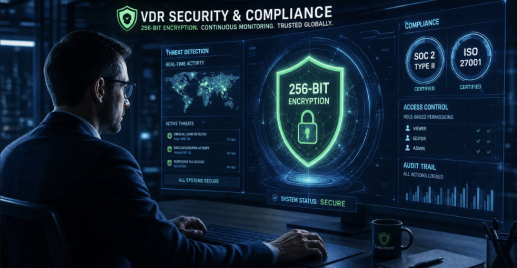
Encryption is the foundation of any serious VDR security strategy. Leading platforms implement AES-256 encryption for data at rest and TLS 1.3 encryption for data in transit — the same data room encryption standards used by government agencies and major financial institutions. The National Institute of Standards and Technology (NIST) has established AES-256 as the gold standard for protecting classified and sensitive information, making it the minimum acceptable benchmark for M&A document security.
Actionable advice: When evaluating a VDR, verify that encryption covers the entire data lifecycle — during upload, storage, download, and viewing. Ask whether the provider holds SOC 2 Type II certification and whether encryption keys are managed independently from the data they protect. Any provider that cannot clearly articulate their encryption architecture should be immediately disqualified from consideration for sensitive deal work.
Granular User Permissions and Role-Based Access Control
Granular permissions represent the most powerful tool for controlling who sees what within a data room. Rather than granting all-or-nothing access, sophisticated VDRs allow administrators to set permissions at the document, folder, and even page level. This means you can allow a potential buyer’s legal team to view employment contracts without giving their financial analysts access to trade secret formulas — a critical capability for due diligence document security.
Actionable advice: Structure your data room permissions around the principle of least privilege. Each user or user group should have access only to the documents directly relevant to their role in the transaction. Create separate permission groups for financial advisors, legal counsel, management teams, and technical reviewers. Review and adjust permissions at each phase of the deal as the scope of information sharing evolves.
Key permission controls to configure include:
- View-only access: Users can view documents in a secure viewer without downloading.
- Download restrictions: Prevent users from saving local copies of sensitive files.
- Print blocking: Disable printing capabilities for specific documents or user groups using DRM security.
- Copy-paste restrictions: Prevent users from extracting text content from viewed documents.
- Time-limited access: Automatically revoke access after a specified date or deal milestone.
Dynamic Watermarking for Leak Traceability
Dynamic watermarking overlays user-specific identifying information — such as the viewer’s name, email address, IP address, and timestamp — directly onto documents during viewing and download. This feature serves a dual purpose: it deters users from sharing documents inappropriately because their identity is embedded in every page, and it provides forensic traceability if a leak does occur.
Actionable advice: Enable dynamic watermarking on all documents classified as highly confidential, including financial projections, customer data, intellectual property documentation, and board materials. Configure watermarks to include at minimum the viewer’s full name and the date and time of access. For the most sensitive documents — trade secrets, proprietary technology specifications, and pre-announcement financial terms — consider using diagonal watermarks that are difficult to crop or edit out of screenshots.
Comprehensive Audit Trails
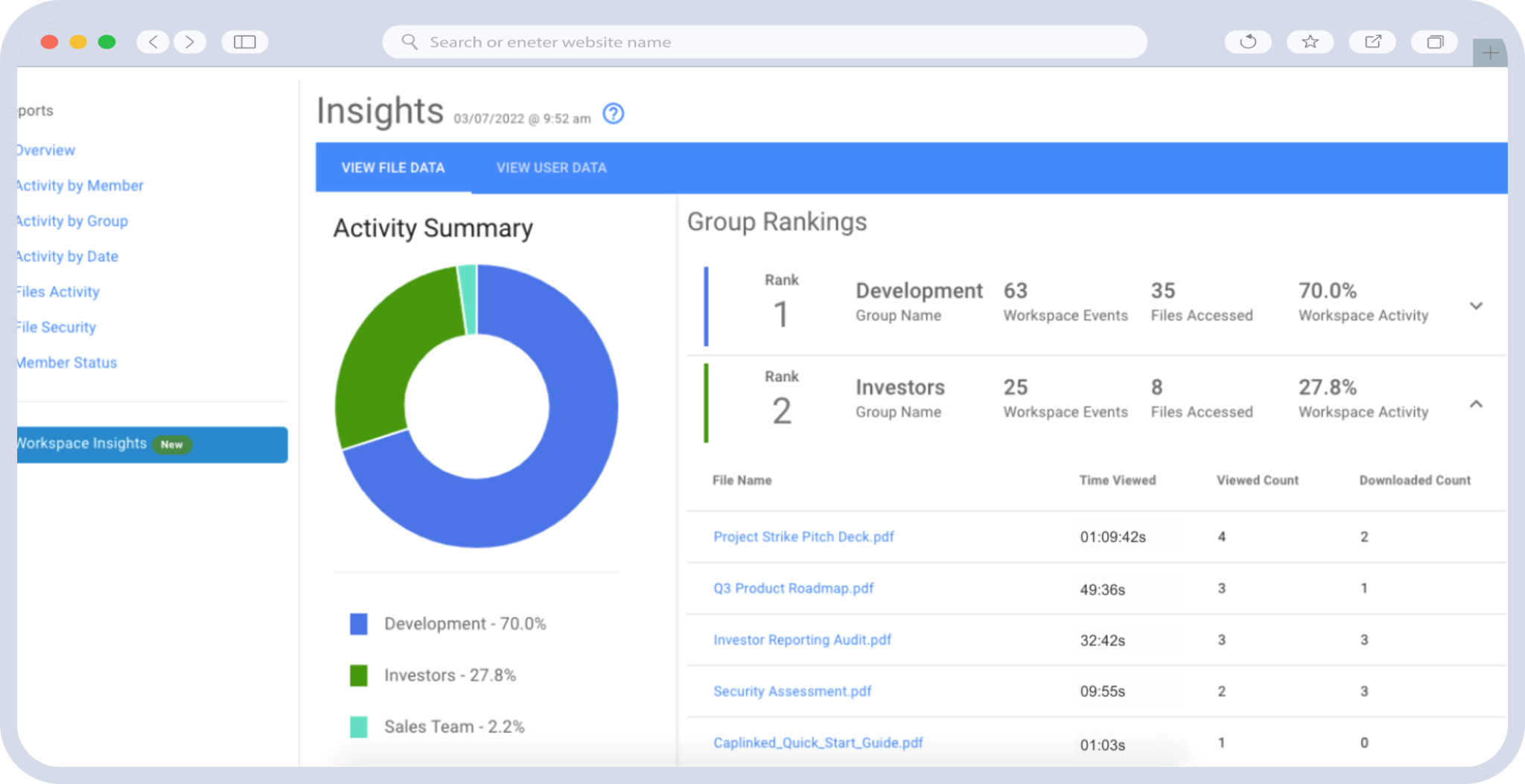
A detailed audit trail records every action taken within the data room — who accessed which document, when they accessed it, how long they viewed it, whether they downloaded or printed it, and from which IP address and device. This creates an immutable record that serves multiple critical functions: real-time monitoring of suspicious activity, post-breach forensic investigation, regulatory compliance evidence, and deal intelligence about buyer engagement levels.
Actionable advice: Designate a team member to review audit trail reports at least weekly during active due diligence. Set up automated alerts for unusual activity patterns, such as bulk downloads, access from unfamiliar geographic locations, or repeated attempts to access restricted documents. These early warning signals often indicate either compromised credentials or intentional data exfiltration attempts — and catching them early can prevent a full-scale breach.
IP Address and Device Restrictions
IP address restrictions allow administrators to limit data room access to specific network addresses or geographic regions. This means you can ensure that documents are only viewable from approved office locations, specific VPN endpoints, or designated countries — preventing access from unauthorized networks or regions where the deal has no legitimate participants.
Actionable advice: For cross-border M&A transactions, configure IP restrictions to allow access only from countries where deal participants are located. Combine IP restrictions with device-level controls where available — some VDRs allow you to approve specific devices, preventing access from personal or shared computers that may lack adequate endpoint security. This layered approach significantly reduces the risk of credential compromise leading to unauthorized access.
Two-Factor Authentication and Single Sign-On
Two-factor authentication (2FA) adds a critical second layer of verification beyond passwords, typically requiring a time-sensitive code from a mobile authenticator app or SMS message. According to the Cybersecurity and Infrastructure Security Agency (CISA), implementing multi-factor authentication can prevent up to 99% of automated cyberattacks — making it one of the most impactful security measures available for protecting deal environments.
Actionable advice: Require 2FA for all data room users without exception, including senior executives and external advisors. Prefer authenticator app-based 2FA over SMS-based verification, as SMS is vulnerable to SIM-swapping attacks. For organizations with existing identity management systems, implement single sign-on (SSO) integration to maintain security while reducing login friction for deal teams working across multiple platforms.
Building a Layered Security Strategy for M&A Due Diligence
No single security feature is sufficient on its own. Effective virtual data room security requires a layered defense strategy where multiple controls work together to create overlapping protections. If one layer is bypassed, the next layer catches the threat.
Phase 1: Pre-Deal Setup
Before any documents are uploaded, establish your security framework. Define document classification tiers (e.g., public, confidential, highly confidential, restricted), map each tier to specific permission configurations, and create user groups that align with the deal’s organizational structure. Draft and distribute a data room usage policy that clearly communicates expectations and consequences for policy violations.
Phase 2: Active Due Diligence
During the active review period, maintain vigilant monitoring through audit trail analysis. Stagger information release based on deal progression — avoid uploading your most sensitive documents until you’ve reached a stage where disclosure is justified by the deal’s advancement. Use the Q&A features within the VDR to centralize communications, preventing sensitive discussions from migrating to unsecured email threads.
Phase 3: Deal Completion or Termination
When a deal closes or a bidder is eliminated, immediately revoke their access and verify that no downloaded copies remain in unauthorized locations. Use remote document expiration features if available — some VDRs allow administrators to remotely disable previously downloaded documents. Generate a comprehensive audit report for your records and regulatory compliance files. As noted by the American Bar Association’s Business Law Section, maintaining thorough documentation of information access and control throughout the M&A lifecycle is essential for demonstrating compliance with fiduciary duties and contractual confidentiality obligations.
How to Evaluate a Virtual Data Room Provider for M&A Security
When selecting a VDR for your next transaction, use this framework to assess whether a provider meets the security demands of modern M&A:
- Certifications: Look for SOC 2 Type II, ISO 27001, and GDPR compliance. These certifications indicate independently verified security practices.
- Encryption standards: Confirm AES-256 encryption at rest and TLS 1.3 in transit at minimum.
- Permission granularity: Verify that permissions can be set at the individual document level, not just at the folder level.
- Watermarking capabilities: Ensure dynamic watermarks are customizable and applied during both viewing and download.
- Audit trail depth: Confirm that the audit trail captures page-level viewing data, not just document-level access logs.
- Access controls: Verify IP restriction, device management, and 2FA capabilities.
- Data residency options: For cross-border deals, confirm that data can be stored in specific jurisdictions to meet regulatory requirements.
- Uptime and infrastructure: Ask for uptime guarantees and inquire about redundant data center infrastructure.
Protect Your Next Deal with Enterprise-Grade Security
In an environment where a single leaked document can destroy deal value, derail strategic plans, and invite regulatory scrutiny, investing in robust virtual data room security is not optional — it’s a fiduciary responsibility. The security features outlined in this guide — encryption, granular permissions, dynamic watermarking, comprehensive audit trails, IP restrictions, and multi-factor authentication — form the protective framework that keeps your most sensitive M&A information confidential throughout the deal lifecycle.
CapLinked provides enterprise-grade virtual data room solutions built specifically for secure file sharing for M&A, due diligence, and other high-stakes transactions. With advanced security controls, intuitive document management, and the compliance infrastructure that modern deals demand, CapLinked helps dealmakers protect confidential information while accelerating the due diligence process. Start your free trial today and experience how CapLinked’s virtual data room keeps your deals secure from first document upload to final closing.
Frequently Asked Questions
What is virtual data room security and why does it matter for M&A?
Virtual data room security refers to the comprehensive set of technical controls — including encryption, access permissions, watermarking, audit trails, and authentication protocols — that protect confidential documents shared during mergers, acquisitions, and other financial transactions. It matters for M&A because deal participants must share highly sensitive information such as financial records, trade secrets, and strategic plans with outside parties, and any unauthorized disclosure can destroy deal value, violate securities regulations, and expose parties to significant legal liability.
How does data room encryption protect M&A documents?
Data room encryption protects M&A documents by converting files into unreadable code that can only be decrypted by authorized users with the correct credentials. Leading virtual data rooms use AES-256 encryption for stored documents and TLS 1.3 encryption for data in transit, which are the same standards recommended by NIST for protecting sensitive government and financial information. This ensures that even if data is intercepted during transfer or a server is compromised, the documents remain inaccessible to unauthorized parties.
What VDR features best prevent deal leaks during due diligence?
The most effective VDR features for preventing deal leaks during due diligence include dynamic watermarking (which embeds viewer-specific identification into every document), granular user permissions (which restrict access to only the documents each participant needs), comprehensive audit trails (which track every user action for monitoring and forensic analysis), and IP address restrictions (which limit access to approved networks and geographic locations). These features work together as a layered defense to deter, detect, and trace any unauthorized disclosure of confidential deal information.
How do audit trails in virtual data rooms help with M&A compliance?
Audit trails in virtual data rooms create an immutable, timestamped record of every action taken within the data room, including document views, downloads, prints, permission changes, and login attempts. This documentation helps organizations demonstrate compliance with fiduciary duties, contractual confidentiality obligations, and securities regulations by providing verifiable proof of who accessed what information and when. Audit trails also serve as critical forensic evidence in the event of a suspected data breach or regulatory investigation.
What encryption standards should a secure M&A data room use?
A secure M&A data room should use AES-256 encryption for data at rest and TLS 1.2 or higher (preferably TLS 1.3) for data in transit. The data room provider should also hold SOC 2 Type II and ISO 27001 certifications, which independently verify that their security practices meet rigorous international standards. Additionally, encryption key management should be handled independently from data storage to ensure that a compromise of one system does not expose the other.
How is a virtual data room more secure than regular cloud file sharing for M&A?
A virtual data room is more secure than regular cloud file sharing for M&A because it is purpose-built for high-stakes document exchange with features that standard cloud storage platforms lack. These include granular document-level permissions, dynamic watermarking, fence-view viewing modes, remote document expiration, detailed page-level audit trails, and IP-based access restrictions. While platforms like Google Drive or Dropbox provide basic file sharing, they do not offer the layered security controls, compliance certifications, or forensic traceability that M&A due diligence requires to protect deal confidentiality.