A $400 million acquisition nearly collapsed last year when the seller discovered that a confidential revenue forecast had been accessed by an unauthorized third party—and no one could determine who, when, or how. The absence of a reliable audit trail turned a routine due diligence dispute into a deal-killing liability. This scenario is far more common than most dealmakers admit, and it underscores a critical truth: in high-stakes M&A transactions, virtual data room audit trails are not a nice-to-have feature—they are the evidentiary backbone of deal security, regulatory compliance, and stakeholder trust.
Whether you are a sell-side advisor managing hundreds of bidder interactions or a buy-side counsel verifying that your team’s document access is defensible, understanding how VDR document access tracking works—and how to leverage it strategically—can mean the difference between a smooth close and a costly dispute. This guide breaks down everything deal professionals need to know about audit trail capabilities in modern virtual data rooms, from the technical mechanics to the regulatory frameworks they satisfy.
Table of Contents
ToggleWhat Are Virtual Data Room Audit Trails?
A virtual data room audit trail is an automated, immutable record of every action taken within a VDR platform. Every login, document view, download, print, upload, permission change, and even failed access attempt is timestamped, attributed to a specific user, and stored in a tamper-proof log. Think of it as a comprehensive forensic ledger for your deal’s most sensitive information.
Unlike basic activity logs found in generic cloud storage platforms, virtual data room audit trails are purpose-built for regulated transactions. They capture granular metadata—including IP addresses, device types, session durations, and page-level document engagement—that generic tools simply cannot provide. This level of detail is what transforms a simple access log into a legally defensible compliance record.
Core Data Points Captured in a VDR Audit Trail
- User identity and authentication method: Who accessed the data room, including two-factor authentication verification status
- Access events: Which documents were viewed, downloaded, printed, or forwarded—and for how long
- Permission changes: When access rights were granted, modified, or revoked, and by which administrator
- Upload and version history: Who uploaded or replaced documents, with full version tracking
- Failed access attempts: Unauthorized login attempts, expired invitation clicks, and permission-denied events
- Session metadata: IP addresses, geolocation data, device identifiers, and browser information
- Q&A interactions: Questions asked, answers provided, and response timestamps within the data room’s built-in Q&A module
Why Audit Trails Are Mission-Critical for M&A Due Diligence
M&A transactions involve the controlled disclosure of a company’s most sensitive information—financial statements, customer contracts, intellectual property, employee records, and litigation history. The stakes of mishandling this information are enormous, spanning regulatory penalties, competitive harm, and personal liability for directors and officers. VDR document access tracking addresses these risks on multiple fronts.
1. Establishing Accountability Across Deal Parties
A typical sell-side due diligence process may involve dozens of potential buyers, each with their own legal, financial, and technical advisors. That can mean hundreds of individual users accessing thousands of documents over weeks or months. Without granular audit trails, it is nearly impossible to determine who accessed what and when—a question that inevitably arises during post-closing disputes, indemnification claims, or allegations of information leakage.
Detailed access logs create a clear chain of custody for every document shared during the deal. If a bidder claims they were never shown a material contract, or a seller alleges that confidential pricing data was shared beyond authorized personnel, the audit trail provides objective, timestamped evidence to resolve the dispute.
2. Detecting Suspicious Activity in Real Time
Modern M&A deal security monitoring goes beyond passive logging. Leading VDR platforms offer real-time alerts and anomaly detection that flag unusual behavior patterns—such as a user downloading an unusually large volume of documents at 3 a.m., accessing the data room from an unfamiliar geographic location, or repeatedly attempting to view folders outside their permission level.
These early warning signals allow deal administrators to investigate and respond before a potential breach escalates. In a competitive auction process, where the risk of information leakage between bidders is acute, this capability is invaluable.
3. Satisfying Regulatory and Legal Requirements
Regulatory frameworks across multiple jurisdictions increasingly mandate robust data access controls and audit capabilities for financial transactions. The Sarbanes-Oxley Act (SOX) requires public companies to maintain internal controls over financial reporting, including the ability to demonstrate who accessed financial data and when. The General Data Protection Regulation (GDPR) imposes strict requirements on data controllers to document processing activities and demonstrate accountability for personal data handling—requirements that are directly relevant when employee or customer data is shared during due diligence.
For financial institutions, frameworks such as SOC 2 Type II certification require continuous monitoring and logging of access to sensitive systems. As the Gramm-Leach-Bliley Act (GLBA) makes clear, financial institutions have affirmative obligations to protect the security and confidentiality of customer information—obligations that extend to third-party platforms used during transactions. A comprehensive due diligence compliance audit capability within the VDR ensures that organizations can demonstrate adherence to these overlapping regulatory demands.
4. Providing Strategic Deal Intelligence
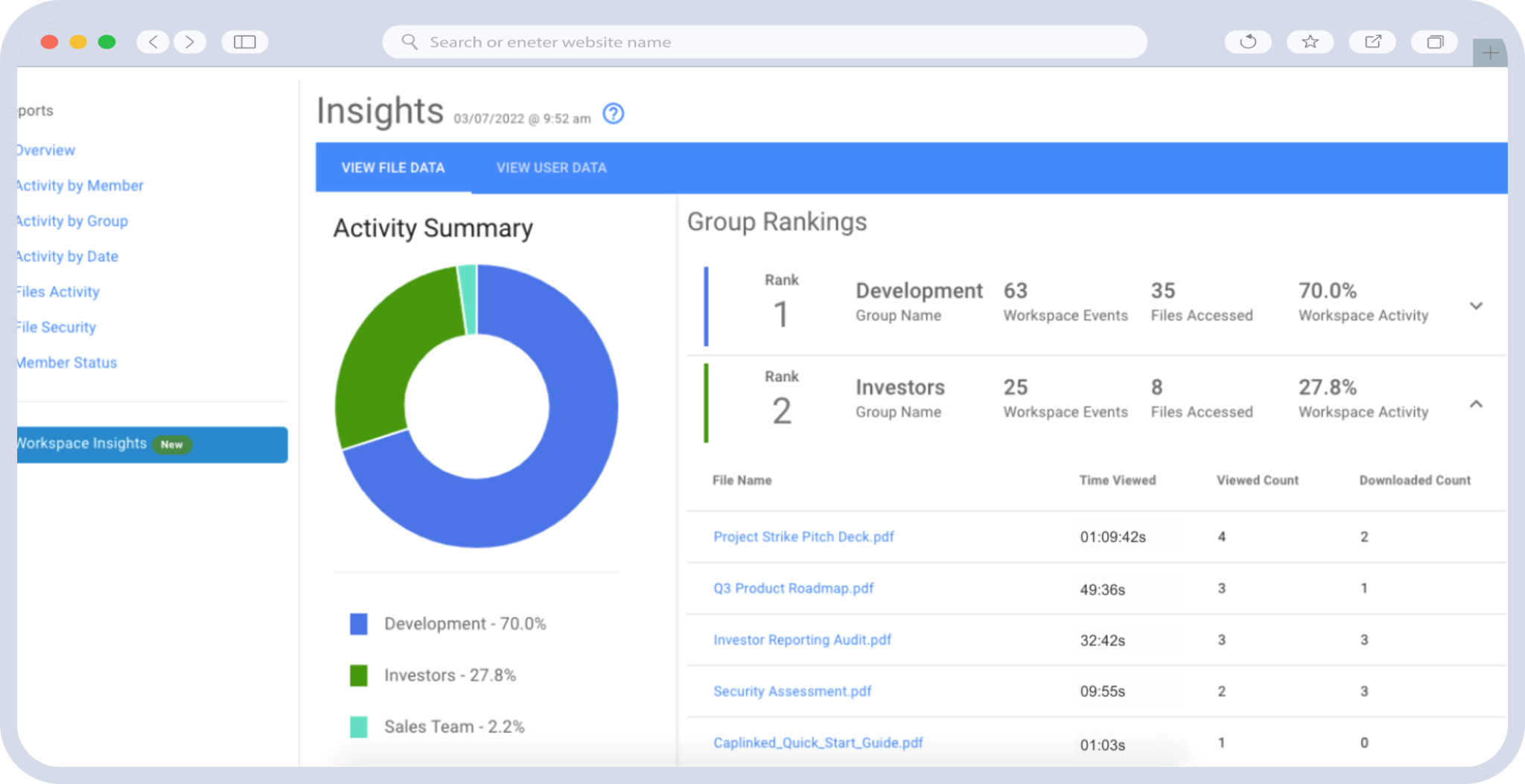
Beyond risk mitigation, audit trails offer powerful strategic insights. Sell-side advisors routinely analyze buyer engagement data—which documents each bidder spent the most time reviewing, which sections they revisited, and which they skipped entirely—to gauge the seriousness and sophistication of each bid. A buyer who has spent forty hours in the data room and carefully reviewed every material contract is signaling a different level of commitment than one who logged in twice and glanced at the financial summary.
This intelligence helps sellers prioritize negotiations, anticipate due diligence questions, and allocate management time to the most promising bidders. It is a competitive advantage that only becomes available when the underlying audit trail is sufficiently granular.
What to Look for in VDR Audit Trail Capabilities
Not all virtual data rooms are created equal when it comes to audit trail depth and usability. When evaluating VDR platforms for your next transaction, prioritize the following capabilities to ensure secure file sharing accountability throughout the deal lifecycle.
Immutable, Tamper-Proof Logs
The audit trail must be write-once and non-editable—even by data room administrators. If logs can be altered or deleted, they lose their evidentiary value. Look for platforms that store audit data in append-only formats with cryptographic integrity verification, ensuring that the record is as reliable as it needs to be in a legal proceeding.
Granular, Page-Level Tracking
Document-level tracking tells you that a user opened a file. Page-level tracking tells you which specific pages they viewed, for how long, and whether they scrolled through or focused on particular sections. This granularity is particularly valuable for large documents like financial models, lease agreements, or patent portfolios where specific sections carry disproportionate sensitivity.
Real-Time Reporting and Custom Dashboards
Deal administrators should be able to generate on-demand reports filtered by user, user group, document, folder, date range, or activity type. The best platforms offer customizable dashboards that surface key metrics—total logins, most-viewed documents, download volumes—at a glance, without requiring administrators to manually comb through raw log data.
Exportable Audit Reports
At deal close, the complete audit trail should be exportable in standard formats (PDF, Excel, CSV) for inclusion in closing binders, regulatory filings, or internal compliance archives. This is a non-negotiable requirement for any transaction where post-closing indemnification or regulatory review is possible—which is to say, virtually every transaction.
Integration with Permission Controls
Audit trails are most powerful when tightly integrated with the VDR’s permission and access control system. The ability to see not just what a user did, but what they were authorized to do at any given moment—and how those authorizations changed over time—creates a complete picture of information governance throughout the deal. As the National Institute of Standards and Technology (NIST) Cybersecurity Framework emphasizes, the combination of access control and continuous monitoring is foundational to protecting sensitive information systems.
Best Practices for Leveraging Audit Trails in Your M&A Deal
Having a powerful audit trail capability is only half the equation. How you configure, monitor, and act on audit data throughout the deal lifecycle determines whether it delivers real value. Here are actionable best practices drawn from experienced deal teams.
Establish Access Policies Before Launching the Data Room
Define clear user roles, permission levels, and access rules before inviting any external parties into the VDR. Document these policies in writing and ensure that every user acknowledges them upon accepting their data room invitation. This creates a defensible baseline against which all subsequent activity can be measured.
Assign a Dedicated Data Room Administrator
Designate at least one person on the deal team whose explicit responsibility is to monitor audit trail data on a daily or weekly basis. This individual should be trained to recognize anomalous patterns—unusual download volumes, off-hours access, access from unexpected jurisdictions—and empowered to escalate concerns immediately.
Use Watermarking and View-Only Settings Strategically
Combine audit trail monitoring with dynamic watermarking (which embeds the viewer’s name and timestamp on every page viewed) and view-only document settings (which prevent downloads entirely for sensitive materials). When a user knows that every view is watermarked and logged, the deterrent effect is substantial. This layered approach to M&A deal security monitoring addresses both detection and prevention.
Generate Interim Audit Reports at Key Deal Milestones
Do not wait until closing to review audit data. Generate and review audit reports at key milestones—after the initial data room launch, after management presentations, after the submission of non-binding indications of interest, and before exclusivity is granted. These interim reviews can reveal whether certain bidders are genuinely engaged or merely harvesting competitive intelligence, as discussed in the Harvard Law School Forum on Corporate Governance’s analysis of M&A trends.
Archive the Complete Audit Trail as Part of the Closing Record
At deal close, export the full audit trail and include it in the transaction’s permanent closing binder. This archive serves as a definitive record of the information exchange process and can be invaluable in defending against post-closing claims, warranty disputes, or regulatory inquiries that may surface months or years after the transaction.
Conduct a Post-Deal Audit Trail Review
After closing, review the audit trail for lessons learned. Were there access patterns that should have been flagged earlier? Were permission levels appropriately calibrated? Did any users attempt to access documents outside their authorized scope? These insights improve your data room governance for future transactions.
How CapLinked Delivers Enterprise-Grade Audit Trail Capabilities
CapLinked’s virtual data room platform was built from the ground up for high-stakes transactions where secure file sharing accountability is non-negotiable. Every action within a CapLinked data room—from the first login to the final document download—is captured in an immutable, granular audit trail that satisfies the most demanding regulatory and legal requirements.
With CapLinked, deal teams benefit from page-level document tracking, real-time activity dashboards, customizable alert notifications, and one-click exportable audit reports that integrate seamlessly into closing binders and compliance archives. Combined with granular role-based permissions, dynamic watermarking, 256-bit AES encryption, and two-factor authentication, CapLinked delivers the complete security and accountability infrastructure that risk-averse buyers, sellers, and their advisors demand.
Ready to see how CapLinked’s audit trail capabilities can protect your next deal? Request a demo today and experience the confidence that comes from knowing exactly who accessed what, when, and for how long—every step of the way.
Frequently Asked Questions
What are virtual data room audit trails and why do they matter in M&A?
Virtual data room audit trails are automated, tamper-proof records that log every user action within a VDR—including document views, downloads, logins, permission changes, and failed access attempts. They matter in M&A because they establish a chain of custody for sensitive deal documents, provide legally defensible evidence of who accessed what information and when, and satisfy regulatory compliance requirements under frameworks like SOX, GDPR, and SOC 2.
How do VDR audit trails help with due diligence compliance?
VDR audit trails support due diligence compliance by creating an immutable record of all document access and user activity throughout the transaction. This record demonstrates that appropriate access controls were in place, that sensitive information was shared only with authorized parties, and that the organization maintained the data governance standards required by regulators such as the SEC, NIST, and data protection authorities. Exportable audit reports can be included in compliance filings and closing binders as evidence of procedural integrity.
What information should a virtual data room audit trail capture?
A comprehensive virtual data room audit trail should capture user identity and authentication status, document-level and page-level access events (including view duration), file uploads and version changes, permission modifications, Q&A interactions, failed login or access attempts, and session metadata such as IP addresses, device types, and geolocation. This granularity ensures that the audit trail is useful for both compliance reporting and strategic deal intelligence.
Can virtual data room audit trails detect suspicious activity during an M&A deal?
Yes. Modern VDR platforms use audit trail data to power real-time alerts and anomaly detection systems that flag unusual behavior patterns—such as bulk downloads, off-hours access, logins from unexpected locations, or repeated attempts to view restricted documents. These alerts enable deal administrators to investigate and respond to potential security incidents before they escalate into breaches or information leaks.
How do M&A deal teams use audit trail data strategically?
Beyond security and compliance, M&A deal teams analyze audit trail data to gauge buyer engagement during competitive processes. By reviewing which documents each bidder accessed, how much time they spent in specific sections, and how frequently they returned to the data room, sell-side advisors can assess the seriousness of each bid, anticipate due diligence questions, and prioritize negotiations with the most engaged and qualified buyers.
Are virtual data room audit trails legally admissible as evidence?
When generated by a reputable VDR platform with immutable, tamper-proof logging and cryptographic integrity verification, audit trail records are generally accepted as reliable evidence in legal proceedings, arbitration, and regulatory inquiries. To maximize admissibility, deal teams should ensure that the VDR provider maintains recognized security certifications (such as SOC 2 Type II and ISO 27001) and that the complete audit trail is archived as part of the official closing record immediately upon deal completion.