Key Takeaways
- An asset purchase agreement transfers specific assets and only the liabilities the buyer agrees to assume, unlike a stock purchase, which moves the whole entity with its history intact.
- Excluded liabilities language is not absolute. Courts recognize express or implied assumption, de facto merger, mere continuation, and fraudulent transfer as grounds to pursue the buyer.
- State tax, environmental cleanup, and multiemployer pension obligations can attach to an asset buyer by statute rather than by contract.
- Purchase price allocation across the seven asset classes under Section 1060 decides the tax outcome for both sides, and buyer and seller each file Form 8594.
- The asset-versus-stock choice is not binary. A 338(h)(10) or 336(e) election gives the buyer asset-sale tax treatment while leaving the deal legally a stock sale, so contracts transfer without consents.
- Third-party consents and asset-by-asset retitling are the real cost of an asset deal, and they are the reason some buyers pay more for a structure that avoids them.
Table of Contents
ToggleAn asset purchase agreement is a contract in which a buyer acquires named assets of a business and assumes only the liabilities the agreement lists. Everything not named stays with the selling entity. That is the theory, and it holds for most obligations. Several categories of liability follow the assets regardless of what the agreement says.
Asset purchase agreements get described as the safe structure, the one where the buyer takes what it wants and leaves the problems behind. That description is roughly right and it sets up the two mistakes that cost the most money: treating excluded liabilities as a complete shield, and treating purchase price allocation as a tax detail to sort out after signing.
This piece covers what an asset purchase agreement transfers, how it compares with a stock purchase and why that comparison is less binary than it looks, which liabilities follow the buyer anyway, how the price gets allocated, and which terms take the longest to negotiate. It is general information rather than legal or tax advice, and the structure decision belongs with counsel who know the specific deal.
What an Asset Purchase Agreement Is
An asset purchase agreement, usually shortened to APA, is the definitive agreement for a transaction in which the buyer acquires assets rather than equity. The selling entity survives the deal, keeps whatever was not sold, and typically distributes the proceeds and winds down or continues with its remaining business.
What gets sold runs across both tangible and intangible property. Tangible assets include real estate, equipment, inventory, vehicles, and fixtures. Intangible assets include intellectual property, trademarks, licenses and permits where transferable, customer lists, contracts, and goodwill. The agreement names them, either individually or by category with a schedule attached, and anything omitted from that list stays with the seller.
Asset structures show up most often in three situations: a buyer wants a business line rather than a company, the seller is keeping part of the operation, or the target carries history the buyer will not take on. Carve-outs, distressed sales, and bolt-on acquisitions of small owner-operated businesses are the common cases, and each appears across the wider range of M&A transaction types.
Asset Purchase or Stock Purchase
The two structures differ in what changes hands. In an asset purchase the buyer takes named property from the selling entity. In a stock purchase the buyer takes the entity itself, which means everything the entity owns and everything it owes, including obligations nobody has found yet.
| Asset purchase | Stock purchase | |
|---|---|---|
| What transfers | Named assets, and only the liabilities the buyer assumes | The entire entity, with its assets, liabilities, and history |
| Buyer’s tax position | Stepped-up basis in the acquired assets, with goodwill and other Section 197 intangibles amortized over 15 years | Carryover basis, so no new depreciation or amortization |
| Seller’s tax position | Allocation-dependent, and a C corporation faces tax at the entity and shareholder level | Usually a single layer of capital gain on the shares |
| Contracts and licences | Assigned individually, so anti-assignment clauses trigger consent requirements | Stay with the entity, though change-of-control clauses can still bite |
| Employees | Terminated by the seller and rehired by the buyer, with the paperwork that implies | Employment continues uninterrupted |
| Closing mechanics | Bills of sale, assignments, retitling, and lien releases per asset | A stock transfer and updated registers |
| Usual preference | Buyers, for liability and tax reasons | Sellers, for cleanliness and a single tax layer |
Table 1: How an asset purchase and a stock purchase differ in practice.
The tax asymmetry is what makes this a negotiation rather than a preference. A buyer in an asset deal writes off the purchase price over time, which is worth real money. A C corporation seller in the same deal can be taxed twice on the same proceeds. Both sides know this, so the structure usually gets priced rather than simply chosen.
Why the Asset Versus Stock Choice Is Not Really Binary
Almost every explanation of asset purchase agreements presents the decision as a fork: pick the asset deal for the tax step-up and liability protection, or the stock deal for a clean transfer. Experienced deal teams work with a third option that most of those explanations skip.
Where the target is an S corporation or a subsidiary within a consolidated group, the parties can jointly make an election under Section 338(h)(10), or in some cases Section 336(e), that treats a qualifying stock purchase as an asset purchase for federal tax purposes. The buyer gets the stepped-up basis and the 15-year amortization. The deal stays legally a stock sale, so contracts, licences, and permits stay with the entity and no assignment consents are needed.
Two constraints keep it from being free. The election has to be made jointly, so a seller who ends up worse off will ask to be compensated, and the usual answer is a gross-up in the purchase price. And eligibility is narrow: the buyer must be a corporation acquiring at least 80 percent of the stock, and the target must fit one of the qualifying categories. When it does fit, the question stops being asset or stock and becomes whether the tax benefit is worth what the seller wants for it.
What Gets Bought and What Stays Behind
The heart of the negotiation is four lists, and the agreement is largely an argument about where the line falls in each one.
| Usually transferred | Usually excluded | |
|---|---|---|
| Assets | Operating equipment, inventory, intellectual property, transferable contracts, customer relationships, goodwill, and books and records for the acquired business | Cash and bank accounts, tax refunds and attributes, corporate records of the selling entity, insurance policies, and anything tied to a retained business line |
| Liabilities | Trade payables in the ordinary course, obligations under assumed contracts arising after closing, and accrued vacation where employees are rehired | Pre-closing taxes, litigation and claims, employee liabilities up to closing, debt, environmental matters, and any obligation not named |
Table 2: Typical transferred and excluded assets and liabilities in an asset purchase.
Two drafting points make more difference than their length suggests. A catch-all excluded-liabilities clause covering “all liabilities not expressly assumed” closes gaps that an itemized list leaves open. And assumed contracts need a schedule rather than a category, because “all customer contracts” transfers the unprofitable ones alongside the rest.
Where “No Assumed Liabilities” Stops Being True
This is the part that gets stated too confidently. The general rule is that an asset buyer does not inherit the seller’s liabilities. Courts have carved four long-standing exceptions into that rule, and legislatures have added more.
- Express or implied assumption. The obvious one, and the one that catches people through conduct rather than drafting. A buyer that pays a seller’s creditor or keeps servicing a claim can be treated as having assumed it.
- De facto merger. Where the transaction looks like a merger in substance, courts can treat it as one. The markers are continuity of ownership, management, and operations, seller payment in buyer stock, and the seller dissolving shortly after closing.
- Mere continuation. Where the buyer is effectively the same business under a new name, with the same people, premises, and customers, and the seller has ceased to exist as anything more than a shell.
- Fraudulent transfer. Where assets moved for less than reasonable value and left creditors without recourse. This is the exception that makes distressed asset deals their own specialism.
Some states add a product line exception, under which a buyer that continues manufacturing a product line can be liable for injuries caused by units the seller made. It is a minority rule and it is applied unevenly, which is exactly why it needs checking jurisdiction by jurisdiction rather than assuming.
Statutory successor liability is the part that surprises buyers most, because it does not depend on how the deal was structured at all. Many states impose successor liability for the seller’s unpaid state taxes unless the buyer obtains a tax clearance certificate. Federal and state environmental law can attach cleanup obligations to whoever owns the contaminated property. And buyers have been held liable for a seller’s unpaid contributions to multiemployer benefit plans.
| Common Mistake
Treating the excluded-liabilities schedule as the end of the analysis. It governs what the seller and buyer owe each other. It does not bind a third-party claimant, a state revenue department, or an environmental regulator, none of whom signed the agreement. Diligence, tax clearance certificates, a Phase I environmental assessment, and indemnity backed by escrow are what actually close the gap. |
How the Purchase Price Gets Allocated
An asset purchase agreement does not just state a price. It allocates that price across the assets being bought, and the allocation decides how much tax each side pays. This is where asset deals are won and lost economically, and it gets treated as a post-signing detail far more often than it should be.
Federal law prescribes the method. Under Section 1060, the consideration is allocated across seven asset classes using the residual method, so each class absorbs value up to its fair market value before anything reaches the next. Both buyer and seller file Form 8594 with the return for the year of the sale, which means the two filings are visible side by side.
| Class | What it covers | Why it matters |
|---|---|---|
| I | Cash and general deposit accounts | Rarely in dispute |
| II | Actively traded personal property, certificates of deposit, foreign currency | Rarely in dispute |
| III | Accounts receivable and other mark-to-market or debt instruments | Ordinary income to the seller |
| IV | Inventory and property held for sale in the ordinary course | Ordinary income to the seller |
| V | Everything not in another class, including equipment, buildings, land, vehicles, furniture and fixtures | Faster cost recovery for the buyer, and depreciation recapture for the seller |
| VI | Section 197 intangibles other than goodwill, such as customer lists, licences, and non-competes | Amortized by the buyer over 15 years |
| VII | Goodwill and going concern value | Capital gain to the seller, 15-year amortization for the buyer |
Table 3: The seven asset classes used in a Section 1060 purchase price allocation.
The interests genuinely conflict, and knowing how sharpens the negotiation. A seller usually pushes value toward Class VII goodwill, which is capital gain, and away from Class III and IV, which produce ordinary income, and away from Class V, where depreciation recapture bites. A buyer often wants the opposite on Class V, since equipment recovers faster than 15-year goodwill. Both sides can live with Class VI and VII once the price is set, which is why allocation frequently gets settled as a trade rather than on principle.
| Did You Know
Because buyer and seller each file Form 8594 for the same transaction, inconsistent allocations land in front of the IRS as a matched pair. Agreeing the allocation in the agreement itself, and committing both parties to file consistently with it, removes a dispute that otherwise surfaces a year later with no mechanism to resolve it. Source: IRS Instructions for Form 8594 |
The Terms That Take the Longest to Negotiate
Asset purchase agreements share a familiar skeleton: parties and recitals, definitions, the transaction terms, representations and warranties, covenants, closing conditions, indemnification, termination, and signatures. Four of those consume most of the negotiating time.
- Purchase price and adjustments. The headline number, the working capital peg and true-up, any earnout, and the allocation described above. Adjustment mechanics matter more than the headline, since they decide what actually gets paid.
- Representations and warranties. Statements of fact about the business, each one backed by a disclosure schedule. A representation is a statement that something is true. A warranty is the promise that it is true, with indemnification as the remedy if it is not, and the two are usually drafted together.
- Covenants. Promises about conduct between signing and closing and afterwards: running the business normally, pursuing consents, non-competition, and cooperation on transition. Interim covenants matter most where the gap period is long.
- Indemnification. Who pays for a breach, capped at what, for how long, and funded how. This is where survival periods, baskets, and caps live.
Indemnification and price protection are usually negotiated as one package. The indemnification clauses set the obligation and the escrow funds it, which is why a seller who concedes a broad indemnity without looking at the escrow size has conceded twice. The wider set of elements that make a deal contract enforceable applies here as it does to any purchase agreement.
What Makes an Asset Deal Slower to Close
The cost of an asset structure is not paid in drafting. It is paid in consents and paperwork, and both scale with how many counterparties the business has.
Because the buyer becomes a new contracting party, an asset purchase triggers anti-assignment provisions that a share purchase usually does not. Every material contract has to be read for an assignment restriction, and each restriction means asking a customer, landlord, lender, or supplier for permission. Some of them will use the moment to renegotiate. A few will decline. Discovering this in week six is what turns a signed letter of intent into a structure conversation.
The mechanics add to it. Each asset class transfers on its own instrument: bills of sale for personal property, deeds for real estate, assignments for intellectual property and contracts, lien releases where debt was secured, and new titles for vehicles. Licences and permits often cannot be assigned at all and have to be applied for fresh, which puts a regulatory clock on closing that nobody controls.
None of this is a reason to avoid an asset deal. It is a reason to count the consents during diligence rather than after signing, and to price the delay into the timetable.
Where the APA Sits in the Deal Timeline
The agreement arrives late and depends on everything before it.
- Approach and letter of intent. The parties agree price, structure, and exclusivity in principle. Structure is named here, which is why the tax analysis belongs before the LOI rather than after it.
- Diligence. The buyer verifies the assets, tests the liabilities, and builds the consent list. Findings feed straight into the asset and liability schedules.
- Drafting and disclosure schedules. Counsel negotiates the agreement while the seller prepares the schedules qualifying each representation. The schedules take longer than clients expect and they are where diligence quality shows.
- Signing. The agreement is executed. Where closing is simultaneous, this is also completion.
- The gap period. Consents, regulatory approvals, and closing conditions get satisfied. Interim covenants govern behavior throughout.
- Closing. Funds move, transfer instruments are delivered, and any escrow is funded.
A template can shorten step three, and it cannot do step two or the schedules. Asset purchase agreement templates are widely available and useful as a checklist of provisions to cover, though the parts that decide the outcome, namely the schedules, the allocation, and the indemnity package, are specific to the deal and need drafting for it.
What the Diligence Record Has to Carry
An asset purchase agreement is only as good as the schedules attached to it, and those schedules are assembled from diligence. The asset list has to reconcile to the fixed asset register. The assumed contracts schedule has to match the actual contracts, including the ones with assignment restrictions. Each representation needs its supporting documents identified so the disclosure schedule can qualify it accurately.
That work runs in a due diligence data room, and two things about the record matter after closing as much as during the process. Version history shows which draft of a schedule each party worked from, which is the first question in any dispute about what was disclosed. And a complete access log shows which documents the buyer received and when, which is what an indemnification claim alleging non-disclosure runs into.
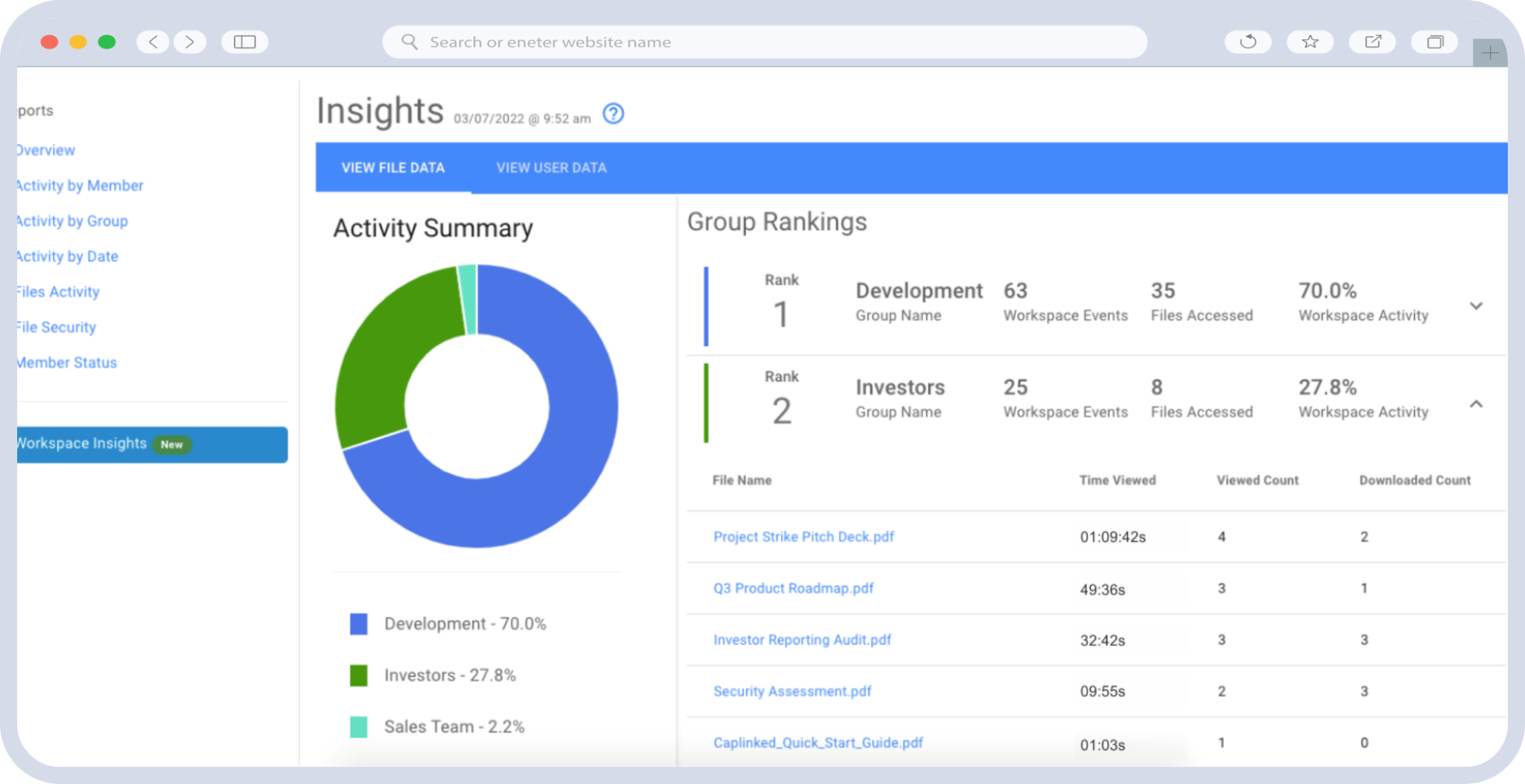
In CapLinked, permissions are set per group so a buyer’s counsel, its accountants, and its technical reviewers can each see the folders relevant to them. EZ Q&A, the structured question and answer module, keeps each diligence answer attached to its question and document, which produces an exportable disclosure record rather than a search through email threads. FileProtect, the digital rights management layer, revokes access to files a party already downloaded, which matters when a bidder exits mid-process. Teams running asset sales and purchases regularly tend to keep a standing room structure, since the schedule categories repeat from deal to deal.
Worth reviewing the data room features a deal team should expect before a process opens rather than during one. The full feature set and published pricing are both public, and you can start a 14-day free trial to build the schedules against a real document set first.
Asset Purchase Agreement Questions People Ask Most
What is an asset purchase agreement?
An asset purchase agreement is a contract in which a buyer acquires named assets of a business and assumes only the liabilities the agreement specifies. The selling entity survives and keeps whatever was not sold.
What is the difference between an asset purchase and a stock purchase?
An asset purchase transfers named assets and selected liabilities. A stock purchase transfers the entire entity with all its obligations. Buyers usually prefer asset deals for tax and liability reasons, sellers usually prefer stock deals.
Does the buyer assume liabilities in an asset purchase?
Only those the agreement names, with important exceptions. Courts recognize de facto merger, mere continuation, and fraudulent transfer claims, and state tax, environmental, and pension obligations can attach by statute.
How is the purchase price allocated in an asset purchase?
Across seven asset classes under Section 1060, using the residual method. Both buyer and seller file Form 8594, so agreeing the allocation in the agreement and filing consistently avoids a later dispute.
Why do buyers prefer asset purchase agreements?
They can select which assets to buy, limit assumed liabilities, and take a stepped-up tax basis, with goodwill and other Section 197 intangibles amortized over 15 years rather than inherited at carryover basis.
What are the disadvantages of an asset purchase?
Third-party consents, asset-by-asset retitling, non-transferable licences, and employee rehiring all add time. Anti-assignment clauses in material contracts are usually the biggest source of delay.
Can you use an asset purchase agreement template?
A template is a useful checklist of provisions. The parts that decide the outcome, namely the disclosure schedules, the price allocation, and the indemnity package, are deal-specific and need drafting with counsel.
This article is general information and is not legal or tax advice. Structure, liability, and allocation decisions should be reviewed by qualified counsel and tax advisors for the specific transaction.