Every M&A transaction hinges on a single, high-stakes decision that most deal teams underestimate: choosing the right virtual data room. With dozens of providers competing for your attention—each promising enterprise-grade security, seamless collaboration, and transparent pricing—decision paralysis is real. A misstep here doesn’t just slow down due diligence; it can derail timelines, erode buyer confidence, and expose sensitive deal information at the worst possible moment. This buyer’s guide cuts through the noise with a practical, feature-based evaluation framework so you can select the best virtual data room for M&A with confidence and speed.
Table of Contents
ToggleWhy the Right Virtual Data Room for M&A Is a Strategic Decision
A virtual data room (VDR) is far more than a secure file-sharing tool. In M&A transactions, it serves as the central nervous system of the deal—housing confidential financials, legal agreements, intellectual property records, and operational data that multiple parties need to access, review, and act on under tight deadlines. According to McKinsey & Company’s M&A research, the due diligence phase is where most deal value is either preserved or destroyed, making the platform you use to manage that process a genuinely strategic choice.
The wrong VDR can introduce friction at every turn: slow upload speeds that frustrate advisors, rigid permission structures that force workarounds, missing audit trails that create compliance gaps, and opaque pricing that blows up your deal budget. The right one accelerates timelines, strengthens buyer confidence, and gives your team the visibility and control needed to close successfully.
The VDR Evaluation Framework: 6 Critical Capability Areas
Rather than comparing vendors feature-by-feature in a spreadsheet that grows unwieldy, use this structured framework to evaluate any virtual data room for M&A transactions. Each capability area maps directly to a real-world deal requirement.
1. Granular User Permissions and Access Controls
M&A deals involve multiple parties with different levels of trust—buyers, sellers, legal counsel, financial advisors, management teams, and sometimes regulatory bodies. Your VDR must support role-based access controls that go beyond basic read/write permissions.
Look for platforms that offer:
- Document-level permissions — Control who can view, download, or edit specific files
- Dynamic watermarking — Overlay user-identifying information on viewed or downloaded documents to deter leaks
- Time-limited access — Automatically revoke permissions after a deal phase concludes or a party exits the process
As the U.S. Securities and Exchange Commission (SEC) has emphasized in its disclosure guidance, maintaining strict control over who accesses material nonpublic information is not just best practice—it’s a regulatory obligation in many transaction contexts.
2. Comprehensive Audit Trails and Reporting
In M&A, knowing who viewed what—and when—is as important as the documents themselves. A robust audit trail creates a defensible record of the entire due diligence process and provides deal teams with actionable intelligence.
Evaluate whether the VDR provides:
- Granular activity logs — Every login, page view, download, and upload event captured with timestamps and IP addresses
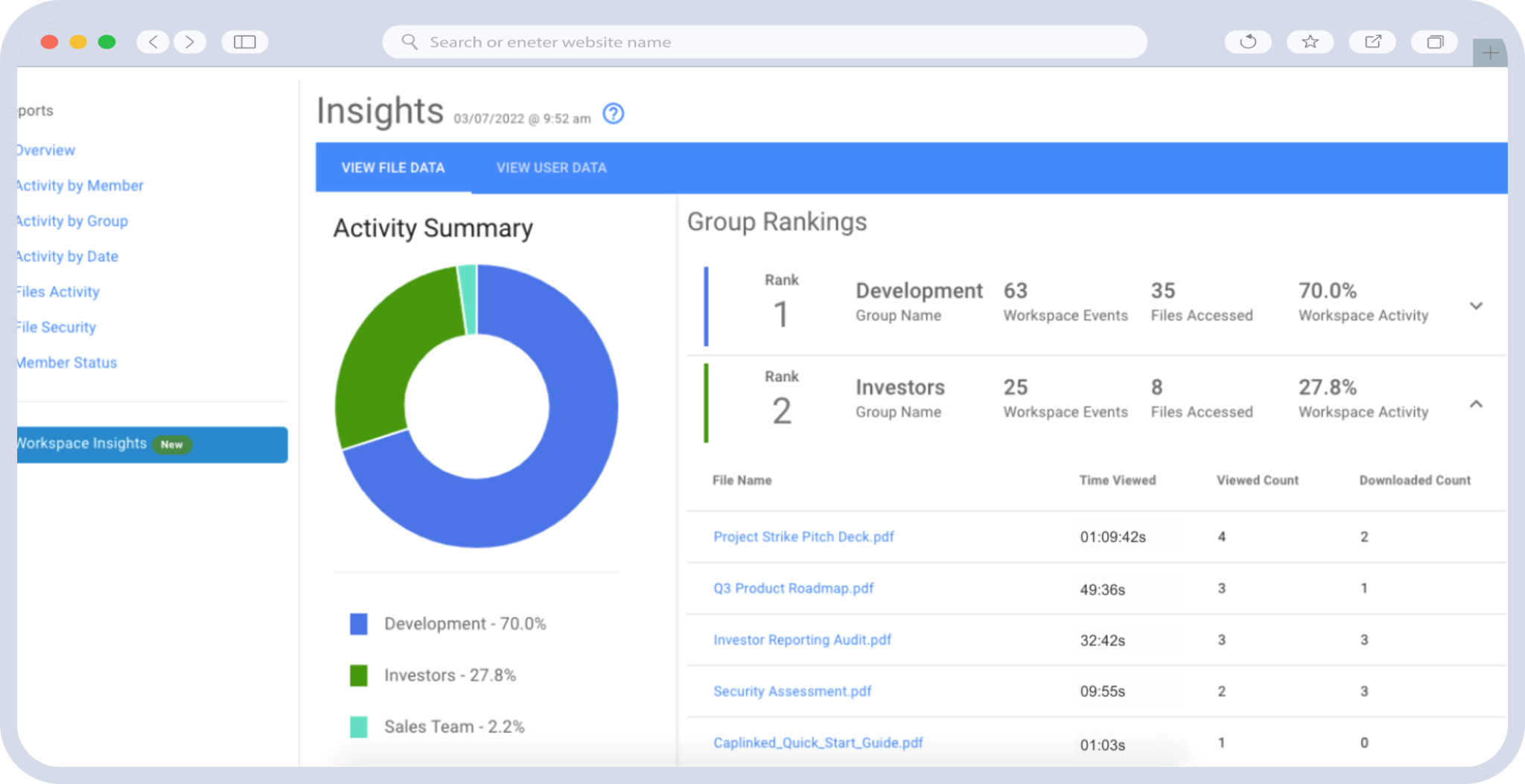
- Real-time analytics dashboards — Visual summaries of buyer engagement, document popularity, and time spent per section
- Exportable reports — The ability to generate detailed audit reports for compliance, board presentations, or post-deal review
- Q&A tracking — Full history of questions, answers, and response times linked to specific documents or deal sections
These analytics are not just for compliance. Sell-side teams routinely use VDR engagement data to gauge buyer seriousness, identify which bidders are deepest into diligence, and prioritize follow-up conversations accordingly.
3. Security Architecture and Compliance Certifications
Security is the foundational promise of any virtual data room, but not all security is created equal. For M&A transactions involving sensitive corporate, financial, or personal data, you need a VDR whose security architecture meets recognized industry standards.
Non-negotiable security features include:
- AES 256-bit encryption at rest and in transit
- Two-factor authentication (2FA) for all users
- SOC 2 Type II certification — Verifies that the vendor’s controls for security, availability, and confidentiality are independently audited
- ISO 27001 certification — The international standard for information security management systems
- GDPR compliance — Essential for any cross-border deal involving European data subjects
The National Institute of Standards and Technology (NIST) Cybersecurity Framework provides a useful benchmark for evaluating the maturity of a VDR provider’s security posture. Ask vendors directly how their practices align with NIST’s five core functions: Identify, Protect, Detect, Respond, and Recover.
4. Usability and Collaboration Tools
A VDR that’s secure but difficult to use will slow your deal down just as effectively as one with weak security. M&A due diligence involves dozens—sometimes hundreds—of users, many of whom are external parties unfamiliar with your chosen platform. Usability is not a luxury; it’s a deal-speed multiplier.
Key usability features to assess:
- Intuitive folder structures with drag-and-drop upload and bulk file management
- Full-text search across all uploaded documents, including scanned PDFs with OCR
- Built-in Q&A workflows that route questions to the right team members and track response status
- Multi-language support for cross-border transactions
- Mobile access via responsive design or dedicated apps, so advisors and executives can review documents on the go
The best way to evaluate usability is to run a structured pilot. Invite two or three team members to upload a sample document set, configure permissions, and simulate a buyer’s experience. If they struggle, your actual deal participants will too.
5. Integration Capabilities
Modern M&A workflows don’t live inside a single application. Your deal management platform needs to connect with the tools your team already uses—or risk becoming an isolated silo that creates more work instead of reducing it.
Evaluate integration support for:
- Microsoft 365 and Google Workspace — For seamless document creation and editing
- CRM platforms — So deal pipeline data flows between your relationship management and diligence tools
- E-signature solutions — To accelerate the transition from diligence to signing without leaving the platform
- API access — For custom integrations with internal deal management systems, compliance tools, or reporting dashboards
As deal teams increasingly adopt end-to-end deal management platforms, integration capabilities have become a meaningful differentiator among VDR providers.
6. Customer Support and Vendor Track Record
When a deal is on the line—often with millions or billions of dollars at stake—you need a vendor that responds in minutes, not hours. Evaluate the quality and availability of customer support as rigorously as you evaluate features.
Questions to ask during vendor evaluation:
- Is support available 24/7/365, including holidays?
- Do you get a dedicated account manager or project manager for your deal?
- What is the average first-response time for critical issues?
- Can the vendor provide references from similar transaction types and sizes?
- How long has the vendor been serving M&A deal teams specifically?
Track record matters. A provider that has facilitated thousands of M&A transactions understands the unique pressures, workflows, and compliance requirements that general-purpose file-sharing tools simply don’t address.
VDR Pricing Models: What to Expect and What to Watch For
Virtual data room pricing is one of the most confusing aspects of VDR comparison, primarily because vendors use different models that make apples-to-apples comparison difficult. According to industry analyses reported by Forbes Advisor, pricing structures for VDRs generally fall into several categories.
Common Pricing Structures
- Per-page pricing — You pay based on the number of pages uploaded. This model can be cost-effective for small deals but becomes prohibitively expensive for data-heavy transactions.
- Per-user pricing — A monthly or annual fee per user seat. Watch for vendors that charge for every individual user versus those that offer unlimited users within a project.
- Storage-based pricing — Fees tied to the amount of data stored. Predictable for small document sets, but costs can spike as deal rooms expand.
Flat-rate or project-based pricing — A single fee for unlimited users, storage, and features within a defined project or time period. This model offers the greatest cost predictability for M&A transactions.
Hidden Costs to Investigate
Beyond the base subscription, watch for fees that inflate your total cost of ownership:
- Overage charges for exceeding storage or user limits
- Premium fees for advanced features like custom branding, API access, or enhanced analytics
- Additional costs for Q&A functionality or dedicated support
- Setup and onboarding fees
- Data extraction or migration fees when closing a project
The most transparent vendors provide all-inclusive pricing that eliminates these surprises. When requesting quotes, always ask for a total cost estimate based on your specific deal parameters—number of documents, users, expected duration, and required features.
A Practical VDR Selection Checklist for M&A Deal Teams
Use this checklist to structure your evaluation process and ensure you’re comparing vendors on the dimensions that actually matter for your transaction.
- Define your deal requirements — Number of parties, estimated document volume, deal timeline, regulatory environment, and cross-border considerations
- Shortlist 3–4 vendors — Focus on providers with proven M&A experience and security certifications relevant to your industry
- Request tailored demos — Don’t settle for generic walkthroughs. Ask each vendor to demonstrate their platform using a scenario that mirrors your actual deal structure
- Run a pilot project — Upload sample documents, configure permissions, test the Q&A workflow, and evaluate the user experience from both admin and reviewer perspectives
- Compare total cost of ownership — Request detailed quotes that account for all users, storage, features, and potential overage scenarios
- Check references — Speak with at least two clients who used the platform for a similar transaction type and size
Negotiate contract terms — Ensure the agreement includes SLAs for uptime, support response times, and data handling upon project completion
Why CapLinked Is Built for M&A Deal Teams
CapLinked was designed from the ground up to support the complex, high-stakes workflows that define M&A transactions. With granular permission controls, real-time activity tracking, robust security architecture including SOC 2 compliance and AES 256-bit encryption, and an intuitive interface that external parties can navigate without training, CapLinked addresses every dimension of the evaluation framework outlined above.
Our flat-rate pricing model eliminates the hidden fees and overage surprises that plague other providers, giving deal teams full cost predictability from day one. And with dedicated customer support and a track record of facilitating secure transactions for organizations of all sizes, CapLinked delivers the reliability and responsiveness that deal professionals demand.
Ready to see how CapLinked can accelerate your next M&A transaction? Request a free demo and experience the platform your deal team deserves.
Frequently Asked Questions
A virtual data room for M&A is a secure online platform used to store, share, and manage confidential documents during mergers and acquisitions. It enables multiple parties—including buyers, sellers, legal counsel, and financial advisors—to access due diligence materials in a controlled environment with granular permissions, audit trails, and encryption to protect sensitive deal information.
To choose the best virtual data room for M&A, evaluate providers across six key capability areas: granular user permissions, comprehensive audit trails, security certifications (SOC 2, ISO 27001), usability and collaboration tools, integration capabilities, and the vendor's customer support and M&A track record. Shortlist three to four vendors, request tailored demos, run a pilot project, and compare total cost of ownership before making a decision.
Virtual data room pricing for M&A varies widely based on the pricing model used—per-page, per-user, storage-based, or flat-rate. Costs can range from a few hundred dollars per month for small deals to several thousand for large, complex transactions. Flat-rate or project-based pricing offers the greatest cost predictability, and buyers should watch for hidden fees related to overages, advanced features, Q&A usage, and data extraction.
A virtual data room for M&A should include AES 256-bit encryption at rest and in transit, two-factor authentication, dynamic watermarking, granular document-level permissions, and fence view or redaction capabilities. The provider should also hold SOC 2 Type II and ISO 27001 certifications and demonstrate GDPR compliance for cross-border transactions involving European data subjects.
General cloud storage platforms like Google Drive or Dropbox lack the granular permission controls, comprehensive audit trails, document-level security features, and compliance certifications required for M&A due diligence. A virtual data room for M&A is purpose-built to manage sensitive deal information across multiple parties with features like dynamic watermarking, Q&A workflows, and real-time engagement analytics that general file-sharing tools do not provide.
Most modern virtual data rooms for M&A can be set up within hours, not days. Leading providers offer templates for common M&A document structures, drag-and-drop bulk upload, and dedicated onboarding support to help deal teams populate and configure the data room quickly. The key variable is the volume and organization of your source documents—teams that prepare their document index in advance can launch their VDR significantly faster.