A single unanswered question—who accessed that file, and when?—can unravel a billion-dollar deal, trigger regulatory penalties, or expose your organization to devastating litigation. In high-stakes transactions like mergers and acquisitions, capital raises, and corporate restructurings, the ability to produce an irrefutable record of every document interaction isn’t a luxury; it’s a legal and operational necessity. A virtual data room audit trail delivers exactly that: a tamper-proof, time-stamped log of every login, view, download, print, and modification that occurs inside your secure deal environment. Yet many deal teams still treat audit trails as passive monitoring tools rather than what they truly are—powerful compliance safeguards that protect transaction integrity, satisfy regulators, and provide litigation-ready evidence on demand.
This guide explains how VDR document tracking works, why it matters for deal management compliance, and how to leverage audit trail capabilities to reduce risk at every stage of a transaction.
Table of Contents
ToggleWhat Is a Virtual Data Room Audit Trail?
A virtual data room audit trail is a comprehensive, automatically generated record of all user activity within a VDR platform. Unlike simple access logs, a robust audit trail captures granular details: which user accessed the data room, what documents they viewed or downloaded, how long they spent on each page, whether they printed or forwarded files, and what changes were made to permissions or document versions—all recorded with precise timestamps and IP addresses.
Think of the audit trail as a forensic chain of custody for your digital deal room. Every action is logged immutably, meaning it cannot be altered or deleted after the fact. This characteristic is what makes VDR audit trails admissible as evidence in legal proceedings and acceptable to regulators conducting compliance reviews.
Key Data Points Captured in a VDR Audit Trail
- User identity and authentication method: Who logged in, when, and from where (IP address, device type)
- Document-level interactions: Views, downloads, prints, and time spent per page
- Permission changes: Who granted or revoked access, and to which documents or folders
- Upload and version history: When documents were added, replaced, or deleted, and by whom
- Q&A activity: Questions asked, answers provided, and response timestamps
- Agreement and NDA acceptance: Clickthrough confirmations with date and time records
Why Audit Trails Are a Compliance Safeguard—Not Just a Monitoring Tool
Many organizations deploy virtual data rooms primarily for secure file sharing during M&A due diligence documentation reviews. While security is essential, the compliance dimension of VDR audit trails often delivers even greater long-term value. Here’s why deal teams and compliance professionals should view audit trails as strategic safeguards.
Regulatory Compliance Across Jurisdictions
Global data privacy regulations—including the EU’s General Data Protection Regulation (GDPR), the U.S. Health Insurance Portability and Accountability Act (HIPAA), and sector-specific mandates from bodies like the SEC and FCA—require organizations to demonstrate accountability over how sensitive data is accessed, processed, and shared. A virtual data room audit trail provides the documentary evidence needed to prove compliance during regulatory examinations.
Under GDPR’s Article 5, for example, organizations must adhere to the principle of accountability, demonstrating that personal data processing complies with the regulation. Secure file sharing audit logs within a VDR create the verifiable record that satisfies this requirement.
Litigation Readiness and Legal Hold
In the event of post-transaction disputes, shareholder litigation, or regulatory investigations, the ability to produce a complete, unalterable record of who saw what and when becomes invaluable. Courts and arbitration panels increasingly expect digital evidence to meet standards outlined in frameworks like the Federal Rules of Civil Procedure, which govern electronically stored information (ESI) in U.S. litigation. VDR audit trails, because they are system-generated and tamper-proof, carry significant evidentiary weight.
Transaction Integrity and Fiduciary Duty
For boards of directors, investment bankers, and legal counsel, demonstrating that a fair and transparent process was followed during a deal is a fiduciary obligation. Audit trails prove that all qualified bidders had equal access to information, that material documents were available for a specified period, and that no unauthorized parties viewed confidential materials. This documentation protects against claims of information asymmetry or breach of fiduciary duty.
How VDR Document Tracking Strengthens M&A Due Diligence
Due diligence is the phase where VDR audit trail capabilities deliver the most visible, immediate value. Deal teams managing complex M&A transactions rely on document tracking not only for compliance but also for strategic intelligence about buyer interest and engagement.
Measuring Buyer Engagement
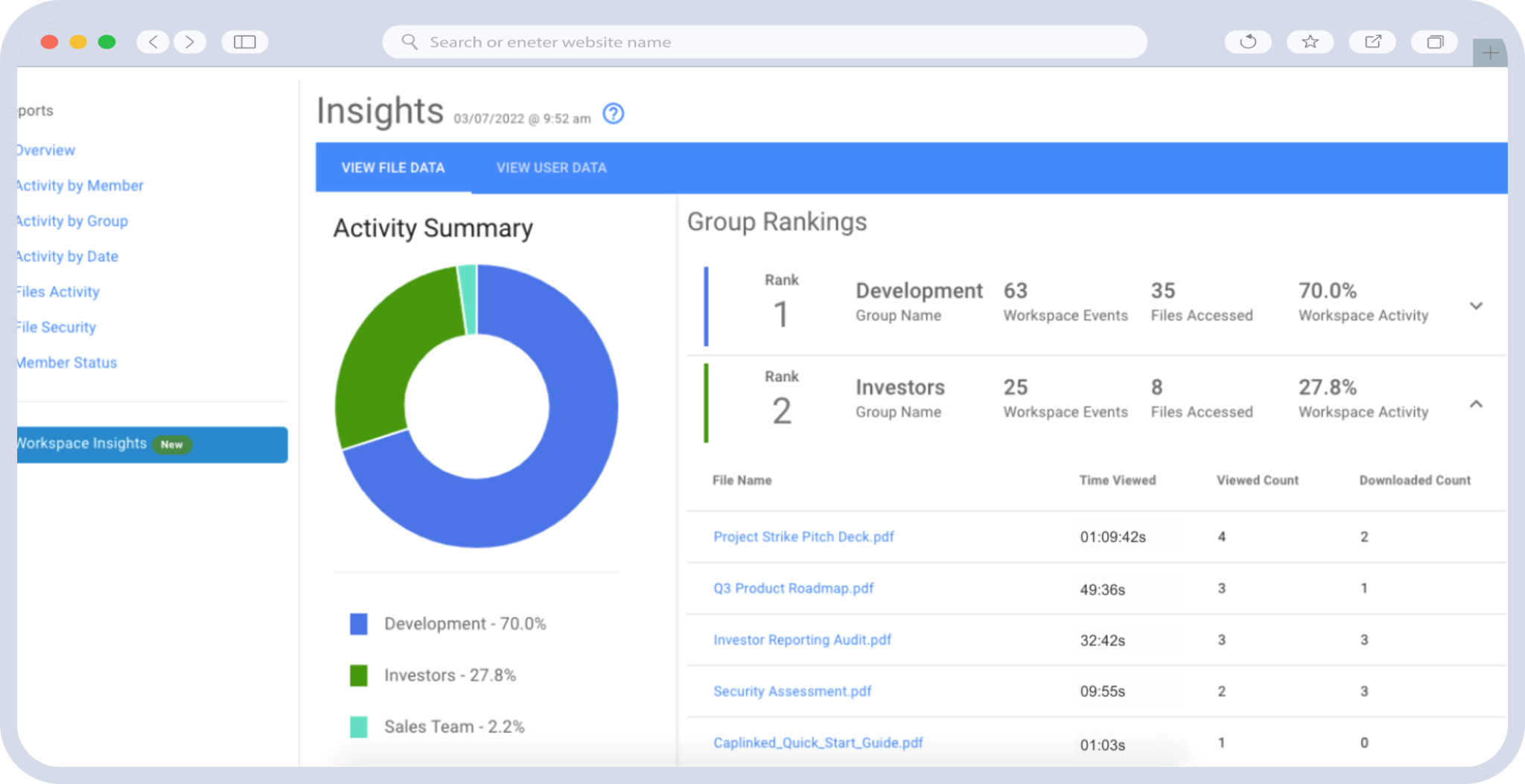
A virtual data room with detailed activity tracking provides a comprehensive audit trail that includes every user login, agreement clickthrough, document viewed, printed, or downloaded—with comprehensive specificity allowing administrators to trace the chronology of activities by user. This intelligence helps sell-side advisors gauge which bidders are conducting the deepest diligence, identify areas of concern based on which documents attract the most scrutiny, and allocate management presentation time to the most serious buyers.
Controlling Information Flow
Granular document tracking works in tandem with permission controls to ensure that sensitive information is disclosed in a staged, controlled manner. For example, during a phased due diligence process, first-round bidders might receive access to high-level financials while second-round participants gain access to detailed contracts and intellectual property documentation. The audit trail records every permission change, creating an unassailable record of the information disclosure sequence.
Accelerating Deal Timelines
According to Deloitte’s M&A Trends Report, deal teams consistently cite due diligence efficiency as a critical factor in transaction speed. VDR document tracking eliminates the ambiguity of traditional document exchange by providing real-time visibility into which parties have reviewed which materials, which questions remain outstanding, and where bottlenecks exist in the review process.
Essential Audit Trail Features to Evaluate in a VDR
Not all virtual data room audit trails are created equal. When selecting a VDR for deal management compliance, evaluate the following capabilities:
Granularity and Depth of Logging
The best VDR platforms log activity at the individual page level—not just at the document level. This means you can see that a specific user spent 12 minutes reviewing pages 15–22 of a financial model, not merely that they “accessed” a file. This granularity is essential for accurately assessing buyer interest and for producing detailed compliance reports.
Real-Time Reporting and Alerts
Look for platforms that offer real-time dashboards and configurable alerts. Administrators should be able to receive immediate notifications when specific high-sensitivity documents are accessed, when users attempt bulk downloads, or when access occurs from unusual geographic locations. Real-time visibility allows teams to respond to potential security incidents before they escalate.
Exportable and Archivable Reports
Audit trail data should be exportable in multiple formats (PDF, Excel, CSV) for inclusion in board reports, regulatory submissions, and legal filings. After a deal closes, the complete audit trail should be archivable for long-term retention, meeting the document preservation requirements that vary by jurisdiction and industry—often ranging from five to ten years or more.
Integration with Access Controls and Security Features
Audit trails deliver maximum value when they operate in concert with robust security features: role-based access permissions, two-factor authentication, dynamic watermarking, and remote document shredding. As the National Institute of Standards and Technology (NIST) Cybersecurity Framework emphasizes, effective security depends on the integration of identification, protection, detection, response, and recovery functions. A VDR audit trail serves the detection and identification functions, while access controls and encryption handle protection.
Tamper-Proof Architecture
Ensure that the VDR platform stores audit logs in an immutable format that cannot be edited, overwritten, or deleted by any user—including administrators. This immutability is what gives audit trail data its evidentiary credibility and distinguishes enterprise-grade VDR platforms from basic cloud storage solutions.
Best Practices for Leveraging VDR Audit Trails
Deploying a VDR with audit trail capabilities is only the first step. To extract maximum compliance and strategic value, follow these best practices:
1. Define Your Audit Trail Requirements Before the Deal Begins
Work with legal counsel and compliance officers to identify which regulatory frameworks apply to your transaction, what level of logging granularity is required, and how long audit data must be retained. Establishing these parameters upfront ensures your VDR configuration meets all applicable standards from day one.
2. Train All Participants on VDR Protocols
Ensure that all participants in the due diligence process—including external advisors, bidders, and internal team members—understand that their activity is logged. This transparency serves dual purposes: it deters careless handling of confidential information and ensures that all parties are aware of their obligations under the data room’s terms of use.
3. Review Audit Reports Regularly During the Transaction
Don’t wait until the deal closes to review audit trail data. Schedule weekly or bi-weekly audit report reviews to identify anomalies, track engagement patterns, and ensure that access permissions remain aligned with the current phase of the transaction. Proactive monitoring transforms audit trails from passive records into active risk management tools.
4. Archive the Complete Audit Trail at Deal Completion
Upon closing—or if a transaction terminates—export and archive the complete audit trail along with all supporting documents. This archived record should be stored in a secure, accessible location and treated as a permanent part of the transaction’s legal file. Many post-closing disputes arise months or years after a deal, and having the full audit trail readily available can be decisive.
5. Use Audit Data to Improve Future Processes
Audit trail analytics can reveal patterns that improve future deal execution: which document categories generate the most questions, where buyers spend the most time, and which sections of the data room cause confusion. Use these insights to build better-organized data rooms and more effective disclosure strategies for subsequent transactions.
The Cost of Inadequate Audit Trails
Organizations that rely on email, generic cloud storage, or poorly configured data rooms for sensitive document exchange expose themselves to significant risk. Without comprehensive, tamper-proof audit trails:
- Regulatory penalties: Inability to demonstrate data handling accountability can result in fines under GDPR (up to 4% of global annual revenue), HIPAA, and other frameworks
- Litigation exposure: Without evidence of who accessed what and when, organizations lose the ability to defend against claims of information leakage, insider trading, or breach of confidentiality
- Deal failure: Sophisticated counterparties and institutional investors increasingly require VDR audit trail capabilities as a precondition for participating in transactions
- Reputational damage: Data breaches or compliance failures during high-profile transactions generate lasting damage to brand credibility and client trust
How CapLinked Delivers Enterprise-Grade Audit Trail Capabilities
CapLinked’s virtual data room platform is built for the exacting requirements of deal professionals, legal teams, and compliance officers who need more than basic file sharing. CapLinked provides granular, real-time audit trails that capture every user action at the page level, combined with advanced permission controls, dynamic watermarking, and encrypted document storage. Every interaction is logged in a tamper-proof format that meets the evidentiary standards required for regulatory compliance and litigation readiness.
Whether you’re managing M&A due diligence, fundraising, board governance, or regulatory submissions, CapLinked gives you the visibility and control to protect transaction integrity from first disclosure through post-closing archival.
Ready to see how CapLinked’s audit trail capabilities can strengthen your compliance posture and accelerate your next deal? Request a demo today and experience enterprise-grade document tracking built for the demands of modern deal management.
Frequently Asked Questions
A virtual data room audit trail is a tamper-proof, automatically generated log that records every user action within a VDR—including document views, downloads, prints, permission changes, logins, and Q&A activity—with precise timestamps, user identities, and IP addresses. It serves as an irrefutable record of document access and interaction for compliance, legal, and security purposes.
Audit trails are critical for M&A due diligence because they provide verifiable evidence that all parties had fair and controlled access to material information, that confidentiality obligations were maintained, and that the disclosure process followed a structured, defensible sequence. This documentation protects sellers and buyers against post-closing disputes and fiduciary duty claims.
A virtual data room audit trail supports regulatory compliance by producing the detailed access and activity records required under frameworks such as GDPR, HIPAA, SOX, and SEC regulations. These logs demonstrate accountability over how sensitive data was accessed, processed, and shared—satisfying auditor and regulator requirements for verifiable data handling documentation.
Look for page-level activity logging, real-time dashboards and configurable alerts, exportable reports in multiple formats, tamper-proof log storage, and integration with security features like two-factor authentication, role-based permissions, and dynamic watermarking. The best VDR document tracking systems provide both compliance evidence and strategic engagement analytics.
Retention periods for virtual data room audit trail records vary by jurisdiction and industry but typically range from five to ten years or longer. Organizations should consult with legal counsel to determine applicable retention requirements under relevant regulations such as GDPR, SEC rules, or industry-specific mandates, and archive complete audit trails at deal completion.
Yes, VDR audit trails can be used as evidence in legal proceedings because they are system-generated, time-stamped, and stored in tamper-proof formats that meet the standards for electronically stored information (ESI) under rules such as the U.S. Federal Rules of Civil Procedure. Their immutability and granularity give them significant evidentiary weight in litigation, arbitration, and regulatory investigations.