Private equity deal teams that lose time in due diligence rarely lose it on analysis—they lose it on logistics. Disorganized folders, unclear permission structures, slow Q&A cycles, and fragmented document access can extend deal timelines by weeks and expose sensitive data to unnecessary risk. In a competitive deal environment where speed and precision define outcomes, the way you implement your virtual data room due diligence process is just as important as the financial models inside it. This guide provides PE firms with a tactical, step-by-step framework for structuring and managing VDRs to reduce deal cycle time, strengthen data security, and project operational excellence to every party at the table.
Table of Contents
ToggleWhy Virtual Data Room Due Diligence Matters More Than Ever in Private Equity
The PE due diligence process has grown significantly more complex over the past decade. Regulatory scrutiny has intensified, ESG diligence has become standard, and the volume of documents buyers request continues to climb. According to the U.S. Securities and Exchange Commission’s guidance on private fund due diligence, investors and advisers are expected to review and document an increasingly broad range of operational, legal, and financial factors before committing capital.
Mid-market transactions now routinely involve 5,000 to 50,000+ pages of documentation spanning financial records, IP portfolios, customer contracts, employment agreements, litigation histories, and regulatory filings. Managing this volume through email attachments, generic cloud storage, or physical data rooms introduces unacceptable risk. A purpose-built private equity data room centralizes access, enforces granular controls, and creates the auditable record that both regulators and limited partners expect.
Beyond compliance, the way you implement your VDR sends a signal. A well-organized, efficiently managed data room tells prospective buyers or investors that your firm operates with discipline—a factor that directly influences valuation confidence and deal velocity.
Step 1: Define Your Data Room Structure Before Uploading a Single Document
The most common VDR implementation mistake is treating folder organization as an afterthought. Before uploading any files, map your folder hierarchy to the due diligence checklist your counterparties will use. This pre-planning step alone can cut days from the review process.
Recommended Top-Level Folder Structure for PE Deals
- 1.0 Corporate Organization — Articles of incorporation, bylaws, organizational charts, entity structure diagrams, good standing certificates
- 2.0 Financial Information — Audited and unaudited financial statements, tax returns, debt schedules, working capital analyses, projections and budgets
- 3.0 Material Contracts — Customer agreements, vendor contracts, partnership agreements, lease agreements, licensing deals
- 4.0 Intellectual Property — Patent filings, trademark registrations, trade secret policies, IP assignment agreements
- 5.0 Employment and Benefits — Executive employment agreements, benefit plans, stock option plans, organizational headcount data, HR policies
- 6.0 Litigation and Regulatory — Pending and threatened litigation, regulatory correspondence, consent orders, compliance audits
- 7.0 Tax — Federal and state tax returns, transfer pricing documentation, tax opinion letters, R&D credit substantiation
- 8.0 Insurance — Policy summaries, claims history, D&O coverage details
- 9.0 Environmental and ESG — Environmental assessments, sustainability reports, ESG metrics and policies
- 10.0 Technology and Cybersecurity — IT infrastructure documentation, cybersecurity audits, data privacy policies, SOC reports
Use consistent numbering conventions (e.g., 2.1, 2.2, 2.3 for sub-folders within Financial Information) so that references in Q&A threads and diligence requests are unambiguous. The National Venture Capital Association (NVCA) publishes model legal documents and transaction guidelines that can inform folder and document categorization for venture-adjacent PE deals.
Step 2: Architect Your Permission Model With Precision
Permission architecture is where many VDR implementations either succeed or create costly data exposure. In private equity transactions, different parties—sponsors, co-investors, legal counsel, management teams, lenders, and operating partners—require vastly different levels of access.
Best Practices for Permission Design
- Group-based access, not individual-based. Create permission groups (e.g., “Buy-Side Legal Team,” “Lender Consortium,” “Management Presentation Only”) and assign users to groups. This makes permission changes scalable and auditable.
- Folder-level and document-level controls. Grant access at the folder level for efficiency, but retain the ability to restrict individual documents within a folder—critical for redacting sensitive compensation data or ongoing litigation details from certain buyer groups.
- View-only versus download privileges. Default to view-only access with dynamic watermarking. Grant download permissions only to specific groups (e.g., lead counsel) and only for categories where offline review is genuinely necessary.
- Staged disclosure. In competitive auction processes, release data in phases. Phase 1 might include a confidential information memorandum and high-level financials. Phase 2 opens detailed contracts and IP documentation to shortlisted bidders only. This staged approach protects sensitive information and creates natural deal momentum.
- Time-limited access. Set automatic access expiration dates aligned to bid deadlines or exclusivity periods. This eliminates the risk of lingering access after a party exits the process.
The Hart-Scott-Rodino Antitrust Improvements Act requires pre-merger notifications for transactions above certain thresholds, and the underlying data shared during diligence must be carefully controlled to avoid antitrust complications—particularly in competitive processes involving rival bidders. Your permission model is a first line of defense.
Step 3: Implement a Structured Q&A Workflow
The Q&A process during due diligence is where deals accelerate or stall. Unstructured Q&A—conducted through scattered email threads with attachments flying between multiple parties—creates confusion, delays responses, and introduces version-control risks.
How to Run Q&A Inside Your VDR
- Centralize all questions. Every question from every buyer, lender, or adviser should be submitted through the VDR’s built-in Q&A module. This creates a single, auditable log of every inquiry and response.
- Route questions to subject matter experts. Assign Q&A categories that map to your folder structure. Financial questions route to the CFO or controller. Legal questions route to outside counsel. IP questions route to the CTO. This routing eliminates the bottleneck of a single deal-team point person.
- Set response SLAs. Establish internal service-level expectations—for example, 24 to 48 hours for standard questions, same-day for deal-critical items. Track response times in VDR analytics dashboards and escalate overdue items.
- Batch and publish answers strategically. When multiple bidders ask similar questions, draft a standardized response and publish it simultaneously to all eligible parties. This maintains fairness and reduces redundant work.
- Link answers to documents. When a question can be answered by referencing a specific document already in the data room, include a direct link. This trains reviewers to search the VDR before submitting questions, reducing overall Q&A volume over time.
Step 4: Optimize Investor and Stakeholder Management
In PE transactions—especially fundraising, co-investment processes, and platform acquisitions with multiple stakeholders—deal management software must go beyond document storage. Your VDR should serve as the central coordination hub.
Key Investor Management Capabilities to Leverage
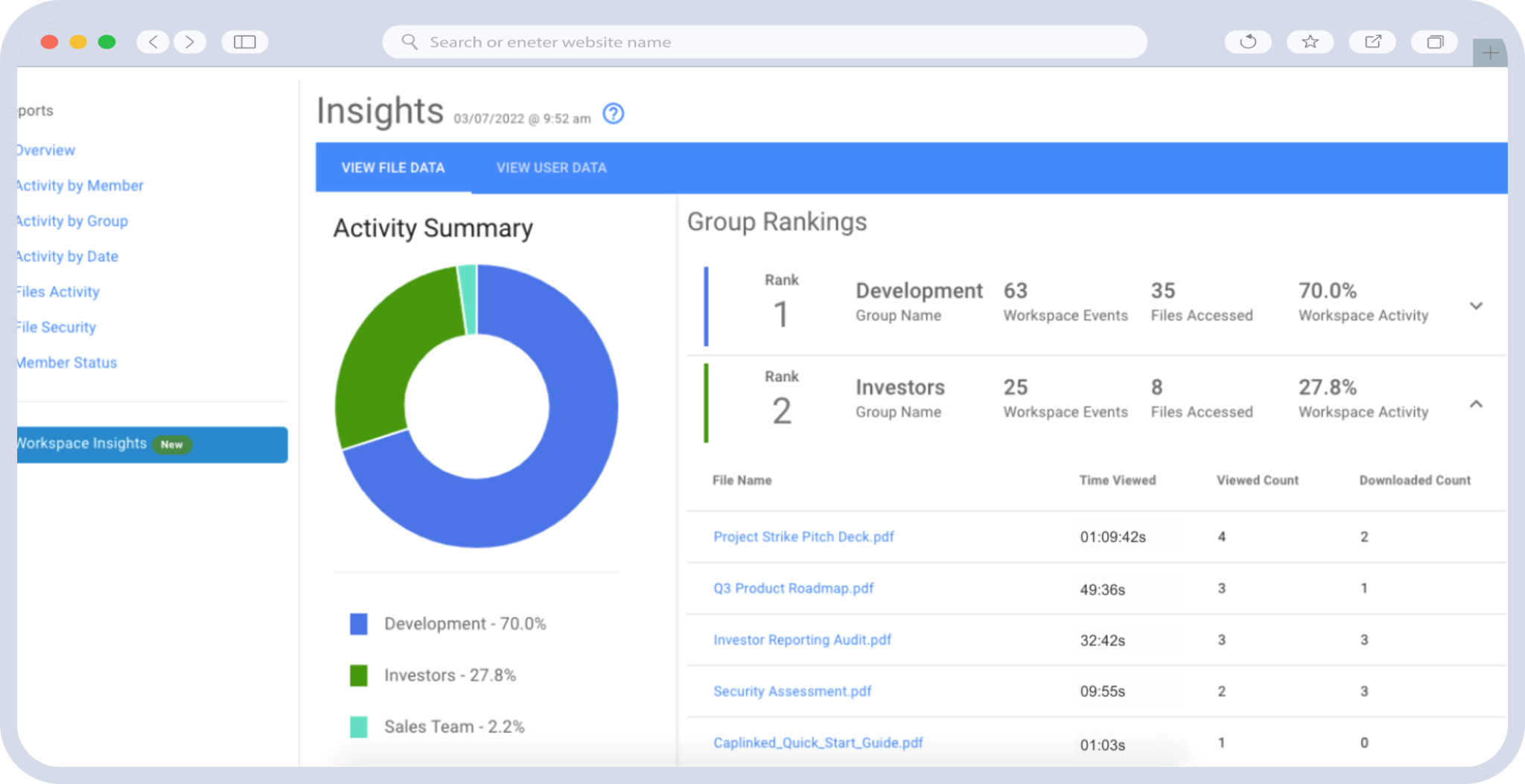
- Activity tracking and analytics. Monitor which documents each party has viewed, how long they spent on each file, and which sections they’ve returned to repeatedly. These engagement signals inform deal strategy: a bidder spending extensive time in the litigation folder may be developing a risk-adjusted pricing model.
- Custom NDAs and click-through agreements. Require each user to accept a non-disclosure agreement before accessing the data room. The VDR should log acceptance with timestamps for legal enforceability.
- Real-time notifications. Configure alerts for key events—new document uploads, Q&A responses, access requests—so that stakeholders stay informed without constant manual follow-up.
- Reporting for LPs and investment committees. Generate summary reports showing diligence progress, outstanding Q&A items, and access statistics. These reports streamline investment committee presentations and LP communications.
Step 5: Prioritize Security as an Ongoing Practice, Not a One-Time Setup
Secure document sharing M&A practices must extend throughout the entire deal lifecycle. According to IBM’s annual Cost of a Data Breach Report, the average cost of a data breach reached $4.88 million in 2024, with financial services and professional services among the most targeted sectors. For PE firms handling proprietary deal data, the stakes are existential—a breach during a live transaction can destroy deal value and trigger regulatory consequences.
Security Best Practices for VDR Implementation
- Two-factor authentication (2FA). Require 2FA for all users without exception. This single measure blocks the vast majority of credential-based attacks.
- Dynamic watermarking. Apply user-specific watermarks to every viewed and downloaded document. This creates traceability if a document is leaked.
- IP address and device restrictions. Limit access to approved IP ranges or known devices, particularly for the most sensitive document categories.
- Fence-view and remote-shred capabilities. Advanced VDRs allow you to restrict screen captures and remotely revoke access to previously downloaded documents—essential when a bidder exits a process.
- Regular access audits. Conduct weekly reviews of user access logs during active deal periods. Remove inactive users promptly and verify that permission groups still reflect the current deal stage.
- SOC 2 Type II and ISO 27001 compliance. Confirm your VDR provider maintains current certifications. Request the latest audit report before onboarding.
Step 6: Prepare for Post-Close Continuity
The data room’s value doesn’t end at closing. Post-acquisition integration, regulatory filings, earn-out disputes, and indemnification claims all require access to the diligence record. Implement these practices to preserve long-term value:
- Archive the data room in its final state. Create a complete, read-only archive that preserves the folder structure, Q&A log, access history, and all document versions as they existed at closing.
- Maintain access for key stakeholders. Grant ongoing access to legal counsel and integration teams for a defined post-close period (typically 12 to 24 months).
- Export audit trails. Download comprehensive activity logs and store them alongside closing binders for future reference during disputes or regulatory inquiries.
How to Choose the Right VDR for Private Equity Due Diligence
Not every virtual data room is built for the demands of private equity transactions. When evaluating providers for VDR implementation, prioritize these criteria:
- PE-specific workflow support — including multi-deal dashboards, co-investor access management, and portfolio-level analytics
- Enterprise-grade security — SOC 2 Type II certification, encryption at rest and in transit, granular permission controls, and dynamic watermarking
- Intuitive user experience — for both internal deal teams and external reviewers who may access the platform only once
- Robust Q&A and reporting — with routing, SLA tracking, and exportable analytics
- Responsive customer support — including dedicated deal-room specialists available during critical transaction phases
- Flexible pricing — per-deal or subscription models that align with your firm’s deal volume
As noted by the Institutional Limited Partners Association (ILPA) best practices framework, transparency and robust operational infrastructure are foundational expectations from LPs evaluating GP capabilities. Your VDR choice and implementation directly reflect your firm’s operational maturity.
Reduce Deal Cycle Time With CapLinked
CapLinked’s virtual data room platform is purpose-built for private equity firms managing complex, multi-party transactions. With granular permission controls, integrated Q&A workflows, real-time activity analytics, and enterprise-grade security, CapLinked gives deal teams the infrastructure to run efficient, secure diligence processes from initial review through post-close archiving.
Start your free trial at CapLinked.com and see how a properly implemented virtual data room transforms your PE due diligence process—reducing cycle time, strengthening data security, and giving your firm a measurable competitive edge in every deal.
Frequently Asked Questions
What is a virtual data room for due diligence?
A virtual data room for due diligence is a secure, cloud-based platform where companies store, organize, and share confidential documents during the evaluation phase of a business transaction such as a merger, acquisition, or private equity investment. It provides granular access controls, audit trails, and structured Q&A workflows that enable multiple parties to review sensitive information efficiently while maintaining strict data security throughout the deal lifecycle.
How should a virtual data room be organized for private equity due diligence?
A virtual data room for private equity due diligence should be organized into clearly numbered top-level folders that map to standard diligence categories, including corporate organization, financial information, material contracts, intellectual property, employment and benefits, litigation and regulatory, tax, insurance, ESG, and technology. Sub-folders within each category should use consistent numbering conventions so that Q&A references and document requests are unambiguous across all deal parties.
What are the most important security features in a virtual data room during due diligence?
The most important security features in a virtual data room during due diligence include two-factor authentication, dynamic watermarking, granular permission controls at both the folder and document level, IP address restrictions, remote access revocation, and encryption at rest and in transit. The VDR provider should also maintain current SOC 2 Type II and ISO 27001 certifications to demonstrate independently verified security standards.
How does a virtual data room reduce deal cycle time in private equity transactions?
A virtual data room reduces deal cycle time in PE transactions by centralizing document access, eliminating back-and-forth email exchanges, enabling structured Q&A with automated routing to subject matter experts, and providing staged disclosure capabilities that keep competitive processes moving efficiently. Real-time activity analytics also help deal teams identify and resolve bottlenecks before they delay the transaction timeline.
What documents do buyers typically request in a PE due diligence data room?
Buyers in a PE due diligence data room typically request audited and unaudited financial statements, tax returns, material customer and vendor contracts, corporate governance documents, intellectual property filings, employment agreements, benefit plan summaries, litigation histories, regulatory compliance records, insurance policies, cybersecurity audit reports, and ESG documentation. Mid-market transactions commonly involve 5,000 to 50,000 or more pages of individual documents across these categories.
How do permission controls work in a virtual data room for due diligence?
Permission controls in a virtual data room for due diligence allow administrators to create user groups—such as buy-side legal counsel, lender consortium, or management team—and assign each group specific access rights at the folder or individual document level. Permissions can be set to view-only, download-enabled, or print-enabled, and can include time-limited access that automatically expires at bid deadlines or exclusivity period conclusions. This ensures each party sees only the information appropriate to their role in the transaction.
Frequently Asked Questions
The appropriate retention period depends on the transaction type, applicable regulations, and contractual obligations. As a general guideline, most M&A practitioners maintain VDR access for a minimum period aligned with the indemnification survival period specified in the purchase agreement—typically 12 to 24 months for general representations and up to six years for fundamental representations such as tax and authority. Financial records should generally be retained for at least seven years per IRS guidelines, and environmental records may require retention for 30 years or more. Organizations should develop a retention schedule that addresses each document category individually, rather than applying a single blanket retention period.
Access for non-winning bidders should be revoked promptly upon their elimination from the process or, at the latest, upon deal closing. Before revoking access, generate a final activity report for each user documenting what they accessed during the process. If NDA provisions require the return or destruction of confidential information, send formal notices to each bidder's legal counsel confirming access revocation and requesting certification of destruction of any downloaded materials. The VDR's audit trail provides documentation of what each party accessed, which may be relevant if confidentiality disputes arise later.
Organizations should conduct a data mapping exercise to identify any personal data contained within the VDR—employee records, customer information, and third-party contact details are common examples. Under GDPR Article 5, personal data must not be retained longer than necessary for the purpose for which it was processed. Establish lawful bases for continued retention (e.g., legitimate interest in defending potential legal claims, compliance with legal obligations), document these bases, and implement technical measures including encryption, access controls, and automated deletion triggers when retention periods expire. For cross-border transactions, ensure that any transfer of archived data complies with applicable data transfer mechanisms such as Standard Contractual Clauses.
A VDR platform suitable for full lifecycle management should offer read-only archive mode (preventing modifications while preserving access), continued encryption and security controls in archive state, preserved audit trails and activity logs, searchability and efficient document retrieval, granular access controls that can be maintained and updated during the retention period, automated notifications for retention period expirations, and the ability to generate secure export packages or destruction certificates. CapLinked's platform provides all of these capabilities, enabling organizations to transition seamlessly from active deal management to long-term secure archiving without migrating data to separate systems.
Post-transaction analysis of VDR analytics yields actionable insights across several dimensions. Review document access patterns to identify which areas received the most scrutiny—these often correspond to buyer concerns that could be proactively addressed in future transactions through improved documentation or operational remediation. Analyze Q&A logs to build a library of frequently asked questions and approved responses that can be deployed in future data rooms, significantly reducing response times. Evaluate the folder structure and document organization for usability, incorporating feedback from buyers and advisors to refine your taxonomy. Finally, use activity timing data to understand how long due diligence actually takes across different document categories, enabling more accurate process timeline planning for future transactions.
Failing to properly close down a VDR after a deal creates several material risks. Continued unauthorized access to sensitive business information exposes the organization to potential data breaches, competitive intelligence leakage, and confidentiality violations. Indefinite retention of personal data without a lawful basis can result in regulatory penalties—GDPR fines can reach up to €20 million or 4% of global annual turnover, whichever is higher. In litigation, an unmanaged data room may become subject to broad discovery requests, with the absence of proper retention and deletion protocols potentially giving rise to adverse inference arguments. Additionally, ongoing VDR subscription costs for unused data rooms represent a direct and unnecessary financial expense. A disciplined wind-down protocol mitigates all of these risks while preserving the data and records that have genuine long-term value.