Every M&A deal lives or dies in due diligence — and the virtual data room you choose can be the difference between a smooth closing and a deal that stalls, leaks, or collapses entirely. With dozens of VDR vendors competing for your attention, each promising best-in-class security, intuitive design, and enterprise-grade features, the real challenge isn’t finding options — it’s knowing how to evaluate them. This guide gives you a structured, actionable framework for comparing virtual data room providers so you can select the platform that protects your deal, accelerates your timeline, and delivers measurable ROI.
Table of Contents
ToggleWhy the Right Virtual Data Room Matters More Than Ever in M&A
The virtual data room has evolved far beyond its origins as a digital filing cabinet. Today’s VDR platforms are mission-critical deal infrastructure — combining secure file sharing, granular access controls, real-time analytics, AI-powered automation, and compliance features that support every phase of a transaction from initial due diligence through post-merger integration.
According to the Institute for Mergers, Acquisitions and Alliances (IMAA), global M&A activity consistently involves tens of thousands of transactions annually, each requiring the secure exchange of highly sensitive financial, legal, and operational documents. The stakes are enormous: a single data breach or access control failure during due diligence can destroy deal value, trigger regulatory penalties, and permanently damage reputations.
For dealmakers, investment bankers, private equity firms, and corporate development teams, choosing the right virtual data room isn’t a procurement decision — it’s a strategic one.
The Core Criteria for Evaluating VDR Vendors
Not all virtual data rooms are created equal. To make a meaningful comparison, you need to evaluate vendors across several dimensions that directly impact deal outcomes. Here are the critical categories to assess.
1. Security Architecture and Compliance
Security is the foundational requirement of any virtual data room. Your VDR must protect confidential deal information from unauthorized access, interception, and leakage at every stage. When evaluating security, look for:
- 256-bit AES encryption for data at rest and in transit
- Granular permission controls — the ability to set access at the document and folder levelDynamic watermarking that tracks every viewed or printed document back to a specific user
- Two-factor authentication (2FA) and single sign-on (SSO) integration
- Remote shred / document expiration capabilities that revoke access after download
- Compliance certifications including SOC 2 Type II, ISO 27001, GDPR, and HIPAA where applicable
The National Institute of Standards and Technology (NIST) Cybersecurity Framework provides a useful benchmark for evaluating whether a VDR vendor’s security controls align with recognized federal standards for protecting sensitive information. Ask every vendor you’re evaluating how their platform maps to NIST guidelines.
2. User Experience and Ease of Adoption
A virtual data room with world-class security features is useless if your deal team, legal counsel, and counterparties can’t navigate it efficiently. Due diligence timelines are compressed, and every hour wasted on platform onboarding or confusing interfaces is time stolen from deal execution.
Evaluate user experience by considering:
- Intuitive drag-and-drop upload with bulk document handling
- Automatic index numbering and folder structure organization
- Full-text search across all uploaded documents, including scanned PDFs via OCR
- Q&A workflow tools that allow buyers to submit questions and sellers to respond within the platform
- Mobile accessibility for reviewing documents on the go
The best VDR providers minimize the learning curve so that all parties — from tech-savvy analysts to senior executives who rarely use document management software — can work productively from day one.
3. Due Diligence–Specific Features
Generic cloud storage platforms like Google Drive or Dropbox were not designed for the adversarial, high-stakes environment of M&A due diligence. A purpose-built virtual data room should offer features tailored specifically to deal workflows:
- Activity tracking and audit trails — detailed logs showing who viewed which documents, when, for how long, and from which IP address
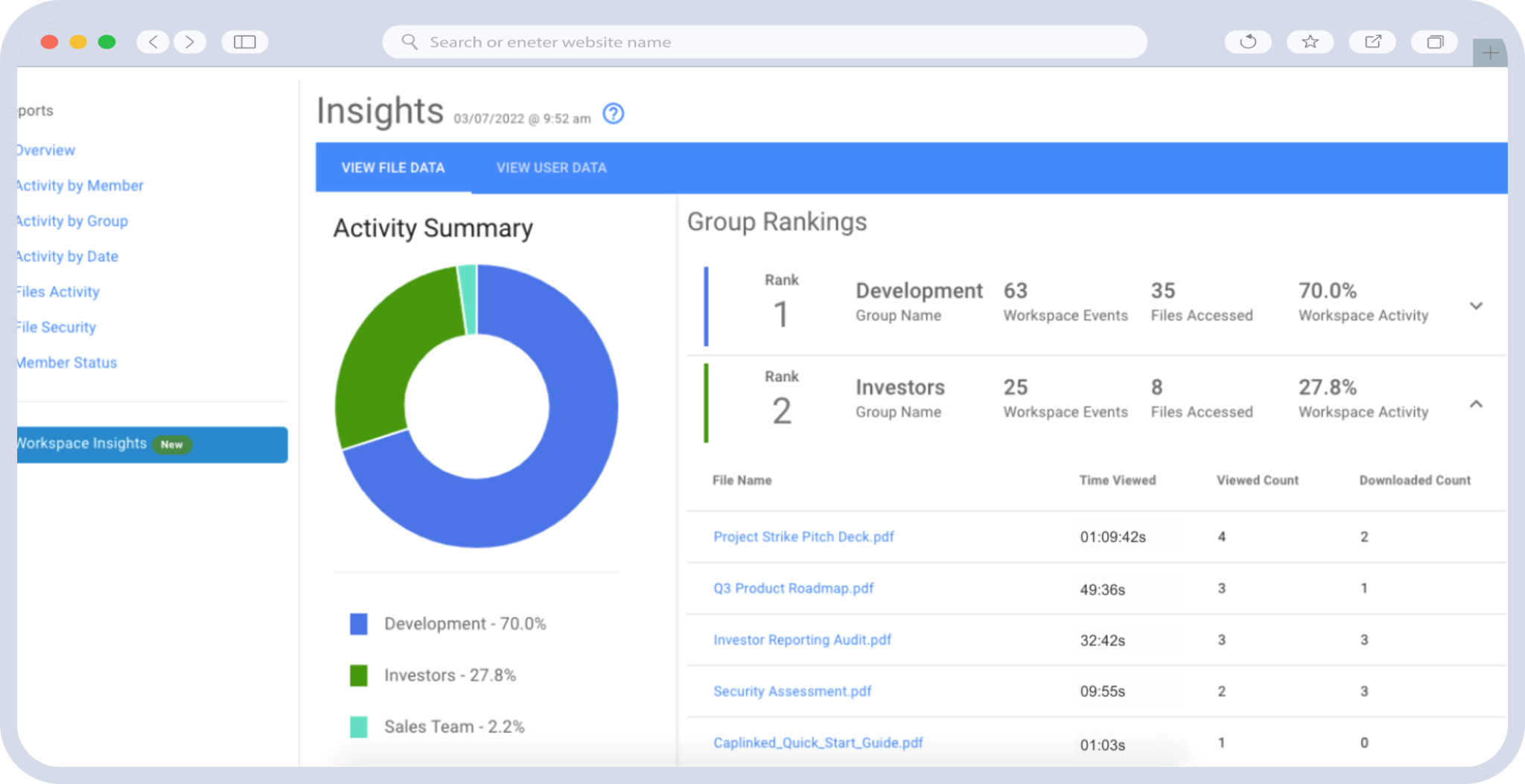
- Buyer interest analytics — heat maps and engagement reports that help sellers gauge which bidders are most active and serious
- Customizable NDAs and click-through agreements before granting data room access
- Redaction tools for selectively obscuring sensitive information in shared documents
- Stage-gating — the ability to progressively reveal documents as buyers advance through diligence phases
These features aren’t nice-to-haves. They give sellers a strategic advantage by providing visibility into buyer behavior and maintaining control over information flow throughout the deal process.
4. Pricing Transparency and Total Cost of Ownership
Virtual data room pricing varies widely based on storage limits, number of users, project duration, feature requirements, and intended use cases. Some vendors charge per page, others per user, and others offer flat-rate or unlimited-user pricing models. The lack of standardization makes apples-to-apples comparisons difficult — which is exactly what some vendors count on.
When evaluating pricing, go beyond the headline number:
- Ask about overage charges for storage, users, or bandwidth
- Clarify what’s included in the base plan versus what requires premium add-ons (e.g., custom branding, advanced analytics, API access)
- Understand contract terms — are you locked into annual commitments, or can you pay per-project?
- Factor in hidden costs like setup fees, training fees, and charges for additional administrators
A 2023 analysis by McKinsey & Company emphasized that transaction cost management and deal execution speed are critical factors influencing whether large transactions successfully cross the finish line. Choosing a VDR with predictable, transparent pricing directly supports both goals.
5. Customer Support and Onboarding
M&A deals don’t operate on a 9-to-5 schedule. When a deal team in New York needs to upload documents at midnight for a buyer in Tokyo reviewing them at noon, your VDR provider’s support team needs to be available. Evaluate:
- 24/7 live support availability — phone, chat, and email
- Dedicated account management for complex or multi-party deals
- Onboarding assistance including data room setup, document organization, and user training
Average response times and support SLAs backed by the vendor’s contract
6. Integration and Scalability
Your virtual data room doesn’t exist in a vacuum. It needs to integrate with the broader technology ecosystem your deal team relies on — from Microsoft Office 365 and DocuSign to CRM platforms and project management tools. Scalability is equally important: a VDR that works for a single mid-market deal should also be able to handle a multi-billion-dollar cross-border transaction with hundreds of counterparties and thousands of documents.
Look for vendors that offer robust APIs, pre-built integrations with common enterprise tools, and infrastructure that scales elastically without performance degradation.
Red Flags to Watch For When Comparing VDR Vendors
Knowing what to look for is only half the equation. You also need to know what to watch out for. Here are the most common red flags in the VDR evaluation process:
- Opaque pricing — if a vendor won’t provide a clear quote without a lengthy sales process, their pricing model may not survive scrutiny
- No SOC 2 or ISO 27001 certification — these are table stakes for any platform handling M&A-grade confidential information
- Limited audit trail capabilities — if the platform can’t tell you exactly who accessed what and when, it’s not built for due diligence
- No free trial or demo environment — reputable vendors let you test their product before committing
- Poor mobile experience — a sign that the platform hasn’t been updated to meet modern workflow expectations
- Vendor lock-in risks — difficulty exporting your data or migrating to another platform if needed
Building Your VDR Evaluation Scorecard
To make your virtual data room comparison systematic and defensible — especially when multiple stakeholders are involved in the decision — create a weighted evaluation scorecard. Here’s a practical template:
- Security & Compliance (25%) — encryption, certifications, access controls, watermarking
- Due Diligence Features (20%) — audit trails, Q&A tools, analytics, stage-gating
- User Experience (20%) — interface design, search, upload speed, mobile access
- Pricing & Value (15%) — total cost of ownership, transparency, flexibility
- Support & Onboarding (10%) — availability, responsiveness, dedicated account management
- Integration & Scalability (10%) — API access, third-party integrations, multi-deal capacity
Score each vendor on a 1-to-5 scale in every category, multiply by the weight, and compare total scores. This approach removes subjectivity and ensures you’re choosing a VDR based on deal-relevant criteria rather than the most persuasive sales pitch.
How VDR Choice Impacts M&A Deal Outcomes
The connection between virtual data room quality and deal success is not theoretical. Research from Deloitte’s M&A Trends report consistently highlights that efficient due diligence processes — enabled by robust deal technology — are correlated with higher deal completion rates and better post-merger performance.
A well-organized, secure virtual data room accelerates buyer review cycles, reduces the volume of follow-up information requests, gives sellers strategic intelligence through buyer engagement analytics, and minimizes the risk of information leaks that can derail negotiations or invite regulatory scrutiny.
Conversely, a poorly chosen VDR can introduce delays, frustrate counterparties, create security vulnerabilities, and add unnecessary cost — all of which erode deal value.
Why CapLinked Is Built for M&A Success
CapLinked was purpose-built for the demands of high-stakes transactions. Our virtual data room platform combines enterprise-grade security — including 256-bit encryption, granular permissions, dynamic watermarking, and SOC 2 compliance — with an intuitive interface that deal teams can adopt in minutes, not days.
With features like real-time activity tracking, customizable Q&A workflows, automated index numbering, and buyer engagement analytics, CapLinked gives sellers the visibility and control they need to run a disciplined deal process. Our transparent, predictable pricing eliminates surprise costs, and our dedicated support team is available when your deal demands it.
Whether you’re managing a single mid-market transaction or running multiple concurrent deals, CapLinked scales with you — providing the secure file sharing infrastructure that dealmakers trust.
Request a free demo of CapLinked to see how our virtual data room can streamline your next M&A due diligence process and help you close with confidence.
Frequently Asked Questions
A virtual data room (VDR) is a secure online platform used to store and share confidential documents during high-stakes business transactions such as mergers and acquisitions. In M&A, a virtual data room enables sellers to organize due diligence materials and grant controlled access to potential buyers, legal advisors, and financial institutions — ensuring sensitive information is protected throughout the deal lifecycle.
To compare virtual data room providers effectively, evaluate them across six key criteria: security and compliance certifications (SOC 2, ISO 27001), due diligence–specific features (audit trails, Q&A workflows, buyer analytics), user experience, pricing transparency, customer support availability, and integration capabilities. Building a weighted scorecard allows you to make an objective, data-driven comparison across multiple VDR vendors.
A virtual data room used for M&A should include 256-bit AES encryption, granular document-level permission controls, two-factor authentication, dynamic watermarking, remote document shred capabilities, and detailed audit trails. The platform should also hold recognized compliance certifications such as SOC 2 Type II and ISO 27001 to meet the security standards expected in confidential deal environments.
Virtual data room pricing varies based on storage capacity, number of users, project duration, and feature requirements. Some VDR providers charge per page or per user, while others offer flat-rate or unlimited-user plans. It is important to evaluate total cost of ownership — including setup fees, overage charges, and add-on features — rather than comparing headline prices alone.
Unlike general cloud storage services such as Dropbox or Google Drive, a virtual data room is purpose-built for secure, controlled document sharing in high-stakes transactions. VDRs offer features like granular access permissions, dynamic watermarking, detailed audit trails, Q&A workflows, and compliance certifications — capabilities that generic file-sharing platforms do not provide and that are essential for M&A due diligence.
Choosing the right virtual data room directly impacts M&A deal outcomes by accelerating buyer review cycles, reducing follow-up information requests, providing strategic insight through buyer engagement analytics, and minimizing the risk of data leaks. Research from firms like Deloitte and McKinsey indicates that efficient due diligence technology is correlated with higher deal completion rates and better post-merger performance.