Virtual Data Room Integration with Deal Management Tools: A Complete Guide for M&A Teams
The average M&A transaction involves more than 1,000 documents, dozens of stakeholders, and months of coordination across legal, financial, and operational teams. Yet a surprising number of deal teams still toggle between disconnected systems—uploading files to a virtual data room in one tab, tracking due diligence requests in a spreadsheet, and managing timelines in yet another platform. This fragmentation doesn’t just slow deals down; it introduces risk, increases errors, and erodes the trust that buyers and sellers depend on. Virtual data room integration with deal management platforms is the single most impactful technology decision M&A teams can make to eliminate these costly manual handoffs, reduce cycle times, and close deals with greater confidence.
In this guide, we’ll break down exactly how VDR integration works, why it matters for your M&A technology stack, the ROI you can expect, and how to implement it without disrupting active deals.
Table of Contents
ToggleWhy Disjointed Systems Are Costing Your Deal Team
M&A workflows are inherently complex. A typical sell-side process involves document preparation, buyer outreach, due diligence management, Q&A facilitation, negotiation, and closing—each with its own data requirements and stakeholder groups. When these stages rely on separate, unconnected tools, several problems compound:
- Manual data entry and re-entry: Deal teams waste hours copying information between CRMs, project trackers, and secure file sharing platforms, increasing the chance of transcription errors.
- Version control failures: Without a single source of truth, outdated documents circulate among buyers, creating confusion and legal exposure.
- Delayed communication: When Q&A threads live outside the data room, responses take longer, and audit trails become fragmented.
- Limited visibility: Executives and advisors can’t see deal progress in real time because status updates are scattered across email chains and spreadsheets.
According to Deloitte’s M&A Trends Report, deal complexity and regulatory scrutiny continue to increase year over year, making operational efficiency not just a competitive advantage but a necessity. Teams that rely on disjointed systems find themselves at a structural disadvantage during competitive auction processes where speed and accuracy determine outcomes.
What Is Virtual Data Room Integration?
Virtual data room integration refers to the technical and operational connection between a VDR platform and other deal management software—including CRM systems, due diligence trackers, project management tools, e-signature platforms, and financial modeling applications. When properly implemented, this integration creates a unified M&A technology stack where data flows automatically between systems, eliminating silos and enabling real-time collaboration.
Key Integration Types
- API-based integration: The most flexible approach, allowing bi-directional data exchange between your VDR and deal management platforms. APIs enable automated document syncing, permission management, and activity reporting.
- Native platform integration: Some VDR providers offer built-in connectors with popular deal management tools, CRMs like Salesforce, or communication platforms like Microsoft Teams.
- Workflow automation integration: Tools like Zapier or custom middleware connect VDRs to broader deal workflows, triggering actions such as notifying team members when new documents are uploaded or automatically updating deal stages.
- Single sign-on (SSO) integration: Centralizes authentication across your entire technology stack, simplifying access management while strengthening security.
The goal of every integration approach is the same: ensure that your deal management software integration creates a seamless experience where information entered once propagates everywhere it’s needed, securely and instantly.
The Business Case: ROI of VDR Workflow Automation
Integrating your virtual data room with deal management platforms isn’t just a convenience—it delivers measurable financial returns. Here’s where the ROI materializes:
1. Accelerated Deal Timelines
Manual handoffs between systems add days or weeks to every deal phase. When document uploads, access permissions, and Q&A workflows are automated, due diligence cycles compress significantly. Industry practitioners report that switching from email-based document management to integrated VDR workflows can reduce deal administration time by 25% or more. For a mid-market transaction where every week of delay costs tens of thousands in advisor fees alone, that acceleration translates directly to savings.
2. Reduced Error Rates
According to research published by the Harvard Business Review, poor data quality costs the U.S. economy an estimated $3 trillion annually. In M&A specifically, a single document versioning error during due diligence can trigger renegotiations, delay closing, or create post-close liability. VDR workflow automation ensures that the document in your data room is always the authoritative version, synchronized with every connected system.
3. Improved Compliance and Audit Readiness
Regulatory bodies and deal counterparties increasingly expect comprehensive audit trails documenting who accessed what, when, and what actions they took. Integrated VDR platforms generate these trails automatically across every connected system, rather than forcing compliance teams to reconstruct activity logs from multiple disconnected tools. The U.S. Securities and Exchange Commission has increasingly emphasized cybersecurity and data governance in its oversight of financial transactions, making robust, integrated audit capabilities essential rather than optional.
4. Better Decision-Making Through Unified Analytics
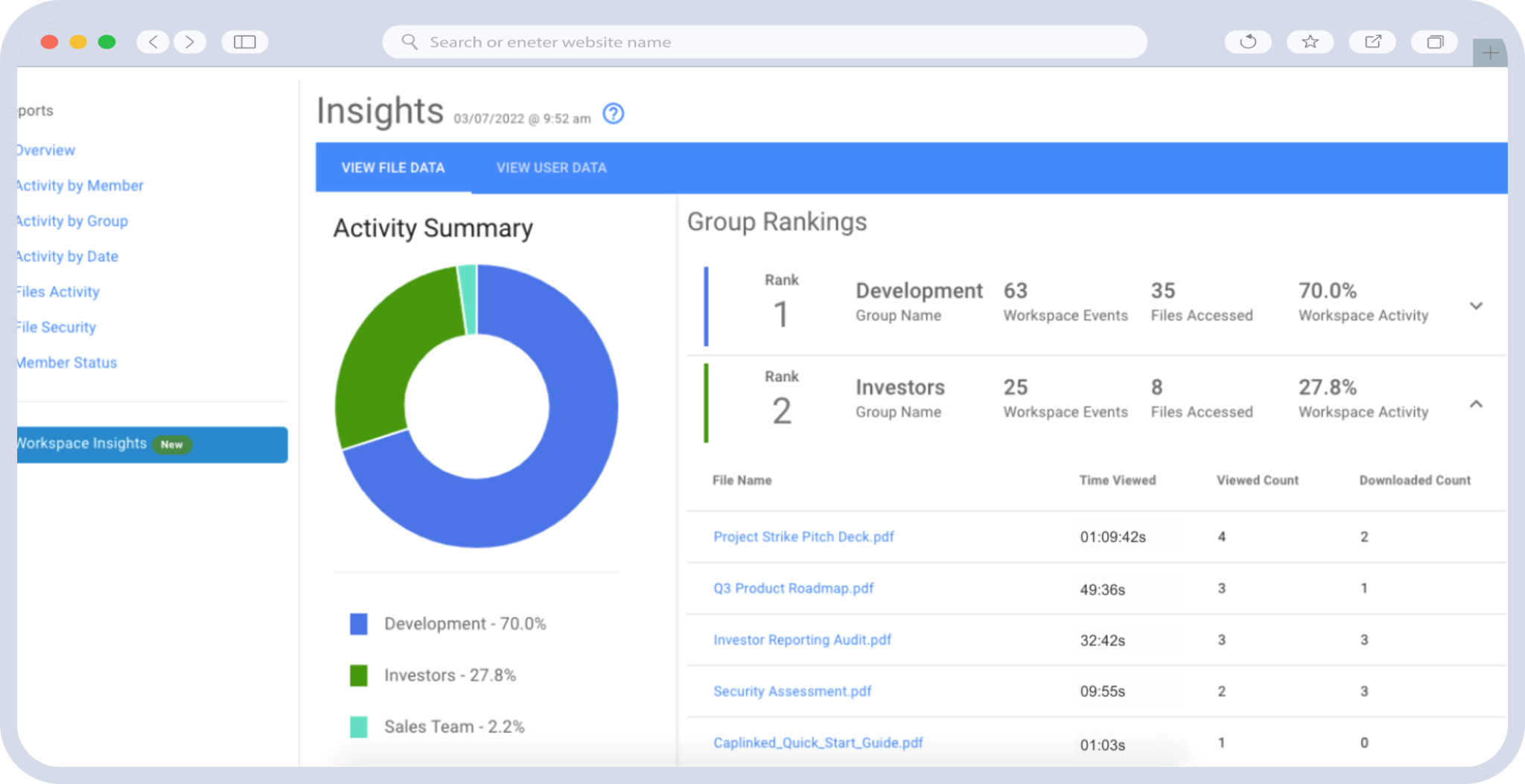
When your VDR feeds activity data into your deal management platform, you gain analytics that would be impossible to assemble manually: which buyers are most engaged based on document review patterns, which due diligence areas are causing bottlenecks, and how your current deal timeline compares to historical benchmarks. This intelligence helps deal teams prioritize their efforts and advise clients with data-driven precision.
How to Evaluate Your M&A Technology Stack for Integration Readiness
Before implementing virtual data room integration, conduct an honest assessment of your current deal technology environment. Here’s a practical framework:
Step 1: Map Your Current Deal Workflow
Document every tool your team uses from deal origination through closing. Include CRMs, VDRs, project management platforms, communication tools, e-signature solutions, and even shared spreadsheets. Identify every point where data is manually transferred between systems.
Step 2: Identify High-Impact Integration Points
Not every connection delivers equal value. Prioritize integrations that address your biggest pain points. For most M&A teams, the highest-impact integration points are:
- VDR to due diligence request tracker (eliminates the most manual work)
- VDR to CRM (provides real-time buyer engagement intelligence)
- VDR to e-signature platform (accelerates closing document execution)
- VDR to communication platform (centralizes Q&A and reduces email dependency)
Step 3: Assess Vendor API Capabilities
Not all VDR providers offer robust integration options. When evaluating secure file sharing platforms, ask specifically about REST API availability, webhook support, pre-built connectors, and developer documentation quality. A provider with a well-documented, enterprise-grade API will offer far more flexibility than one limited to basic file export functions.
Step 4: Evaluate Security Implications
Integration should never compromise security. Ensure that any data flowing between systems maintains the same encryption standards, permission controls, and audit logging as data within the VDR itself. The NIST Cybersecurity Framework provides a useful benchmark for evaluating whether integrated workflows meet enterprise security standards. Look for VDR providers whose integration architecture is SOC 2 Type II certified and supports granular permission inheritance across connected platforms.
Implementation Best Practices for VDR Integration
Once you’ve selected the right platform and mapped your integration priorities, follow these best practices to ensure a successful rollout:
Start with a Pilot Deal
Don’t overhaul your entire technology stack during a critical live transaction. Choose a lower-stakes deal or a deal in its early stages to pilot your integrated workflow. Document what works, identify friction points, and refine before scaling.
Define Clear Data Ownership Rules
When systems are integrated, it’s essential to establish which platform serves as the system of record for each data type. Your VDR should be the authoritative source for deal documents. Your CRM should own contact and relationship data. Your deal management platform should own timeline and milestone data. Integration synchronizes these systems, but ownership prevents conflicts.
Train Your Team on the Integrated Workflow
Technology adoption fails when people don’t understand how to use it. Invest in targeted training that shows deal team members not just how the integration works technically, but how it changes their daily workflow for the better. Focus on the time savings and error reduction they’ll experience personally.
Monitor and Optimize Continuously
Integration is not a one-time project. As deal volumes change, as new team members join, and as your platform providers release updates, revisit your integrated workflows quarterly. Track key metrics: time to populate the data room, average Q&A response time, closing timeline variance from target, and user adoption rates.
What to Look for in an Integration-Ready VDR Platform
When selecting a virtual data room that supports meaningful deal management software integration, prioritize these capabilities:
- Enterprise-grade API: RESTful APIs with comprehensive documentation, sandbox environments for testing, and dedicated developer support.
- Granular permission controls: The ability to extend your VDR’s permission model across integrated systems, ensuring that access rights remain consistent.
- Real-time activity tracking: Webhooks and event-driven architecture that push activity data to connected platforms instantly, not in batch updates.
- Flexible deployment options: Support for cloud, hybrid, and on-premise configurations to match your organization’s security requirements.
- White-label and customization capabilities: Branded experiences across integrated touchpoints that maintain professional presentation for clients and counterparties.
- Proven security certifications: SOC 2 Type II, ISO 27001, and compliance with GDPR, CCPA, and industry-specific regulations. As McKinsey & Company has noted, organizations that treat cybersecurity as a strategic enabler rather than a compliance obligation consistently outperform their peers in deal execution.
The Future of Integrated M&A Workflows
The M&A technology landscape is evolving rapidly. AI-powered document analysis, automated redaction, predictive deal analytics, and agentic workflow orchestration are all moving from experimental to mainstream. But these advanced capabilities only deliver value when they operate within an integrated ecosystem. A brilliant AI tool that can’t connect to your VDR or your deal tracker creates yet another silo.
Forward-thinking deal teams are building their M&A technology stack with integration as a foundational principle, not an afterthought. They’re choosing platforms that play well together, investing in API infrastructure, and designing workflows that treat data as a strategic asset flowing freely—but securely—across every stage of the deal lifecycle.
Close Deals Faster with CapLinked
CapLinked’s virtual data room platform is built for the demands of modern M&A. With enterprise-grade security, robust API capabilities, and a platform designed for seamless integration with your existing deal management tools, CapLinked helps your team eliminate manual handoffs, maintain airtight compliance, and accelerate every deal from kickoff to closing.
Ready to see how virtual data room integration can transform your deal workflow? Request a demo and discover how CapLinked fits into your M&A technology stack.
Frequently Asked Questions
Virtual data room integration is the process of connecting a VDR platform with other deal management tools—such as CRMs, due diligence trackers, and e-signature platforms—so data flows automatically between systems. It matters for M&A because it eliminates manual data entry, reduces document versioning errors, accelerates due diligence timelines, and provides real-time deal visibility that disconnected systems cannot offer.
VDR integration reduces deal timelines by automating manual handoffs between systems, such as syncing uploaded documents with due diligence checklists, pushing buyer activity data to CRM platforms, and triggering e-signature workflows when documents are finalized. Organizations that integrate their VDR with deal management tools commonly report 20–30% reductions in deal administration time compared to email-and-spreadsheet-based workflows.
When integrating a VDR with other platforms, ensure that data in transit and at rest maintains the same encryption standards across all connected systems. Look for SOC 2 Type II certification, granular permission inheritance so access rights remain consistent, comprehensive audit logging across every integration point, and compliance with frameworks like the NIST Cybersecurity Framework. Integration should enhance—not weaken—your overall security posture.
M&A teams benefit most from integrating their VDR with due diligence request management platforms, CRM systems for tracking buyer engagement, e-signature tools for closing document execution, project management platforms for milestone tracking, and communication tools for centralized Q&A. The highest-impact integrations are those that eliminate the most frequent manual data transfers in your current workflow.
Evaluate a VDR provider's integration readiness by reviewing their API documentation for completeness and ease of use, asking about pre-built connectors with popular deal management platforms, confirming webhook and event-driven architecture support for real-time data syncing, and checking whether they offer sandbox environments for testing integrations before deploying them on live deals. Providers with robust developer support and SOC 2 Type II certification are generally the most integration-ready.
The ROI of virtual data room integration comes from four primary areas: reduced deal timelines that lower advisor and operational costs, decreased error rates that prevent costly renegotiations or post-close liabilities, improved compliance through automated audit trails, and better decision-making through unified analytics on buyer engagement and deal progress. For mid-market transactions, these efficiencies can translate to tens of thousands of dollars in savings per deal.