Key Takeaways
- Start with your state’s retention schedule and response deadlines. They determine how records need to be organized.
- In several states, a member request triggers a short statutory response period. Track receipt, review, redaction, and delivery in one log.
- Not every document that an association must keep can be released without redaction. Separate member-accessible records from restricted material.
- Since January 1, 2025, Florida HOAs with 100 or more parcels have been required to make specified records available through a website or app, with protected access for owners.
- Make the association, not an individual director or outgoing management company, the custodian of the authoritative record set.
- A resident portal is normally the right tool for everyday HOA administration. A secure document room is most useful when records must be disclosed to counsel, auditors, buyers, or other external reviewers.
Table of Contents
ToggleHOA document management means keeping an association’s governing, financial, governance, and operating records complete, searchable, and available for lawful inspection. State law can dictate how long to retain documents, how quickly requests must be answered, and which information cannot be disclosed.
Boards tend to treat records as an administrative chore until the first formal request arrives with a statutory clock attached. Then the question is whether the association can produce the right version, with appropriate redactions, on time.
Retention and disclosure rules vary by state, association type, and governing documents. Confirm requirements with association counsel. This guide is general information, not legal advice.
What Are HOA Documents? What HOA Document Management Covers
HOA documents are the records an association creates or maintains to govern the community, account for money, make decisions, and operate common property. They fall into four practical groups.
- Governing documents: declaration or CC&Rs, bylaws, articles, rules, and amendments.
- Financial records: budgets, financial statements, reserve studies, audits, taxes, bank records, and owner ledgers.
- Governance records: minutes, election documents, ballots or proxies where applicable, and written board decisions.
- Operating records: insurance, vendor contracts, architectural applications, violations, maintenance, and correspondence.
The distinction that matters is not tangible against digital. It is disclosable against protection. Most association records are open to member inspection, a defined subset is not, and some records can be released only after specified information is removed.
Association records are not automatically public records available to anyone. Inspection rights are generally defined for members and other authorized parties by state law. Recorded declarations and other recorded instruments can usually be obtained through the relevant county recorder.
HOA Record Retention: Which Records to Keep and for How Long
Retention schedules vary by jurisdiction and document category. Do not treat a single statewide number as permission to delete every type of record when that period ends.
Table 1: HOA record retention baselines in selected states.
| State | Baseline / selected rules | Primary authority |
|---|---|---|
| Florida | Many official records: at least 7 years; special shorter or longer rules can apply to particular record types. | Fla. Stat. §720.303(4) |
| Texas | Tiered schedule: governing documents permanent; minutes and financial records generally 7 years; owner account records 5 years; specified contracts 4 years after expiration. | Tex. Prop. Code §209.005 |
| California | No single general retention term in the cited inspection law; current and prior two fiscal years are generally inspectable, with meeting minutes permanently inspectable. | Cal. Civ. Code §5210 |
| Nevada | Specific retention and access requirements apply; verify the current statutory text and association category rather than relying on an unqualified “10 years for everything” claim. | NRS §116.31175 |
Two practical points follow. If governing documents impose longer retention, or litigation, an insurance claim, or a preservation notice requires records to be held, apply the longer obligation. Maintain an approved schedule showing record category, authority, owner, review date, and destruction hold.
How Long an HOA Has to Answer a Records Request
A records request needs an intake date, an owner, a deadline, and a production record. The clock and remedy are not identical across states or all categories of documents.
Table 2: HOA records request deadlines and remedies in selected states.
| State | Selected deadline | Consequence / critical qualification |
|---|---|---|
| Florida | Generally make official records available within 10 business days of written member request. | For qualifying failures, §720.303 provides damages including $50 per calendar day up to 10 days; the statutory presumption applies to specified certified-mail requests. |
| Texas | Generally respond within 10 business days; if unavailable, written notice may set a date no later than 15 business days after the notice. | A justice court can order access and award eligible costs and attorney fees under §209.005. |
| California | Generally 10 business days for current-year records and 30 calendar days for records from prior two fiscal years; some document classes have different rules. | Courts may award specified relief and penalties for improper withholding under §5235; check the relevant record category. |
| Nevada | Financial and other records have category-specific inspection and copying rules. | Confirm the current deadline and remedy under NRS §116.31175 before giving a board a fixed date. |
Florida’s law does not simply make every late request automatically “intentional.” The rebuttable presumption applies when a qualifying written request is sent by certified mail, return receipt requested. Keep the receipt, review notes, redaction decisions, and proof of access or delivery together.
HOA Privacy Laws: What You Have to Withhold or Redact
HOA privacy laws balance the right to inspect association business with restrictions protecting personal, legal, and security-sensitive information. A board should review the precise exemption before withholding an entire file.
Table 3: Categories of HOA records that may need to be withheld or redacted.
| Category | Examples and handling guidance |
|---|---|
| Personal information | Florida exempts listed identifiers such as Social Security and driver-license numbers, personal contact details and certain other identifying information; Texas has its own owner-information restrictions. |
| Owner finances / enforcement | Personal account information, payment history and violation records may need restricted handling; the exceptions differ by state. |
| Personnel / medical | Private employee and resident medical records and protected personnel files require screening before release. |
| Legal privilege | Attorney-client communications and protected work product should be separately reviewed with counsel. |
| Access and security | Passwords, electronic security measures, guest records and related protected details should not be published casually. |
| Election records | Ballots, votes and proxies have state-specific retention and inspection rules; secret-ballot laws may restrict disclosure of an individual vote. |
Redaction must remove underlying content, not merely draw a black rectangle over text. Check searchable layers, spreadsheet hidden columns, file properties, and earlier versions before producing the final export. Ask a second reviewer to inspect exactly what the recipient will see.
Maintain a counsel-approved list of protected categories and a production record explaining what was withheld and why. Apply it consistently, but do not assume every owner’s balance, vote, or proxy is confidential in every jurisdiction.
What Florida’s HB 1203 Changed for HOA Records (2024–2025)
Florida HB 1203 became law in 2024, with major provisions effective July 1, 2024. The separate deadline for associations with at least 100 parcels to post specified records online was January 1, 2025. The original article incorrectly treated that deadline as the effective date of the entire law.
- Online access: qualifying HOAs must post specified records on a website or downloadable app, including an owner-restricted area for documents not intended for public access. Review and redact protected information before posting.
- Written retention policies: associations must adopt written rules governing how official records are retained and for how long. The policies must be made available as required by law.
- Enforcement: the law provides criminal consequences for narrowly defined intentional or repeated records misconduct, and automatic board-removal consequences for certain charges. Do not describe every lost record or late response as a criminal offense.
The publication rule makes permissioned, owner-accessible records a compliance issue, not merely a convenience. An M&A data room is not a substitute for that ordinary member-facing website.
How to Organize and Digitize HOA Records
An effective system begins with ownership and access rules, not software procurement. These six steps make routine requests and transitions less fragile.
- Designate an association-controlled system of record; do not rely on a director’s personal email or laptop.
- Organize governing documents, finances, minutes, contracts, insurance and restricted records under a consistent folder taxonomy.
- Adopt a written retention schedule with document owner, legal basis, and destruction holds.
- Keep privileged and personal information in restricted areas with named-user permissions.
- Maintain clear filenames and version history; store amendments with the documents they change.
- Log each request, review, redaction, production, recipient and completion date.
Which HOA documents should you digitize first?
Prioritize the current declaration and amendments, bylaws, rules, annual budgets and financial statements, the reserve study, insurance policies, board and member minutes, major vendor contracts, and architectural approvals. Scan paper records into searchable PDFs with a uniform naming convention, such as Association_Category_YYYY-MM-DD_Version.
Preserve originals where recording, evidence, or governing-document requirements call for them. Confirm that scanned copies are legible and indexable before relying on them in response to a member request.
Where HOA Records Get Lost: Board Turnover and Management Transitions
Records rarely disappear through a breach. They disappear through turnover, and two handoffs account for much of the risk.
First, a board transition: a treasurer has the only reserve study and three years of statements in personal email. The fix is an association-owned system where revoking a volunteer’s access does not remove the records.
Second, a management-company transition: the outgoing manager controls historical correspondence, insurance files and vendor contracts, but the contract says nothing about export format. Put return-of-records, indexing, completeness and timing in the services agreement.
HOA turnover checklist
- Reconcile the inventory against the retention schedule and open legal holds.
- Transfer control of accounts, domain, storage, credentials and administrator roles.
- Request indexed exports and verify attachments, versions and restricted folders.
- Revoke access for outgoing directors, contractors and management staff after the approved handoff.
- Reconcile bank statements, reserve study, insurance, contracts and active disputes.
- Document the handover, outstanding gaps and responsible owners in the minutes.
Apply the same discipline when control transitions from the developer to owner-elected directors; the applicable turnover obligations can differ from a routine manager change.
When an HOA Needs More Than a Resident Portal
For day-to-day association management, a community association platform is the right answer, and CapLinked is not one. Portals handle dues, owner messages, violations, architectural reviews, and resident access. Buy that category when that is the problem.
Use a dedicated secure document room when the work is a bounded, sensitive disclosure to outsiders: a contested inspection request handled by counsel; litigation, construction-defect or insurance production; a forensic audit; or a management-company transfer. A fifth fit is acquisition due diligence when a community association management company is sold and bidders need to examine contracts, insurance, claims history and records-custody obligations.
The decision rule: if residents need to self-serve routine forms, choose an HOA portal. If outside parties need staged, restricted access with an auditable record of production, consider a document room alongside the portal, not in place of it.
What Security Features Should HOA Document Management Software Have?
For sensitive HOA files, prioritize association-controlled administration, granular access rights, durable export capability, true redaction, and reviewable activity history. For external disclosure, also test MFA, encryption, secure sharing and access expiry.
- Who owns the account, domain, workspace and master copy?
- Can named groups receive view-only access to specified folders?
- Does redaction remove underlying PDF content? Can an administrator preview the recipient view?
- Can the administrator export detailed user activity and request logs?
- Can the association export files and an index if it changes providers?
- Does the resident-facing system satisfy applicable publication and owner-access rules?
- Are files encrypted at rest and in transit, and how are keys managed?
- Can administrators enforce two-factor authentication?
- Is a current independent SOC 2 Type II report available for review, where relevant?
- Does a per-user log record views and downloads, and can it be exported directly?
Do not mistake a provider’s attestation for the association’s legal compliance. The board still owns decisions about retention, member rights, redaction and record completeness.
How CapLinked Helps Counsel, Management Companies and Acquirers Share HOA Records
CapLinked is most relevant when association records must leave the day-to-day management system for an external review. Its value is controlled disclosure and documentation of the review, not collection of dues or resident portal operations.
For association counsel: controlled production and audit evidence
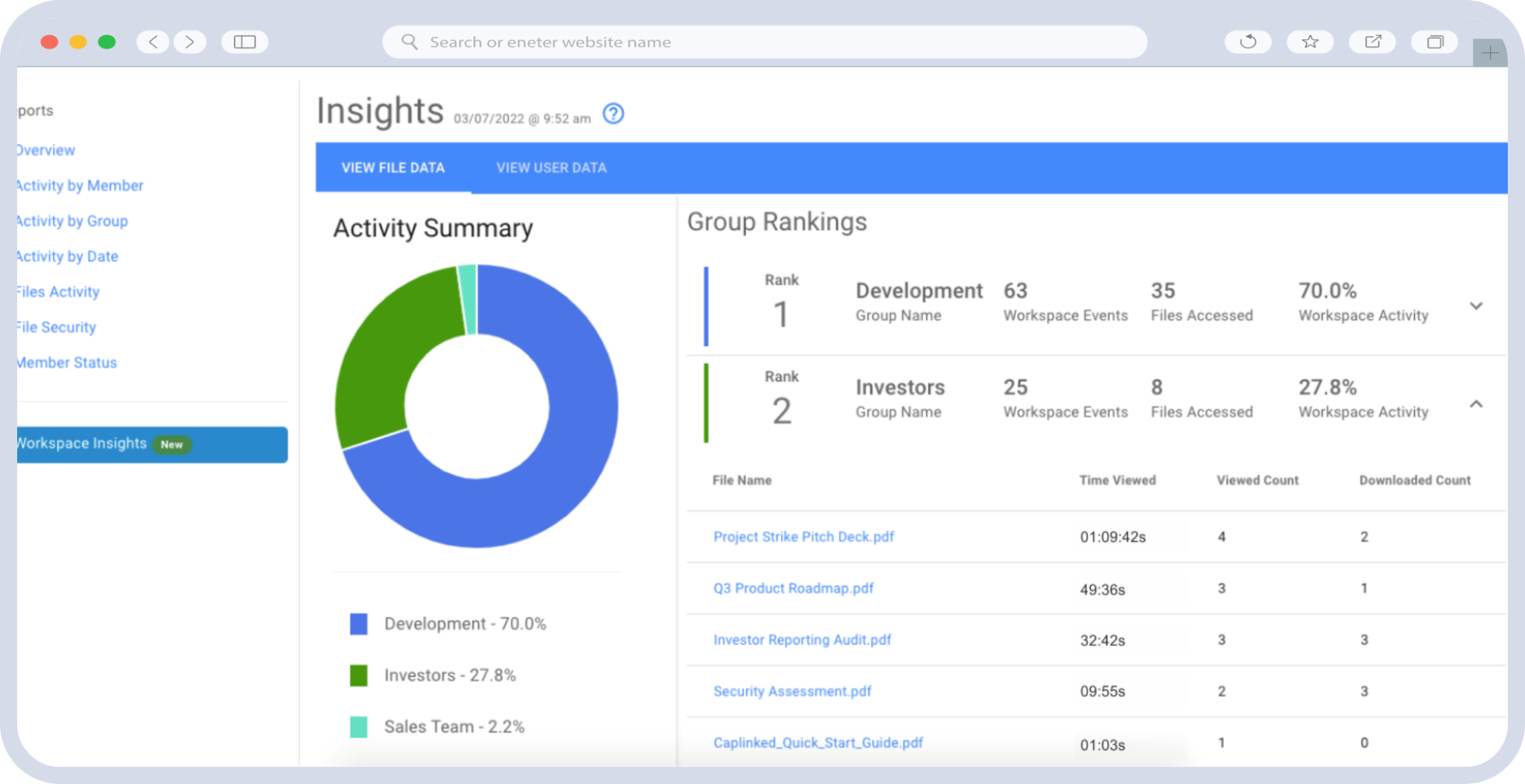
Create distinct access groups for counsel, auditors and outside parties, with folder-specific viewing or downloading. Enterprise PDF redaction supports removing sensitive details and previewing what a non-admin recipient sees; retain the new version as part of the production record. FileProtect can protect downloaded material and allow subsequent revocation. Activity Tracker and workspace reports support documenting user access and exported activity. Keep counsel’s own privilege and production log alongside the platform record.
For management-company transitions: collect and reconcile the handoff
Give the outgoing manager a restricted file-collection path and organize one workspace per association where practical. Import files from approved upload sources, review automatic indexing and metadata, and generate an indexed export for the receiving team. Verify completeness against the turnover inventory before cutting off the old system. These workflows assist a transition; the governing services agreement still determines records ownership and return obligations.
For acquirers and bankers: diligence on a management company
When a community association manager is being acquired, bidders may need to review association management contracts, fee schedules, fiduciary or fidelity coverage, customer concentration, record-custody provisions and active claims. Separate bidder permission groups, require deal-specific confidentiality terms, and keep questions in the controlled Q&A workflow. This is a conventional M&A disclosure problem with unusual record-custody risk, not a reason to replace every client HOA’s portal.
CapLinked documents 256-bit encryption at rest and in transit, enforceable two-factor authentication, AWS hosting, and SOC 2 Type II (SSAE 18) controls. Redaction is listed with Enterprise features. Verify the exact plan, user rights and reporting configuration before promising a specific workflow.
| Handling a sensitive HOA records production or evaluating an association management acquisition? Start CapLinked’s 14-day free trial to test group permissions, review access and controlled sharing before external disclosure. |
HOA Document Management FAQs
What is HOA document management?
The process of retaining, indexing, securing and lawfully producing an association’s governing, financial, governance and operational records. A usable system links each record category to a retention rule, access group and documented request process.
How long must an HOA keep records?
There is no universal U.S. period. Florida generally sets seven years for many official records; Texas uses categories; California distinguishes inspection periods; other states impose their own rules. Check special document categories and preservation holds.
How quickly must an HOA answer a records request?
It depends on the state, record category and request method. For example, Florida generally provides ten business days for inspection of official records after a written owner request, with specific qualifications for remedies.
What happens if an HOA misses a request deadline?
Statutes may provide damages, court orders, costs or other relief. Florida provides specified damages in qualifying circumstances; Texas provides an access-enforcement process. Record when the request arrived and what was made available.
Which HOA records can be withheld?
Protected items can include identifiers, personnel and medical files, legally privileged material, owner financial details and security credentials. Exemptions vary. Review the precise statute and redact only the protected information when partial release is permissible.
What did Florida HB 1203 change?
HB 1203 took effect in 2024 for most relevant provisions and required Florida associations with 100 or more parcels to post specified records through a website or app by January 1, 2025. It also addressed records policies and records misconduct.
Who owns HOA records: the association or the management company?
The records are association records even if a management company stores them. The management agreement should specify ownership, availability, export format and responsibilities during termination or transition.
Are HOA documents public record?
Not necessarily. Members often have statutory inspection rights, subject to exceptions; that is different from unlimited public access. Recorded declarations or covenants may be obtainable from the county recorder.
What HOA documents are needed for closing?
A resale or estoppel certificate when required, governing documents, current assessments, relevant budgets, reserve information and insurance may be requested. The exact seller, association and closing obligations depend on state law and transaction type.
What should an HOA turnover checklist include?
Inventory and indexed export; transfer of ownership and credentials; deactivation of outgoing access; reconciliation of financial, insurance and contract records; unresolved matters; and board documentation of who accepted the files.