Table of Contents
ToggleExecutive Summary
Virtual data rooms (VDRs) have become indispensable infrastructure for M&A transactions, fundraising rounds, restructuring processes, and complex due diligence workflows. Yet the vast majority of guidance available to deal teams focuses narrowly on the active transaction phase—the period when buyers, investors, or counterparties are reviewing documents and negotiating terms. This limited perspective leaves significant value on the table and exposes organizations to unnecessary risk.
The reality is that the virtual data room lifecycle extends far beyond the live deal window. It begins weeks or months before a transaction launches—during preparation, document collection, and structural planning—and it continues long after closing, encompassing document retention, compliance archiving, access revocation, and integration into the acquirer’s knowledge management systems. According to Deloitte’s M&A Trends Report, over 60% of deal professionals cite inadequate pre-deal preparation as a leading contributor to transaction delays. Meanwhile, post-closing data governance failures can trigger regulatory penalties, litigation exposure, and loss of institutional knowledge.
This comprehensive guide maps the complete VDR deal management workflow—from initial setup and stakeholder onboarding through deal completion, post-closing document retention, and long-term compliance archiving. Whether you are a corporate development officer orchestrating an M&A data room transition, a legal department managing secure file archiving after acquisition, or an investment banker advising clients on best practices, this resource provides the strategic and operational roadmap you need to maximize ROI across the entire virtual data room lifecycle.
Why Lifecycle Management Matters: The Case for End-to-End VDR Strategy
The Hidden Costs of a Transaction-Only Mindset
Most organizations treat their virtual data room as a temporary utility—a tool activated when a deal begins and abandoned when it closes. This transactional mindset creates three categories of risk:
- Pre-deal inefficiency: Without proper preparation, deal teams scramble to collect, organize, and upload documents under time pressure, leading to incomplete data rooms, disorganized folder structures, and delayed buyer access. Research from McKinsey & Company’s M&A practice indicates that poorly prepared data rooms can extend due diligence timelines by 20–30%, directly impacting deal velocity and closing certainty.
- Active-phase governance gaps: During the deal, inadequate permission management, inconsistent Q&A workflows, and lack of audit trail monitoring can compromise confidentiality, create liability, and erode buyer or investor confidence.
- Post-closing exposure: When a data room stays open longer than necessary, access rights are never reviewed or revoked, and sensitive files remain stored indefinitely without governance controls, the organization faces regulatory non-compliance, data breach risk, and potential litigation exposure. The EU General Data Protection Regulation (GDPR) Article 5 explicitly requires that personal data be kept only as long as necessary for the purpose for which it was collected—a principle that applies directly to transaction data rooms containing employee records, customer information, and other personal data.
The ROI of Full-Lifecycle VDR Management
Organizations that adopt a lifecycle approach to virtual data room management report measurable benefits. According to EY’s Global Transaction Advisory Services, companies with established deal readiness programs—including pre-configured VDR templates, standing document repositories, and post-closing archiving protocols—close transactions an average of 25% faster than those that begin preparation only after a deal is initiated. Furthermore, firms with documented data retention policies reduce post-transaction legal disputes by mitigating the risk of discoverable evidence gaps or unauthorized data exposure.
Lifecycle management transforms the VDR from a single-use deal tool into a strategic asset that supports ongoing compliance, institutional memory, and future transaction readiness.
Phase 1: Pre-Deal Preparation and VDR Setup
Establishing Deal Readiness Before the Transaction Begins
The most successful transactions are won or lost before a single buyer enters the data room. The pre-deal phase—often spanning three to six months before launch—is where the foundation for an efficient, secure, and confidence-inspiring VDR is built.
Deal readiness assessment: Begin with a comprehensive audit of the documents and data that will be required for the anticipated transaction type. For M&A sell-side processes, this typically includes corporate governance documents, audited financial statements, tax filings, material contracts, intellectual property registrations, HR and compensation records, regulatory filings, environmental reports, and litigation summaries. The U.S. Securities and Exchange Commission provides guidance on disclosure requirements that can inform document collection for public company transactions.
Choosing the right VDR provider: Not all virtual data rooms are created equal. Evaluate providers based on security certifications (SOC 2 Type II, ISO 27001), granular permission controls, dynamic watermarking, Q&A management capabilities, audit trail comprehensiveness, and—critically for lifecycle management—archiving and long-term retention features. CapLinked’s enterprise platform, for example, is purpose-built to support the full deal lifecycle, from initial document staging through post-closing archival.
Designing the Folder Architecture
A well-organized folder taxonomy is arguably the single most impactful decision in VDR setup. As experienced M&A advisors note, “No buyer has ever responded positively” to a data room with hundreds of documents thrown into a single folder. Structure communicates professionalism, competence, and transparency—it functions as what deal practitioners call the “silent negotiator.”
Best practices for folder architecture include:
- Top-level categorization by functional area: Corporate & Governance, Financial Information, Tax, Legal & Litigation, Contracts & Agreements, Intellectual Property, Human Resources, Operations, Regulatory & Compliance, Real Estate & Environmental, and Insurance.
- Consistent naming conventions: Use a standardized format such as “[Category Number].[Subcategory Number] – Document Name – Date” to enable intuitive navigation and alphabetical sorting.
- Index document: Include a master index (often in the root directory) that maps every document to its folder location, providing reviewers with a bird’s-eye view of the data room’s contents.
- Placeholder folders: For documents still being collected, create placeholder folders with clear labels indicating expected upload dates. This signals to counterparties that the data room is comprehensive and that remaining items are on a defined timeline.
Document Collection, Quality Control, and Staging
Document preparation is more than simple uploading. Each file should undergo quality review before entering the VDR:
- Completeness check: Ensure all pages are present, signatures are executed, and exhibits or schedules are attached.
- Redaction review: Sensitive information that is not relevant to the transaction—such as Social Security numbers, bank account details, or unrelated personal data—should be redacted before upload. Automated redaction tools can accelerate this process while reducing human error.
- Format standardization: Convert documents to searchable PDF format where possible. This improves reviewability, enables text search functionality, and prevents accidental edits to source files.
- Metadata scrubbing: Remove hidden metadata from files (author names, revision history, tracked changes) that could inadvertently reveal negotiation strategies or internal commentary.
According to PwC’s Global Deals practice, organizations that invest in pre-deal document preparation reduce due diligence Q&A volumes by up to 40%, directly accelerating time-to-close.
Phase 2: Stakeholder Onboarding and Permission Management
Defining User Roles and Access Hierarchies
Once the VDR is structured and populated, the next critical step is configuring access controls. A robust VDR deal management workflow requires multi-layered permission hierarchies that reflect both the sensitivity of the information and the role of each participant.
Common user roles include:
- VDR Administrator: Full control over settings, structure, user management, and audit logs. Typically a senior member of the sell-side advisory team or internal corporate development group.
- Content Manager: Can upload, modify, and organize documents but cannot alter user permissions or security settings.
- Reviewer (Full Access): Can view and download all documents in their assigned folders. Often assigned to lead buy-side legal counsel and senior deal team members.
- Reviewer (Restricted): Can view documents with limitations—such as view-only access without download or print capabilities, or access limited to specific folder categories.
- Q&A Participant: Can submit and respond to questions within the integrated Q&A module but may have limited document access.
Staged Disclosure and Information Gating
Not all information should be available from day one. Sophisticated deal teams use staged disclosure strategies, releasing information in phases aligned with the transaction timeline:
- Phase 1 (Teaser / Initial Review): High-level financial summaries, company overview, and market positioning documents available to a broad pool of potential buyers or investors.
- Phase 2 (Preliminary Due Diligence): Detailed financials, material contracts, and operational data available to parties who have signed NDAs and submitted initial indications of interest.
- Phase 3 (Confirmatory Due Diligence): Full access to sensitive materials—including employment agreements, customer-level data, and litigation files—available only to final-round bidders or the selected counterparty.
This gating approach protects competitive intelligence, limits exposure of the most sensitive data to the smallest necessary audience, and creates a natural workflow rhythm that keeps the deal process on track.
Onboarding Communication and Training
Even the most well-organized VDR will underperform if users don’t know how to use it effectively. Provide clear onboarding communications that include login credentials, two-factor authentication instructions, browser compatibility requirements, and a brief user guide. For complex transactions with large reviewer groups, consider hosting a short webinar or recording a video walkthrough of the data room structure and Q&A process.
Phase 3: Active Deal Management and Monitoring
Real-Time Audit Trail and Activity Analytics
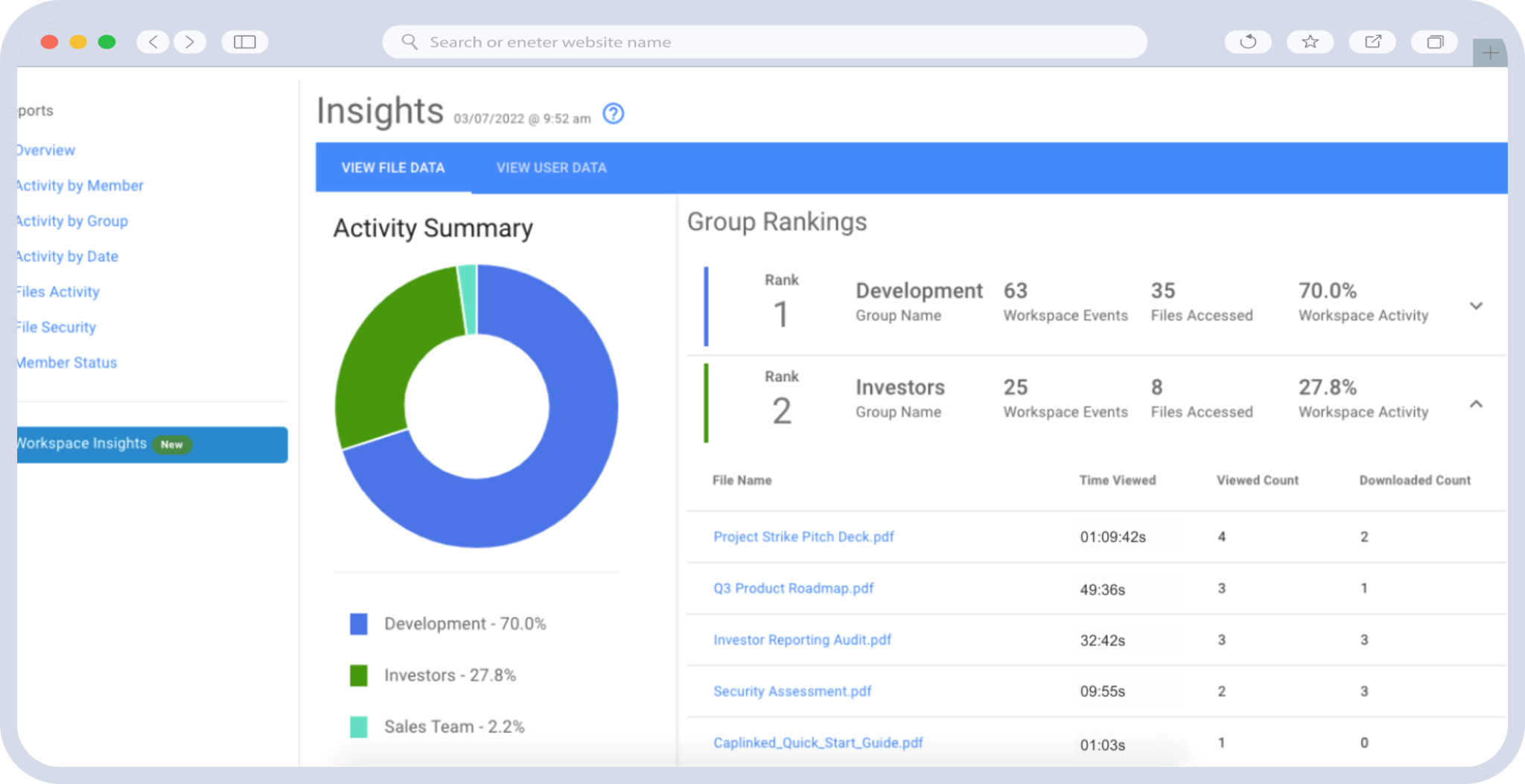
During the active deal phase, the VDR’s audit trail becomes one of the most strategically valuable tools available to the deal team. Modern VDR platforms track every action within the data room—document views, page-by-page time spent, downloads,, Q&A submissions, and login events—creating a comprehensive activity log.
This data serves multiple purposes:
- Deal intelligence: By analyzing which documents buyers are spending the most time reviewing, sell-side advisors can anticipate areas of concern, prepare proactive responses, and gauge buyer engagement levels. A buyer who spends significant time in the litigation or environmental folders may have specific risk concerns that can be addressed early.
- Compliance documentation: The audit trail creates an immutable record of who accessed what information and when—essential for demonstrating regulatory compliance, particularly in regulated industries or cross-border transactions subject to Foreign Corrupt Practices Act (FCPA) or anti-money laundering requirements.
- Security monitoring: Unusual access patterns—such as bulk downloads at odd hours, access from unexpected geographies, or repeated attempts to access restricted folders—can trigger alerts that enable administrators to respond before a breach occurs.
Q&A Workflow Management
The due diligence Q&A process is often the most labor-intensive element of the active deal phase. Best practices for VDR-integrated Q&A management include:
- Routing and assignment: Automatically route questions to the appropriate subject matter expert (finance, legal, operations, HR) based on the document category or folder from which the question originated.
- Response templates: Develop standardized responses for frequently asked questions to ensure consistency and accelerate turnaround times.
- Audit and approval workflows: Require legal or advisory review of responses before they are published to the counterparty, ensuring that no inadvertent representations are made.
- Tracking and analytics: Monitor open questions, average response times, and question volume trends to identify bottlenecks and allocate resources accordingly.
Dynamic Document Updates and Version Control
Transactions are dynamic. New documents are generated throughout the process—updated financial models, revised draft agreements, supplemental disclosures, and management presentations. Proper version control is essential to ensure that all parties are working from current information.
Best practices include maintaining a clear versioning protocol (e.g., “v1.0,” “v2.0,” or date-stamped filenames), using the VDR’s built-in version history functionality to preserve earlier iterations, and notifying relevant users when material documents are updated or added.
Phase 4: Pre-Closing Preparation and Transition Planning
The Often-Overlooked Transition Phase
As a transaction approaches closing, deal teams are typically focused on final negotiations, regulatory approvals, and closing condition satisfaction. The VDR’s role during this phase is often overlooked—yet critical decisions made during this window determine the success of post-closing data governance.
Closing Documentation and Signing Management
The VDR should serve as the central repository for all closing-related documents, including:
- Executed purchase agreements and ancillary documents
- Closing certificates and officer certifications
- Regulatory approvals (e.g., Hart-Scott-Rodino Act clearance letters)
- Third-party consents and estoppel certificates
- Funds flow memoranda and wire transfer confirmations
- Closing binders and transaction summaries
Planning the M&A Data Room Transition
Before closing, establish a clear plan for what happens to the VDR after the transaction is complete. Key decisions include:
- Who retains administrative access? In most cases, administrative control should transfer to the acquiring entity’s legal or corporate development team, with the sell-side retaining limited read-only access for a defined period.
- What is the retention timeline? Define specific retention periods based on regulatory requirements, contractual obligations (e.g., indemnification claim periods, earn-out provisions), and institutional knowledge needs.
- Which documents require long-term archiving? Not all VDR contents carry equal post-closing significance. Executed agreements, financial records, regulatory filings, and intellectual property documentation typically require longer retention than preliminary drafts or marketing materials.
- What format will archived data take? Determine whether the VDR will remain active in read-only mode, whether documents will be exported to a separate archival system, or whether the VDR provider offers a dedicated archiving tier with reduced cost but maintained security.
Phase 5: Post-Closing Operations and VDR Wind-Down
Executing the Controlled Wind-Down
Closing down a virtual data room is a critical step that demands the same rigor applied to its setup. The post-closing wind-down process should follow a documented protocol:
Step 1: Generate comprehensive final reports. Before any access is revoked or data is archived, generate and preserve the complete audit trail. These reports should detail all activities conducted in the virtual data room, including user access logs, document upload histories, Q&A transcripts, and permission change records. These reports serve as the authoritative record of the due diligence process and may be required in future disputes, regulatory inquiries, or indemnification claims.
Step 2: Review and revoke user access. Systematically revoke access for all external parties—bidders who did not prevail, advisory team members whose engagement has concluded, and any other third parties. For the acquiring entity’s team, transition access to the appropriate long-term administrators.
Step 3: Classify documents for retention, archiving, or deletion. Apply the retention schedule developed during the pre-closing transition planning phase. Documents falling outside the retention scope should be securely deleted, with deletion certificates generated for the record.
Step 4: Confirm compliance with data protection obligations. If the VDR contained personal data subject to GDPR, CCPA, or other data protection regulations, confirm that all obligations have been met—including responding to any outstanding data subject access requests and ensuring that personal data is not retained beyond the lawful basis for its processing.
Post-Closing Document Retention: Regulatory and Contractual Requirements
The duration and manner of post-closing document retention are governed by a patchwork of regulatory requirements that vary by jurisdiction, industry, and document type:
- Corporate and financial records: The IRS generally recommends retaining financial records for a minimum of seven years. State corporate laws may impose additional requirements for articles of incorporation, bylaws, and board minutes.
- Employment records: Under EEOC guidelines, employment records should be retained for at least one year from the date of the personnel action, with longer periods for records related to charges of discrimination.
- Environmental records: Environmental compliance records may need to be retained for 30 years or more under certain EPA regulations, particularly for facilities with hazardous substance exposure.
- Contractual obligations: Purchase agreements often include indemnification periods of 12 to 24 months (or longer for fundamental representations), during which access to the underlying due diligence materials may be necessary to evaluate or defend claims.
- Litigation hold requirements: If any litigation, investigation, or regulatory inquiry is pending or reasonably anticipated, all potentially relevant documents must be preserved regardless of standard retention schedules. Failure to comply constitutes spoliation of evidence and can result in severe sanctions.
Secure File Archiving After Acquisition
Secure file archiving after acquisition requires a purpose-built approach that balances accessibility with security:
- Encrypted archival storage: Archived VDR contents should be stored with enterprise-grade encryption (AES-256 at rest, TLS 1.2+ in transit) and access limited to a small number of authorized administrators.
- Searchability and retrieval: Even in archive mode, documents must be retrievable in response to legal discovery requests, regulatory inquiries, or internal business needs. Maintain the original folder structure and index to facilitate efficient retrieval.
- Periodic access reviews: Conduct quarterly or semi-annual reviews of who retains access to archived data rooms, removing users who no longer require access.
- Defined destruction schedules: When retention periods expire, execute secure destruction with documented certification. This is not merely good practice—it is a regulatory requirement under many data protection frameworks.
CapLinked’s platform supports seamless transition from active deal mode to long-term archival, maintaining full security controls, audit trail integrity, and search capabilities throughout the retention period—eliminating the need to export sensitive data to less secure storage environments.
Phase 6: Long-Term Value Extraction and Future Deal Readiness
Building Institutional Knowledge From Transaction Data
Forward-thinking organizations treat completed VDRs not as static archives but as repositories of institutional knowledge. Lessons learned from the due diligence process—common buyer questions, areas of concern, documentation gaps—can inform future transactions, improve operational practices, and strengthen compliance programs.
Specific strategies include:
- Post-mortem analysis: Review Q&A logs and audit analytics to identify the most-questioned areas of the business. These areas often represent operational or compliance weaknesses that should be addressed proactively.
- Template creation: Use the folder structure, document checklists, and permission configurations from successful transactions as templates for future VDR deployments, reducing setup time and ensuring consistency.
- Integration with knowledge management: Key documents from the archived VDR—such as executed contracts, intellectual property filings, and regulatory approvals—should be integrated into the acquiring company’s ongoing document management system to support post-merger integration and daily operations.
Maintaining Perpetual Deal Readiness
For serial acquirers, portfolio companies, and organizations in dynamic industries, the VDR lifecycle is not linear but cyclical. Maintaining a “standing” or “evergreen” VDR—a continuously updated repository of core corporate documents—enables rapid deployment when the next transaction opportunity arises. According to Bain & Company’s M&A research, frequent acquirers who maintain deal readiness programs consistently outperform peers in transaction execution speed and deal value realization.
Best Practices Summary: The Virtual Data Room Lifecycle Checklist
The following checklist summarizes the key actions at each phase of the virtual data room lifecycle:
- Pre-Deal: Conduct readiness assessment, select VDR provider, design folder taxonomy, collect and quality-check documents, establish naming conventions, and scrub metadata.
- Onboarding: Define user roles and permission hierarchies, plan staged disclosure strategy, distribute onboarding communications, and enable two-factor authentication.
- Active Deal: Monitor audit trails, manage Q&A workflows, maintain version control, track buyer engagement analytics, and respond to supplemental information requests.
- Pre-Closing: Centralize closing documents, plan post-closing transition, define retention schedules, assign long-term administrative access, and document the transition protocol.
- Post-Closing: Generate final audit reports, revoke external access, classify and archive documents, confirm data protection compliance, and securely delete out-of-scope materials.
- Long-Term: Conduct periodic access reviews, maintain encrypted archives, execute scheduled destructions, extract institutional knowledge, and update deal readiness templates.
Conclusion: Key Takeaways
The virtual data room lifecycle extends far beyond the active transaction window, and organizations that recognize this reality gain significant competitive, operational, and compliance advantages. The key takeaways from this guide are:
- Preparation is the highest-leverage investment. The pre-deal phase—document collection, folder architecture, and quality control—determines the speed, professionalism, and effectiveness of the entire transaction process. Organizations that invest in deal readiness consistently close faster and with fewer complications.
- Active deal management requires intelligence, not just security. Audit trail analytics, Q&A workflow management, and staged disclosure strategies transform the VDR from a passive document repository into an active deal management tool that generates strategic insight.
- Post-closing is not an afterthought—it’s a requirement. Regulatory obligations, contractual provisions, and litigation risk demand disciplined post-closing document retention, access management, and secure archiving. Organizations that neglect this phase expose themselves to avoidable legal and financial consequences.
- The lifecycle is cyclical. Every completed transaction generates knowledge, templates, and processes that make the next transaction more efficient. Treating VDR management as a continuous discipline—not a one-time event—compounds organizational capability over time.
Your VDR platform must support the full lifecycle. Choose a provider like CapLinked that offers not just active deal functionality but also robust archiving, long-term retention, and security controls that persist from deal initiation through post-closing and beyond.
Frequently Asked Questions
The appropriate retention period depends on the transaction type, applicable regulations, and contractual obligations. As a general guideline, most M&A practitioners maintain VDR access for a minimum period aligned with the indemnification survival period specified in the purchase agreement—typically 12 to 24 months for general representations and up to six years for fundamental representations such as tax and authority. Financial records should generally be retained for at least seven years per IRS guidelines, and environmental records may require retention for 30 years or more. Organizations should develop a retention schedule that addresses each document category individually, rather than applying a single blanket retention period.
Access for non-winning bidders should be revoked promptly upon their elimination from the process or, at the latest, upon deal closing. Before revoking access, generate a final activity report for each user documenting what they accessed during the process. If NDA provisions require the return or destruction of confidential information, send formal notices to each bidder's legal counsel confirming access revocation and requesting certification of destruction of any downloaded materials. The VDR's audit trail provides documentation of what each party accessed, which may be relevant if confidentiality disputes arise later.
Organizations should conduct a data mapping exercise to identify any personal data contained within the VDR—employee records, customer information, and third-party contact details are common examples. Under GDPR Article 5, personal data must not be retained longer than necessary for the purpose for which it was processed. Establish lawful bases for continued retention (e.g., legitimate interest in defending potential legal claims, compliance with legal obligations), document these bases, and implement technical measures including encryption, access controls, and automated deletion triggers when retention periods expire. For cross-border transactions, ensure that any transfer of archived data complies with applicable data transfer mechanisms such as Standard Contractual Clauses.
A VDR platform suitable for full lifecycle management should offer read-only archive mode (preventing modifications while preserving access), continued encryption and security controls in archive state, preserved audit trails and activity logs, searchability and efficient document retrieval, granular access controls that can be maintained and updated during the retention period, automated notifications for retention period expirations, and the ability to generate secure export packages or destruction certificates. CapLinked's platform provides all of these capabilities, enabling organizations to transition seamlessly from active deal management to long-term secure archiving without migrating data to separate systems.
Post-transaction analysis of VDR analytics yields actionable insights across several dimensions. Review document access patterns to identify which areas received the most scrutiny—these often correspond to buyer concerns that could be proactively addressed in future transactions through improved documentation or operational remediation. Analyze Q&A logs to build a library of frequently asked questions and approved responses that can be deployed in future data rooms, significantly reducing response times. Evaluate the folder structure and document organization for usability, incorporating feedback from buyers and advisors to refine your taxonomy. Finally, use activity timing data to understand how long due diligence actually takes across different document categories, enabling more accurate process timeline planning for future transactions.
Failing to properly close down a VDR after a deal creates several material risks. Continued unauthorized access to sensitive business information exposes the organization to potential data breaches, competitive intelligence leakage, and confidentiality violations. Indefinite retention of personal data without a lawful basis can result in regulatory penalties—GDPR fines can reach up to €20 million or 4% of global annual turnover, whichever is higher. In litigation, an unmanaged data room may become subject to broad discovery requests, with the absence of proper retention and deletion protocols potentially giving rise to adverse inference arguments. Additionally, ongoing VDR subscription costs for unused data rooms represent a direct and unnecessary financial expense. A disciplined wind-down protocol mitigates all of these risks while preserving the data and records that have genuine long-term value.