Key Takeaways
- Escrow holds back part of the purchase price at closing to cover post-closing claims, and the unclaimed balance goes to the seller when the period expires.
- Without representation and warranty insurance, the median general indemnity escrow is about 10 percent of transaction value; with insurance, it is about 0.5 percent.
- Insured deals still carry escrows: a separate adjustment escrow, a retention escrow and special-issue escrows for known problems are all common.
- Escrow period, survival period and insurance policy period are separate contract terms, and each one can end on a different date.
- The escrow agent releases funds only on joint written instructions from buyer and seller, or on a final court order or arbitration award. It never decides a claim.
- Choose an escrow service by deal situation: onboarding speed for a simple deal, paying agent capability for many shareholders, and multi-currency and KYC support for cross-border deals.
- Escrow size is not the seller’s total exposure, since fundamental representations, tax and fraud are usually carved out of the cap.
Table of Contents
ToggleM&A escrow is the part of the purchase price paid into an escrow account at closing instead of to the seller. A neutral escrow agent, usually a bank or trust company, holds it for an agreed period as the buyer’s funded source of recovery for post-closing claims, then releases the unclaimed balance to the seller.
For the deal team, escrow is two problems on two timelines. At closing, the escrow amount has to move through a separate wire to an agent that has already verified everyone’s identity, under an agreement signed alongside the purchase agreement. After closing, someone has to track claims, objections and release dates for a year or more, often across several escrows at once. On a $40 million deal, that can mean $34 million paid at closing and $6 million sitting in three separate escrow balances.
What Is M&A Escrow and How Does It Work?
An M&A escrow account is a separate account, held by an escrow agent, into which an agreed share of the purchase price is deposited at closing rather than paid to the seller. The agent, typically a bank or trust company, can release the funds only as the escrow agreement directs. The buyer cannot spend the money, the seller cannot access it, and neither side can move it alone.
The arrangement exists because buyers and sellers value a promise differently. A seller who has just sold a company and distributed the proceeds is a difficult party to pursue for a breach found eight months later. Escrow turns the seller’s contractual promise into money the buyer can actually reach. It is standard in private-target deals and rare when the target is public, because the price goes to thousands of public shareholders and there is no single seller left to claim against.
Escrow covers four post-closing risks:
- Breaches of representations and warranties. If a statement about the financials, contracts or litigation turns out to be wrong, the buyer claims against escrow. The representations and warranties decide what can be claimed.
- Purchase price adjustments. Working capital at closing rarely matches the estimate, and the true-up is settled after closing, once the seller has been paid.
- Known specific risks. An open tax position, a live dispute, or an environmental matter found in diligence can get its own escrow rather than a price cut.
- Undisclosed liabilities. Obligations neither side knew about at signing that still belong to the pre-closing period.
Escrow does not protect against a party walking away before closing. That job belongs to a good-faith deposit, or to a reverse termination fee the buyer pays if it fails to close for reasons such as financing or regulatory approval.
Escrow vs. holdback
Escrow and holdback both withhold part of the purchase price. The difference is who holds the money, which decides how hard it is to get back.
Table 1: Escrow and holdback compared on custody, release, and risk.
| Escrow | Holdback | |
|---|---|---|
| Who holds the funds | A neutral escrow agent, usually a bank | The buyer, on its own balance sheet |
| Release mechanism | Governed by the escrow agreement, normally on joint written instruction | The buyer pays when the purchase agreement says it should |
| Seller’s position if disputed | Money sits outside both parties, so neither side can hold it as a bargaining chip | The buyer is holding the money and the seller has to chase it |
| Cost | Escrow agent fees, split by negotiation | None |
| Credit risk | Held at a bank, so seller exposure is minimal | Seller carries the buyer’s credit risk |
| Typical use | The default on most institutional deals | Smaller deals, set-off against earnouts, or where the parties want to avoid agent fees |
A holdback can be acceptable when the amount is small relative to the buyer’s balance sheet, when the buyer is creditworthy, or when the buyer already owes the sellers future payments, such as an earnout or rollover equity, that claims can be set off against. The trade-off is real: the seller carries the buyer’s credit risk, and if the buyer refuses to pay at the release date, the seller’s remedy is to sue for it rather than to sign a release instruction.
What Happens to Escrow Funds at Closing?
At closing, the buyer wires the escrow amount directly to the escrow agent, separately from the seller’s proceeds, following a funds flow memo both sides have signed off. Here is how that looks on an illustrative $40 million deal with three escrows.
Table 2: Illustrative closing funds flow on a hypothetical $40 million deal, excluding debt payoff, fees and adjustments.
| Payment at closing | Amount | Paid to |
|---|---|---|
| Seller proceeds | $34,000,000 | Sellers, directly or through a paying agent |
| General indemnity escrow (10%) | $4,000,000 | Escrow agent, held 12 months |
| Adjustment escrow (1%) | $400,000 | Escrow agent, held until the closing statement is settled |
| Special-issue escrow for an open tax matter | $1,600,000 | Escrow agent, held until the matter resolves |
| Total purchase price | $40,000,000 |
What must be in place before closing?
Escrow onboarding can hold up a closing if it starts late. The escrow agent will not accept funds until four things are done:
- KYC complete. The agent has verified the buyer, the seller representative and, on some deals, the major sellers, along with every authorized signatory.
- Signatories confirmed. Each party has delivered its list of people authorized to sign release instructions, with specimen signatures.
- Wire instructions verified. Account details for every payment in the funds flow have been confirmed by a call-back to a known phone number, not by email alone.
- Escrow agreement executed. Signed by buyer, seller representative and agent, with tax forms delivered so the agent can report income on the escrowed funds.
How do escrow agents work in M&A transactions?
An escrow agent is a neutral bank or trust company that holds the escrow amount, invests it as the escrow agreement directs, and releases it only on joint written instructions or a final court order or arbitration award. It runs six steps:
- Engagement and KYC. Identity verification for the parties and signatories, which is the compliance step.
- The escrow agreement. Negotiated and signed alongside the purchase agreement, so its release mechanics match the indemnity terms.
- Funding at closing. The escrow amount arrives in the same wire sequence as the seller proceeds, per the funds flow memo.
- Holding and investing. Funds sit in a segregated account, usually in cash or money market instruments.
- Acting only on instructions. The agent pays a claim or a release only on a joint written instruction, or on a final order or award where the parties disagree. It does not judge claims.
- Release and tax reporting. The agent pays the balance at the release date, less any reserve for pending claims, and reports the escrow’s income as the agreement assigns it.
A paying agent is a different role: it distributes closing proceeds to shareholders and option holders, collecting letters of transmittal and tax forms before it pays each holder. On deals with many shareholders, one institution often does both. Escrow agent fees are usually a flat acceptance fee plus an annual administration fee, split as the escrow agreement says.
What Is Market for M&A Escrow in 2026?
On private deals without representation and warranty insurance (RWI), the median general indemnity escrow is about 10 percent of transaction value, held for a median of 12 months. On insured deals it falls to well under 1 percent, because the policy takes most of the risk the escrow used to carry.
Table 3: M&A escrow statistics from the latest market studies.
| Measure | Figure | Source and data year |
|---|---|---|
| Median general indemnity escrow, no RWI identified | 10.0% of transaction value | SRS Acquiom 2026 Deal Terms Study, 2025 deals |
| Median general indemnity escrow, RWI identified | 0.5% of transaction value | SRS Acquiom 2026 study, 2025 deals |
| Median indemnity escrow, middle market (non-insured / insured) | About 9% / 0.3% of purchase price | Seyfarth 2025 Middle Market M&A SurveyBook, deals signed 2024 to H1 2025 |
| Median indemnity escrow period | 12 months, insured and non-insured | Seyfarth 2025 SurveyBook |
| Median general survival period (non-insured / insured) | 18 months / 12 months | Seyfarth 2025 SurveyBook |
| Deals with a separate adjustment (PPA) escrow | 72%, median size 0.97% of transaction value | SRS Acquiom 2026 study, 2025 deals |
| Median general indemnity cap (no RWI / RWI) | 10.0% / 0.5% of transaction value | SRS Acquiom 2026 study, 2025 deals |
| Deals referencing RWI | 63% (55% in the prior study) | ABA 2025 Private Target Deal Points Study, deals 2024 to Q1 2025 |
| Deals with no survival of general representations | 41% (30% in the prior study) | ABA 2025 Deal Points Study |
The studies use different samples (SRS Acquiom more than 2,300 deals closed from 2020 through 2025, Seyfarth more than 150 middle market agreements, the ABA 139 deals between $25 million and $900 million), so the figures differ at the margins. Private equity deals sit at the insured end: sponsor buyers commonly use RWI, and sponsor sellers push for small escrows so the fund can distribute proceeds quickly.
What these numbers mean when negotiating escrow
- When a proposed escrow looks large, ask about insurance first. A 10 percent escrow is the median for uninsured deals. On a deal large enough to support an RWI policy, ask why one is not being used, and consider offering to share the premium if it moves most of the escrow back to closing. If the buyer’s concern is one known issue, propose a special-issue escrow sized to that issue instead of a larger general escrow.
- Insured deals still need escrows. RWI policies typically exclude matters the buyer knew about before signing, so known issues get special-issue escrows. Purchase price adjustments are not insured either: among 2025 deals with an adjustment mechanism, 89 percent of insured deals still had a separate adjustment escrow (SRS Acquiom). The small retention escrow covers the seller’s share of the policy retention.
- Escrow period, survival period and policy period are three different dates. The escrow period sets when the money is released. The survival period sets how long the buyer can bring claims for breach of the representations. The RWI policy period sets how long the insurer covers losses, under the policy’s own terms. A claim brought inside the survival period but after the escrow is released has to be pursued against the sellers directly, if the agreement allows it at all. Line the three up deliberately rather than assuming they match.
| Common Mistake
Treating the escrow figure as the seller’s worst case. Fundamental representations, tax, and fraud are typically carved out of the cap and can be pursued beyond the escrow balance, and in some deals beyond the escrow period. Read the carve-outs before treating the escrow as the limit of exposure. |
Which Types of M&A Escrow Are Used, and When?
A deal can carry several escrows at once, each with its own size, trigger, and release date. Treating them as one pot is how sellers end up surprised.
Table 4: The four main types of M&A escrow and when each is used.
| Escrow type | What it covers and when it is used | When it releases |
|---|---|---|
| General indemnity | Breaches of representations and warranties and other indemnified losses. Used on most private deals; small on insured deals, where it covers the retention | At the end of the escrow period, less reserves for pending claims |
| Adjustment (purchase price adjustment) | The working capital and net debt true-up. Common on insured and uninsured deals alike; 2025 median 0.97% of transaction value | Once the closing statement is agreed or decided |
| Tax | Pre-closing tax exposure, which runs to the statute of limitations | Often three years or longer after closing |
| Special-issue | A specific known problem found in diligence: a disputed contract, a pending approval, a live claim | When the matter resolves |
A special-issue escrow is often a better outcome for a seller than the alternative. A buyer who finds a problem in diligence can cut the price permanently or escrow against it, and an escrow at least gives the seller a route to recover the money if the problem never materializes. The indemnification clauses in the purchase agreement decide which of those happens, and the same logic runs through an asset purchase agreement as through a share sale.
Escrows also appear in restructuring work. In a bankruptcy sale under Section 363, bidders usually post a good-faith deposit held in escrow, and Chapter 11 plans often fund escrows for professional fees or for distributions held back pending disputed claims. CapLinked’s bankruptcy and restructuring work covers the document side of those processes.
What Should You Negotiate in the Escrow Agreement?
The escrow agreement is a separate contract among the buyer, the seller or its representative, and the escrow agent, signed at closing. It gets treated as an administrative document and it is not one. Six terms are worth negotiating rather than accepting from the agent’s template.
- Claim notices. Require each claim to state the amount and the basis in reasonable detail, so a buyer cannot park a vague placeholder claim against the whole balance days before the release date.
- Objection window. How long the seller representative has to dispute a claim, and what happens if it says nothing.
- Release dates and partial releases. A partial release partway through the period returns capital earlier and often costs the buyer little, since claims tend to surface once it has run the business through a full reporting cycle.
- Disputed amounts. Only the disputed amount should be held past the release date, not the whole balance.
- Interest and investment. Who earns the interest, which is often the seller since the money is economically theirs. On $5 million for 18 months this is not a rounding error.
- Seller representative and fees. Who acts for the sellers, their authority and indemnity, and how agent fees are split.
Negotiate these alongside the core terms of the purchase agreement, since the escrow agreement only works if its claim and release mechanics match the indemnity provisions.
How Do Escrow Claims and Releases Work After Closing?
After closing, the adjustment escrow settles first, indemnity claims run until the survival period ends, and each escrow releases on its own date, less reserves for anything still disputed. Continuing the $40 million example:
- Closing statement. The buyer delivers it within the period the purchase agreement sets, and the $400,000 adjustment escrow pays out to whichever side the true-up favors.
- A claim. In month seven, the buyer notifies a $300,000 claim for an undisclosed customer credit. The seller representative accepts $200,000 and disputes $100,000.
- Undisputed amount paid. Both sides sign a joint instruction, and the agent pays the buyer $200,000.
- Disputed amount reserved. At month 12, the agent releases $3,700,000 to the sellers and keeps $100,000 in reserve until the parties settle or an arbitrator decides.
- The tail. The $1,600,000 special-issue escrow stays in place until the tax matter resolves, on its own timetable.
Sellers should assume the money is not theirs until it arrives. Planning shareholder distributions around a release date that a single pending claim can push out by months is a reliable way to create a second problem.
How Do You Choose an M&A Escrow Service?
Choose an M&A escrow service by matching the provider to your deal’s situation, then test the shortlist with the same five questions. Banks and trust companies and specialist providers can all do the core job; what separates them is how they handle the parts of your deal that are unusual.
Table 5: What to prioritize when choosing an escrow service, by deal situation.
| Deal situation | What to prioritize |
|---|---|
| Straightforward deal with one seller | All-in fees, onboarding speed and a simple release process |
| PE exit or startup sale with many shareholders | Combined escrow and paying agent service, handling letters of transmittal, tax forms and payments to each holder |
| Cross-border acquisition | Jurisdictions and currencies supported, KYC requirements for foreign parties, and tax documentation |
| Several escrows with different release dates | Ability to administer separate balances, claims and releases, with reporting by escrow |
| Indemnity process likely to be contested | Clear disputed-claim procedures, reporting on reserved amounts, and how instructions are authenticated |
Five questions to ask every shortlisted provider:
- How long will onboarding and KYC take for our parties and signatories?
- What are the all-in fees, including acceptance, annual, per-payment and wire charges, and who is invoiced?
- How are disputed amounts held, reported and released?
- What is the release process: portal or paper instructions, and how are instructions verified?
- Can you support our jurisdictions, currencies and shareholder structure?
CapLinked is not an escrow provider. The escrow agent holds the funds; a data room holds the diligence record that a claim against those funds may later need.
Why Your Diligence Record Matters After Closing
Escrow terms are negotiated partly on what diligence could verify. A buyer who could not confirm revenue recognition, could not find the customer contracts, or received three versions of the same schedule tends to price that uncertainty into the escrow, the survival period, or both. The documents that matter are the disclosure schedules behind each representation, contracts with change-of-control and renewal terms, tax filings, and the monthly financials behind the working capital peg, which a quality of earnings review tests.
After closing, a claim can turn on what information was made available, to whom, and when. Whether that amounts to legally effective disclosure depends on the disclosure schedules, the purchase agreement’s knowledge and disclosure terms, and the governing law, which is why the buy-side and sell-side disclosure rules are negotiated. A reliable record does not win a claim on its own, but it means both sides can establish the facts rather than argue about them. In a CapLinked due diligence data room, that record includes:
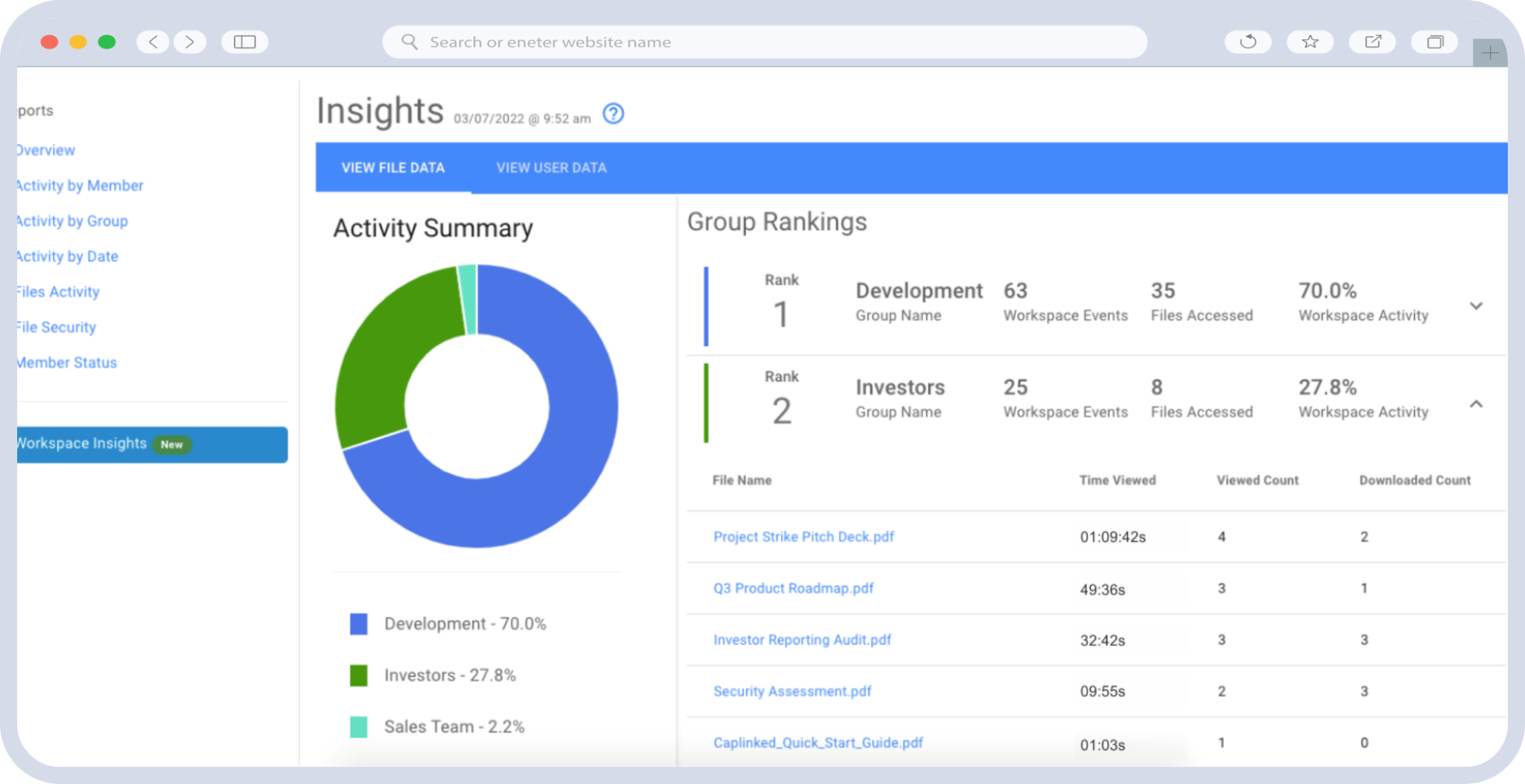
- Access history. Activity Tracker shows which documents each permission group and person viewed or downloaded, and when, and exports to CSV.
- Every clarification. EZ Q&A keeps each answer attached to its question and exports a full Q&A report.
- Which version was shared. Version badging and full version history show administrators every saved version of a disclosure schedule.
- Confidentiality agreements. Signed entry agreements are stored in the workspace.
- Control after a bidder exits. FileProtect revokes access to files a losing bidder downloaded.
A view record shows that a document was opened, not that its contents were legally disclosed against a particular representation. Keep the workspace open through the last escrow release, set any workspace expiry date after that release rather than at closing, and export the activity and Q&A records before the room closes. The room can also store the escrow agreement, funds flow memo and allocation schedule for the seller group under group permissions; it does not hold or track the money. The data room features a deal team should expect are worth checking before a process opens, since the record cannot be rebuilt afterwards.
| Start the disclosure record before buyers arrive, and keep it intact until the last escrow releases. The free trial runs 14 days. |
M&A Escrow FAQs
What is M&A escrow?
Part of the purchase price paid at closing to a neutral escrow agent instead of the seller, held for an agreed period to fund the buyer’s post-closing claims, then released to the seller less any amounts claimed or reserved.
How much is typically held in M&A escrow, and for how long?
On private deals without warranty insurance, the median general indemnity escrow is about 10 percent of transaction value; on insured deals, about 0.5 percent. The median escrow period is 12 months.
Does representation and warranty insurance replace escrow?
Not entirely. Insured deals usually keep a small retention escrow, a separate adjustment escrow for the working capital true-up, and special-issue escrows for known problems the policy excludes.
How do escrow agents work in M&A?
The agent verifies the parties, signs the escrow agreement, receives the escrow amount at closing, holds and invests it as directed, and releases it only on joint written instructions or a final court order or arbitration award.
What is the difference between an escrow agent and a paying agent?
A paying agent distributes closing proceeds to shareholders and collects their transmittal letters and tax forms. An escrow agent holds only the withheld portion until release. On deals with many shareholders, one institution often does both.
Who pays escrow agent fees in M&A?
It is negotiated in the escrow agreement. Fees are usually a flat acceptance fee plus an annual administration fee, split between buyer and seller or borne by one side as the parties agree.
Can escrow funds be released early?
Yes, if the escrow agreement provides for a partial release or both parties sign a joint instruction. Partial releases partway through the period are a common negotiating point for sellers.